Your 2026 Guide to a 1 Bedroom Apartment Berlin
July 22, 2026 · 16 min read
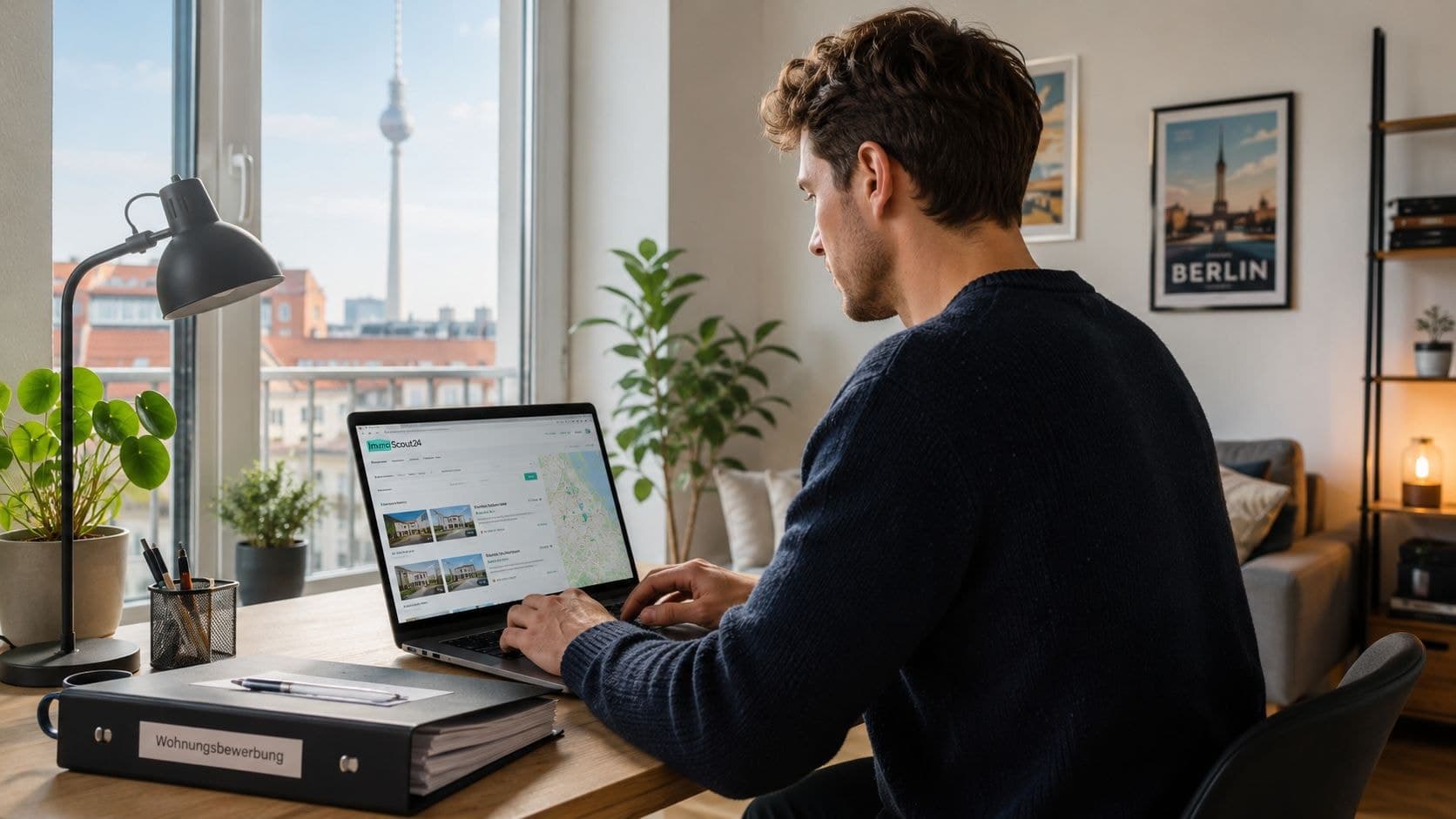
You've opened ImmoScout24, sent a few messages in English, maybe translated one with DeepL, and now you're wondering why nobody replies. Then a listing finally looks perfect, but the rent is higher than you expected, the landlord wants documents you've never heard of, and someone tells you that after you get the keys you still need Anmeldung paperwork from the landlord.
That's a very normal Berlin start.
Finding a 1 bedroom apartment in Berlin isn't impossible, but it rarely rewards improvisation. It rewards speed, complete documents, clear communication, and realistic expectations about where you can live for your budget. The good news is that once you understand how the process works in Berlin, the search gets much less chaotic.
In German listings, room count works differently from English apartment language. If you mean a separate bedroom plus a living room, you will usually be looking for a 2-Zimmer-Wohnung. A 1-Zimmer-Wohnung usually means a studio-style apartment. This guide uses "1 bedroom apartment" in the English newcomer sense, but you should understand the German search terms before filtering listings.
Welcome to Berlin Your Apartment Hunt Starts Here
Most newcomers start with the same mix of optimism and panic. You arrive in Berlin with a temporary place, a deadline, and a vague hope that a clean one-bedroom near a U-Bahn line will somehow work out quickly. Then the replies are slow, the listings disappear fast, and every conversation seems to produce a new German word.
That doesn't mean you're doing everything wrong. It usually means you're meeting Berlin's rental process for the first time.
A one-bedroom search here is rarely just about the apartment. It's also about your documents, your timing, your ability to respond quickly, and whether you can manage messages, calls, and appointments in German without missing something important. I've seen people lose good options not because the flat was out of reach, but because they sent an incomplete application, misunderstood a viewing invitation, or didn't know what to bring.
Practical rule: In Berlin, the apartment hunt starts before the viewing. It starts with preparation.
The process usually unfolds in a very predictable order. First, you decide what you can afford and which neighborhoods make sense. Then you search on the main platforms, send strong first messages, and prepare your application folder before a landlord asks for it. After that come viewings, the lease, the handover, and finally the paperwork needed to register your address.
That last step matters more than many newcomers expect. Getting the flat is one milestone. Being able to register properly and move forward with the rest of Berlin life is the next one.
If you treat the search like a small project instead of a hopeful scroll through listings, things get easier. Not easy, but easier. And that difference is often what gets people from short-term sublet stress to keys in hand.
Budgeting Realistically and Choosing Your Kiez
A lot of frustration comes from searching too broadly. If your budget fits Wedding but your saved listings are all in Mitte and Prenzlauer Berg, Berlin will feel impossible very quickly.
What a 1 bedroom apartment in Berlin really costs
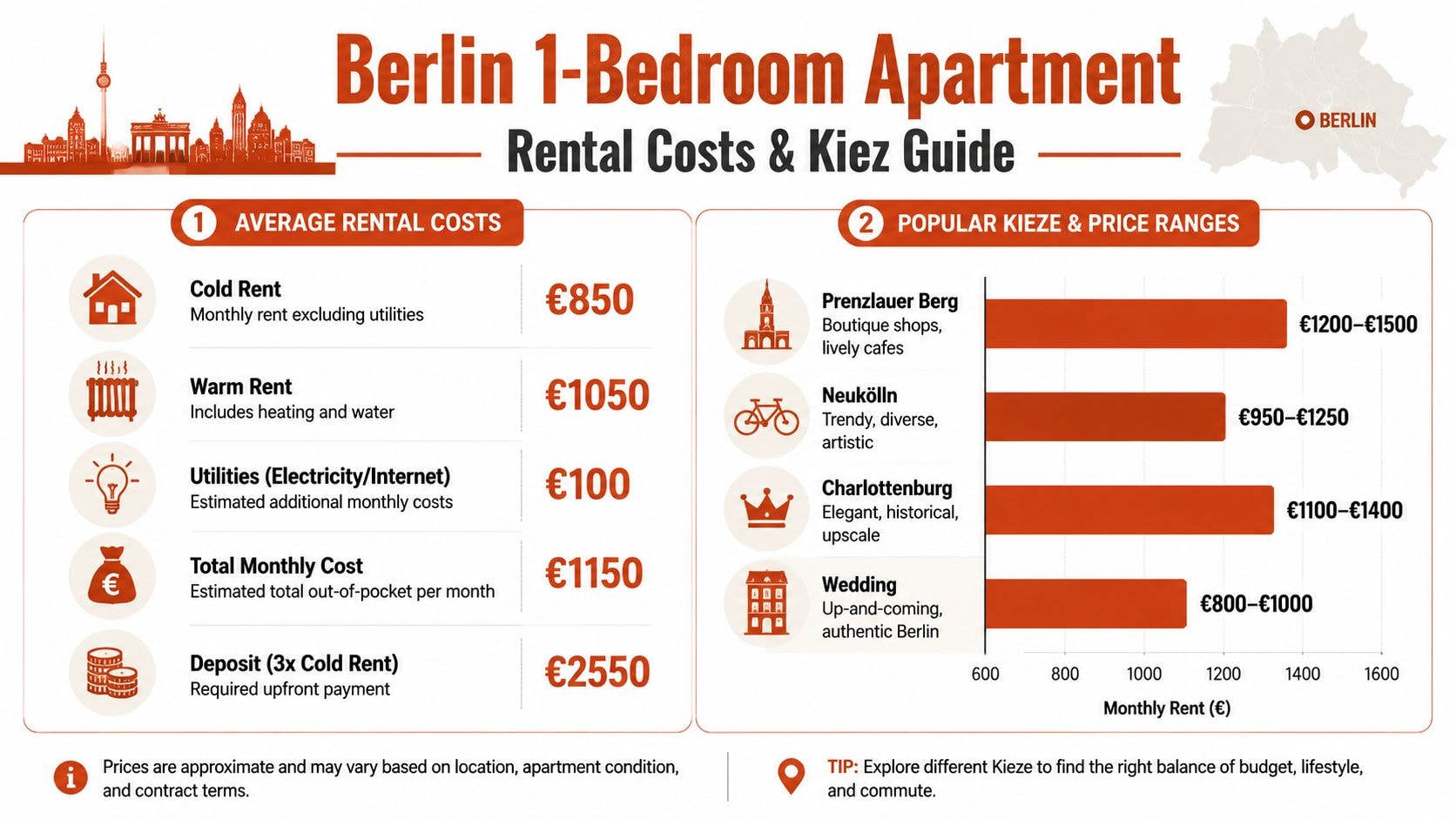
Prices for a one-bedroom-style apartment in Berlin vary heavily by district, condition, furnishing, contract type, and whether the listing is closer to a studio, a 2-Zimmer-Wohnung, or a furnished temporary rental.
Central and highly demanded areas such as Mitte or Prenzlauer Berg are usually much more competitive, while outer districts can offer more realistic options if your commute works.
That single average is useful, but it obscures the varied Berlin experience. The city is segmented. A renovated central apartment, a plain outer-district flat, and a furnished short-term place may all be called "1 bedroom" and feel like completely different markets.
If you're looking for a 1 bedroom apartment Berlin search target that gives you a fair chance, it helps to split neighborhoods into three practical buckets:
-
Central premium areas like Mitte and Prenzlauer Berg. These are attractive, well connected, and expensive.
-
Popular compromise areas like Neukölln, Wedding, Friedrichshain, or Charlottenburg. These often offer a better balance of transport, daily life, and budget.
-
Outer districts where rents can be lower, but commuting time and neighborhood fit matter more.
Warm rent cold rent and the budget mistake many newcomers make
The first Berlin rent lesson is simple. Kaltmiete is the base rent. Warmmiete usually includes heating and water charges. Your full monthly housing cost can still be higher because electricity and internet often sit outside that figure.
Many people misread listings. They compare one cold-rent listing with one warm-rent listing and think they're looking at the same thing. They aren't.
Rent is only one part of your Berlin budget. You also need to plan for deposit, furniture or kitchen items, electricity, internet, transport, groceries, insurance, phone bills, and first-month setup costs.
If a listing already stretches your comfort level before deposit, furniture, and moving costs, it usually won't become more comfortable after you sign.
Berlin neighborhoods at a glance for a 1 bedroom apartment
The best kiez for you depends less on internet reputation and more on your routine. If you work near Zoologischer Garten, a cheap flat on the far east edge may not feel cheap after a long daily commute. If you're new and want easier day-to-day settling in, being near transit, supermarkets, and appointment locations often matters more than nightlife.
| Neighborhood (Kiez) | Average 1-Bed Rent (Warm) | Vibe | Best For |
|---|---|---|---|
| Neukölln | Higher than outer districts, often less than prime central areas | Busy, mixed, creative, uneven street to street | Newcomers who want activity and can handle variety |
| Prenzlauer Berg | Often near the top end of the market | Polished, family-friendly, café-heavy | Professionals and couples with more room in the budget |
| Charlottenburg | Usually mid-to-high depending on building and location | Classic West Berlin, calm, established | People who want a more traditional residential feel |
| Friedrichshain | Competitive and popular | Social, energetic, well connected | Younger renters who want quick access to the east-side core |
| Wedding | Often one of the more practical compromise choices | Local, mixed, changing fast | Renters prioritizing value and transport connections |
A few quick filters help:
-
Choose Mitte or Prenzlauer Berg if budget is strong and you want less compromise on centrality.
-
Choose Neukölln or Friedrichshain if you want energy and accept more competition.
-
Choose Wedding if you care more about practical value than prestige.
-
Choose outer districts if lower rent matters most and your commute is manageable.
The smartest shortlist is usually not your dream neighborhood plus three backup options. It's three neighborhoods you'd be happy to live in, all within your real budget.
Where to Search and How to Craft Your Application
Once your kiez list is clear, speed starts to matter.
Where people actually look
For a standard one-bedroom search, most newcomers start with ImmoScout24, Immowelt, and WG-Gesucht. ImmoScout24 often has the broadest visibility. Immowelt is worth checking in parallel because some listings appear there but not elsewhere. WG-Gesucht is better known for shared flats, but it can still be useful for temporary one-bedroom options and furnished sublets.
The platform matters less than your response time and message quality. In practice, competition is high, and a generic English message sent hours late often goes nowhere. Speed, clarity, and a complete application package matter.
Why your first message matters so much
Landlords and agents skim fast. They want signs that you are organized, serious, and easy to communicate with. A message that says “Hi, is this available?” doesn't give them much to work with. A long personal life story doesn't help either.
A better first contact usually includes:
-
Who you are. Keep it short. Job, study status, or reason for moving.
-
Why the flat fits. Mention move-in timing and household size.
-
Your readiness. Say your documents are prepared.
-
Language awareness. If your German is limited, it helps to acknowledge that politely.
For many newcomers, the hard part isn't writing one good message. It's handling the follow-up when the landlord switches to quick German email or phone communication. That's where practical support with landlord communication in Berlin can make a real difference, especially when the next step arrives fast and you don't want to misunderstand it.
A simple first contact structure
You don't need perfect German. You need a message that feels reliable.
Try this structure:
-
Greeting and listing reference
-
One sentence about your situation
-
One sentence about work or income
-
Move-in date and number of occupants
-
Confirmation that documents are ready
-
Polite closing
Here's a practical point many people learn late. Don't wait for a viewing invitation before assembling your materials. If someone replies at 10:15 and asks for documents by noon, the window can close quickly.
A quick visual summary can help if you're still getting your search routine together:
Video walkthrough: watch it on YouTube.
Preparing Your Essential German Rental Documents
Berlin landlords don't just rent to the nicest person at the viewing. They often rent to the applicant whose paperwork is complete, easy to review, and financially credible.
The documents landlords expect
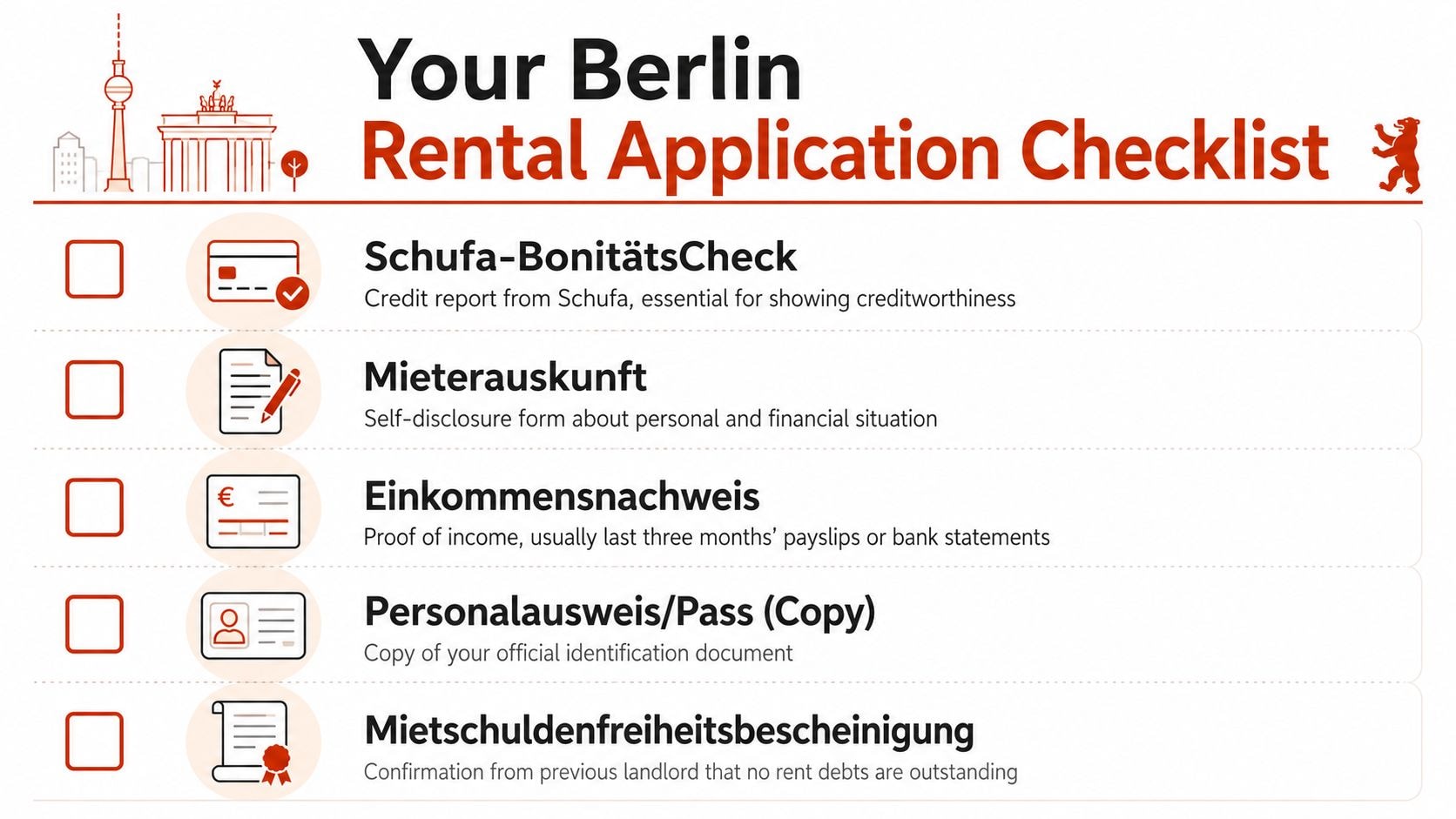
The most common rental folder includes these core items:
-
Schufa-BonitätsCheck. This is the credit report many landlords expect from applicants who already have a German credit history.
-
Mieterauskunft. A self-disclosure form about your personal and financial situation.
-
Einkommensnachweis. Proof of income, often recent payslips or similar evidence of regular income.
-
Passport or ID copy. Keep it clear and readable.
-
Mietschuldenfreiheitsbescheinigung. A statement from your previous landlord confirming there are no rent debts.
Many landlords prefer applicants whose income clearly supports the rent and whose documents are complete. For newcomers, rejection often has less to do with being "undesirable" and more to do with presenting an incomplete or confusing file.
A messy folder creates doubt. A clean folder creates trust.
If you're still collecting everything, a good companion resource is this documents checklist for Berlin appointments. It helps you keep the apartment search paperwork and your wider Berlin admin paperwork from getting mixed together.
How to organize your folder so it actually helps
Don't send fifteen random attachments with inconsistent filenames. Put everything into one clean PDF when possible, in a sensible order, with simple names.
A practical order looks like this:
-
Short cover page with your name, contact details, and move-in date
-
ID copy
-
Employment contract or job confirmation, if relevant
-
Payslips or other income proof
-
Schufa, if available
-
Previous landlord confirmation
-
Optional short note if you're new to Germany and replacing one document with another
Newcomers often need judgment, not just translation. If you don't have a German Schufa yet, you may need to present alternative financial proof clearly. If your income comes from abroad or from a scholarship, the file should still feel coherent.
A few small details improve your chances:
-
Use consistent file names so a landlord can find things quickly.
-
Redact only carefully. Hiding too much can make the file look suspicious.
-
Keep one version in English-friendly order for yourself, but be ready to send a landlord-facing version that matches German expectations better.
The goal isn't to look fancy. It's to look easy to rent to.
Mastering the Apartment Viewing in Berlin
Getting invited to a viewing already means you've passed the first filter. Now the challenge becomes social, practical, and very Berlin.
What a Berlin viewing often feels like
Some viewings are calm one-on-one appointments. Others are group events where applicants line up on the staircase, everyone is trying to look prepared, and the agent repeats the same details ten times. If you arrive late, seem uncertain, or spend the whole appointment smiling without asking anything, you can disappear into the crowd.
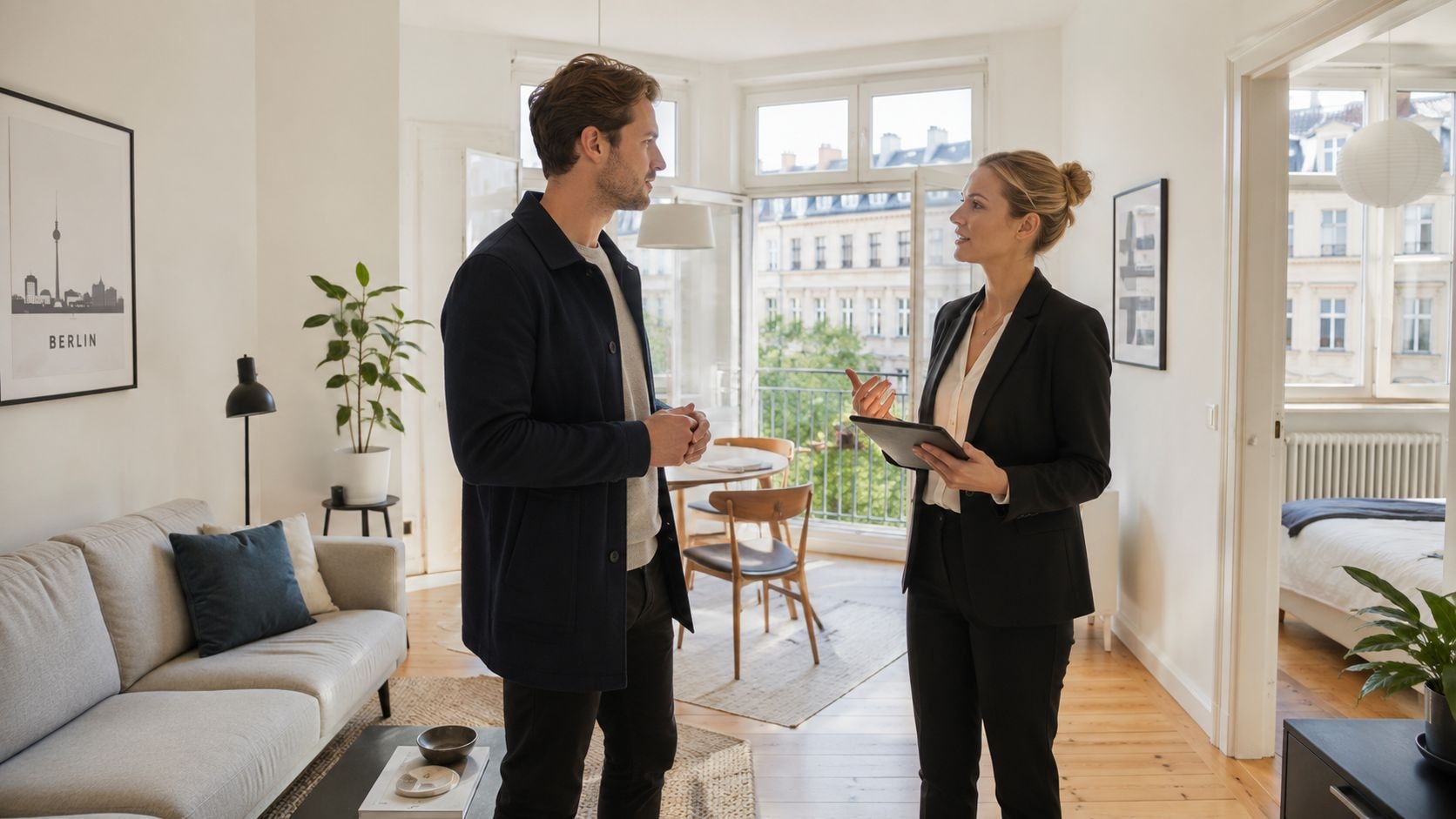
The best approach is calm and direct. Introduce yourself briefly. Be friendly, but don't oversell. If the landlord or agent explains next steps in fast German, don't guess. Clarify. Missing one sentence about where to send the documents or when to respond can cost you the apartment.
That's why some newcomers bring practical support for apartment viewings in Berlin. The value is not certified translation or legal advice. It is practical support: making sure key questions are asked, answers are understood, and next steps are clear.
What to check inside the flat
Newcomers often focus only on size and location because they're relieved to get a viewing at all. Slow down and look properly.
Check these first:
-
Windows and drafts. Older Berlin buildings can be charming and cold at the same time.
-
Bathroom condition. Look for mold marks, weak ventilation, and signs of past leaks.
-
Kitchen setup. In Germany, not every rental comes with the same kitchen standard.
-
Water pressure. Test taps if appropriate.
-
Noise level. Listen with windows open and closed.
-
Storage and layout. A one-bedroom can look good in photos and feel awkward in person.
If something seems unclear at the viewing, ask while you're still inside the apartment. Later emails often get shorter answers.
Questions worth asking before you leave
You don't need an interrogation. A few practical questions are enough:
| Ask about | Why it matters |
|---|---|
| Heating and utility setup | Helps you understand real monthly costs |
| Included kitchen or appliances | Avoids expensive move-in surprises |
| Move-in date | Berlin timing often decides whether a flat works |
| How documents should be submitted | Makes your follow-up cleaner and faster |
| Whether registration paperwork will be provided | Important for your next bureaucratic step |
The social side matters too. Berlin landlords and agents often prefer applicants who feel straightforward and low-drama. That doesn't mean pretending to be someone else. It means being prepared, punctual, and easy to communicate with.
Understanding the Lease and Securing Your Apartment
The message arrives. You've been selected, or at least shortlisted, and now there's a Mietvertrag in your inbox. This is the point where excitement can make people rush.
What to confirm before signing
Read the lease carefully and confirm the practical basics first:
-
Rent structure. Make sure you understand what is base rent and what is included in monthly charges.
-
Deposit or Kaution. Confirm the amount and payment timing.
-
Start date. Check when the tenancy begins.
-
Notice period. Know how much notice is required if you later move out.
-
House rules. Noise, storage, shared spaces, and building expectations matter more in Germany than many newcomers expect.
-
Furniture and fixtures. Confirm what stays in the flat.
At this stage, it also helps to look beyond rent alone. Rent is only one part of your Berlin budget. You also need to plan for deposit, furniture or kitchen items, electricity, internet, transport, groceries, insurance, phone bills, and first-month setup costs. That's a useful reminder that the apartment you can sign for isn't always the apartment you can live in comfortably.
Where practical help ends and legal help begins
There's a clear line worth respecting.
Practical support is useful for scheduling the signing, clarifying landlord communication, understanding the everyday meaning of lease sections, and making sure you know which documents or payments are expected before move-in. That kind of help can reduce a lot of stress.
But if you need a legal review of the contract, an opinion on whether a clause is enforceable, or advice about a dispute, use a qualified professional such as a lawyer or a tenant association. The same applies if the lease contains unusual clauses, a subletting issue, or anything that affects your legal rights in a serious way.
That boundary matters because good support should make things clearer, not pretend to replace the right expert.
The Final Steps Handover Protocol and Anmeldung
A lot of newcomers think the hard part ends at contract signing. In Berlin, there are still two practical moments that matter a lot. The handover and the registration paperwork.
Don't skip the handover notes
When you receive the keys, ask for or review the Übergabeprotokoll, which is the handover protocol documenting the apartment's condition. Scratches, stains, damaged fixtures, missing items, and meter readings should be recorded in it.
Don't treat it as routine admin. It protects both sides. If you notice wall damage, appliance issues, broken blinds, or old wear that isn't yours, it should be noted before you settle in.
A simple move-in checklist helps:
-
Photograph each room clearly on handover day
-
Check keys and confirm how many were given
-
Record visible defects in writing
-
Review meter readings if they are part of the handover
-
Keep copies of the signed protocol and any follow-up emails
The apartment feels new to you. The paperwork should still describe its old imperfections.
The paper you need for Anmeldung
For Berlin registration, the essential landlord document is the Wohnungsgeberbestätigung. Without it, your Anmeldung usually can't move forward. Ask for it early and make sure the details match your new address exactly.
According to Berlin's official address registration service on Berlin.de, registration is generally required within 14 days after moving in. Identification is required, and the Wohnungsgeberbestätigung is required as part of the process. A rental contract does not replace the Wohnungsgeberbestätigung.
Once you have that paper, the next challenge is preparing for the Bürgeramt appointment. If this is your first time dealing with Berlin registration, this step-by-step guide to Anmeldung in Berlin is the most useful next read. It helps you avoid the classic mistakes of bringing the wrong form, missing the landlord confirmation, or showing up unsure what the appointment will involve.
For many newcomers, this final stage is where housing stress turns into bureaucracy stress. That's normal. The apartment hunt doesn't just end with a key. It ends when your address is properly registered and the rest of your Berlin admin can finally move forward.
If your apartment search is getting stuck on German calls, landlord messages, viewing support, or the paperwork that comes after move-in, book a SettlyGo helper. SettlyGo helps newcomers in Berlin with practical tasks like communication, appointment preparation, and document organization. It's a good fit when you need calm, local help with everyday bureaucracy. SettlyGo does not provide legal advice, tenancy-law advice, immigration advice, tax advice, insurance brokerage, medical guidance, certified translation, sworn interpretation, or official representation.
Need practical help in Berlin?
Book a verified SettlyGo helper for German phone calls, appointments, landlord communication, apartment viewings, and document preparation.