Apartments for Students in Berlin: A Practical Guide 2026
June 23, 2026 · 16 min read
You've landed in Berlin, classes are starting soon, and your browser already has too many tabs open. One tab shows a room that looked promising until the landlord replied in German. Another asks for documents you've never heard of. A third says “available immediately,” which sounds great until you realize you still need an address registration after move-in.
Most housing guides list websites and rent ranges. What they often do not explain is what happens after a landlord replies: German messages, viewing questions, documents, Anmeldung, and move-in paperwork.
Berlin can still work for you. You just need a strategy that matches the city as it is. Tight market, fast decisions, lots of paperwork, and a lot of things happening in German.
Your Realistic Berlin Student Apartment Search Guide
Berlin attracts a huge student population, and the pressure on housing is real. A 2025 market report estimates that Berlin represents 19.10% of Germany's student accommodation market and has more than 200,000 students, while only about 5% currently live in student dormitories. That imbalance pushes most students into the private market, where competition is intense and public dorm waiting times often stretch to six to twelve months, according to Germany student accommodation market reporting.
That sounds discouraging, but it helps to be honest about what you're walking into. If you treat the search like a side task, Berlin will punish that quickly. If you treat it like a small project with documents ready, backup options, and enough flexibility on area and room type, your chances improve a lot.
What usually works
Students who find apartments for students in Berlin faster usually do three things well:
-
They search on several tracks at once. They don't rely on one dorm list or one platform.
-
They answer quickly. Good listings disappear fast, especially rooms in shared flats.
-
They prepare documents before viewings. When a landlord asks for papers, they can send them the same day.
Practical rule: In Berlin, finding the room is only half the job. The other half is being ready for the paperwork that follows.
What usually goes wrong
The common mistakes are predictable. People wait until they arrive in Berlin to start. They focus only on central districts. They ignore German-language messages because they plan to “deal with that later.” Or they apply with a weak introduction that looks copied and generic.
A better approach is simple. Search early, stay flexible, and prepare for bureaucracy from day one. Your room, your registration, your bank setup, and your landlord communication are all connected.
Plan Your Search Timeline Budget and Neighborhoods
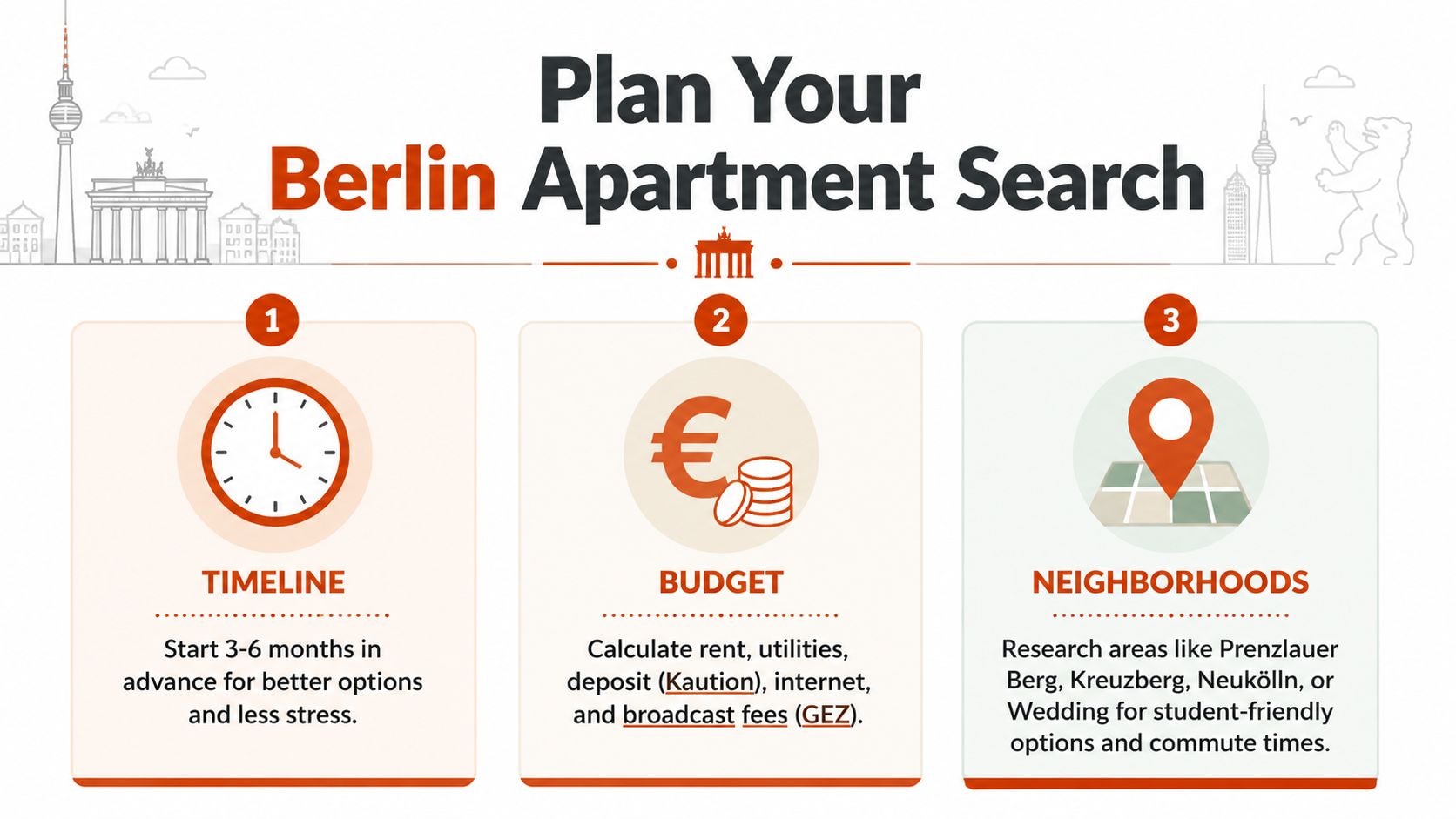
Start earlier than feels necessary
If you're still a few months away from arrival, that's good news. Berlin rewards early preparation. Even students who search months ahead can struggle, so early research is not overkill. It's normal.
Use that time well. Save searches, write a short self-introduction in clear English and simple German, and keep all key documents in one folder on your phone and laptop. If you'll need temporary housing first, accept that early instead of treating it like failure. For a lot of newcomers, a short first stay takes pressure off the main search.
A practical timeline looks like this:
-
First phase
Decide on your maximum monthly housing cost, preferred move-in date, and whether you can live in a WG (shared flat), student residence, or private studio. -
Second phase
Apply broadly. Don't wait for the “perfect” room in one trendy area. -
Third phase
Keep your first weeks in Berlin logistically light. If needed, use temporary accommodation while attending viewings in person.
Build a student budget that reflects Berlin reality
You need a realistic number before you send a single application. In 2023, the average rent for a room in a shared apartment in Berlin reached about €650 per month, and a one-bedroom apartment in the city center averaged about €925 per month, according to DW's reporting on Germany's student housing pressure. That's one reason Berlin is among the more expensive German cities for students.
Those numbers matter because many students arrive with a budget built around older advice. Berlin has changed. You may still find cheaper options, but you shouldn't plan your life around finding one immediately.
When you calculate your housing budget, include more than the advertised rent:
-
Rent type
Check whether the listing shows warm rent or cold rent. A cheap-looking number can become less attractive once utilities are added. -
Deposit
You'll usually need money upfront before you're financially comfortable in the city. -
Setup costs
Internet, household basics, bedding, kitchen items, transport, and sometimes furniture if the place isn't fully furnished. -
Ongoing admin costs
Budget space for recurring bills and basic services, even if the room itself looks manageable.
Don't choose a flat just because the monthly rent barely fits. Leave room for the first month in Germany to be more expensive than expected.
Choose neighborhoods by commute not just by reputation
Most students start with district names they've heard online. That's understandable, but it's not the best filter. Choose based on commute, transport links, and the kind of housing stock you're likely to find.
Here's a simple decision guide:
| Area style | Typical appeal | Trade-off | Best for |
|---|---|---|---|
| Charlottenburg and nearby west-side university areas | Good fit for TU Berlin or UdK routines, established housing stock, solid transport | Often competitive and not cheap | Students who want a practical commute to west-side campuses |
| Friedrichshain and Kreuzberg | Social life, lots happening, easier to meet people | Strong competition, fast-moving listings | Students who value centrality and shared-flat living |
| Neukölln and Wedding | More flexibility in search, broad mix of flat shares and sublets | You need to check the exact micro-location and commute carefully | Budget-conscious students willing to compromise on trendiness |
| Outer districts | More space or lower pressure in some cases | Longer travel times, fewer spontaneous campus trips | Students who prioritize price and can handle longer commutes |
Berlin's transport network makes compromise possible. A room that's farther out but right next to an S-Bahn or U-Bahn line can be more practical than a “central” room with awkward connections.
Where and How to Search for Student Apartments
Not all housing channels in Berlin behave the same way. Some are cheaper but slow. Some are fast but expensive. Some are the best value on paper, but only if you can tolerate uncertainty and long waiting lists.
Public student housing
Studierendenwerk Berlin is the obvious first stop for many students. It also runs an InfoCenter Wohnen with public opening and phone hours and dedicated contact points for housing-related questions, as shown on the Studierendenwerk Berlin housing page. That's useful because the system is structured and official, not vague.
The downside is simple. Public student housing is limited and heavily oversubscribed. You should still apply, but don't build your whole move around getting a room there on time.
Public housing is best for students who can plan early, can tolerate waiting, and need the most affordable route.
Private student residences
Private residences are the easier option administratively. They're often furnished, utilities are bundled, and the move-in process can feel more predictable than a random landlord on the open market.
The trade-off is price. At the time of writing, listed starting prices vary widely between providers. Premium private student residences can be significantly more expensive, while community-style student villages and shared-room options may start lower. Always check the provider’s current price page before applying.
That difference matters because these products serve different needs. Providers like Neon Wood's Berlin offering sit in a more premium student-housing segment, while options such as Studentendorf Berlin room listings are closer to community-style shared living.
The open private market
This channel is a common destination for many students. Shared flats, sublets, single rooms, and occasional studios all show up here. It's also the least forgiving channel if your profile is incomplete or your replies are slow.
For WG applications, your message matters more than many students think. A short note that says only “Is this still available?” won't do much. A better message includes who you are, what you study, when you're moving, whether you're tidy and reliable, and why the room fits your situation.
A landlord or flatmate often decides quickly. Clear, polite, complete messages beat long dramatic ones.
Berlin Student Housing Options Compared
| Platform Type | Pros | Cons | Best For |
|---|---|---|---|
| Public student dorms | Usually the most affordable, student-focused, structured process | Long waits, limited supply, less control over exact location | Students with time to wait and tight budgets |
| Private student residences | Furnished, all-inclusive pricing, simpler move-in process | Higher monthly cost, less flexibility | International students who want convenience |
| Open private market | Largest pool of options, flexible room types, more neighborhood choice | Most competitive, more paperwork, more scam risk | Students who need multiple search options and can move fast |
The best approach is usually mixed. Apply for public options, check private residences, and work the open market at the same time.
The Bewerbungsmappe Your Complete Document Checklist
You find a room that fits your budget, send a quick message, and get a reply asking for your documents within the hour. That is a normal Berlin moment. If your folder is ready, you can respond fast. If it is not, the room often goes to someone else before you finish renaming files.
Your Bewerbungsmappe is your application folder. On Berlin's private market, it needs to do two jobs at once. It must show that you can pay rent, and it must show that communication with you will be easy once the tenancy starts. Landlords and main tenants often read your paperwork as a preview of how you will handle deadlines, forms, and the later bureaucracy around the flat.
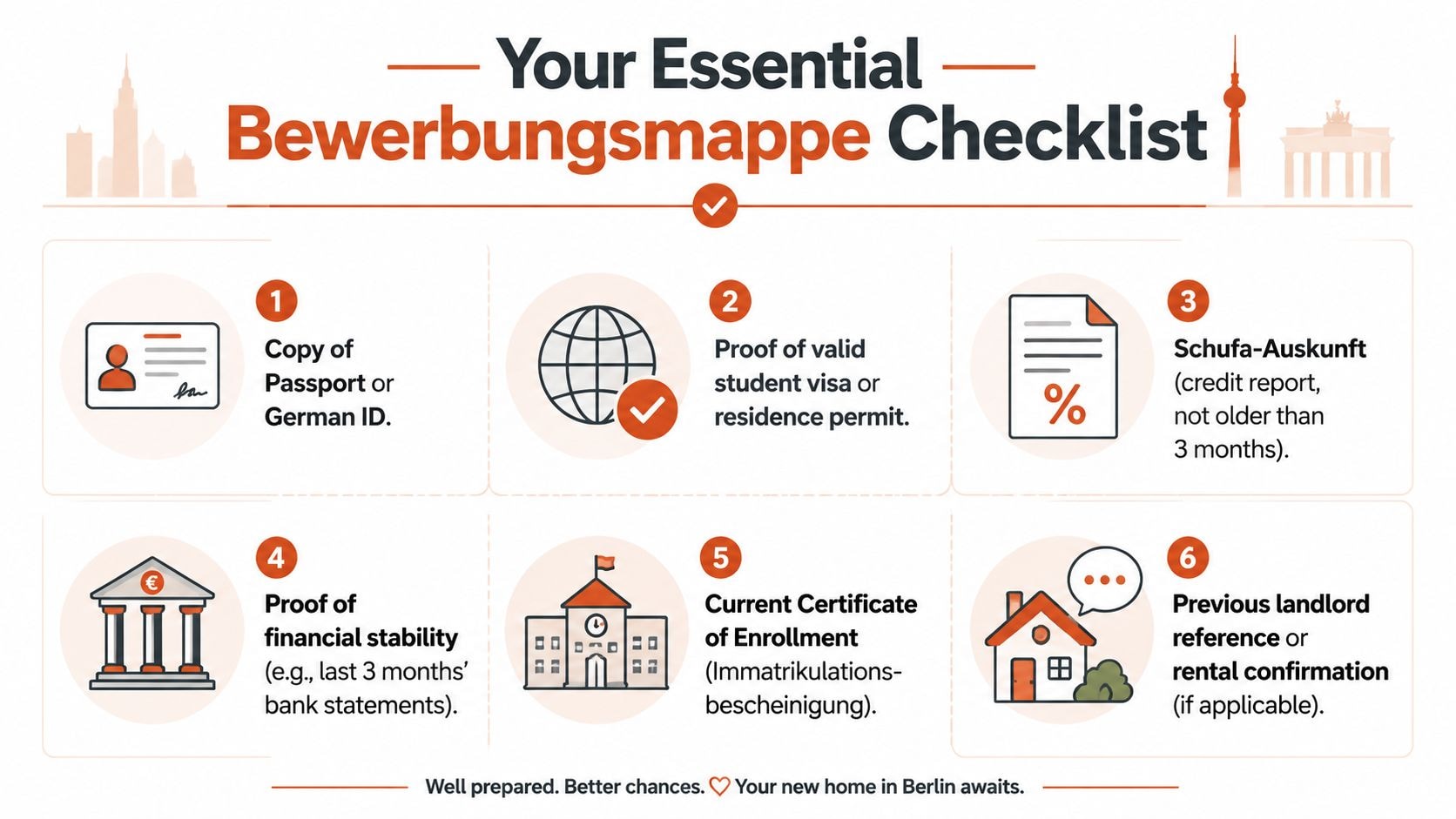
What belongs in your folder
Keep one tidy PDF for quick sending. Also keep each document as a separate file, because some landlords want attachments one by one or ask for one missing item after the viewing.
-
Passport or ID copy
This confirms your identity and helps the landlord match your name across all documents. -
Student documents
Your Immatrikulationsbescheinigung or admission letter shows why you are in Berlin and what your current status is. -
Visa or residence status documents if relevant
If you already have them, include them. If the process is still running, say that clearly in your email. -
Proof of financial stability
This can be bank statements, a blocked account confirmation, scholarship proof, payslips from a student job, or a guarantor letter. Use what you have and label each file clearly. -
Schufa if available
If you already live in Germany and can get one, add a recent copy. -
Previous landlord reference if applicable
Many new students will not have this. If you do, it can help, especially for private landlords.
For Berlin appointments beyond housing, it helps to keep your paperwork in one system from day one. This documents checklist for Berlin appointments is a useful cross-check.
What newcomers can do without a German credit history
No Schufa yet is a common problem for international students. It does not end your chances. It just means the rest of your file has to be clearer.
Add a short note to your application email. Say that you are new to Germany, do not yet have a local credit record, and have attached other proof of funds instead. Keep the tone calm and practical. One sentence is enough.
A complete folder gives a landlord or Hauptmieter less work. In Berlin, less work often means a faster yes.
There is also a bureaucratic reason to get this right early. After you get the flat, you will usually need the landlord's Wohnungsgeberbestätigung for your Anmeldung. If communication is messy during the application stage, getting that paper later can turn into a long chase. This is one place where a German-speaking local helper can make a real difference. They can check whether your file sounds natural in German, call to clarify missing documents, and clear up confusion around terms that many newcomers only discover after move-in.
Need help preparing your rental application in German?
SettlyGo helpers can support you with landlord messages, document organization, apartment viewing preparation, and German follow-up calls.
Book practical housing support
Master the Apartment Viewing and Avoid Common Scams
A viewing in Berlin can feel like a casting round. Sometimes it is one. Sometimes you walk into a hallway full of applicants holding printed folders. Sometimes it's just you, the landlord, and five fast questions in German.
That pressure is manageable if you decide in advance how you'll show up. Calm, prepared, and observant beats overconfident every time.
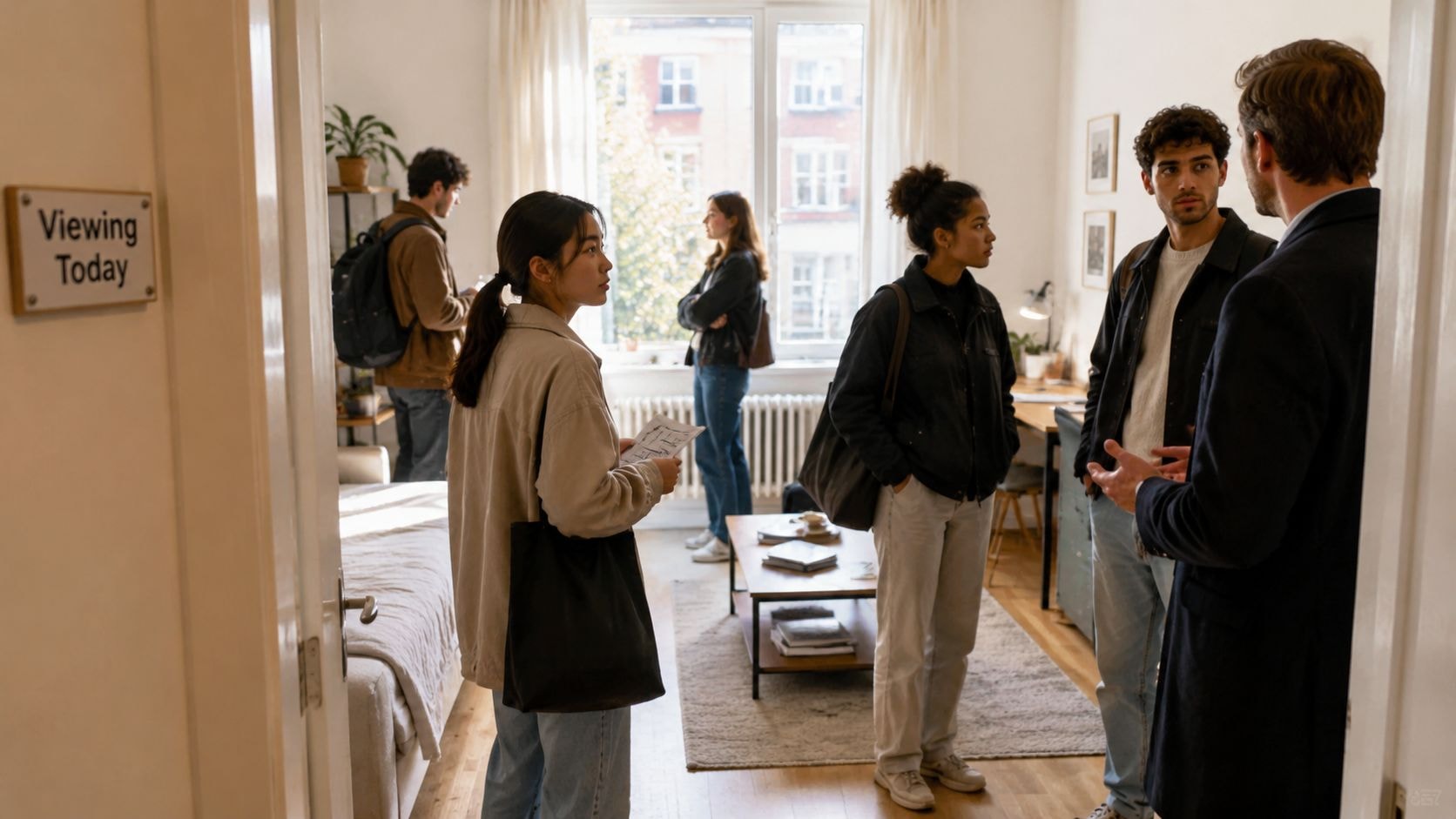
How to handle viewings calmly
Arrive on time. Dress like someone who respects the process, not like you're going to a formal interview. Bring your application folder digitally and, if possible, in print.
If it's a WG viewing, remember that flatmates aren't only choosing a tenant. They're choosing a person to share a kitchen and bathroom with. Be friendly, but don't perform. Short, clear answers work better than a rehearsed speech.
At a landlord or agent viewing, focus on practical points:
-
Show reliability
Mention your studies, move-in date, and that your documents are ready. -
Listen carefully
Many details are said quickly and only once. -
Take notes
After your third viewing, rooms blur together.
If language is your weak point, get support before the appointment. A local helper can make it much easier to understand what's being asked, what's being promised, and what documents you should send next. If you want someone to join you for that practical communication layer, this apartment viewing support in Berlin is the kind of help many newcomers look for.
Questions worth asking before you say yes
Not every important question is about rent. Ask the things that affect your first month of living there.
-
Is Anmeldung possible at this address?
If the answer is unclear, pause. This matters. -
What is included in the rent?
Clarify utilities, internet, furniture, and any house-related costs. -
How long is the contract?
Check whether it's a sublet, fixed term, or open-ended arrangement. -
When do you receive the Wohnungsgeberbestätigung?
Don't assume this will appear automatically. -
Are there house rules or shared cleaning expectations?
In a WG, this can matter as much as price.
If someone gets irritated because you ask normal practical questions, that's useful information too.
Scam patterns that should stop you immediately
Berlin's stress level makes students vulnerable to bad offers. The basic rule is simple. Never transfer a deposit before you've seen the apartment and signed a legitimate contract.
Watch for these warning signs:
-
The landlord is “abroad” and can't show the flat
This is one of the oldest stories in the book. -
The rent is strangely low for what's being offered
Berlin bargains exist, but miracle deals are often bait. -
You're pressured to pay immediately to “reserve” the room
Real urgency exists in Berlin. Fake urgency does too. -
The sender avoids direct questions
If you ask about Anmeldung, contract type, or move-in process and get vague answers, be careful. -
The listing photos don't match the communication
If details shift each time you ask, step back.
Scams aren't always dramatic. Some are just messy arrangements that create problems later. An unclear sublet, no written terms, no registration possible, no official confirmation from the main tenant. Even if it's not a scam in the strict sense, it can still create serious trouble for your registration and residence paperwork.
What works better than panic
Use a simple viewing routine:
| Before | During | After |
|---|---|---|
| Confirm address, time, and what kind of contract is offered | Ask about Anmeldung, included costs, and move-in paperwork | Send your documents quickly and summarize your interest politely |
| Bring your folder and ID | Take photos only if allowed | Save screenshots and messages in one folder |
| Check transport route in advance | Notice the building condition and shared spaces | If anything felt unclear, ask in writing before paying |
Students often think the biggest mistake is losing a room. Usually, the bigger mistake is accepting a room that creates registration problems, missing documents, or money loss.
You Got the Apartment Your Next Steps
Getting the yes is a big relief. It's not the end of the process, though. The next few admin steps matter just as much as the search.
First, read the contract carefully before signing. Check names, address, rent structure, move-in date, and whether the rental period matches what you were told. If something looks legally unclear, use a qualified lawyer or tenant advisory professional rather than relying on informal advice.
Then get the Wohnungsgeberbestätigung from the landlord or main tenant. You'll need it for your Anmeldung. Without that document, your move-in is not fully “usable” for bureaucracy.
After that, line up the basics:
-
Book your Anmeldung appointment as soon as you have the required paperwork.
-
Set up electricity and internet if they aren't included.
-
Keep every housing document together because you may need them again for banking, residence matters, or official letters.
-
Document the apartment condition at move-in with photos and a written handover record if possible.
A good settling-in checklist helps here. This first 30 days in Berlin checklist is useful for keeping the post-move admin in order.
If you need practical help with landlord communication, German phone calls, apartment viewing support, appointment preparation, or understanding official letters after move-in, SettlyGo can be a useful local option. It's designed for newcomers who need hands-on support with routine bureaucracy in Berlin, not legal advice, visa strategy, tax advice, insurance brokerage, certified translation, or tenant-law representation. For legal disputes, visa matters, tax matters, insurance brokerage, certified translations, or tenant-law issues, use a qualified professional.
If your apartment search is turning into missed calls, confusing German messages, or paperwork stress, start booking support with SettlyGo. You can get practical help with landlord communication, apartment viewings, German phone calls, document preparation, and everyday newcomer tasks in Berlin. For legal disputes, visa strategy, tax matters, insurance brokerage, or certified translations, use a qualified professional.
Need help with Anmeldung or the Bürgeramt?
Book a verified SettlyGo helper to guide you through city registration, document preparation, and office appointments in Berlin.