Blue Card for Germany: Your Ultimate Guide for 2026
July 7, 2026 · 17 min read
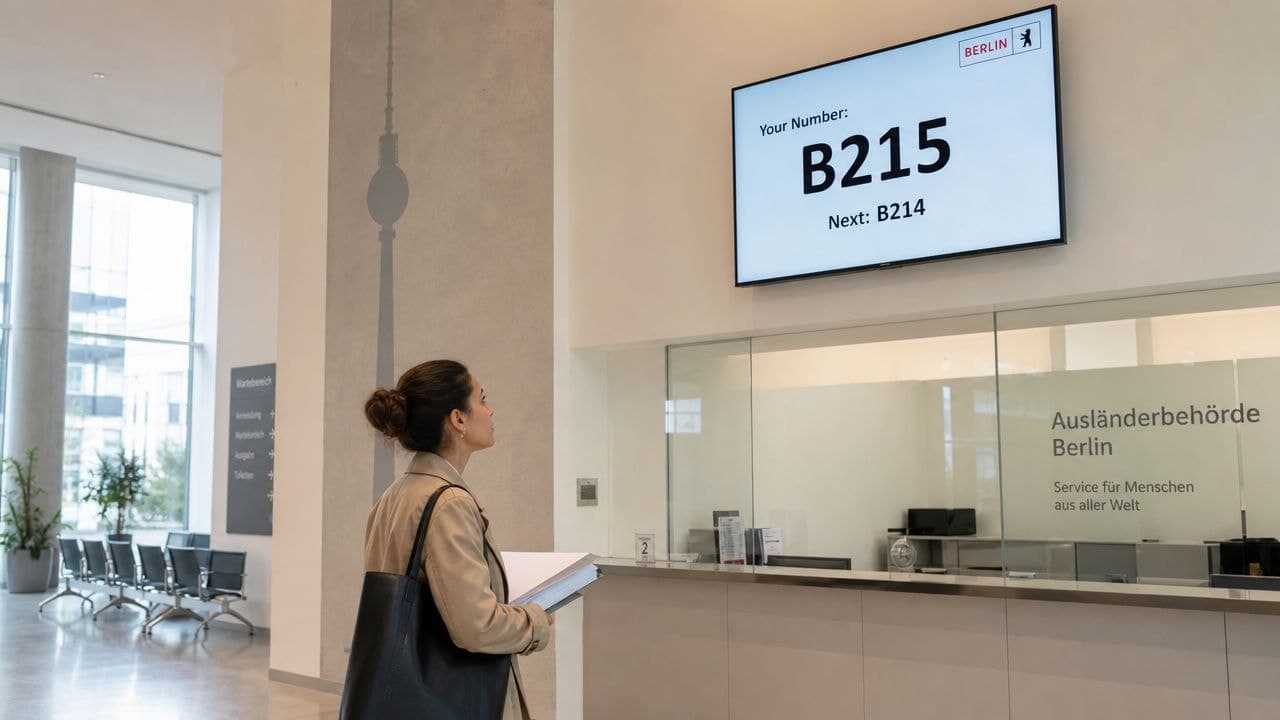
You've got the job offer. The salary looks good, the company wants you in Germany soon, and then the paperwork starts. Suddenly you're comparing visa categories, trying to work out whether your degree counts, whether your contract is long enough, and what Berlin expects from you once you arrive.
That's where the EU Blue Card for Germany usually comes in. For many skilled non-EU professionals, it's the clearest route into Germany if the job, salary, and qualification fit. The problem is that most guides stop at the legal basics and leave out the practical part. In Berlin, that practical part matters a lot.
What Is the EU Blue Card and Who Is It For
The EU Blue Card is a residence permit for highly qualified non-EU professionals who have a qualifying job in Germany. If you've been hired into a skilled role and your salary meets the threshold, this is often the strongest permit to look at first.
Germany uses this route heavily. According to the Federal Office for Migration and Refugees Blue Card statistics, more than 41,000 EU Blue Cards were issued for the first time in Germany in 2023, and roughly 113,500 EU Blue Card holders were living in Germany at the end of 2023.
Why people choose this permit
The Blue Card is popular because it combines work permission with a stronger long-term path than many people expect. It's designed for skilled workers Germany wants to attract, especially in fields where employers are hiring internationally.
In practice, that means it often feels more predictable than trying to force your case into the wrong permit category. If your contract, salary, and qualification line up, the Blue Card is usually the cleanest match.
Practical rule: If you already have a serious job offer in Germany and your role is clearly skilled, check Blue Card eligibility before you look at more complicated residence options.
Another reason people focus on the Blue Card for Germany is that it's tied to a specific type of profile. It's not aimed at casual work, short-term odd jobs, or vague plans to “move first and figure it out later.” It's for people who can show a real professional role, an employer, and qualifications that fit the job.
Who usually fits this route
Most successful applicants fall into one of these groups:
-
Degree-based professionals with a recognized university qualification and a matching skilled job in Germany.
-
Shortage occupation candidates in fields where Germany applies a lower salary threshold.
-
Experienced IT specialists who may qualify through professional experience rather than a formal degree, if they meet the specific IT exception covered below.
That last category matters more than many newcomers realize. A lot of people still assume the Blue Card is only for degree holders. For Germany, that's too simplistic.
Here's the practical difference between the Blue Card and a standard mental picture of a “work visa”:
| Permit question | Blue Card approach |
|---|---|
| Who is it for | Skilled non-EU professionals in qualifying jobs |
| Main proof | Matching qualification or IT experience, plus salary threshold |
| Why it's attractive | Strong long-term route and clearer fit for skilled hires |
| Who shouldn't rely on it | People without a qualifying job, unclear credentials, or mismatched employment terms |
People often get stuck because they ask the wrong first question. They ask, “Can I work in Germany?” when the better question is, “Does my exact job offer fit the Blue Card rules?”
If the answer is yes, your next steps become much easier to organize.
A good Blue Card case is usually tidy on paper. The job title makes sense, the salary is clearly above the threshold, and your qualification or IT experience matches the role.
That doesn't mean the process feels easy. It just means you're using the right lane.
Are You Eligible? Salary Degree and IT Rules for 2026
The eligibility check comes down to two things first. What qualifies you for the role, and whether the salary clears the correct threshold.
The two checks that matter most
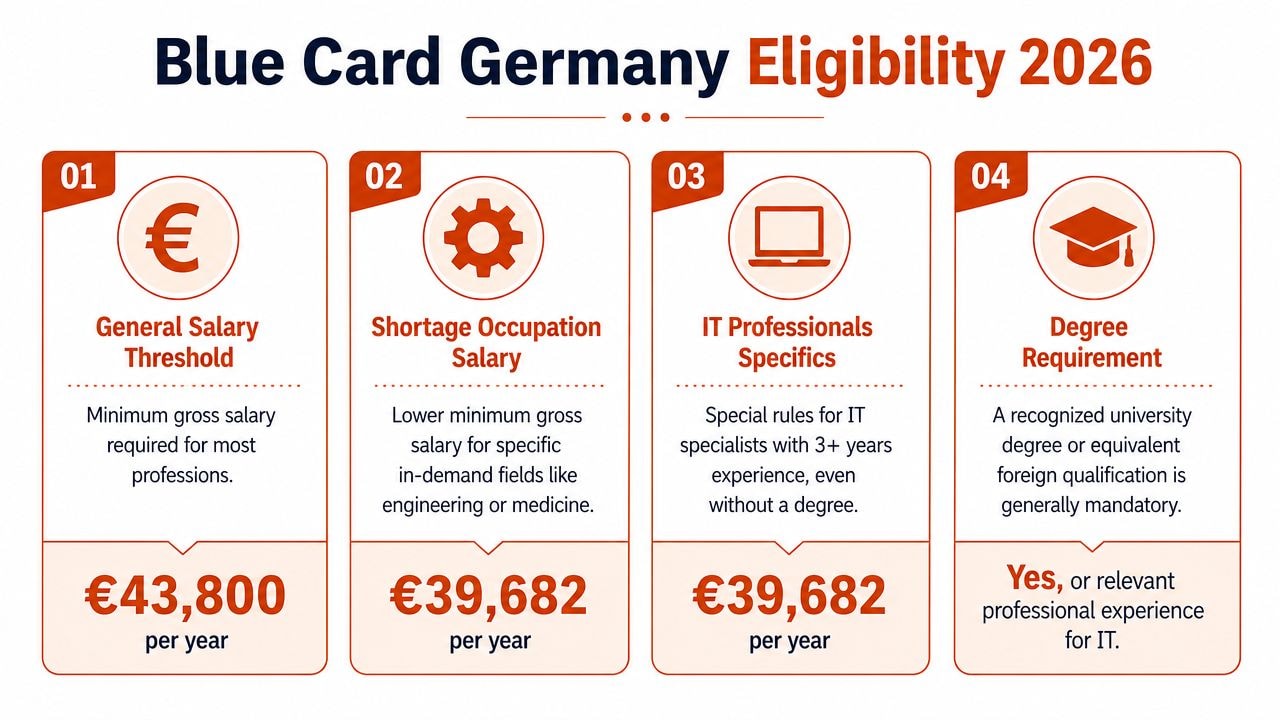
For 2026, Make it in Germany lists the regular EU Blue Card salary threshold as €50,700 gross per year. A lower threshold of €45,934.20 gross per year can apply to shortage occupations, young professionals whose last degree or equivalent qualification was completed less than three years ago, and eligible IT specialists without a formal degree. Berlin.de lists the same 2026 thresholds for Berlin applications.
A lot of applicants lose time when they read one guide, see one threshold, and assume they're either definitely eligible or definitely not. In real life, you need to check the current rule set used for your application channel and your exact profession.
Quick eligibility guide
Use this as a practical first check:
-
You have a recognized university degree.
Your job should correspond to that qualification, and your salary must meet the relevant threshold for your occupation. -
You work in a shortage occupation.
The lower threshold may apply, which can make the Blue Card more accessible. -
You work in IT but don't have a degree.
Don't stop here. Germany has a specific route for IT professionals with at least three years of recent experience at an academic level. -
Your contract is short or vague.
That's a warning sign. The Blue Card works best when the contract is clear, skilled, and long enough to satisfy the permit requirements.
One of the most common mistakes is self-rejecting too early. This happens a lot with developers, sysadmins, and other IT specialists who assume “no degree” means “no Blue Card.”
A simple decision table helps:
| Your situation | Likely direction |
|---|---|
| Recognized degree + qualifying salary | Strong Blue Card candidate |
| Shortage role + lower threshold met | Often a good fit |
| IT experience, no degree, lower threshold met | Possible under the IT exception |
| Salary below threshold | Usually not a Blue Card case |
| Job unrelated to your qualification or experience | Needs closer review, often with a professional |
If your case is borderline, that's when it makes sense to get formal immigration advice from a qualified lawyer or regulated professional. The Blue Card can be straightforward, but only when the details line up cleanly.
Your Step-by-Step Blue Card Application Checklist
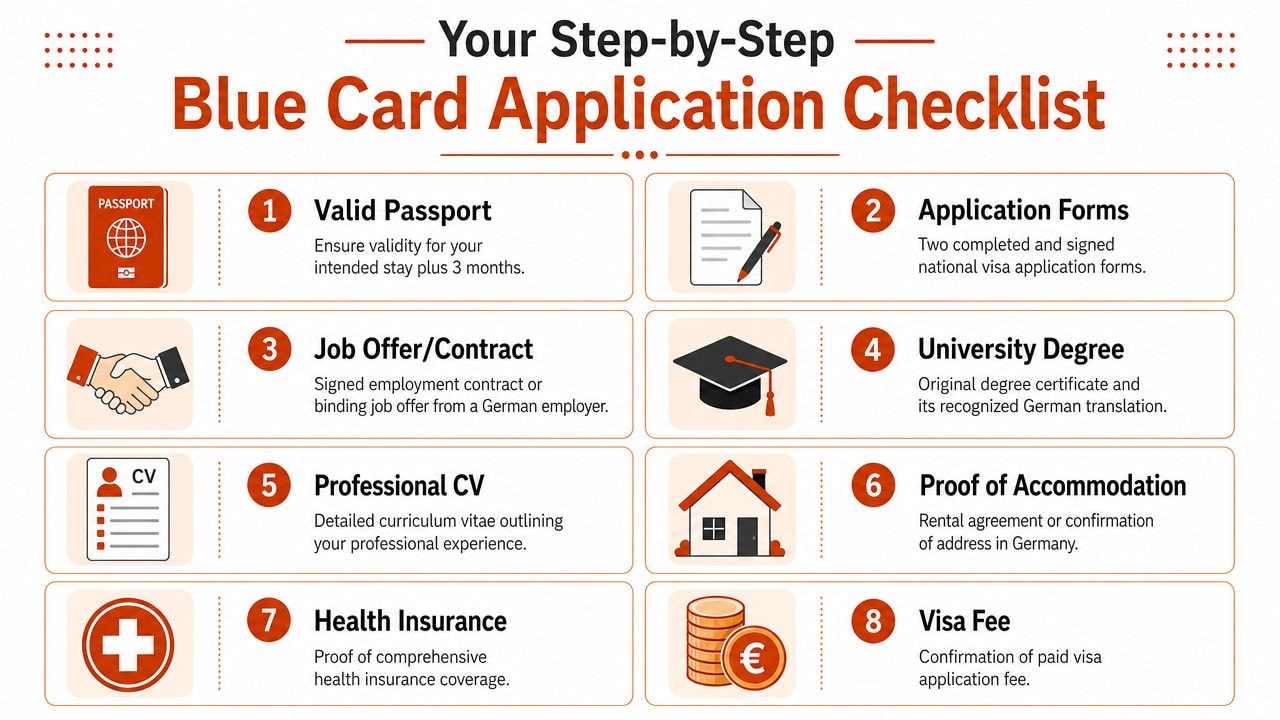
The fastest way to make this process harder is to collect documents randomly. The better approach is to build your file in layers, starting with the documents that prove the job itself, then adding the papers that prove you personally qualify for it.
Start with the documents that prove the job
These are usually the foundation of the application:
-
Online EU Blue Card application
Use the official Berlin process and complete the online application carefully. -
Passport copies
Your passport should be valid and clearly scanned. If it's close to expiry, fix that first. -
Employment contract or concrete job offer
This needs to show the role, salary, and terms clearly. If the job title is vague, ask the employer for clarity. -
University qualification or equivalent qualification
Your qualification should match the route you are using for the Blue Card. -
Proof of residence
Depending on your stage, this can include registration or other proof connected to your address in Germany. -
Proof of housing size and cost
Berlin may ask for documents showing the size of the accommodation and what it costs. -
Proof of health insurance
This often becomes confusing because the required format can depend on whether you are applying from abroad or after arrival. -
Erklärung zum Beschäftigungsverhältnis
This employer form is part of the Berlin checklist for many work-based residence applications.
Then prepare the documents that usually slow people down
This is the part that catches people off guard.
-
ZAB or anabin evidence, if needed
If you studied outside Germany, you may need proof that your qualification is recognized or comparable. In many cases, people check Anabin or use a ZAB statement of comparability. -
CV and other diplomas or certificates for the IT or no-degree route
Your CV should be consistent with your contract and your qualification story. If you are applying through the IT exception, supporting certificates and work-history evidence matter even more. -
Proof of address or accommodation documents
Depending on your application stage, you may need to show where you live or will live in Germany. -
Registration records if you already live in Germany
In Berlin, your Anmeldung paper often ends up mattering for later appointments, even when the initial focus is your residence permit.
Bring both originals and copies when that's realistic. Berlin appointments go more smoothly when you can hand over what the caseworker asks for without improvising.
A simple preparation checklist
Before you book or attend any appointment, check these points:
-
Match the salary wording: Make sure the contract shows the annual gross salary clearly.
-
Match the qualification story: Your degree or IT experience should make sense for the exact role.
-
Check names and dates: Spellings must align across passport, contract, forms, and supporting documents.
-
Sort documents in order: Put identity papers first, then employment, then qualifications, then supporting records.
-
Keep a digital backup: Save scans in one folder so you can resend quickly if asked.
-
Prepare for Berlin paperwork habits: Officials may ask for a document you didn't expect, so neat preparation helps.
If you already know Berlin bureaucracy tends to make you freeze when papers are in German, use a written checklist before the appointment. This Berlin appointment documents checklist is a useful starting point for organizing the file itself.
A calm application file doesn't guarantee approval. It does reduce the most common self-inflicted problems.
Applying in Berlin Navigating the Ausländerbehörde
Berlin is where the legal process becomes very physical. Screenshots, PDFs, appointment portals, waiting areas, ticket numbers, printed forms. Even people with strong applications can feel overwhelmed once they have to deal with the local office.
The appointment problem is real
For Berlin EU Blue Card applications, the official process starts with the online application on Berlin.de. Berlin.de says applicants should upload the required documents, pay the fee, save the confirmation PDF, and wait for the LEA to check the file. If the application is considered successful, the applicant receives an appointment for an in-person interview and must bring the original documents.
That is the first Berlin-specific reality many generic guides skip. The second is that you need to keep your file complete and easy to review while you wait for the LEA to respond.
A few practical habits help:
-
Upload a complete file: Missing papers can slow down the review.
-
Save the confirmation PDF and payment proof: You may need them later if there is confusion.
-
Keep your original documents ready: If the LEA invites you to an interview, you need to bring them.
-
Read the instructions carefully: Small category or document mistakes can create avoidable delays.
What the appointment day usually feels like
On the day itself, applicants don't struggle with the law first. They struggle with pace. You wait, listen for your number, walk to the desk, and suddenly someone is speaking fast German while scanning your papers.
That's why practical appointment support matters, especially in Berlin. Not legal advice. Not a promise of approval. Just someone who helps you stay organized, understand what's being asked, and leave the building knowing what happened.
For people who want that kind of non-legal support, residence permit appointment help in Berlin can be useful for preparation and accompaniment.
If you don't understand a request at the counter, ask for it to be repeated and written down. Guessing is what creates problems later.
What usually works well in Berlin is simple. Arrive early. Carry your documents in a clear order. Keep a pen with you. Don't hand over extra papers unless they're asked for. And before you leave the desk, make sure you understand whether the office approved something, requested more documents, or expects another step from you.
That last part is where many people stumble. They survive the appointment, then realize later they didn't fully understand the outcome.
Your Rights and Fast-Track to Permanent Residence
Once you have the Blue Card, the permit starts paying back the effort. It isn't only about taking a job in Germany. It's about building stability much faster than many newcomers expect.
Why this permit is worth the effort
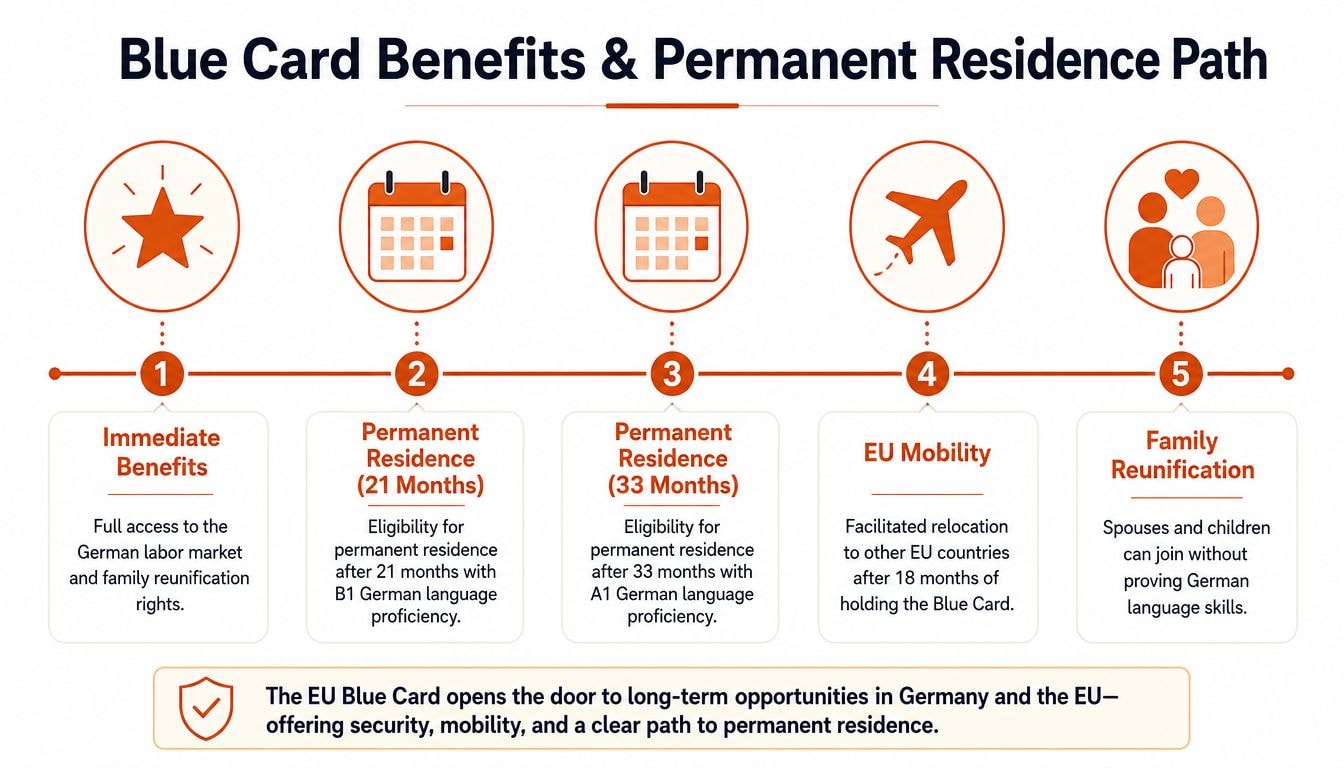
The headline benefit is the route to permanent residence. Make it in Germany states that EU Blue Card holders can obtain a settlement permit after 27 months if they can prove A1 German, or after 21 months if they can prove B1 German, provided the other conditions are met.
That timeline changes how people plan their lives. Instead of thinking only about the next visa renewal, they can think about longer-term housing, family stability, and whether it makes sense to invest in German classes sooner rather than later.
The residence timeline that gets people's attention
This is the practical takeaway:
| Language level | Possible permanent residence timeline |
|---|---|
| B1 German | 21 months |
| A1 German | 27 months |
That's one reason the Blue Card for Germany has become such an important route.
The smartest long-term move for many Blue Card holders is to treat German classes as a residence strategy, not just a cultural extra.
The bureaucracy is still bureaucracy. But the reward is concrete. If your job is stable and you handle the paperwork properly, the Blue Card can move you from “temporary skilled worker” to “settled resident” much faster than a lot of newcomers assume.
Bringing Your Family to Germany
For many people, the Blue Card only makes sense if their partner or children can come too. The good news is that family reunification is one of the more practical advantages of this permit.
What makes family reunification easier on a Blue Card
Blue Card holders generally have a more workable path for close family members than many other residence categories. In everyday terms, family reunification can be easier to plan for Blue Card holders, but the exact requirements depend on the family member, documents, and application route.
What matters most in practice is preparation. Families often don't struggle because the route is impossible. They struggle because one person has the work documents, another has the civil status documents, and nobody has checked whether names, translations, or certificates line up properly.
A sensible approach looks like this:
-
Start with relationship documents: Marriage certificates and birth certificates often become central.
-
Check passport validity for each family member: One weak document can hold up the group.
-
Keep the main permit file consistent: The Blue Card holder's job documents and residence status need to be easy to connect to the family application.
-
Prepare for arrival admin in Berlin: After entry, practical tasks like Anmeldung, school paperwork, insurance calls, and landlord communication can pile up fast.
What your family should prepare
The exact document list can vary by case, but families usually need papers that prove identity, family relationship, and the Blue Card holder's lawful residence situation.
Two practical tips matter here.
First, don't treat family documents as an afterthought. Civil status papers often take longer to gather, translate, or replace than work documents.
Second, separate legal questions from practical ones. If you're unsure about formal family reunification eligibility, use a qualified immigration professional. If the problem is organizing papers, understanding appointment letters, or preparing for Berlin admin after arrival, that's a different kind of task.
Families usually feel most stressed after arrival, not before. The visa part is only one part of settling in.
Common Pitfalls and How to Get Practical Help
A typical Berlin Blue Card problem looks like this: the job offer is fine, the applicant is qualified, and the case should work. Then the file gets delayed because one document uses a different spelling, an email from the Ausländerbehörde is misunderstood, or nobody replies quickly enough to a request for missing papers.
That is the part official checklists rarely explain well. In Berlin, small administrative mistakes can cost more time than the actual eligibility review.
Mistakes that cause the most stress
Timing causes a lot of avoidable trouble. Waiting until the last weeks before a permit expires puts people in a weak position, especially in Berlin, where appointments and replies can take time. Start early, keep copies of everything you submit, and save proof of submission.
A few other problems show up again and again:
-
Documents that are complete but hard to review
The papers are all there, but they are scattered across PDFs, translated inconsistently, or missing a clear order. A caseworker who has to guess how the pieces fit together is more likely to ask for more. -
Letters from the authority that are read too casually
A request for additional documents can contain a deadline, a specific file format request, or a warning about what happens if you do not respond. -
Too much confidence in spoken German under pressure
Everyday German is one thing. Fast administrative German at a counter or on the phone is another. -
Guessing on edge-case eligibility questions
Degree recognition, IT experience rules, job-title fit, and family paperwork are the areas where guessing becomes expensive.
Berlin adds one more practical issue. Different offices, contact channels, and caseworkers do not always communicate in a way that feels predictable from the outside. That is normal here. It still helps to prepare as if nobody will fill in the gaps for you.
What practical help can and cannot do
For many applicants, the primary problem is not immigration law. It is getting the file into a shape that survives Berlin bureaucracy.
Practical support can help you prepare a document pack in a clear order, draft or review non-legal emails, call offices in German, accompany you to appointments, and help you understand routine wording in official letters in plain language, without giving immigration advice or deciding eligibility questions. If that is the kind of help you need, paid human support in Berlin is useful for the non-legal side of the process.
It cannot give legal advice, interpret disputed points of immigration law, guarantee an appointment, promise approval, or replace certified translators where certification is required.
That line matters.
If you have a refusal, a deadline with legal consequences, a complicated residence history, or a real dispute about whether you qualify, use a qualified immigration lawyer. If your case is legally straightforward but practically messy, a local helper can save time and lower the chance of simple mistakes.
The best way to decide is simple. If the question is "What does the law allow in my case?", ask a lawyer. If the question is "How do I organize this file, answer this letter, prepare for this appointment, or handle this office in Berlin?", practical support is usually the right tool.
If your Blue Card process is getting stuck on German letters, document organization, appointment preparation, landlord paperwork, or communication with Berlin offices, book a SettlyGo helper. SettlyGo can help with practical admin support such as organizing documents, preparing questions, understanding routine German wording, and making German phone calls easier. SettlyGo does not provide immigration advice, legal advice, visa or residence-permit eligibility advice, tax advice, insurance brokerage, medical guidance, certified translation, sworn interpretation, application filing, or official representation.
Need help with your residence permit?
Book a verified SettlyGo helper to assist with Ausländerbehörde appointments, permit applications, and document preparation in Berlin.