Kirchensteuer in 2026: A Guide to Church Taxes Germany
June 28, 2026 · 13 min read

You open your first German payslip, scan past income tax and social insurance, and then hit a line you didn't expect: Kirchensteuer or KiSt. If you never actively joined a church in Germany, that deduction can feel absurd. A lot of newcomers in Berlin only discover church tax after money has already started leaving their salary.
What makes this especially stressful isn't just the tax itself. It's the paperwork around it. The trigger often happens during Anmeldung, the fix usually requires an in-person bureaucratic step, and the whole process gets much harder if you don't speak German well enough to deal with forms, letters, and office conversations on the spot.
This guide is for that exact moment. It explains what church tax in Germany is, why it appears, how much it can cost, and what you can do next if you want it stopped. It also focuses on the part most guides skip: how to handle the appointment and document side of the process when German bureaucracy already feels like too much.
Your First German Payslip What Is This Church Tax Deduction
A common Berlin newcomer story goes like this. You've finally started work, rent is high, every euro matters, and then your payslip shows a deduction you never agreed to. You might ask your HR team, “Is this a donation?” It isn't.
Kirchensteuer is church tax. On payslips, it may appear as Kirchensteuer or KiSt. If it's there, your payroll system is treating you as a registered member of a church community that can collect this tax in Germany.
For many people, the shock isn't religious. It's administrative. They didn't sign up for anything in Germany, but somewhere in the chain of registration, payroll, and tax records, a church affiliation was recorded.
Practical rule: If church tax appears on your payslip, don't ignore it and hope it disappears. It usually means your official records currently show a church membership status that payroll is following.
Two things usually cause the confusion:
-
You declared a religion during Anmeldung: Even if you didn't realize the financial consequence.
-
Your background was treated as church membership: This especially affects people who were baptized abroad and assume that personal belief today is all that matters.
That's why church taxes in Germany feel so strange to newcomers. The issue isn't just faith. It's the way the state records affiliation and connects it to payroll deductions.
If you're staring at that line on your salary statement right now, the useful question isn't “Why is Germany like this?” The useful question is: What exactly triggered it, and what do I need to do to fix it?
What Is the Kirchensteuer and Who Pays It
The short version is simple. Kirchensteuer is not a voluntary donation. It is a formal tax collected by the state for certain religious communities.
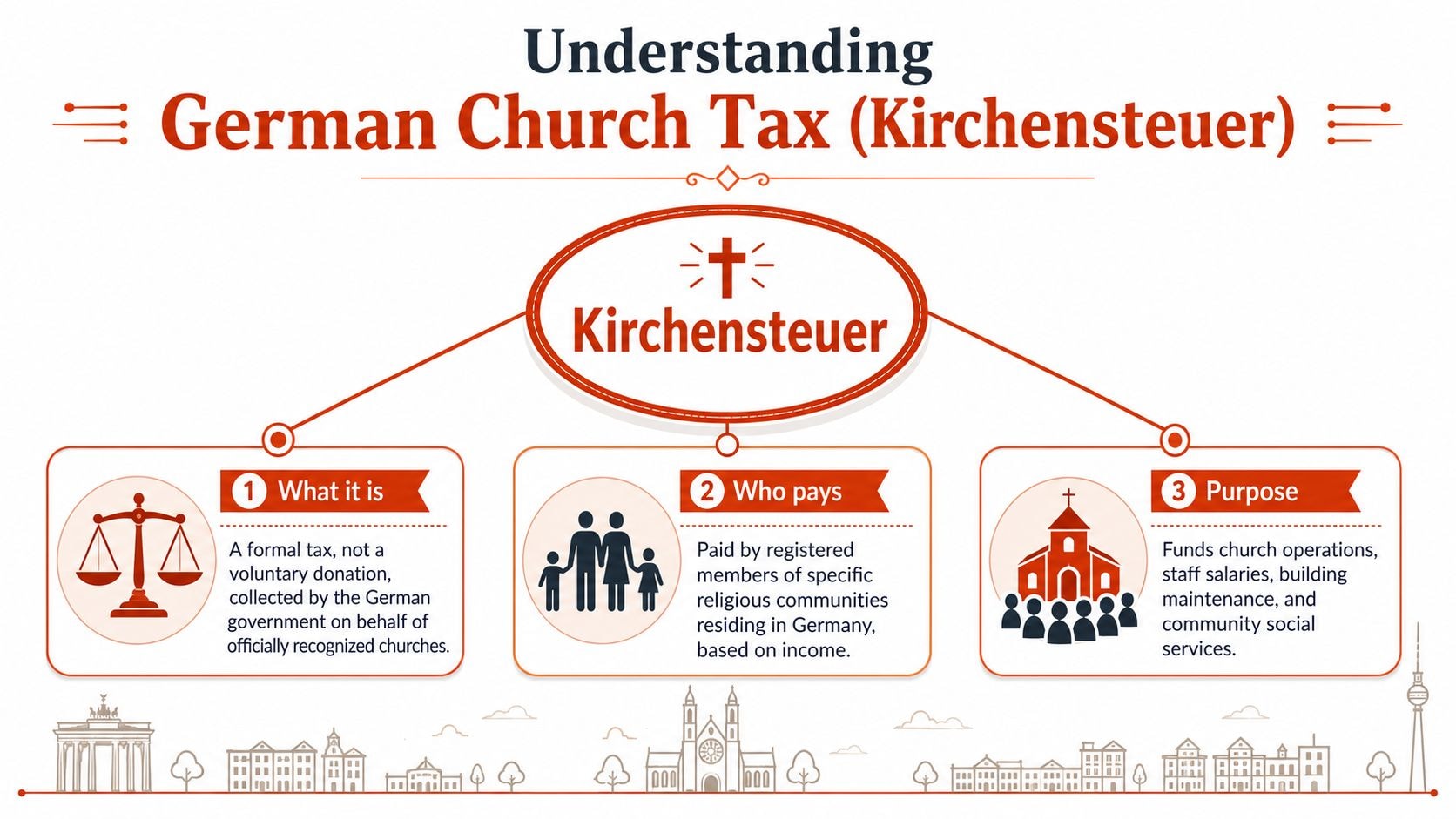
In practice, this means your employer can deduct it directly from your salary during payroll, and the tax authorities pass it on to the relevant religious institution. The main groups tied to this system are the Roman Catholic Church, the Evangelical Church, and certain Jewish communities.
What makes it different from donations
In many countries, giving to a church is personal and optional. In Germany, church tax works through the tax system once membership is officially recorded. That's the part many newcomers don't expect.
The rate is based on your income tax, not directly on your gross salary. According to SteuerGo's explanation of German church tax rates, the tax is 8% or 9% of an individual's assessed income tax. Bavaria and Baden-Württemberg use 8%, while all other federal states, including Berlin, use 9%. The same source states that total church tax revenue in Germany reached approximately €13.1 billion in 2022.
This is why a relatively small line on a payslip can add up to a noticeable yearly cost.
Who normally pays it
You typically pay church tax if the system has you recorded as a member of a tax-collecting religious community. That can happen because of a current declaration, or because an earlier affiliation carries over into your German records.
Here's a straightforward view:
| Situation | Likely result |
|---|---|
| You are officially registered as Catholic or Protestant | Payroll may deduct church tax |
| You are registered as having no religion | Church tax usually should not be deducted |
| You are unsure what was recorded | Check your Anmeldung details, payroll, or tax records |
For newcomers, the most important part isn't theology. It's record-keeping. German bureaucracy works off what is entered into the system. If the system shows a taxable church affiliation, your employer usually follows that record.
How Much Is the Church Tax in Germany
The amount surprises people because it doesn't look huge on one payslip, but over a year it can become a meaningful expense.
A simple way to calculate it
Church tax in Germany is calculated as a share of your income tax bill, not as a direct percentage of your salary. That distinction matters.
A verified example from Statista's church tax revenue overview gives a clear benchmark: for an individual earning €50,000 with a 20% income tax rate (€10,000), church tax adds €800 to €900 per year. That equals approximately 1.6% to 1.8% of total taxable income.
So if you live in Berlin, where the state rate is 9% of income tax, you would be at the higher end of that example. If you live in Munich, the state rate is lower.
This is also why two people with similar salaries can pay different amounts. Their income tax burden may differ, and so can the applicable state rate.
German Church Tax Rates by State 2026
| Tax Rate | Federal States (Bundesländer) |
|---|---|
| 8% | Bavaria, Baden-Württemberg |
| 9% | All other federal states, including Berlin |
If you want a fast mental check, think in two steps:
-
Find your income tax amount
-
Apply the church tax rate for your federal state
That's the logic payroll follows.
If you're trying to estimate the impact on your budget, use your income tax as the base. Don't calculate it from gross salary alone.
One more point matters if you're comparing guides about church taxes in Germany. Some articles mention that church tax can be deductible in a tax return as a special expense. That's true in principle, but the moment you're dealing with deductions already taken, tax-year timing, or refund questions, it stops being simple bureaucracy and starts becoming a tax matter. For that part, a Steuerberater or qualified tax advisor is the right person.
How Your Anmeldung Can Automatically Make You a Taxpayer
For many newcomers, the trigger happens long before the first payslip. It happens at the Bürgeramt.
During Anmeldung, you fill in your residence registration. One field asks about religion. That line looks harmless. It isn't. For church tax purposes, it can shape how the tax system categorizes you.
Why this catches so many newcomers
Some people write down the religion they were raised in without thinking about money. Others were baptized years ago, no longer practice, and assume that personal belief is what matters. In the German system, the administrative record matters a lot.
According to CISPA's practical note on church tax in Germany, many newcomers, especially those baptized in their home countries, are automatically registered as Catholic or Protestant upon German Anmeldung and trigger church tax liability, even if they are non-religious. The same source notes that the formal exit process requires a personal court visit and a fee, which can be a major hurdle for non-German speakers.
That's the trap. What feels like a simple identity field can lead to an ongoing payroll deduction and then a separate bureaucratic process to undo it.
How to avoid accidental church-tax registration during Anmeldung
Do not casually write a church affiliation during Anmeldung unless it accurately reflects your official church membership status and you understand the tax consequence. If you are unsure, ask the Bürgeramt, your tax advisor, or the relevant church or authority before submitting the form.
A helpful starting point is this Anmeldung in Berlin step-by-step guide, especially if you're still preparing for your appointment and want to avoid an expensive mistake.
A simple decision guide:
| What you put in the religion field | Likely effect |
|---|---|
| Catholic or Protestant | Can trigger church tax registration |
| No religion or a dash | Usually avoids church tax registration |
| You are unsure what to write | Get clarification before submitting |
The expensive mistake usually isn't malicious. It's a rushed form filled in during a stressful move.
If you've already completed Anmeldung and church tax has started, don't panic. It can usually be addressed. But fixing it is more involved than preventing it.
The Kirchenaustritt A Step-by-Step Guide to Stop Paying Church Tax
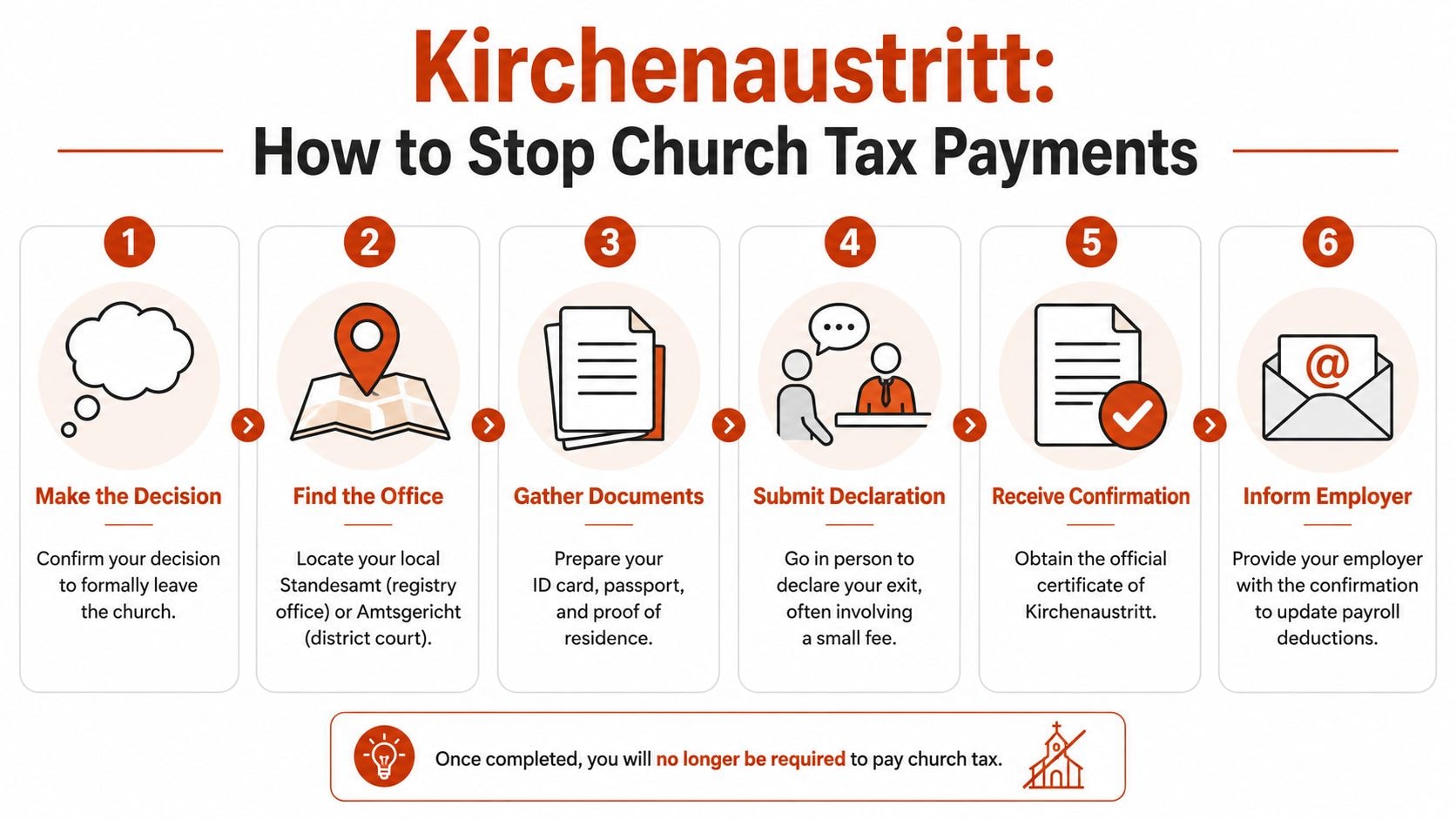
If church tax is already being deducted, the formal process to stop it is called Kirchenaustritt. In plain English, that means church exit.
This is an administrative act. It's not just a conversation with HR, and it's not solved by telling your employer that you're not religious.
What the process is really for
German offices need a formal record to change your church membership status for tax purposes. In Berlin, the declaration is made through the Amtsgericht. The official Berlin Service Portal page for Kirchenaustritt states that you must declare the exit personally at the local court or submit a notarially certified written declaration. The same official source explains that you generally need a valid ID card or passport plus a registration certificate (Meldebescheinigung) and that the fee in Berlin is €30.
The practical steps
The process sounds simple when written in one sentence. In real life, it can still be intimidating, especially if the office interaction happens only in German.
-
Find the correct office
In Berlin, the responsible place is the Amtsgericht for your area. You can use the official Berlin Service Portal entry for Kirchenaustritt to check the responsible court and current requirements. -
Prepare identification
Bring your valid passport or ID. According to the official Berlin guidance, you may also need your Meldebescheinigung if you use a passport instead of a German ID card. -
Bring your local registration details if available
In practice, proof of address information can help the office match your records quickly. -
Appear in person
This is the part many people underestimate. The official Berlin guidance states that the declaration is made personally at the court unless you use a notarially certified written declaration. -
Pay the administrative fee
The official Berlin source lists the fee as €30. -
Keep the official confirmation
Once you receive your exit certificate, store it carefully. This document matters if payroll or records need to be checked later.
What to bring and what to keep
A lot of stress comes from turning up with the wrong paperwork. This documents checklist for Berlin appointments is useful if you want to organize everything before you go.
A simple checklist:
-
Valid ID: Passport or official identity document.
-
Residence details: Anything that helps confirm your local registration, including a Meldebescheinigung where relevant.
-
Payment method: Check what the office accepts so you're not caught off guard.
-
A folder for the certificate: Keep the exit confirmation safe after the appointment.
If you don't speak German confidently, the hardest part is often not the form. It's understanding what the clerk is asking, what you are signing, and what happens next.
At this point, people often ask whether they need a lawyer, a tax advisor, or just practical help. For the appointment itself, language support and document preparation are usually the main issue. If your case turns into a dispute about past tax years, refunds, or unclear registration history, that's when a qualified tax advisor becomes important.
What Happens After Your Kirchenaustritt
Once your Kirchenaustritt is completed, a common question is: when does the deduction stop?
When the deduction usually stops
The exit is formally recorded and the relevant records should be updated, but payroll may take some time to reflect the change. Keep the confirmation certificate and follow up with HR if the deduction continues.
A calm follow-up routine helps:
-
Check your next payslip
-
Send HR a copy of the confirmation if needed
-
Keep the original document in a safe place
What this does not automatically solve
Kirchenaustritt ends future church membership for tax purposes. It doesn't automatically resolve every question about earlier deductions.
If church tax was already taken in a prior period and you want to know whether anything can be corrected through a tax return, that's no longer just a paperwork issue. It becomes a tax filing question, and a Steuerberater or qualified tax professional should handle that advice.
There can also be personal consequences outside payroll. Some people care about this, others don't. Depending on the religious community, formal exit can affect access to certain church ceremonies or roles.
Keep the certificate longer than you think you need. German bureaucracy often runs on proof, not memory.
Don't Let German Bureaucracy Stress You Out
Church taxes in Germany confuse people because the problem starts subtly. One form field during Anmeldung. One line on a payslip. Then an office visit you didn't plan for, in a language you may not fully control.
That combination is what makes the issue feel bigger than it is. The rules themselves are rigid, but the path through them is usually straightforward once someone helps you prepare properly.
When practical help is enough
A lot of newcomers don't need legal representation. They need help with routine bureaucracy, such as:
-
understanding routine German letters
-
appointment preparation
-
document organization
-
German phone calls
-
practical support at routine bureaucracy appointments
If you're still at the registration stage, an Anmeldung helper in Berlin can also help you avoid the problem before it starts.
One extra layer people miss is that, beyond the national church tax system, some parishes may charge an additional local church tax (Kirchgeld) that can be up to €120 per year, as explained in GermanTaxes.de's overview of church tax and Kirchgeld. That kind of detail adds more confusion, especially when you're already trying to decode German letters and local rules.
What SettlyGo does not provide
SettlyGo does not provide:
-
tax advice
-
legal advice
-
refund strategy
-
tax return support
-
representation in disputes
-
certified translation
For past deductions, refunds, tax returns, or disputes, use a qualified Steuerberater or another qualified professional.
When you need a tax advisor or another professional
Be direct with yourself about the kind of problem you have.
Use a qualified tax advisor if you need help with:
-
past-year deductions
-
tax return treatment
-
refund questions
-
a complicated record history
-
disputes or representation needs
Use practical appointment support if you need help with:
-
booking and preparing for the office visit
-
understanding forms and letters
-
live communication during a routine bureaucratic appointment
-
organizing documents before and after the appointment
That distinction matters. Practical support can make the process less stressful. It can't replace professional tax advice when your issue becomes a tax dispute or filing question.
If church tax is showing up on your payslip and you want calm, practical support with the appointment and paperwork side, you can book a local helper through SettlyGo. For related bureaucracy tasks, SettlyGo also offers practical support with German phone call help and understanding Berlin appointment paperwork. SettlyGo is practical newcomer support, not a law firm or tax advisor, so if your situation involves tax return strategy or a dispute about past payments, book a qualified professional for that part.
Need practical help in Berlin?
Book a verified SettlyGo helper for German phone calls, appointments, landlord communication, apartment viewings, and document preparation.