eID Card in Berlin for EU/EEA Citizens: Newcomer Guide
August 27, 2026 · 10 min read
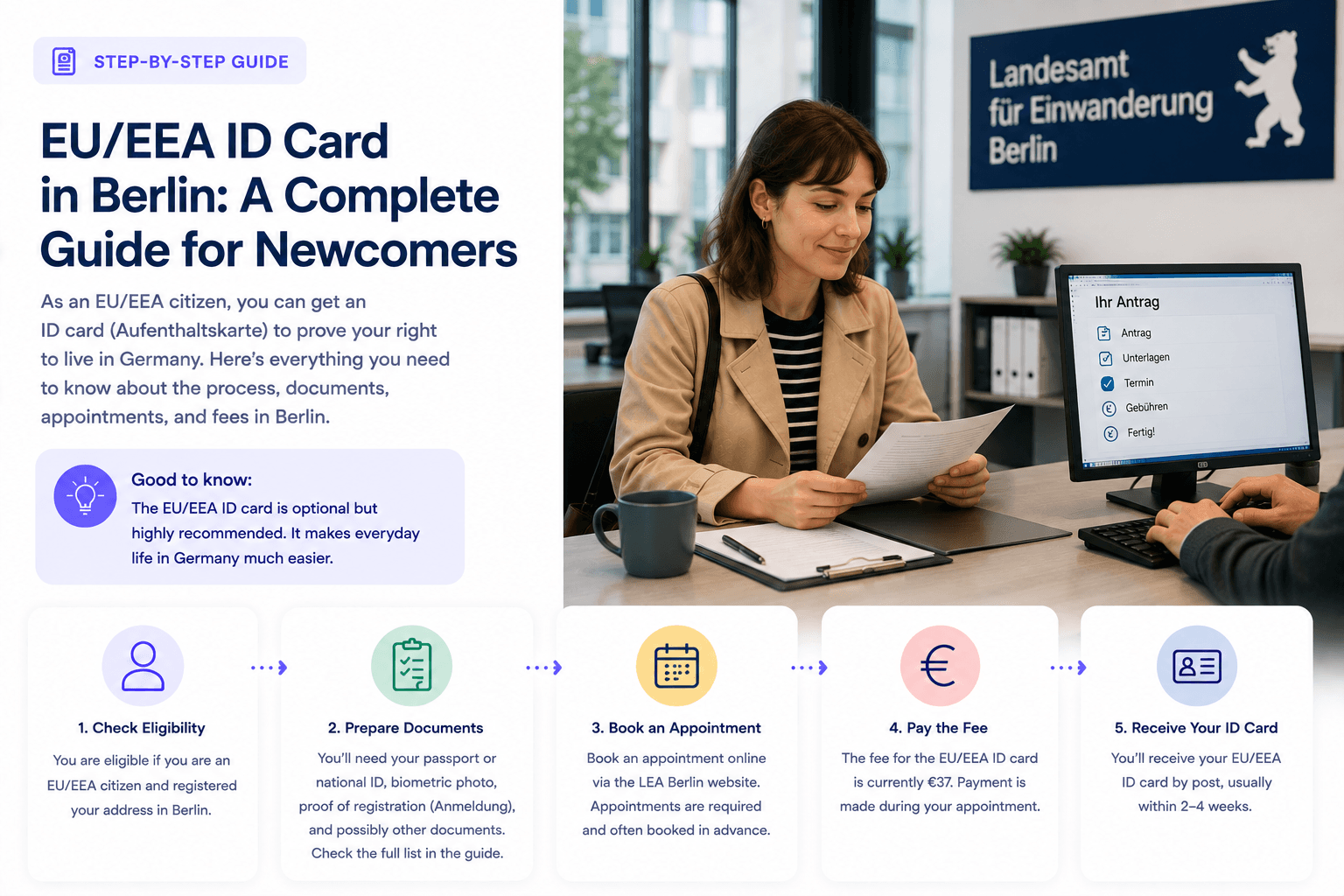
If you are an EU or EEA citizen living in Berlin, you may come across Germany's eID-Karte für EU/EWR-Bürger/innen.
It is a German electronic identification card that lets eligible EU and EEA citizens use the same type of online identification function available through the German Personalausweis and the electronic residence permit.
For newcomers, the important point is simple: the eID-Karte is useful for digital identification, but it is not a passport, national identity card, residence permit or travel document.
This guide explains who can apply in Berlin, what to bring, what it costs, how long production normally takes and what to do after you move.
Important scope: This article provides general administrative information. SettlyGo can help you understand visible requirements, organize documents, prepare questions and support ordinary German communication. SettlyGo does not provide legal or immigration advice, determine residence rights, replace an authority, or guarantee that an application will be accepted.
What is the German eID-Karte?
Berlin's official eID-Karte application service describes the eID-Karte as a chip card for electronic identification.
Its main purpose is to let eligible EU and EEA citizens prove their identity online at a high level of assurance when using participating public or private digital services.
Berlin currently states that the card is valid for 10 years.
The eID-Karte does not replace the identity document issued by your home country. It also cannot be used as a travel document.
Who can apply?
Berlin currently lists these core requirements:
- you are a citizen of another European Union member state or of the European Economic Area;
- for this service, the EEA includes Iceland, Liechtenstein and Norway;
- you are at least 16 years old; and
- you are not simultaneously German within the meaning of Article 116(1) of the German Basic Law.
You can apply even if your home country does not operate its own compatible eID system.
Do you have to live in Germany?
No.
Berlin's official guidance says eligible EU/EEA citizens can obtain the German eID-Karte regardless of whether they live in Germany.
If you are registered in Berlin, you can use a Berlin Bürgeramt.
If you are not subject to German registration requirements and live in Berlin or abroad, different proof-of-address rules can apply. In those cases, follow the current authority instructions for your place of residence.
For most newcomers already registered in Berlin, the practical route is a Berlin Bürgeramt appointment.
Is the eID-Karte a residence permit?
No.
EU citizens generally exercise residence rights under EU free-movement rules rather than through the same residence-permit system used for many non-EU nationals.
The eID-Karte itself does not create, extend or prove a residence right. Its purpose is electronic identification.
Do not use the eID-Karte as a substitute when an authority asks for a passport, national identity card or another specific document.
Where do you apply in Berlin?
Berlin currently says the service is available Berlin-wide at Bürgerämter.
The application must be made in person.
The official service page provides Berlin-wide appointment booking, so you are not limited to the Bürgeramt in your home district.
That can be useful when appointment availability differs between districts.
What should you bring?
Berlin currently requires a valid identity document issued by your home country, for example:
- a passport; or
- a national identity card.
Depending on your situation, the authority may also require proof of your residence or current address.
If you do not have a residence in Germany, Berlin says proof of your foreign address may be required. For applicants living abroad, the responsible German diplomatic mission can explain what evidence it accepts.
Before the appointment, check the current ServicePortal entry because the exact evidence can depend on where you live and whether your Berlin registration can already be confirmed electronically.
How much does the eID-Karte cost?
Berlin currently lists a fee of €37.00.
The official service page states that no fee exemption is available for this application.
Payment methods can vary by Bürgeramt location, so check the selected location before attending rather than assuming cash will be accepted.
How long does it take?
Berlin currently lists an average processing time of around three to four weeks.
The ServicePortal also warns that production can take significantly longer in individual cases.
The card is therefore not a same-day document. If you want to use it for a specific online procedure, leave enough time for production and collection.
What happens at the Bürgeramt appointment?
At the appointment, the authority checks your identity and application requirements.
Berlin states that you receive information needed to activate the online identification function, including a PIN letter for the card.
The PIN letter contains a temporary PIN that you use to set your own six-digit PIN. It also includes information used for blocking the online identification function if necessary.
This article does not go into PIN-recovery procedures because those are a separate administrative task and can change independently of the initial application.
When can you use the card online?
The online identification function becomes usable after you have the physical card and set your own PIN as instructed.
You also need compatible hardware or software for the service you want to use. In practice, many people use a compatible smartphone with the official AusweisApp.
Whether a particular website accepts German online identification depends on that service.
The eID-Karte does not automatically give you access to every German online portal.
How do you collect the card?
Berlin has a separate official service for collecting an eID-Karte.
Follow the collection instructions you receive from the Bürgeramt that handled your application.
Do not assume that collection rules are identical at every location. Check the appointment or collection notice before travelling to the office.
What happens if you move after getting the eID-Karte?
This is easy to overlook.
The eID-Karte does not print your address visibly on the card, but your address is stored electronically on its chip.
Berlin's official address-change service for the eID-Karte says that after moving, you must have the address on the card's chip updated without delay.
The address-change request is currently handled in person at a Bürgeramt.
Berlin lists the address change itself as free of charge.
What do you need for an eID address change?
Berlin currently lists:
- your eID-Karte;
- a valid identity document from your home country; and
- where applicable, a current official registration confirmation.
The authority updates the address stored on the chip. Because no address is printed on the physical eID-Karte, there is no address sticker to replace on the card itself.
If you have just completed a Berlin Anmeldung or Ummeldung, check whether you can handle the chip update during the same Bürgeramt visit or whether the location requires a separate service booking.
Does Anmeldung automatically update the eID-Karte?
Do not assume it does.
Registering your new address in Berlin and changing the address stored on your eID-Karte are related administrative steps, but Berlin maintains a separate service specifically for the eID-Karte address update.
After a move, confirm that both your registration record and the card's chip contain the correct address.
What if you only have your home-country ID card?
That is normal.
The German eID-Karte is optional electronic-identification infrastructure for eligible EU/EEA citizens. It does not replace your national identity card.
If the online services you need already accept another identification method, you may not need a German eID-Karte at all.
Consider which digital procedures you actually expect to use before applying.
Is the eID-Karte the same as the German Personalausweis?
No.
A German Personalausweis is a German national identity document issued to eligible German citizens.
The eID-Karte gives eligible EU/EEA citizens access to an electronic identification function, but it is not a German national identity card.
That distinction matters when a form asks specifically for a Personalausweis, passport or nationality document.
Is the eID-Karte the same as an electronic residence permit?
No.
An electronic residence permit, often called an eAT, is a different document used in German immigration administration for many non-EU nationals.
Both documents can provide an online identification function, but their legal purposes are different.
If you hold an eAT, use the administrative service that applies to that document rather than the EU/EEA eID-Karte process.
A practical application checklist
Before booking:
- I confirmed that I am an eligible EU/EEA citizen and at least 16 years old.
- I understand that the eID-Karte is for electronic identification, not travel or residence status.
- I checked the current Berlin ServicePortal page.
- I found a Bürgeramt appointment that offers the eID-Karte service.
Before the appointment:
- My passport or national identity card is valid.
- I checked whether I need additional proof of my current address.
- I checked the payment methods at the selected Bürgeramt.
- I know the current fee before attending.
After applying:
- I keep the application or collection information from the Bürgeramt.
- I allow several weeks for production rather than expecting same-day issuance.
- I follow the PIN instructions carefully when the card arrives.
- I update the chip address if I later move.
Common mistakes newcomers can avoid
Treating the eID-Karte as a travel document
Berlin explicitly says it is not an identity or travel document. Carry the document actually required for travel.
Assuming every EU citizen needs one
The card can be useful, but it is not a universal newcomer requirement like registering a residence when registration law applies.
Going to the Bürgeramt without a valid home-country ID
Your identity must be established using an accepted valid identity document.
Expecting the card immediately
Berlin currently gives an average production time of about three to four weeks, and individual cases can take longer.
Forgetting the address stored on the chip
If you move, Berlin requires the chip address to be updated. The card itself does not show a printed address, so the need for this extra step can be easy to miss.
Confusing it with the eAT
The eID-Karte for EU/EEA citizens and the electronic residence permit are separate documents with different purposes.
How SettlyGo can support you
A SettlyGo helper can provide practical support such as:
- helping you find the correct Berlin ServicePortal page and Bürgeramt service;
- organizing a checklist from the visible official requirements;
- helping you prepare questions about missing or unclear documents;
- supporting an ordinary German phone call or administrative conversation; and
- accompanying you when in-person communication support is useful.
SettlyGo does not issue identity documents, determine eligibility or residence rights, act as the Bürgeramt, provide legal or immigration advice, or guarantee approval.
Final takeaway
For eligible EU and EEA newcomers, Germany's eID-Karte can make electronic identification easier when using supported online services.
In Berlin, the application is currently made in person at a Bürgeramt, costs €37.00, and normally takes around three to four weeks to produce. The card is valid for 10 years, but it is not a passport, residence permit or travel document.
If you later move, remember that Berlin requires the address stored on the card's chip to be updated in person; that address-change service is currently free.
Use Berlin's official eID-Karte application service to confirm the latest requirements, fee, appointment availability and processing information before applying.
For practical help organizing documents, preparing questions or handling German administrative communication, book SettlyGo support.
Need help with Anmeldung or the Bürgeramt?
Book a verified SettlyGo helper to guide you through city registration, document preparation, and office appointments in Berlin.