Furnished Apartments Berlin: Newcomer's Guide 2026
July 10, 2026 · 14 min read

You've landed in Berlin, opened three tabs, saved twenty listings, and somehow feel less sure than when you started. One apartment says Anmeldung is possible, another avoids the question, a third wants a fast deposit, and the viewing invitation arrives in German five minutes before your work call. That's a normal Berlin apartment search, especially when you need a furnished place quickly.
The hardest part usually isn't finding websites. It's figuring out which listings are real, which offers fit your timeline, what documents a landlord expects from a newcomer, and how to handle the very human part of the process when the conversation switches to rapid German. If you're looking for furnished apartments in Berlin in 2026, realistic expectations and good preparation matter more than endless scrolling.
The Reality of Berlin's Furnished Apartment Market
Berlin can make furnished housing look easy. Open the big portals and it seems like every second listing comes with a bed, desk, lamps, cookware, and a rent that looks painful but manageable if it saves you from buying furniture on day one.
Why the market feels bigger than it is
That impression can be misleading. Some market analyses suggest furnished apartments appear disproportionately often in online listings compared with their share of the total housing stock. The practical takeaway is simple: furnished listings may look abundant online, but good options still move quickly.
So if you've been thinking, “There are so many furnished apartments in Berlin, why am I still not getting one?”, the answer usually isn't that you're doing something wrong. You're competing for a small slice of the market that can look larger online than it really is.
Practical rule: Treat furnished apartments in Berlin as a narrow, fast-moving category, not an abundant one.
This changes your strategy. It means timing matters. It means slow replies hurt. It means landlords and agencies often prefer applicants who can send a clean document package immediately and confirm practical details without confusion.
What this means for your search
A furnished apartment can still be the right move. For many newcomers, it's the most sensible first base because it reduces setup stress. You can arrive, sleep, work, and deal with German paperwork before making a long-term housing decision.
But it helps to split your search into two clear goals:
-
Short landing solution: You need something reliable so you can start life in Berlin without panic.
-
Longer settling solution: You want a place that supports Anmeldung, a stable routine, and fewer expensive surprises.
If you go in expecting a miracle bargain in the most in-demand areas, you'll burn time. If you go in expecting competition, paperwork, and quick decisions, you'll move much more calmly.
The people who do best in this market usually aren't the people who send the most messages. They're the ones who send the clearest ones.
Where to Find Furnished Apartments in Berlin
You don't need fifty search channels. You need the right channel for your timeline.
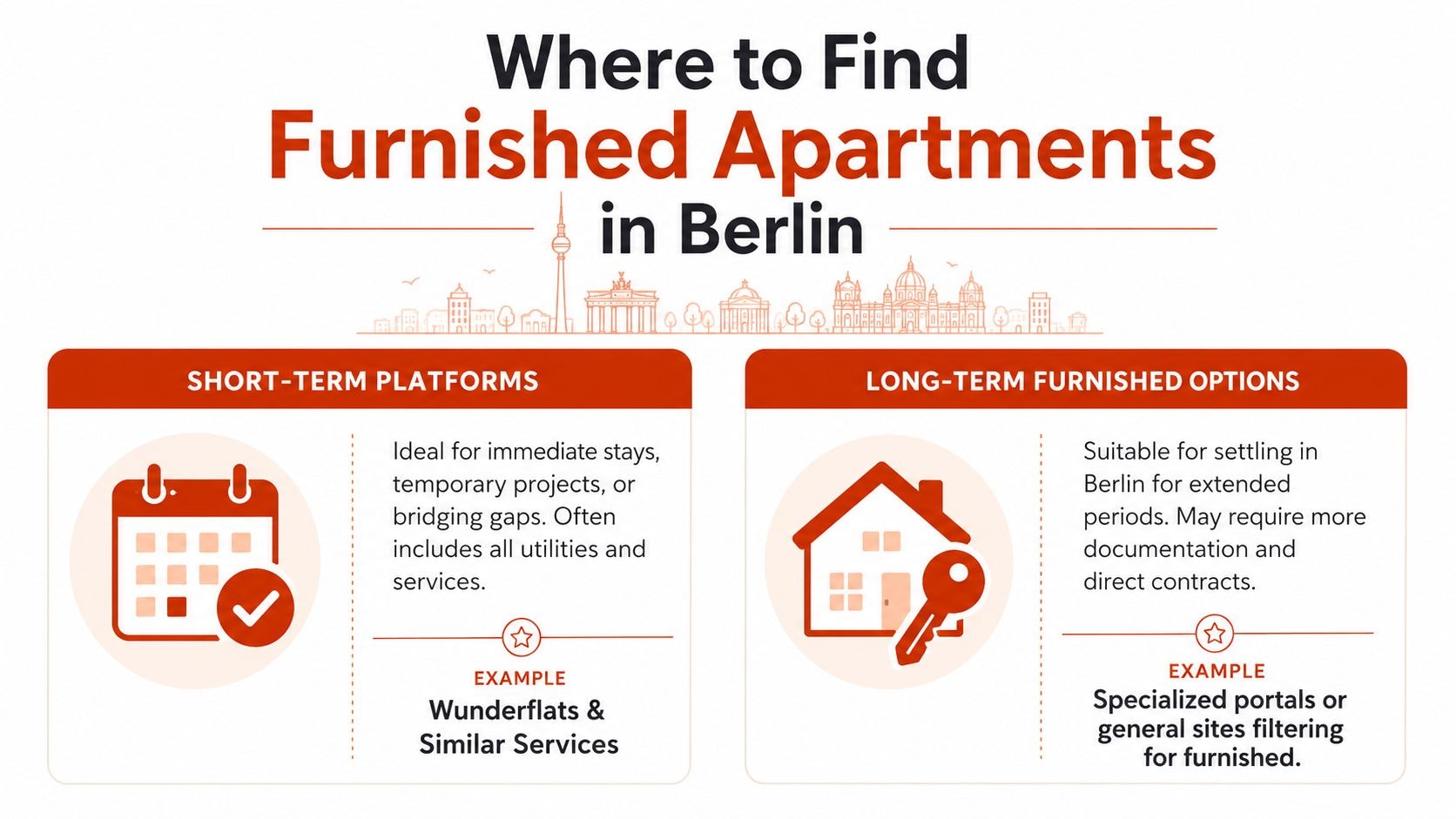
Short-term platforms versus longer-stay channels
For most newcomers, the market splits into two broad lanes.
| Search route | Best for | What usually works well | Common trade-off |
|---|---|---|---|
| Short-term platforms | First arrival, project stays, temporary housing | Move-in-ready setup, simpler remote booking, utilities often bundled | Higher monthly cost, less flexibility, stricter house rules |
| Longer-stay furnished options | Settling in for a longer period | More stability, stronger basis for daily life in Berlin | Heavier document requests, more landlord screening, slower process |
Short-term platforms are useful when you're arriving from abroad and need certainty more than optimization. In such cases, services like Wunderflats and similar furnished-rental platforms are often simpler to use than the broad open market. They're practical when your priority is having an address and a bed, not negotiating every contract detail.
General portals can also work if you filter for furnished listings, but the experience is different. You'll usually see more variety, more private advertisers, and more cases where you have to clarify the basics yourself.
How to search safely
The legal side matters, especially for temporary stays. For short-term or temporary furnished stays, check whether the provider is legally allowed to offer the apartment for that use and whether any required registration or permission is in place. Rules can differ depending on the type of stay, the apartment setup, and whether it is a private sublet, serviced apartment, or commercial provider.
That leads to a simple screening method.
-
Check the stay length first: Under 90 days and over 90 days don't function the same way in Berlin.
-
Ask about Anmeldung early: Don't wait until after the viewing.
-
Verify who is renting the unit: Agency, owner, serviced operator, or subletter all create different risks.
-
Avoid pressure tactics: “Deposit today or it's gone” is a bad start.
-
Keep payments formal: If the payment path feels improvised, stop.
A lot of stress comes from treating every listing the same. They aren't the same. Some are proper temporary housing offers. Some are standard rentals with furniture. Some are sublets that may be fine for a short bridge but weak for registration or long-term planning.
If a provider gives vague answers about registration, billing, or who legally controls the apartment, move on.
Berlin-specific examples help here. In Mitte or Prenzlauer Berg, you'll often find polished listings with clean presentation and fast competition. In Neukölln or Friedrichshain, you may see more private arrangements and sublet-style offers. In Charlottenburg, furnished options can feel more conventional and quiet, which some families and professionals prefer.
The best search method depends on whether you need a safe landing in two weeks or a stable home for the next year. Those are different searches, and Berlin punishes people who mix them up.
Preparing Your Documents and Choosing Neighborhoods
A furnished apartment search gets easier the moment your documents stop living across screenshots, inboxes, and half-finished downloads. Berlin landlords and agencies usually decide fast when they have what they need, and they drift away just as fast when your file looks incomplete.
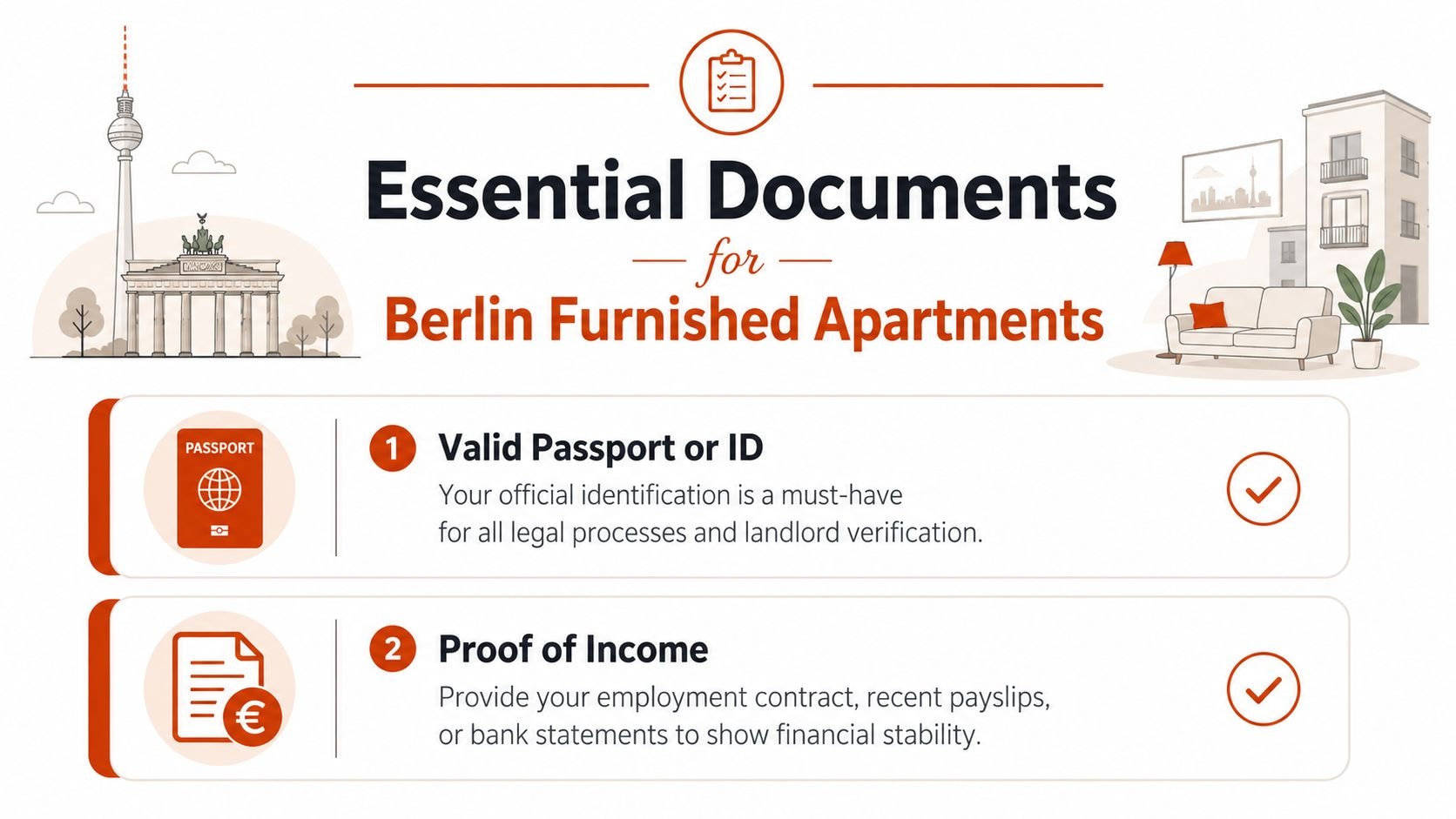
The document stack landlords expect
For furnished apartments in Berlin, expect some mix of these:
-
Passport or national ID: This is the basic identity document for nearly every rental conversation.
-
Proof of income: Employment contract, recent payslips, or bank statements are the usual fallback if you're new.
-
Short introduction message: A concise note about who you are, why you're moving, and your intended stay length helps more than people think.
-
Schufa if available: New arrivals often don't have one yet, so don't panic. Offer substitute proof of stability.
-
University or employer confirmation: Very useful for students, researchers, and skilled workers.
-
Ready-to-send PDF folder: One clearly named file set is easier for landlords than ten separate attachments.
If you're stuck in the classic newcomer loop, you're not alone. You may need an address for parts of your setup, while landlords want a clean profile before offering the address. The practical answer is to reduce uncertainty wherever you can. If you don't have a Schufa yet, provide stronger income or sponsor documentation. If your job hasn't started, show the signed contract and salary details. If you're a student, include enrollment and funding proof.
A useful starting point is this documents checklist for Berlin appointments, especially if your apartment search overlaps with Anmeldung or other city paperwork.
Good application files feel easy to trust. That matters almost as much as the contents.
Choosing a district without trapping yourself
Newcomers often choose neighborhoods based on reputation alone. That's understandable, but it's usually better to choose based on your first three months. Ask where you'll commute, where your appointments will happen, and how much friction you can tolerate.
A simple way to think about it:
-
Mitte: Central and convenient if you expect many appointments and want easier transport connections.
-
Prenzlauer Berg: Popular with people who want a calmer day-to-day routine.
-
Charlottenburg: Often suits professionals and families who prefer a more traditional feel.
-
Friedrichshain and Neukölln: Attractive if lifestyle and nightlife matter, but not always the easiest base for a quiet reset.
One more local factor matters for temporary furnished housing. The Berlin Senate is actively considering a ban on new temporary furnished apartments in social protection areas called Milieuschutzgebiete, including parts of Kreuzberg, Neukölln, and Pankow, and these areas are home to over a million Berliners, according to The Berliner's report on the proposed Milieuschutz ban.
That doesn't mean you should avoid those districts entirely. It means you should be careful about assuming every temporary furnished offer there will remain straightforward. If your plan is to settle, don't just ask whether a neighborhood is trendy. Ask whether the apartment setup fits your actual next steps.
Mastering the Viewing and Landlord Communication
Viewings in Berlin are often short, slightly awkward, and more important than they look. Even when the apartment is furnished and the listing feels standardized, a lot gets decided in the conversation around the viewing.
What to ask at the viewing
People often leave a viewing and realize they forgot the essentials. Keep your questions practical.
-
Can I do Anmeldung here? This is one of the first questions, not the last.
-
What is included in the warm rent? Clarify utilities, internet, electricity, and any cleaning or service fees.
-
How long is the minimum stay? Temporary furnished contracts often have tighter stay logic than standard flats.
-
Who handles repairs? You want a contact person, not a vague promise.
-
Is there a handover protocol? Ask how keys, inventory, and existing damage are documented.
-
What happens at move-out? This helps you understand expectations before you commit.
Some viewings are calm one-on-one appointments. Others are rushed and crowded. Virtual viewings can be useful, but they're easy to misread if you don't know what's normal in Berlin. A room can look bright and generous on camera and feel much smaller in person. “Fully furnished” may mean fully livable, or it may mean one chair and a mattress with a lamp.
Why communication changes the outcome
The biggest difference between a strong applicant and a forgotten one is often communication quality. Not fancy language. Clear language.
One common pattern looks like this. A newcomer visits alone, understands half of what the agent says, nods through the rest, and later sends a hesitant follow-up with missing attachments. The landlord reads that as uncertainty.
A better version looks very different. You ask direct questions, confirm your timeline, send a complete file the same day, and show that you understand the process. That makes you easier to choose.
If you want practical help during this stage, apartment viewing support in Berlin can make the interaction much clearer. This kind of support isn't about replacing a lawyer or negotiating legal clauses. It's about making sure the questions get asked, the answers are understood, and the next steps don't disappear into confusion.
Sometimes the viewing goes fine. The problem comes after, when the landlord sends a German message with three requests and a deadline hidden in polite wording.
That's why follow-up matters as much as first impression. Reply the same day if you can. Confirm what you're sending. Keep your message short, respectful, and easy to scan. Berlin landlords and agents deal with volume. Help them say yes to you.
Understanding Your Rental Contract and Deposit
German rental contracts can look dense even when the arrangement itself is simple. Furnished apartments add another layer because the contract often bundles housing, furniture use, and temporary stay terms into one package.
The contract terms that matter most
A few terms deserve your full attention:
-
Kaltmiete: The base rent, before most running costs.
-
Warmmiete: The total rent including operating costs that are bundled in.
-
Möblierungszuschlag: The furniture surcharge. This is especially relevant in furnished rentals.
-
Kaution: The security deposit.
-
Befristung: A fixed-term contract.
For budgeting, one legal point matters a lot. Temporary furnished rentals can follow different legal and pricing logic from classic long-term unfurnished leases. Furniture surcharges, fixed-term arrangements, and short-stay terms can make the contract harder to compare with a standard rental. If the rent, deposit, fixed term, or sublet setup feels unclear, ask a tenants' association or qualified lawyer before signing.
That doesn't automatically make a contract bad. It does mean you shouldn't compare a temporary furnished apartment directly with a classic long-term unfurnished lease and expect the same pricing logic.
| Contract point | Why it matters | What to clarify |
|---|---|---|
| Rent structure | Furnished pricing can hide add-ons | Ask what is bundled into the warm rent |
| Furniture inventory | Disputes often start here | Make sure the listed items match reality |
| Deposit rules | This affects move-in cash pressure | Confirm amount, payment timing, and return process |
| Stay length and notice | Temporary contracts can be rigid | Check extension and early-exit conditions |
Contract check mindset: If a term changes your cost, your registration, or your move-out risk, get it clarified before signing.
When practical help is enough and when you need a lawyer
Practical support is useful when you need help understanding landlord messages, preparing questions, or clarifying everyday rental points in plain language. That can include apartment-viewing support, landlord communication, German phone calls, document organization, appointment preparation, and routine bureaucracy support. It also includes asking what's included, requesting the inventory list, or confirming whether the landlord will provide the Wohnungsgeberbestätigung for registration.
For that kind of communication, landlord communication help in Berlin can save a lot of back-and-forth.
But there's a clear line. If you need a formal legal review, a dispute assessment, or advice on whether a contract clause is enforceable, use a qualified lawyer or a tenants' association such as a local Mieterverein. The same applies if the situation involves subletting rights, deposit disputes, or formal legal letters.
SettlyGo does not provide legal advice, tenancy-law advice, tax advice, insurance brokerage, certified translation, sworn interpretation, immigration advice, or official representation.
That boundary matters. Practical support helps you function. Legal professionals handle legal interpretation.
You Have the Keys Your Next Steps in Berlin
Getting the keys feels like the finish line, but in Berlin it's really the handover into the next phase. The first days after move-in tend to decide whether your setup becomes smooth or chaotic.
Start with the urgent part first.
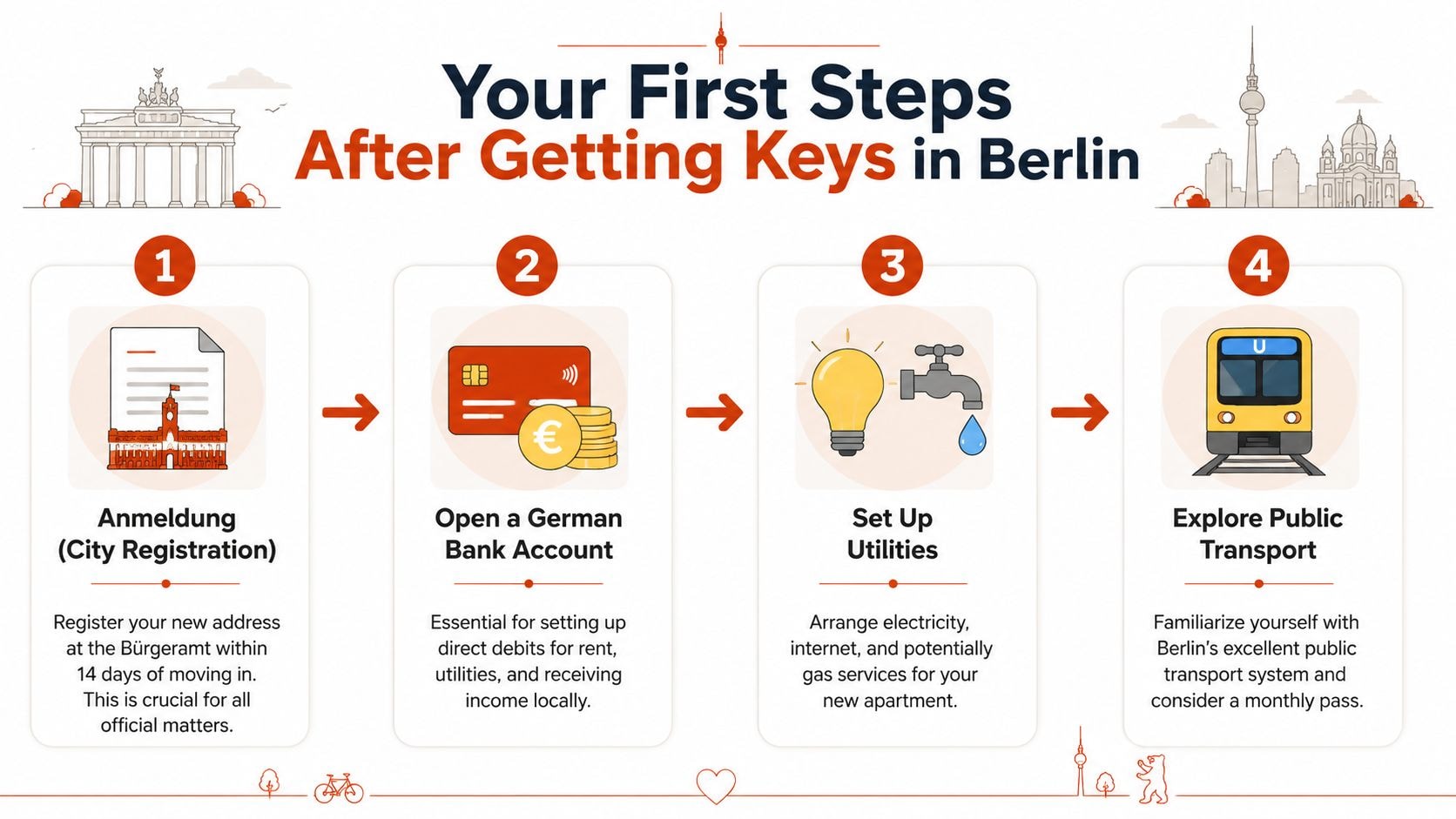
Your first administrative priorities
The top priority is usually Anmeldung, your city registration. According to Berlin.de's official registration guidance, registration is generally required within 14 days after moving in. You'll typically need identification and the Wohnungsgeberbestätigung, and a rental contract does not replace the Wohnungsgeberbestätigung. Don't assume this document will appear automatically. Ask for it clearly and early.
If your furnished apartment allows registration, book your Bürgeramt appointment as soon as possible and keep your paperwork together in one folder. Appointment preparation matters more than people expect. The missing item is often not your passport. It's a form, a confirmation, or a detail that wasn't checked in advance.
A short explainer can help if you want the process in video form:
Video walkthrough: watch it on YouTube.
The move-in checklist most newcomers forget
Once registration is in motion, deal with the rest in a calm sequence:
-
Inspect the apartment properly: Photograph existing wear, missing items, and anything that could affect the deposit later.
-
Store every move-in document: Keep the contract, handover notes, inventory, and payment confirmations together.
-
Set up banking and recurring payments: Rent, internet, and other services are easier once your payment flow is stable.
-
Check utilities and internet responsibility: In some furnished rentals this is included. In others, it isn't.
-
Learn your local transport route: Your first week gets easier once your daily path is predictable.
Berlin gets easier once the basics are in place. Not perfect. Just manageable. And manageable is a big win when you're new.
If your apartment search, landlord messages, or next Bürgeramt step still feels messy, book a SettlyGo helper. SettlyGo can help with practical tasks such as apartment-viewing support, landlord communication, German phone calls, document organization, appointment preparation, and routine bureaucracy support. SettlyGo does not provide legal advice, tenancy-law advice, tax advice, insurance brokerage, certified translation, sworn interpretation, immigration advice, or official representation.
Need help with Anmeldung or the Bürgeramt?
Book a verified SettlyGo helper to guide you through city registration, document preparation, and office appointments in Berlin.