German Residence Permit Requirements: A Berlin Guide
July 11, 2026 · 18 min read
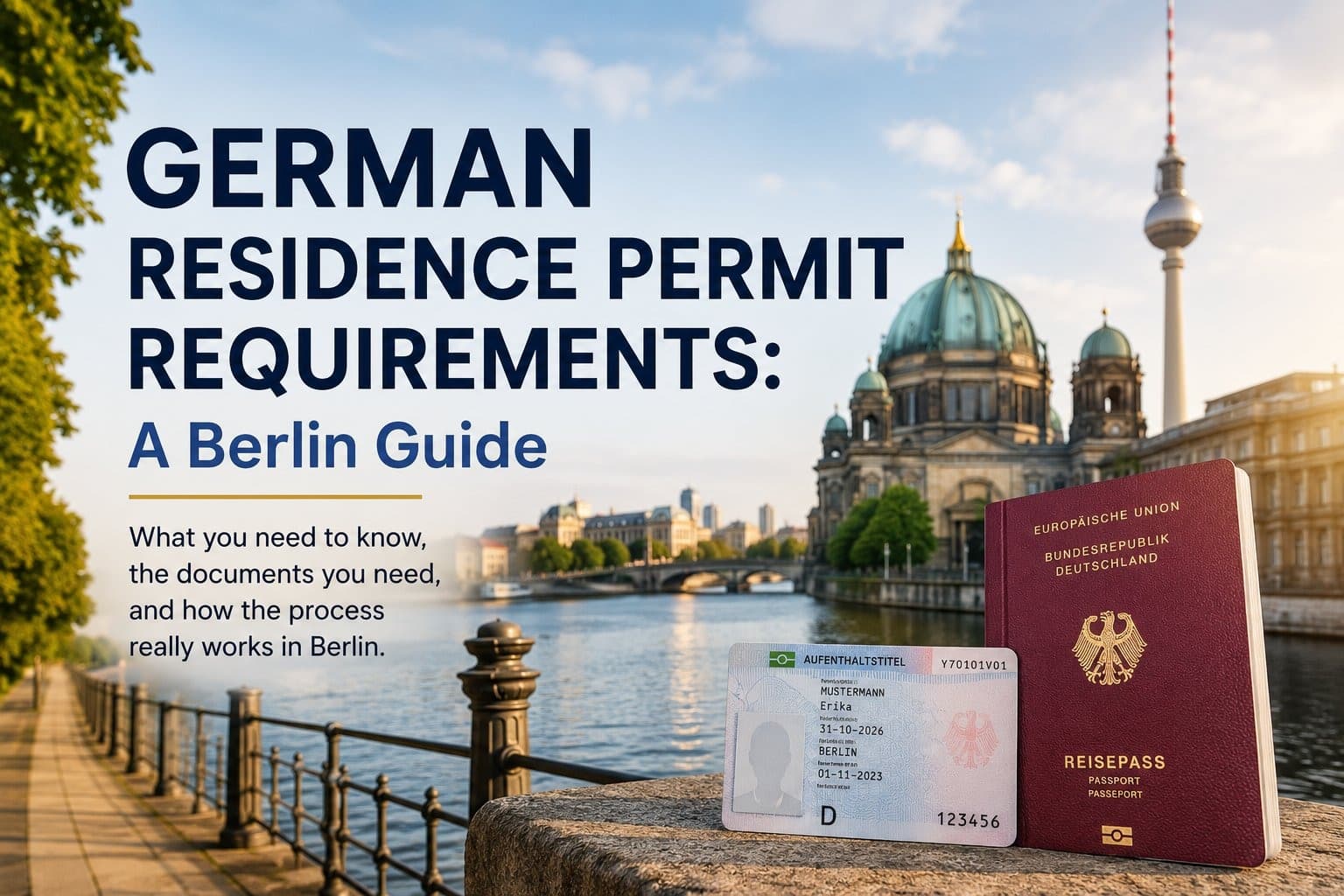
You've arrived in Germany, found a place to stay, maybe started work or university, and then the paperwork hits. The phrase German residence permit requirements sounds simple enough until you try to book an appointment, decode a German email, and figure out whether your documents are complete for Berlin.
Official guidance often feels too clean. On paper, the process looks linear. In real life, the hard parts are getting the right appointment in time, preparing documents in the format the office expects, and handling a meeting that usually happens in German. If you're in Berlin, there are also local quirks that can catch even well-prepared newcomers off guard.
What Is a German Residence Permit and Who Needs One
You land in Berlin, find a flat sublet, start work or classes, and then hit the part nobody warns you about clearly enough. The rule is federal, but the experience is local. In Berlin, that means your residence permit is not just a legal formality. It is tied to appointment availability at the LEA, document quality, and whether you can get through an appointment that may switch between German and English without much patience for missing paperwork.
A German residence permit is the status that lets many non-EU, non-EEA, and non-Swiss nationals stay in Germany beyond a short visit. You will also hear the term Aufenthaltstitel. That is the general German term for the permission to live here for a specific purpose.
The key distinction is simple. A visa gets you in. A residence permit allows you to remain in Germany for a longer period for reasons such as work, study, or joining family. In many cases, applicants enter Germany and then apply through the local immigration office, the Ausländerbehörde. In Berlin, the local office is the LEA.
That local piece matters more than official summaries suggest.
The law may be the same across Germany, but Berlin applicants deal with very practical friction points. Appointment slots can be hard to secure. Instructions are not always as clear as they should be. A document that looks fine to you can still trigger delays if it is outdated, incomplete, or not presented in the format the caseworker expects. This is one reason services like SettlyGo are useful. They help with the part people struggle with in real life: getting the case ready for Berlin, not just reading the rulebook.
What the permit does in practice
A residence permit confirms your legal right to live in Germany for a defined purpose. That purpose is the center of the whole application.
Common examples include:
-
Employment
-
Full-time study
-
Family reunion
-
Other legally recognized residence purposes
Your permit usually comes with conditions. It may be time-limited. It may be tied to a specific employer, course of study, or family relationship. If the underlying basis changes, the permit often needs to be updated, extended, or reapplied for.
Who usually needs one
Applicants from outside the EU, EEA, and Switzerland who want to stay in Germany longer than a short visit usually need a residence permit or another residence title that fits their case. The exact route depends on nationality and the reason for staying.
Applicants for work or study permits typically need to show four things early on:
-
A valid passport
-
Health insurance that Germany accepts
-
Proof that they can support themselves
-
Documents linked to the purpose of stay
For employees, that often means a signed work contract and role details. For students, it usually means formal admission from a German university. Family cases depend heavily on relationship documents and the status of the family member already living in Germany.
One practical point from Berlin cases. Eligibility is only half the problem. The other half is proving it in a way the LEA will accept without back-and-forth. That is where applicants lose time. Missing translations, old insurance letters, unclear salary documents, and inconsistent registration details cause more trouble than the basic rule itself.
After approval, the permit is generally issued as an electronic residence title card. The wait, the appointment process, and the communication around missing documents can vary a lot in Berlin, which is why preparation matters so much more here than the official checklists imply.
The Main Types of Residence Permits for Newcomers
Most newcomers don't need a full map of German immigration law. They need to identify which lane they're in, because the document list and the appointment conversation depend on that.
The most common categories for Berlin newcomers are work, study, family-based residence, and longer-term settlement planning. The practical difference between them usually comes down to your main purpose in Germany and the key proof attached to it.
Quick Guide to Common German Residence Permits
| Permit Type | Primary Purpose | Key Requirement | Typical Duration |
|---|---|---|---|
| Skilled worker permit | Working in a qualified role | Signed job offer or work contract with job details | Case-dependent; often tied to the purpose of stay, employment contract, study status, or authority decision |
| EU Blue Card | Qualified employment with a faster long-term path for some applicants | Eligible employment plus meeting the Blue Card route requirements | Case-dependent; often tied to the purpose of stay, employment contract, study status, or authority decision |
| Student residence permit | Full-time studies in Germany | Official university admission proof | Case-dependent; often tied to the purpose of stay, employment contract, study status, or authority decision |
| Family reunion permit | Joining close family members in Germany | Family-based supporting documents and proof linked to the residence basis | Case-dependent; often tied to the purpose of stay, employment contract, study status, or authority decision |
The general initial duration comes from the standard residence permit framework described in the earlier federal-style guide. The exact period still depends on your case, and the office can tie it to your employment continuity or study progress.
What matters for each type
Skilled worker permit
This is the route many newcomers use when they already have a job lined up. In practice, the contract alone isn't the whole story. The office also wants the role itself to be clearly documented, which is why a detailed job description matters.
EU Blue Card
This is still a work permit, but it matters later because it can lead to permanent settlement faster. According to Make it in Germany, EU Blue Card holders may be able to obtain a settlement permit after 27 months with A1 German, or after 21 months with B1 German, if the other requirements are met.
Student permit
This one is straightforward on paper. You need official proof from your university, valid insurance, proof you can support yourself, and a registered address. In Berlin, the practical challenge is often less about eligibility and more about timing and office handling.
Family reunion
This category depends heavily on the exact family relationship and the resident family member's status. The process can look simple from the outside, but family cases are where people should be careful not to rely on half-correct forum advice.
If your case involves unusual family circumstances, prior status problems, or conflicting instructions from authorities, get qualified immigration advice rather than guessing.
Your Step-by-Step Application Flow in Berlin
You land in Berlin, start your job or studies, and assume the residence permit is just paperwork. Then the friction begins. Your address registration is delayed, the LEA appointment page shows nothing useful, and the meeting itself may happen in fast administrative German.
The good news is that the process is still manageable if you do things in the right order and prepare for Berlin's bottlenecks, not just the legal requirements on paper.
Start with your address registration
For many newcomers, Anmeldung comes first. If your address registration is not in place, later steps tend to become slower and more confusing because official post, insurance paperwork, and identity checks often depend on it.
In Berlin, this part can already go off track if you are in temporary housing or your landlord is slow to provide the right confirmation. That is common. It does not mean your case is broken. It means you should sort out the registration paperwork early and keep every confirmation you receive.
Build your application pack before hunting for the slot
This is the order that causes the fewest problems:
-
Confirm the correct permit category
-
Collect your core documents
-
Add the permit-specific documents
-
Organize everything in one clear file
-
Then push hard for the appointment
People often reverse steps 2 to 5 and lose time. They start chasing an appointment with half the documents missing, then scramble when a slot finally appears. In Berlin, that is a bad trade-off because appointments can be hard to get and short-notice slots do happen.
A better approach is to prepare as if the appointment could appear tomorrow. Keep one folder with your passport copy, registration, insurance proof, employment or study documents, photos, and any forms already filled in. If you want a practical way to check whether your file is Berlin-ready, use this document checklist for Berlin residence permit appointments.
Save screenshots of booking attempts, contact forms, and confirmation emails. This reduces risk if you later need to show that you tried to apply on time.
A lot of applicants blame themselves when they cannot get a slot quickly. In Berlin, the system is often the problem. SettlyGo is useful here because the official instructions rarely tell you how to stay organized while you are stuck between missing appointments, unclear document standards, and time pressure.
Here's a short visual summary of the process many newcomers go through:
Video walkthrough: watch it on YouTube.
Prepare for the appointment itself
The appointment is not just a document drop-off. It is a short administrative meeting, often under time pressure, and small misunderstandings can slow things down.
Bring originals and copies where requested. Put your documents in a logical order. Keep answers short and consistent. If your German is limited, prepare the key facts in advance, especially your address, job title, salary, insurance provider, university status, or family relationship, depending on your permit type.
This matters more in Berlin than many guides admit. Some officers are happy to switch to English for parts of the meeting. Some are not. If your case has any complication, a language gap can turn a simple question into a document problem.
The usual flow is straightforward once you are in front of the right desk:
-
You attend the LEA or the responsible office
-
Your documents are checked
-
Biometric steps may be taken
-
The case moves to review and card production
-
If approved, you receive the electronic residence title
After submission, the waiting period can still test your patience. The file may be fine, but Berlin's backlog and office routines often make the process feel longer than official timelines suggest. That is another place where practical support helps. SettlyGo is built for the parts that official websites leave vague, especially appointment pressure, document readiness, and handling the meeting with confidence.
The Ultimate German Residence Permit Document Checklist
The fastest way to make a stressful appointment worse is to arrive with incomplete paperwork. The office may not have patience for a half-prepared file, and small omissions can lead to delays that feel much bigger than they should.
This is the part worth checking twice.
Universal documents almost everyone needs
Most applicants should expect some version of the following core set:
-
Valid passport
It should be valid for at least the duration of your intended stay. -
Completed application form
Fill it in carefully and make sure it's signed where needed. -
Biometric passport photo
Use a current compliant photo, not an old casual passport image you happen to have saved. -
Proof of German health insurance
This is a standard requirement and one of the easiest items to underestimate if you're still between insurance arrangements. -
Proof of financial stability
The office needs to see that you can support yourself and any dependents without public assistance. -
Proof of accommodation and address registration
Your rental setup and Anmeldung often connect directly to this part of the file. -
Current residence title or entry basis, if applicable
If you entered on a visa or already hold a status document, include it.
Purpose-specific documents by permit type
The universal file isn't enough. Your purpose of stay must be proven with the right supporting papers.
For employment
Bring the signed job offer letter or work contract, and make sure the role description is specific enough. Vague employment paperwork creates unnecessary questions.
For studies
Bring official university admission proof. For student permits in Berlin, the Berlin service page for full-time study residence permits also notes that the online application can be submitted at the earliest 4 months before the current residence title expires, and that the LEA at Keplerstrasse 2 is the exclusive location for this service.
For family-based residence
Bring the documents that show the family relationship and the legal basis of the family member already in Germany. These particular details often require careful case-specific checking.
For a practical preparation aid, this documents checklist for Berlin appointments is useful as a working list before you submit anything.
How to organize the file so the appointment goes smoothly
Don't hand over a messy stack and hope the caseworker sorts it out. Use a simple order that matches how questions usually come up.
A workable structure looks like this:
-
Identity documents first
Passport, current permit, photo. -
Residence and contact documents next
Anmeldung, address proof, lease-related documents where relevant. -
Health insurance and finances together
These are often checked as basic eligibility items. -
Purpose-of-stay documents last
Work contract, university admission, or family documents.
A clean document order doesn't guarantee approval, but it reduces friction. In busy offices, reducing friction matters more than people think.
Berlin-Specific Tips for the Ausländerbehörde LEA
Berlin has its own rhythm, and the Landesamt für Einwanderung, usually shortened to LEA, is where that becomes very obvious. If you follow a generic Germany-wide checklist without checking Berlin details, you can still end up at the wrong place or on the wrong timeline.
Know which Berlin office handles your case
One of the most common Berlin mistakes is assuming any immigration branch can handle any request. That isn't how it works.
Student cases are a good example. As noted on the official Berlin service page cited earlier, the LEA location at Keplerstrasse 2 is the exclusive location for the full-time studies residence permit service. If you're looking for a practical orientation point before your appointment, this Berlin offices newcomers need resource can help you map the office locations more clearly.
Treat renewal timing as its own task
Renewal timing depends on the residence permit type and the Berlin service page that applies to your case. Check the official Berlin.de page for your permit category early, prepare the documents before the allowed submission window opens, and keep proof of any online application or communication with the LEA.
A practical way to handle that is to separate preparation from submission:
-
Prepare early by checking passport validity, insurance, and permit-specific papers.
-
Check the official Berlin.de page for the permit type you need to renew.
-
Keep every confirmation once you've filed or contacted the office.
-
Watch your mailbox and email closely for follow-up requests.
Berlin rewards admin discipline more than speed. The people who have the smoothest renewals are often the ones who prepare the file early and track the official service instructions closely.
Another Berlin-specific reality is emotional, not legal. The LEA can feel impersonal and overloaded. Don't read too much into a short reply, a blunt form request, or an appointment system that seems impossible. That's normal for Berlin. The goal is to stay organized enough that the system's rough edges don't knock your case off course.
Common Rejection Reasons and How to Avoid Them
A rejection usually feels sudden. In practice, the problem often started earlier with one missing paper, one unclear answer at the counter, or one appointment where the applicant did not fully understand what the officer asked for.
That is frustrating, but it also means a lot of these problems are preventable if you prepare for the practical pressure points in Berlin, not just the legal requirements on paper.
The mistakes that cause the most trouble
Incomplete applications
This is still the classic one. A missing attachment, an unsigned form, or a document that belongs to a different permit type can stop the file or trigger a follow-up request that adds weeks.
Weak proof of financial means
Officers want a clear, believable picture of how the stay will be funded. If income documents, blocked account proof, salary slips, or sponsor papers feel patchy or contradictory, the case gets harder fast.
Wrong form or wrong permit category
This happens more often than people expect, especially in Berlin, where applicants compare notes in WhatsApp groups and assume a friend's path applies to them too. Similar cases can still require different forms and different supporting documents.
Late submission or poor timing
A legally valid case can still become stressful if the application goes in late or too close to expiry, especially when appointments are scarce and email responses are slow.
An unclear explanation of the purpose of stay
Your documents and your spoken answers need to tell the same story. If the paperwork points to employment but the conversation sounds like freelance work, or your study plans are vague when asked aloud, the officer may pause the case until things are clarified.
Language causes more problems than many official checklists admit. Even when the legal requirements are clear, the appointment itself may involve German-language communication. If you are not confident understanding fast administrative German, arrange practical language support before the appointment.
What actually reduces the risk
Treat the appointment like a document check and a short interview at the same time.
-
Use the current official form for your exact permit type.
-
Assemble one clean folder with identity, registration, insurance, finances, and purpose-of-stay documents.
-
Match every detail across names, addresses, dates, employer information, and course or university records.
-
Practice short spoken answers about why you are in Germany, how you support yourself, and what each key document shows.
-
Arrange language support in advance if you are likely to miss details in German.
If you would struggle to answer a basic question about your job, insurance, income, or study plan in German, sort that out before the appointment day.
Many problems originate from misunderstanding what was said during the appointment, rather than from eligibility issues. That is one of the least discussed reasons people get stuck in Berlin. The rules may be manageable. Getting the appointment, following rapid-fire instructions at the desk, and responding correctly afterward is where cases often wobble.
That is also the gap practical support can fill. A focused service such as Berlin residence permit appointment help is useful when the case itself is straightforward, but the process is hard because of appointments, paperwork order, or German-language communication on the day.
When You Need Help and Who to Call
The residence permit process sits in an awkward middle ground. Part of it is routine bureaucracy. Part of it can become legal or technical. Knowing which is which saves time and stress.
When practical support is enough
Many newcomers don't need a lawyer. They need help with the parts that break down in real life:
-
Preparing documents in a clear order
-
Understanding letters and appointment instructions
-
Handling German phone calls
-
Getting ready for the LEA meeting
-
Having practical language support during the appointment
That kind of support is especially useful when your case is standard but the process feels hard because of language, timing, or Berlin office logistics. A focused service like this residence permit appointment helper in Berlin fits that practical gap.
When you need a qualified professional instead
There are also moments when practical help isn't enough.
Use a qualified immigration lawyer or immigration professional when your case involves an overstay risk, a formal rejection, an appeal, conflicting legal advice, or a situation that depends on legal interpretation.
Use a certified or sworn translator when an authority specifically requires certified translations of formal documents such as certificates or civil-status records.
Use a tax advisor, insurance professional, or medical professional when the issue clearly belongs in those areas.
That distinction matters. Good practical support can make bureaucracy much less stressful. It should never pretend to replace regulated professional advice.
SettlyGo does not provide legal advice, immigration strategy, visa or residence-permit eligibility advice, tax advice, insurance brokerage, medical guidance, certified translation, sworn interpretation, or official representation.
Need help with your residence permit?
Book a verified SettlyGo helper to assist with Ausländerbehörde appointments, permit applications, and document preparation in Berlin.