How to Get Help with Health Insurance: Germany Guide 2026
June 26, 2026 · 12 min read
You've landed in Germany, opened your mailbox, maybe started a job or a degree, and now someone tells you that health insurance isn't optional. Then the significant stress begins. Which insurance? Which documents? Who do you call if the letter is in German and the hotline answers too fast?
That's where most newcomers freeze. Not because the process is impossible, but because it mixes deadlines, unfamiliar terms, and small administrative details that can block the next step if you miss them.
If you're searching for how to get help with health insurance in Germany, the useful answer isn't just “pick a provider and apply.” The useful answer is knowing what to do first, where people usually get stuck, and what kind of human help works at each stage.
Your First Steps With German Health Insurance
Germany treats health insurance as a basic requirement of living here. Health insurance is mandatory in Germany, and newcomers usually need proof of coverage early for work, university, visa/residence processes, or other administrative steps. The exact route depends on your status. Official public information for students and newcomers confirms that health insurance is a core requirement in Germany, including for many enrollment and residence-related processes, as explained by gesund.bund.de, BARMER, and the German mission's health insurance requirements for visa applications.
Know which system you are entering
For most newcomers, the first practical question is simple: Are you expected to join public insurance, or are you even allowed to choose private?
A few common Berlin examples:
-
You're starting a normal job and your income doesn't place you above the relevant threshold. You'll usually be directed into GKV.
-
You're a student. In many cases, student status points you toward statutory insurance, though age and status details can change what's possible.
-
You're self-employed, a freelancer, or in a special employment category. You may have different options, including private insurance.
-
You're a high earner or civil servant. Private insurance may be available, but “available” doesn't always mean “best.”
Practical rule: Don't start by comparing dozens of providers. Start by confirming which system you're eligible for.
A quick decision guide
| Situation | Usual direction | What to check first |
|---|---|---|
| Employee in a standard role | Usually GKV | Employment contract and start date |
| International student | Often GKV at student status | Age, university paperwork, enrollment status |
| Freelancer or self-employed | Case-by-case | Whether GKV entry is available in your situation |
| High earner or civil servant | May choose PKV | Long-term family and cost implications |
The trade-off is real. GKV is usually easier for newcomers who want a familiar, standardized path. PKV can look attractive on paper, but the wrong decision can create confusion later, especially if your status changes, you add family members, or you need help understanding the contract. If you need plan comparison or formal insurance advice, that's the moment to speak with a qualified insurance professional, not a general helper.
The Official Enrollment Process A Checklist
The process gets easier once you stop treating it like one giant problem. In practice, it's a sequence. If you do the steps in the wrong order, you lose time. If you do them in the right order, most cases are manageable.
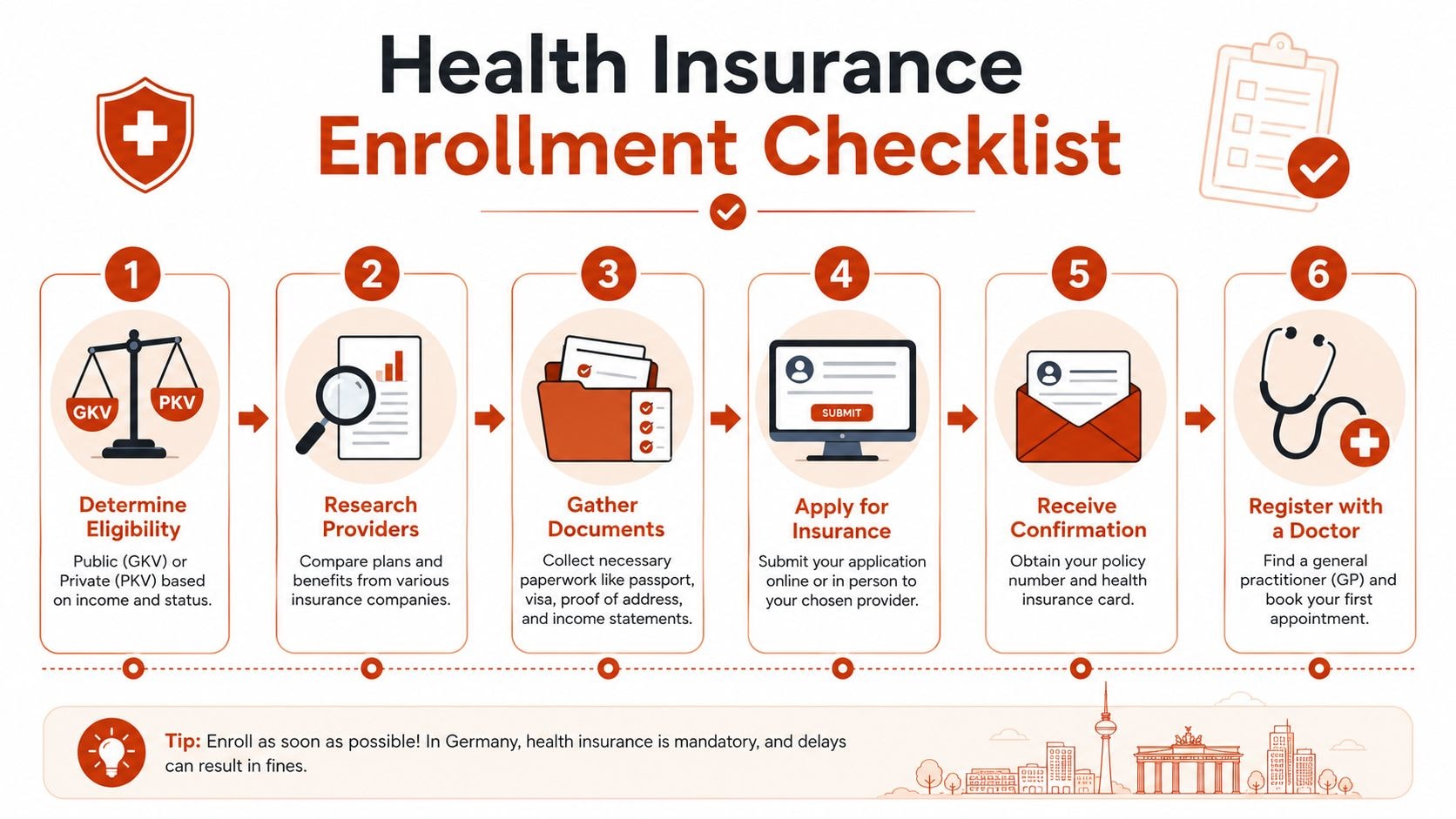
The order matters
For many newcomers, the basics are consistent: choose the right insurance route for your status, prepare the documents the insurer asks for, and make sure your registration, employment, or university paperwork matches what you submit. Public insurer guidance and official student guidance consistently show that enrollment depends on status and supporting documents, including proof tied to work or study, as outlined by BARMER and gesund.bund.de.
That point matters in Berlin because many newcomers try to handle insurance before their address registration or other core paperwork is settled. Then the provider asks for proof of residence or status, the application stalls, and you end up repeating the process.
Bring the process back to basics. If you don't yet have your Meldebescheinigung, treat that as the blocker, not the insurance form itself.
Enrollment checklist
Use this in order:
-
Confirm your category
Employee, student, freelancer, jobseeker, family member, or something less straightforward. -
Finish your Anmeldung-related step
You need the Meldebescheinigung. Without it, many applications can't move cleanly. -
Choose a Krankenkasse or private provider
Don't overcomplicate this stage. For many newcomers in GKV, the first goal is not “perfect optimization.” It's getting correctly enrolled. -
Collect the core documents
Usually this includes:-
Passport
-
Residence proof
-
Proof of employment or income
-
University enrollment papers if you're a student
-
-
Submit the application
Most providers allow online submission. Save every confirmation email and screenshot. -
Watch for the temporary confirmation or card process
Some steps move before the physical card arrives, so don't assume “no card yet” means “no progress.” -
Update your insurer if your status changes
New job, end of studies, freelance switch, marriage, relocation. These changes matter.
What people in Berlin often miss
A few repeat problems come up again and again:
-
Applying too early with incomplete documents
-
Using different address versions across forms
-
Not answering follow-up emails from the insurer
-
Assuming HR or the university already handled everything
-
Ignoring letters because the wording looks official and intimidating
If your paperwork is messy, the fastest improvement is often very basic: put passport, registration document, work or study proof, and every insurer email into one folder before making any call.
Finding Language Support for Calls and Paperwork
Most newcomers don't get stuck on the idea of health insurance. They get stuck when the insurer asks for one missing document, sends a letter in German, or puts them into a phone menu they can't follow.

Public insurer and student guidance makes the paperwork sound straightforward until a follow-up question arrives. In practice, that is where many people stall: one unclear request, one missing attachment, one letter they do not fully understand.
What usually goes wrong on calls
Phone calls are hardest when the issue is small but specific. A few examples:
-
The insurer says they need a different version of your enrollment certificate.
-
You're asked whether you were previously insured abroad.
-
The employer needs proof of membership, but you don't know what document counts.
-
You received a contribution notice and can't tell whether it's informational or urgent.
Translation apps prove insufficient beyond simple sentences. DeepL can help with a sentence. It can't ask a follow-up question when the insurer changes wording mid-call. Furthermore, it can't notice when the problem is not language, but a missing attachment or a mismatched date.
Useful phrases for real situations
If you want to try the first call yourself, keep it simple.
-
“I would like to ask about my application status.”
Ich möchte nach dem Status meines Antrags fragen. -
“Which document is still missing?”
Welches Dokument fehlt noch? -
“Can you send that request by email?”
Können Sie mir das bitte per E-Mail schicken? -
“I am new in Germany and I need help understanding this letter.”
Ich bin neu in Deutschland und brauche Hilfe, diesen Brief zu verstehen.
If you don't understand the answer, don't guess. Ask for the request in writing.
A practical option is to get support for the live call itself. That's especially useful when the issue is urgent, the letter is confusing, or you know you won't catch details fast enough in German. If that's your bottleneck, German phone call help is often the most efficient kind of help because it solves the exact task blocking you.
You can also pair phone help with appointment prep or document organization when the issue at hand is broader than one call. That's often the case when a newcomer in Berlin is juggling Anmeldung papers, university documents, and health insurance requests at the same time.
How to Book a Helper for Health Insurance Tasks
Good practical help should reduce friction, not create more of it. If you're booking support for a health insurance task, the useful version is narrow and concrete: one call, one letter, one clarification, one appointment-prep problem.

What to prepare before booking
Before you ask for help, pull together the exact items connected to the task:
-
The insurer name
TK, AOK, Barmer, or another provider. -
The document or letter causing the problem
A screenshot, PDF, or photo is usually enough for orientation. -
Your question in one sentence
For example: “I need to confirm whether my application is complete.” -
Relevant dates
Employment start, semester start, deadline on the letter. -
Any reference number you already have
This changes the quality of support immediately. Vague requests lead to vague results. A focused request gives the helper something they can act on.
What good support looks like
For a health insurance task, the flow should feel simple:
-
You describe the task clearly.
-
The helper reviews what's needed.
-
The call or prep step happens.
-
You get a plain-language summary of what was learned and what to do next.
That kind of help is especially useful for routine bureaucracy. SettlyGo can help with German insurer calls, understanding routine letters, appointment preparation, document organization, asking what document is missing, and communicating with HR, university offices, or insurers. It is not the same thing as formal insurance advice, insurance brokerage, legal advice, medical advice, tax advice, certified translation, or a GKV/PKV recommendation.
For direct task support, the relevant place to start is health insurance call help in Berlin.
The best help is often small and specific. One resolved call can unblock the entire process.
In Berlin, that matters because newcomers often don't need a big relocation service. They need someone to help with one insurer call, one German letter, or one missing document before a deadline gets worse.
Other Places to Find Health Insurance Help
Not every kind of help fits every situation. Sometimes the fastest route is your employer. Sometimes it's your university. Sometimes you need a local support person because the formal channels are too slow or too hard to work through in German.
Official and public-service sources are useful for understanding the rules, but they do not always solve the practical bottleneck in front of you: one unanswered call, one unclear letter, one document chain that is still incomplete. That is where one-to-one operational support can make the process easier.
Where each option helps most
| Help Source | Best For | Potential Downside |
|---|---|---|
| Employer HR | New employees with standard onboarding questions | Usually limited to basic employment-related cases |
| University international office | Students with enrollment-related insurance issues | Often busy, and support may be general rather than hands-on |
| Public advice center or Beratungsstelle | People who need orientation and local information | Waiting times and language limitations can make urgent issues harder |
| Qualified insurance broker | Comparing plans or understanding private insurance choices | Not the right fit for simple admin tasks like chasing one document |
| Local practical helper | Calls, letters, paperwork prep, language support | Should not replace legal, tax, medical, or certified professional help |
A few direct rules help here.
-
Use HR first if the problem is tied to your employment start or payroll registration.
-
Use your university office if the insurer is asking for student-related proof.
-
Use a broker or qualified insurance professional if you are deciding between insurance models and need formal advice.
-
Use a practical helper if the issue is operational: a phone call, a letter, a translation during an appointment, or organizing the documents needed for the next step.
You don't need the “best” support category in theory. You need the support that matches the task in front of you.
For example, if your landlord still hasn't returned a registration-related document, your insurance issue may be a document chain problem. In that case, practical help with German communication can matter just as much as the insurer call itself. The same is true if you're preparing for a Bürgeramt appointment that affects the rest of your paperwork.
You Don't Have to Do It Alone
Health insurance in Germany feels bigger than it is when you're handling it in a new language, in a new city, with other deadlines hitting at the same time. The paperwork is real. The stress is real too. But it's also normal to need support.
The most useful mindset is this: getting help is not a sign that you've failed at bureaucracy. It's part of doing bureaucracy well. One clear phone call, one translated letter, or one properly prepared appointment can save days of confusion.
If you're still unsure what kind of support is reasonable, it helps to look at how helpers are vetted. Trust matters when someone is helping you handle personal admin tasks.
Use the right level of help for the right problem. Practical helpers are useful for calls, appointment preparation, document organization, German letters, and day-to-day bureaucracy in Berlin. For legal disputes, tax consequences, medical treatment decisions, certified translations, or formal insurance advice, go to a qualified professional.
That line is important. Good support doesn't pretend to be everything. It removes friction from the tasks that are slowing you down right now.
If you want practical support with a German insurer call, a confusing letter, or the documents you need for the next step, book a helper through SettlyGo. It's a straightforward way to get local, human help in Berlin without pretending this process has to be easy on your own.
Need practical help in Berlin?
Book a verified SettlyGo helper for German phone calls, appointments, landlord communication, apartment viewings, and document preparation.