How to Relocate to Germany: A Berlin Newcomer's Roadmap
July 15, 2026 · 19 min read
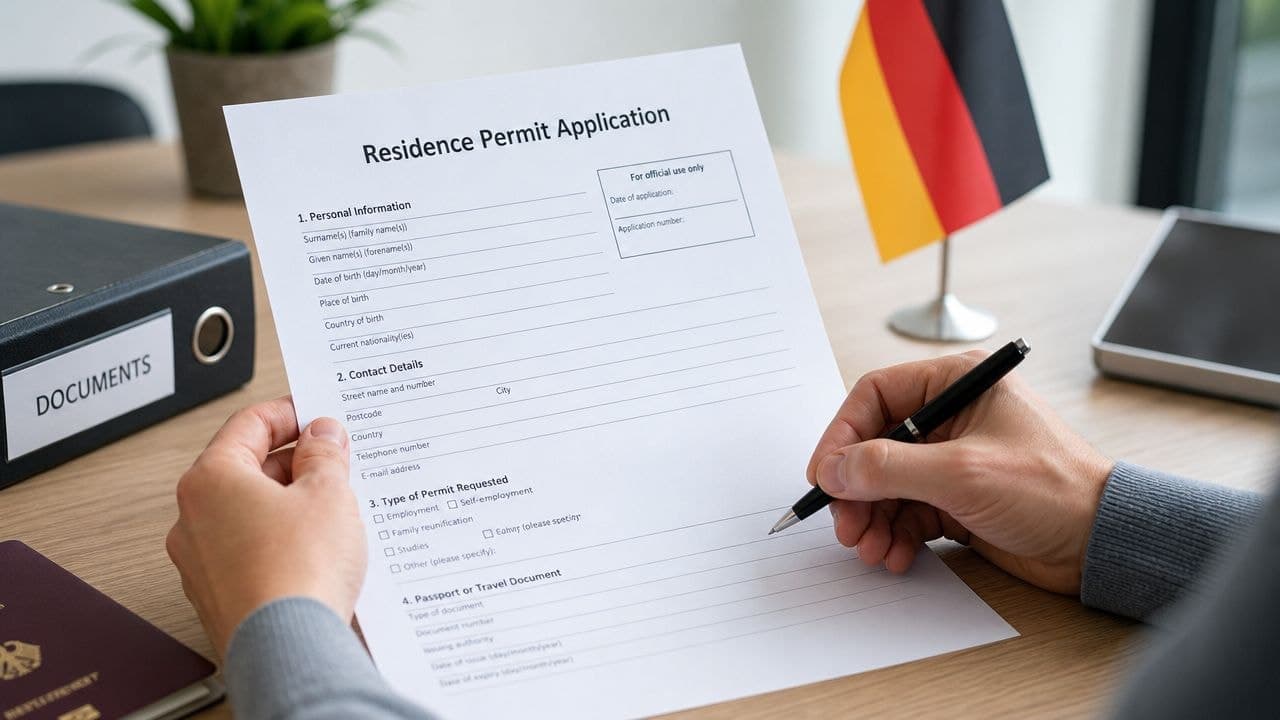
You've probably already opened ten tabs.
One tab has visa rules. Another has a Berlin apartment listing that looks suspiciously good. A third explains Anmeldung in German legal language. Your inbox has a message from an employer, a landlord, or a university, and you're trying to work out what needs to happen before you fly, what must happen after you land, and what can wait.
That's the hard part of relocating to Germany. It's not usually one giant problem. It's a chain of smaller ones, each depending on the last. If one step slips, the next one gets harder.
This roadmap is built for that exact moment. It's practical, Berlin-aware, and focused on what helps when you're stressed, short on time, and dealing with paperwork in a language you may not fully speak yet. If you're trying to figure out how to relocate to Germany without getting buried in bureaucracy, start here.
Your Relocation Roadmap Starts Here
A typical Berlin move looks neat on paper. Get a visa. Find a place. Register your address. Open a bank account. Start work or study. Apply for your residence permit. In real life, it rarely feels neat.
A more honest version looks like this. You land with two suitcases, temporary housing, a folder full of documents, and one question repeating in your head: what if I miss something important? That fear is reasonable. German bureaucracy often expects you to know the sequence before anyone explains it to you.
The good news is that the process becomes manageable once you stop treating it like one giant project and start treating it like phases. Before you leave home, your job is preparation. In your first days in Germany, your job is timing. After that, it becomes a matter of document flow, appointments, and staying organized.
Practical rule: Don't optimize for perfection. Optimize for a clean sequence. The right paper at the right time matters more than trying to solve everything at once.
Berlin adds its own pressure. Appointments can be hard to get. Housing is competitive. Offices may communicate in German even when the forms exist in English. That doesn't mean you need to panic. It means you need a plan that matches local reality.
The sections below follow the order that usually works best for newcomers:
-
Before departure so you don't arrive already behind.
-
Your first 14 days so you handle the one deadline that can block everything else.
-
Bank, insurance, and tax setup so daily life starts to function.
-
Residence permit steps if you're a non-EU newcomer.
-
Longer-term housing once you can present yourself properly to landlords.
-
Integration so Germany starts to feel like your life, not just your admin project.
If you're moving with a partner, children, or a job offer, the details change. The core order usually doesn't.
Phase 1 Planning Before You Leave Home
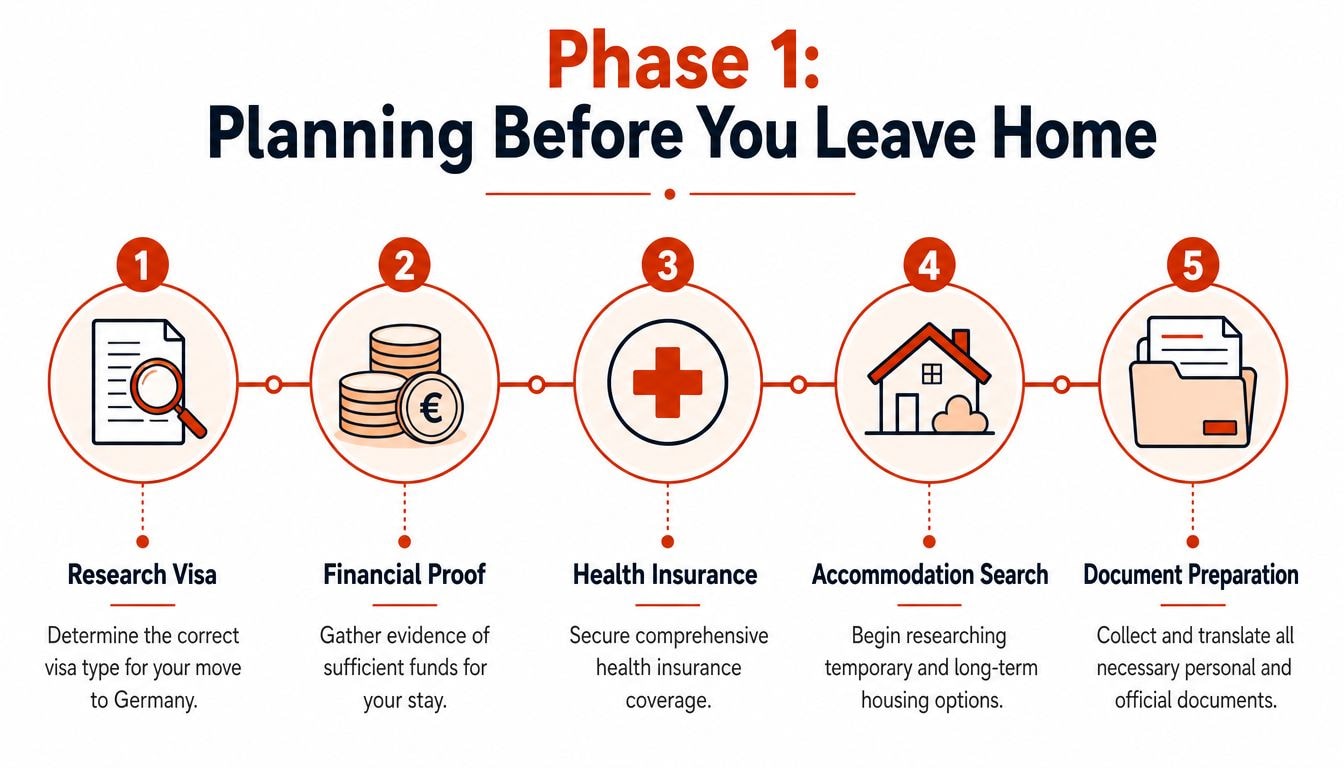
The smoothest relocations start before the flight is booked. If you want a practical answer to how to relocate to Germany, start with three things: immigration path, documents, and money flow.
Start with your immigration path
Don't guess your visa type. Check the official German embassy or consulate information for your country and match your purpose of stay to the correct route. Skilled worker, student, family reunion, job seeker, and Blue Card cases don't use the same paperwork.
Your later steps in Germany often depend on what you entered with. If the original visa category is wrong, fixing it later is much harder than getting it right at the start.
A useful working method is to make a one-page summary for yourself with:
-
Your visa category and the exact name used by the authority
-
Your purpose of stay such as employment, study, or family reunion
-
Your key documents including anything tied to your job offer or university admission
-
Your next appointment after arrival so you know what the first in-Germany deadline will trigger
Build a document system before you pack
Most newcomers don't struggle because they have no documents. They struggle because the documents are scattered across email threads, cloud folders, old phones, and paper envelopes.
Create one master folder with subfolders for passport, housing, employment or study, insurance, financial records, and civil documents. Keep digital scans on your phone and in secure cloud storage. Carry paper originals in your hand luggage.
Focus on documents that are commonly requested in multiple places:
-
Passport
-
Birth certificate
-
University diplomas or qualifications
-
Employment contract or university admission
-
Rental contract or temporary accommodation confirmation
-
Insurance paperwork
-
Passport photos
If a document isn't in German or English, don't rely on machine translation for official use. When a formal translation is required, use a qualified certified or sworn translator. An app can help you understand a message. It cannot replace a formally accepted translation.
Bring both paper and digital versions. A Berlin office might ask for a printed document even when you already emailed it.
Prepare cash flow, not just savings
People often budget for the obvious things and forget the timing problem. You may need to pay for temporary accommodation, a transport pass, setup costs, and housing-related payments before everything else is running smoothly.
You also need to plan around Berlin's appointment bottlenecks. Berlin appointment availability can be tight, so it is smart to check early, keep your documents ready, and stay flexible about location.
That one detail changes how you should prepare. Don't just ask, “Can I afford Berlin?” Ask, “Can I afford a messy first month if housing and appointments don't line up neatly?”
A simple pre-departure checklist helps:
| Task | Why it matters |
|---|---|
| Confirm visa route | Prevents starting Germany paperwork on the wrong footing |
| Scan and sort documents | Saves time during appointments and applications |
| Set aside arrival funds | Covers temporary housing and setup costs |
| Research health insurance path | Often needed early for work, study, or permit steps |
| Start housing research | Helps you understand what kind of landlord documents you'll need |
Phase 2 Your Critical First 14 Days in Germany
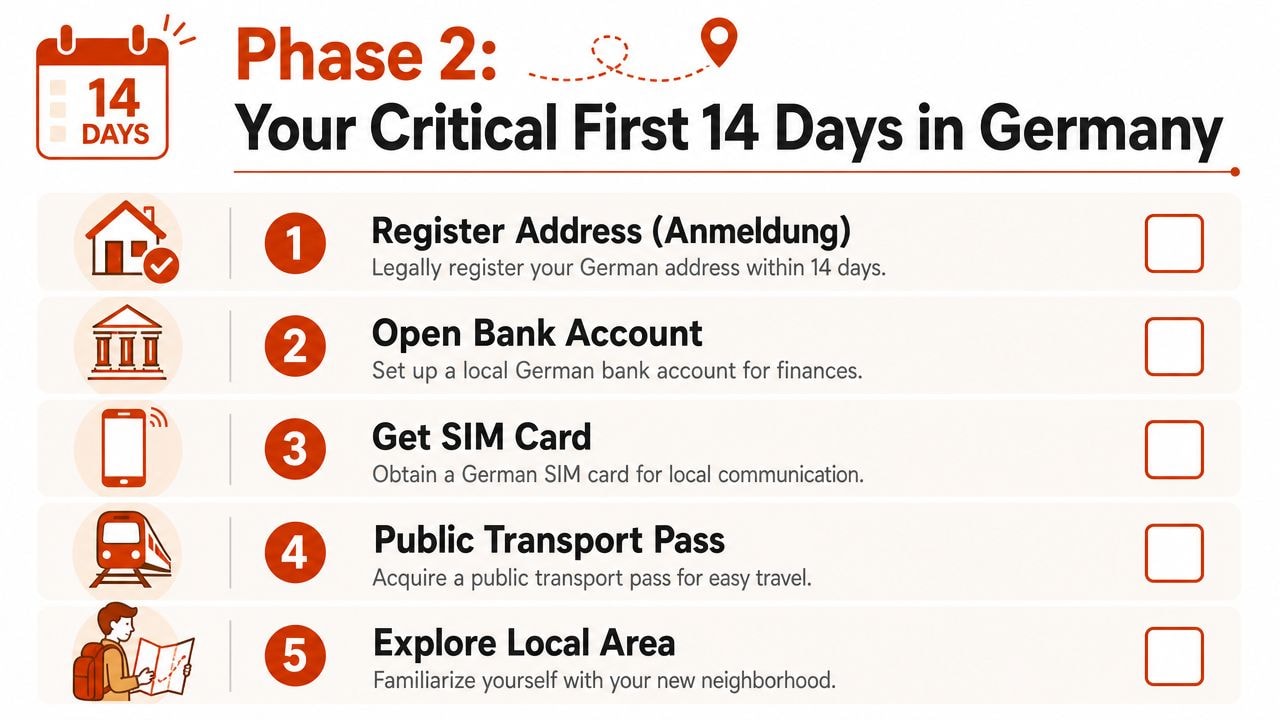
Once you move into a residence in Germany, the clock starts. This is the phase that causes the most panic because the deadline is short, the paperwork is specific, and Berlin appointments can be difficult to secure.
Treat Anmeldung as your first real deadline
Anmeldung is the registration of your residential address at the local Bürgeramt. This is not a nice-to-have task. It is a legal requirement.
Berlin's official service page confirms that registration is generally required within 14 days after moving in. It also confirms the standard appointment logic and document requirements that trip up many newcomers, which is why this step matters so much early on: Berlin.de address registration service.
That registration certificate is the document that enables a lot of daily life. Without it, you can run into problems with tax registration, banking, utilities, and later residence steps.
If you've just arrived in Berlin, keep one principle in mind: after housing, Anmeldung is the first domino.
What to bring to the Bürgeramt
People frequently lose time when they have an appointment, show up, and then they're missing one key paper.
For first-time address registration, the required set commonly includes:
-
Your passport or other accepted identification
-
The completed registration form
-
The landlord confirmation letter called Wohnungsgeberbestätigung
The official Berlin.de address registration service makes four points worth treating as non-negotiable:
-
Registration is generally required within 14 days after moving in
-
Identification is required
-
Wohnungsgeberbestätigung is required
-
A rental contract does not replace the Wohnungsgeberbestätigung
If your landlord or subletter hasn't given you the Wohnungsgeberbestätigung, treat that as urgent. Without it, the appointment can fail even if every other document is ready.
How to handle Berlin appointment scarcity
This is the part generic relocation guides often gloss over. They say “register your address within 14 days” as if you can just pick a slot tomorrow.
Berlin doesn't always work like that. Appointment availability can be tight, so the practical move is to prepare before the slot appears. The official Berlin.de address registration service is the right place to check the current process, required documents, and booking route.
What tends to work better in practice:
-
Start checking immediately after you have a place where you can register.
-
Keep your documents ready before the appointment appears because available slots may be short notice.
-
Print everything even if you also have it on your phone.
-
Stay flexible on location if Berlin offers appointments in different district offices.
What usually doesn't work:
-
Waiting until you feel settled
-
Assuming your landlord will proactively give you every required document
-
Showing up with partial paperwork and hoping the clerk will accept it
-
Treating a temporary accommodation address as automatically registrable without checking the housing documents
If you miss the deadline or fail the appointment, the stress multiplies. The issue isn't only the rule itself. It's the chain reaction that follows when your registration certificate is delayed.
Phase 3 The Bureaucracy Trinity Bank Health Insurance and Tax ID
Once your address is registered, the next stage becomes more functional. You move from “am I allowed to do this?” to “how do I make daily life work?” In Germany, that usually means three linked tasks: bank account, health insurance, and tax ID.
Why these three tasks are linked
Your tax ID is normally issued after registration and sent by post. Keep that letter. It's one of those documents that seems boring until an employer, payroll department, or another office suddenly needs it.
Health insurance sits in the middle of everything. Employers, residence processes, and medical access all intersect with it. Bank accounts matter because they make rent, salaries, phone bills, and insurance payments easier to manage.
The important practical point is sequence. If your address registration is incomplete or delayed, the rest often becomes slower or more awkward.
Here's a simple decision view:
| Task | What usually unlocks it | Common friction point |
|---|---|---|
| Tax ID | Address registration | Waiting for the letter and keeping it safe |
| Health insurance | Employment, study, or residence needs | Understanding options and paperwork |
| Bank account | Passport and local setup documents | Matching the bank's onboarding requirements |
Public and private health insurance at a glance
Germany's health insurance system isn't something you should choose casually. It affects costs, access, and future flexibility. For formal advice on eligibility or long-term implications, use a qualified insurance professional. For understanding letters, phone calls, and practical setup, a local helper can still be very useful.
Public and private health insurance at a glance
| Feature | Public (GKV) | Private (PKV) |
|---|---|---|
| Typical fit | Often the standard route for many employees and students | Often considered in specific income or professional situations |
| How it feels in practice | More standardized and familiar to many newcomers | More individualized and often more paperwork-sensitive |
| Main challenge | Comparing providers and completing enrollment cleanly | Understanding long-term consequences before choosing |
| Best approach | Clarify enrollment steps and required documents early | Get professional advice before committing |
If you're below or above a threshold, or unsure which system you can join, don't rely on hearsay from forums. Rules are case-specific and can have long consequences.
What works and what usually slows people down
Bank setup is often easiest when you decide early whether you need a branch-based bank or an online-first bank. If your employer, landlord, or your own comfort level pushes you toward in-person service, traditional banks can feel more stable. If speed and app-based onboarding matter most, online options can be simpler.
Health insurance is where language friction bites hardest. The problem usually isn't the concept. It's the phone call, the terminology, and the follow-up letter in German that you're suddenly expected to understand.
A calm way to handle this phase is:
-
Keep one folder for all letters from banks, insurers, and tax offices
-
Write down every customer number as soon as you receive it
-
Ask for confirmations in writing when possible
-
Don't ignore post just because it looks formal or dull
A lot of newcomer stress in Germany comes from unread letters, not just difficult appointments.
If you're trying to get practical help with insurance-related calls or understanding what a Krankenkasse is asking for, health insurance call help in Berlin can save time and prevent misunderstandings.
Phase 4 Securing Your Stay with a Residence Permit
You've landed in Berlin, handled the first registrations, and started to breathe again. Then the residence permit becomes the deadline that sits in the background of everything. For non-EU citizens, this is the stage that turns a legal entry into a legal stay.
In Berlin, the office is usually called the LEA or Ausländerbehörde. Your exact permit depends on your reason for staying: work, study, family reunion, freelancing, or an EU Blue Card. The category matters because each one has its own document list, forms, and review standard. A lot of delays happen because applicants bring a generally good file instead of the exact file their permit type requires.
What the residence permit appointment usually involves
The appointment is usually straightforward if your paperwork matches your situation. If it does not, Berlin can make a simple issue drag on for weeks.
Expect the officer to check identity, address, health insurance, and the legal basis for your stay. Depending on the permit, you may also give biometric data, pay a fee, and answer a few factual questions about your job, studies, or family situation. The official LEA pages set out the permit categories, required documents, and booking process for Berlin, and they are the first place to verify your checklist before you show up: Berlin LEA residence permit information.
Commonly requested documents include:
-
Passport
-
Current visa, if applicable
-
Anmeldung certificate
-
Proof of health insurance
-
Biometric photo
-
Employment contract, university documents, or family documents, depending on permit type
-
Completed application forms
-
Proof of income or financial means, if your permit category requires it
One detail people underestimate is consistency. Your address should match across your Anmeldung, employer letter, and application form. Your contract should reflect the actual job title and salary being used for the permit. If your insurer issued a temporary confirmation, check that it is still valid on the day of the appointment.
That is where DIY versus paid help becomes a real decision. If your case is routine and your documents are clear, you can often prepare this yourself by following the LEA checklist line by line. If the paperwork is mostly correct but you need help booking, organizing, or understanding what the officer asked for, a residence permit appointment helper in Berlin can save time and reduce avoidable mistakes. That kind of support helps with logistics and language. It does not replace legal advice.
Blue Card basics for skilled workers
The EU Blue Card is one of the cleaner residence permit paths for skilled non-EU employees, but only if the details line up properly.
For 2026, Make it in Germany's EU Blue Card guide lists the regular EU Blue Card salary threshold as €50,700 gross per year. A lower threshold of €45,934.20 gross per year can apply to shortage occupations, young professionals, and certain IT cases, depending on the route and approval requirements. Because these numbers are updated annually, always check the official Make it in Germany EU Blue Card page before relying on a threshold.
In practice, the salary figure is only one part of the review. I've seen applicants focus on hitting the threshold and miss the more Berlin-specific friction points: a degree that still needs recognition, a contract that uses unclear job wording, or supporting documents that were uploaded in the wrong format. Blue Card cases are often good DIY cases if your employer is experienced with international hires. They become much harder if your degree status is unclear or your role sits on the edge of the eligibility rules.
Later in the process, it helps to know what the appointment environment can feel like. This short overview gives a realistic visual sense of the residence permit setting:
Video walkthrough: watch it on YouTube.
When a helper is enough and when you need a lawyer
Use a helper for administrative friction.
That includes tasks like organizing your file, helping you understand routine German communication, taking notes, preparing questions, and following up after appointments. For many newcomers in Berlin, that is enough. The case is legally simple. The hard part is the language, timing, and document handling.
Use a lawyer when the problem is legal, not administrative.
That usually means:
-
A rejection or threatened rejection
-
An overstay or missed immigration deadline
-
A status gap between visa expiry and permit approval
-
A case involving exceptions, discretion, or conflicting advice
-
A need for formal legal representation or written legal analysis
A simple rule helps here. If your question is, “What exactly do I need to submit, and what happened in the appointment?”, a helper is often enough. If your question is, “Do I still have the right to stay, work, or appeal?”, get an immigration lawyer or another certified professional involved fast.
Phase 5 Finding a Home in Berlin
Most newcomers arrive thinking housing is one task. In Berlin, it's usually an ongoing campaign. You search, apply, follow up, attend viewings, send documents, and repeat.
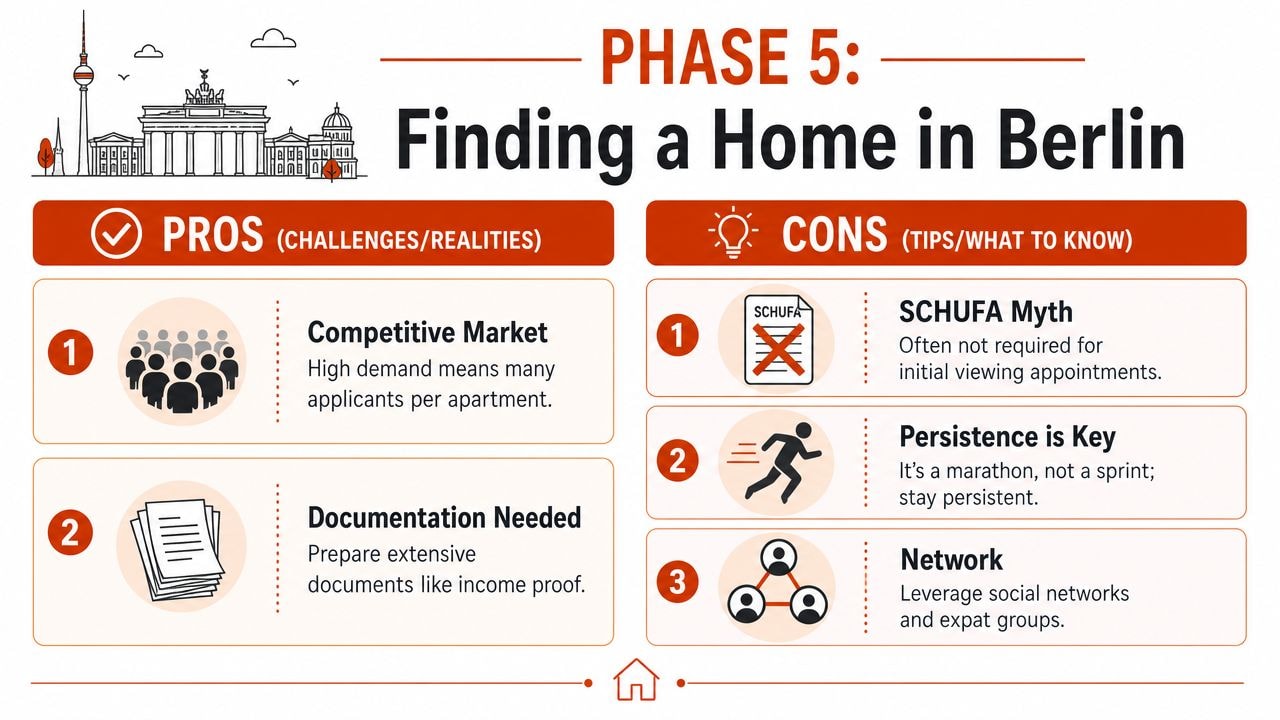
The biggest mindset shift is this: you are not only looking for an apartment. You are presenting yourself as a reliable tenant in a crowded market.
The SCHUFA problem is real but not fatal
Newcomers often hear one discouraging sentence: “Without SCHUFA, you won't get a flat.” That's too simplistic.
Many newcomers do not have a German SCHUFA report yet. That does not make a rental application impossible, but it does mean you need to reduce uncertainty in other ways: proof of income, an employer letter, bank statements, a short introduction, and previous landlord confirmation if available.
The practical takeaway isn't that SCHUFA is irrelevant. It's that, as a newcomer, you often need a SCHUFA-ersatz package instead.
What to include in a newcomer rental application
A strong newcomer file usually looks more convincing than a thin file plus an apology.
Useful substitutes can include:
-
Employment contract
-
Recent bank statements showing income or funds
-
Employer letter
-
Passport copy
-
Short self-introduction
-
Previous landlord confirmation, if you can get one
The goal is simple. If you can't show German credit history yet, show reliability another way.
A compact comparison helps:
| Landlord expectation | Newcomer alternative |
|---|---|
| SCHUFA report | Proof of income and employer letter |
| German rental history | Letter from previous landlord |
| Quick communication | Clear, polite message and complete file |
| Confidence at viewing | Prepared questions and prompt follow-up |
What helps at apartment viewings
Apartment viewings in Berlin can move fast. You may have only a few minutes to understand the apartment, make a decent impression, and work out whether the listing is real, practical, and affordable for your situation.
What helps:
-
Arrive with your documents ready, not later
-
Ask clear questions about rent structure, move-in timing, and what happens next
-
Follow up quickly after the viewing
-
Watch for scam behavior, especially pressure to pay before a proper process
What doesn't help:
-
Sending incomplete applications
-
Waiting days to reply
-
Assuming the contract terms will be explained in English
-
Paying money before you've verified the apartment and the process properly
If you want on-site support during viewings, apartment viewing support in Berlin can help with communication, practical questions, and understanding next steps. For ongoing back-and-forth with owners or agents after the viewing, landlord communication help in Berlin is often the more useful option.
Phase 6 Beyond Bureaucracy Your New Life in Germany
At some point, the move stops being a paperwork project and starts becoming your actual life. That shift matters. If you only think about Germany as a chain of appointments, you'll stay in survival mode longer than you need to.
Build daily confidence in German life
You don't need perfect German to start building confidence. You do need enough routine to reduce friction. Learn the phrases that help in your real day-to-day life first: pharmacy visits, package pickup, bakery orders, train questions, landlord messages, and school or daycare communication if you have children.
Berlin lets many newcomers function in English for a while. It's still worth learning German early. Even basic German changes how official letters feel. Instead of dreading every envelope, you start recognizing the structure, the keywords, and what needs action.
A practical place to look is the local Volkshochschule, which often offers affordable language courses. The best class is the one you'll attend regularly.
Create a support system early
People who settle well usually don't do everything alone. They build a small support structure around themselves.
That might include:
-
A language class
-
One or two reliable local contacts
-
A neighborhood WhatsApp or community group
-
A sports club, meetup, or hobby group
-
A simple admin routine for filing letters and tracking appointments
Germany gets easier when you stop treating every new task as a test and start treating it as a routine.
If a letter from the Ausländerbehörde lands in your mailbox, a landlord sends a German message you don't understand, or you need help preparing for an office appointment, getting practical support early is often much easier than trying to fix a misunderstanding later.
You've already handled the hardest part. You made the move. The rest is usually less about courage and more about having the right help at the right moment.
If you need calm, practical newcomer support in Berlin, book a SettlyGo helper. SettlyGo is useful for German phone calls, appointment preparation, document organization, landlord communication, apartment viewing support, and understanding routine official letters. SettlyGo does not provide legal advice, immigration strategy, visa or residence-permit eligibility advice, tenancy-law advice, tax advice, insurance brokerage, medical guidance, certified translation, sworn interpretation, or official representation.
Need practical help in Berlin?
Book a verified SettlyGo helper for German phone calls, appointments, landlord communication, apartment viewings, and document preparation.