Integration Support Services: Berlin Newcomer Guide 2026
July 17, 2026 · 11 min read

You open your mailbox, or your email, and see a letter from the Bürgeramt, Ausländerbehörde, your landlord, or a health insurer. It's in dense German. The subject line sounds urgent. There's a date in the middle, maybe a request for documents, maybe a warning that something is missing.
That's the moment many newcomers first meet the vague phrase integration support services.
In practice, residents in Berlin don't need a grand theory of integration. They need help with one concrete problem. Understanding a letter. Preparing for an appointment. Calling a landlord. Checking whether the paperwork is complete before taking half a day off work and standing in line.
In this guide, "integration support services" means practical, private help with everyday administration and communication. It does not mean an official government integration course, public social service, immigration consultancy, or legal-advice service.
That Official Letter Arrived What Now
A lot of people freeze at this point. They translate a few lines in DeepL, understand half of it, and then get stuck on the important part. Is this just information, or a deadline? Do you need to reply by email, upload documents somewhere, or appear in person?
If you've missed a call, delayed opening a letter, or postponed booking an appointment because the process felt unclear, you're in very familiar company.
Why this feels bigger than one letter
One official letter rarely comes alone. It usually connects to another task.
A landlord message can lead to a document request. A Bürgeramt appointment can fail because one original paper is missing. A health insurance question can turn into a phone call where the other side speaks quickly and assumes you already know the system.
Practical rule: Don't try to solve the whole German system in one evening. Solve the next task.
That's where people get confused by the term integration support services. It sounds abstract, almost institutional. But at street level in Berlin, support often means something much simpler. Someone helps you understand routine wording, identify visible deadlines or document requests, and prepare questions, without giving legal, immigration, tax, insurance, or medical advice.
What support usually means in real life
For newcomers, support often looks like this:
-
Letter help: Understanding whether the message is informative, urgent, or asking for action.
-
Appointment preparation: Checking forms, IDs, confirmations, and originals before you leave home.
-
Communication help: Making or joining a German phone call to clarify what the office, insurer, or landlord needs.
-
Task organization: Turning one stressful pile of papers into a short checklist.
That's the difference between feeling lost and knowing your next move.
Decoding Integration Support Services
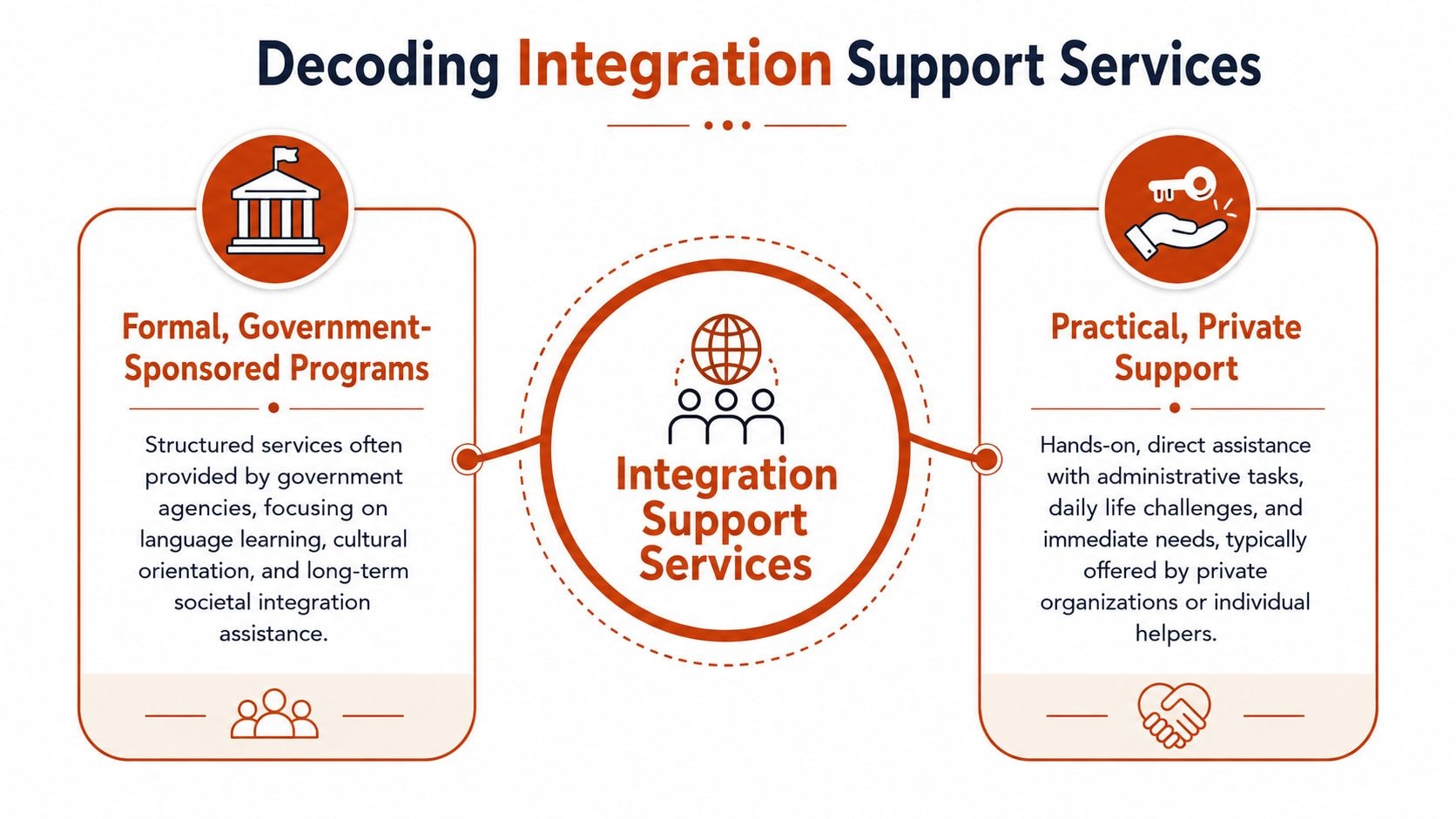
The phrase integration support services gets used for very different things. In Germany, it can refer to formal public programs. It can also mean practical, on-demand help with everyday bureaucracy. If you mix those up, it's easy to look for the wrong kind of support.
Two very different meanings
The formal meaning is the government program many people know as the Integrationskurs. Formal integration support can include the government-supported Integrationskurs. BAMF explains that integration courses combine German-language learning with orientation about life, history, culture, and the legal system in Germany. Course length and format can vary, including general, intensive, literacy, youth, and other specialised courses. That's long-term support. It helps people build language ability and understand life in Germany over time.
That kind of support matters. It gives structure, routine, and a foundation for daily life.
But it doesn't always help when your Bürgeramt appointment is on Tuesday, your landlord wants a reply today, or your health insurer is waiting for a document you can't identify.
Which kind of help fits your situation
A simple way to separate the two:
| Type of support | What it's for | Best moment to use it |
|---|---|---|
| Formal government support | Language learning and long-term orientation | When you're settling in and building your base |
| Practical private support | Immediate tasks and communication help | When one specific bureaucratic task is blocking you |
The confusion usually happens because both kinds of help use the word “integration,” but they solve different problems.
Some support teaches you the system. Other support helps you get through tomorrow's appointment.
If you're struggling with one urgent task, you probably don't need a course first. You need a helper who can work with your real documents, your deadline, and your exact question.
That might mean:
-
checking whether a letter asks for originals or copies,
-
preparing the right set of documents for an office visit,
-
helping with a German phone call,
-
or explaining what happened after an appointment so you know your next step.
This practical version is often the missing middle. It's not legal advice. It's not a full relocation package. It's the hands-on help people need between “I moved to Berlin” and “I fully understand German bureaucracy.”
What Practical Support in Berlin Looks Like
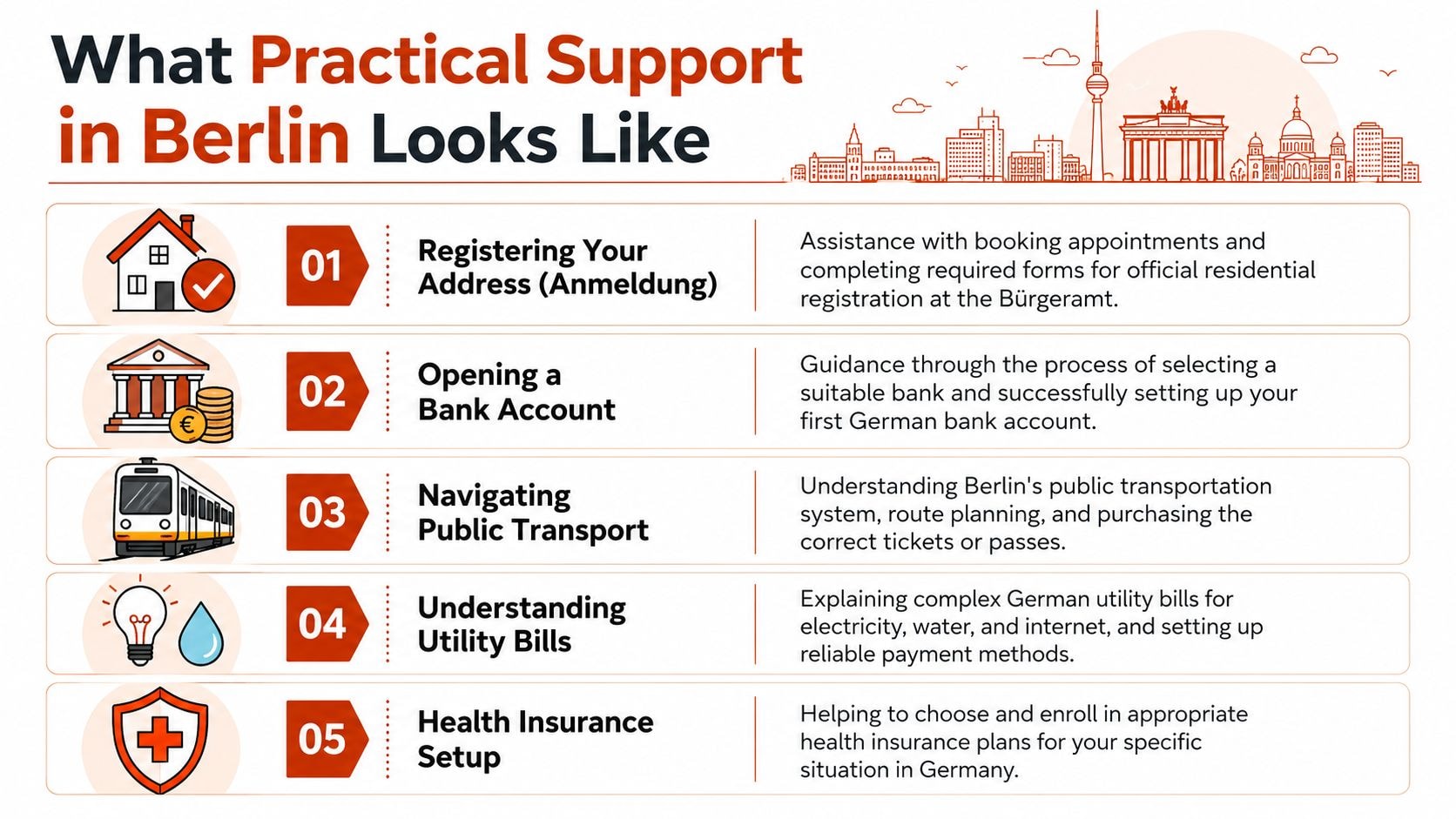
Practical help is easiest to understand through ordinary Berlin problems. Not dramatic ones. Just the annoying, time-sensitive tasks that can derail a week.
Three common Berlin situations
First, the Anmeldung problem.
You finally get a Bürgeramt appointment. Then you realize you're not fully sure what to bring. For Anmeldung in Berlin, Berlin.de states that residents generally need to register within 14 days after moving in. For an in-person appointment, identification, the completed registration form, and a Wohnungsgeberbestätigung are normally required. A rental contract does not replace the Wohnungsgeberbestätigung. A practical helper can go through the pile with you before the appointment, so you're not checking documents in the U-Bahn five minutes before arrival.
You get a message from a Krankenkasse, internet provider, or landlord asking you to call back. You can read some German, but phone German is different. People speak fast, interrupt, and refer to earlier letters you may not have. In that moment, the task isn't “improve your language skills.” The task is “clarify what they need and what happens next.”
Second, the German phone call.
Third, apartment communication.
At a viewing, a landlord or agent may explain the next steps quickly. They might mention additional paperwork, a deposit process, or a follow-up message. If you miss one sentence, you can leave without knowing what to send or by when.
A good helper doesn't make the bureaucracy disappear. They make the next action clear.
A quick task list
Practical support in Berlin often includes:
-
Appointment prep: Checking forms, originals, IDs, and supporting papers before a Bürgeramt or insurer visit.
-
Practical communication support: helping during routine phone calls or appointments, taking notes, preparing questions, and helping you follow what is being discussed.
-
Landlord communication: Clarifying questions after a viewing or responding to routine messages.
-
Document organization: Grouping papers by task, so your Anmeldung documents don't get mixed with insurance or residence documents.
-
Routine bureaucracy help: Support for non-legal tasks that need calm coordination rather than specialist advice.
If you need hands-on help for one of these everyday tasks, a practical Berlin support service is often the most useful format because it focuses on the actual obstacle in front of you.
The Important Boundaries What a Helper Does Not Do
Clear boundaries make support safer, not weaker. If someone claims they can handle everything, that's usually the moment to get careful.
Useful support is practical support
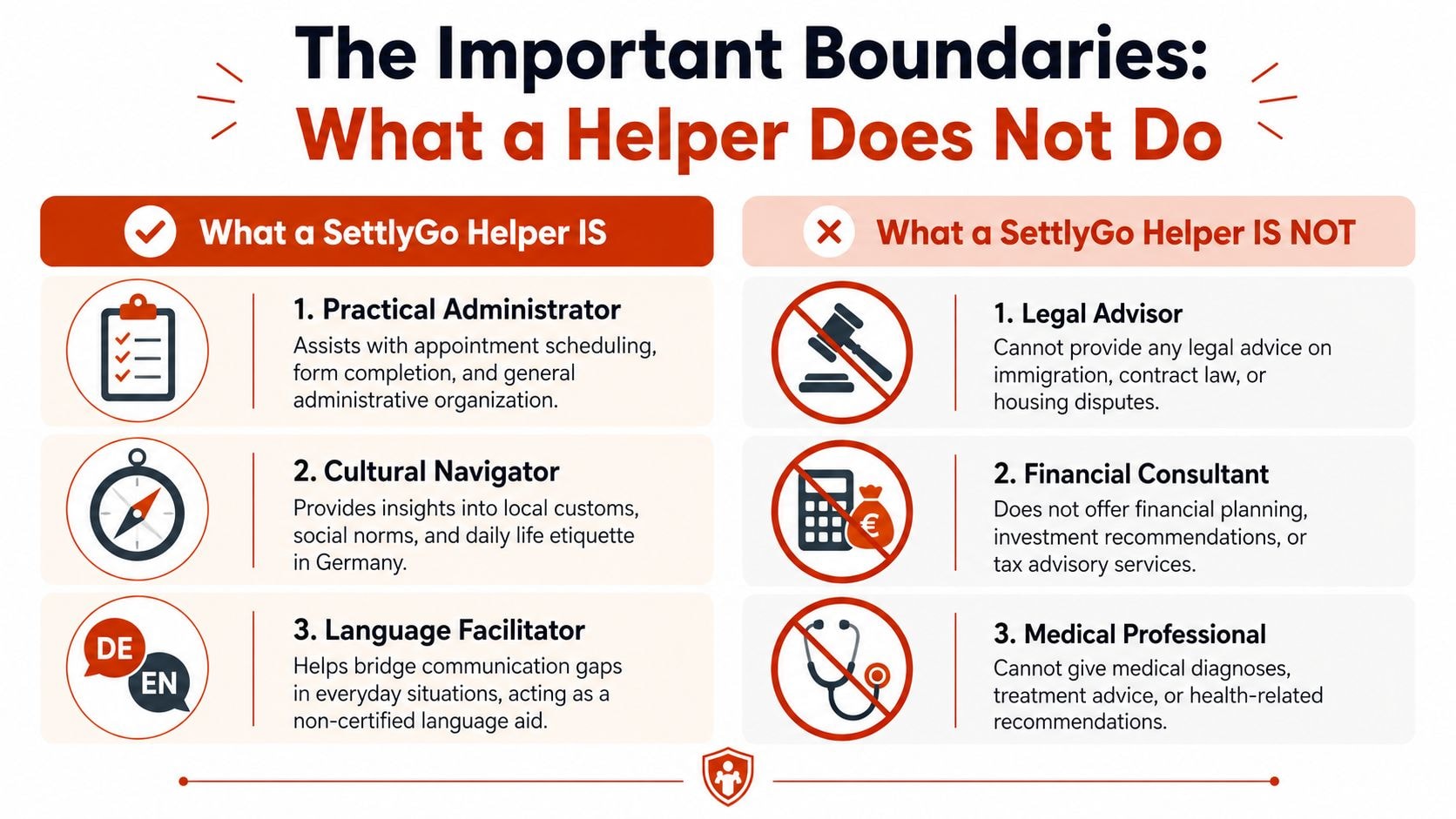
A practical helper can assist with organization, language facilitation in everyday settings, appointment preparation, and routine communication. They can help you understand what a letter appears to request, prepare questions for a phone call, or make sure your papers are in order for a standard appointment.
They are not a law firm, immigration consultant, tax advisor, insurance broker, doctor, or certified sworn translator.
That matters because many newcomer tasks sit right on the edge between “practical” and “professional.” A helper can support you in attending a residence-related appointment. A helper should not tell you which legal strategy to choose for your permit. A helper can help you understand a landlord email. A helper should not give legal advice about a housing dispute.
When you need a qualified professional
Use a qualified professional if your task involves:
-
Legal interpretation: Contract disputes, eviction issues, residence law questions, or anything where legal consequences depend on exact wording.
-
Tax matters: Tax returns, self-employment classification, deductible expenses, or formal tax planning.
-
Medical decisions: Diagnosis, treatment, insurance coverage disputes involving medical judgment.
-
Certified translations: Documents that an authority or court requires in officially certified or sworn form.
A practical service should say this openly. If it doesn't, that's a warning sign.
For a plain-language overview of these limits, the SettlyGo boundaries page is useful because it separates everyday administrative help from work that belongs to licensed or certified professionals.
Comparing Your Support Options in Berlin
Berlin newcomers usually rely on one of three support paths. A relocation agency. A flexible helper service. Or a friend who's been here longer.
Each option can be useful. The right one depends on your budget, your urgency, and how specific the task is.
A simple comparison
| Support Type | Typical Cost | Best For | Key Limitation |
|---|---|---|---|
| Relocation agency | Higher package pricing | Full-service moves, employer-sponsored relocations, multi-step settling-in support | Often more than you need for one phone call, one letter, or one appointment |
| Flexible practical support | Task-based practical support | Specific bureaucracy tasks like appointment prep, calls, landlord communication, and document checks | Not a substitute for legal, tax, medical, or certified translation professionals |
| Friend or colleague | Usually informal help | Quick opinions, basic orientation, emotional support | Availability varies, knowledge may be outdated, and the responsibility can become uncomfortable |
A relocation agency can be excellent if your employer is paying and you want broad support across housing, registration, and early logistics. But many independent newcomers don't need a full package. They need one or two difficult tasks solved this week.
A friend can also help, especially in the first days. Still, informal help has limits. Your friend may not know the latest office process. They may misunderstand formal wording or rely on outdated information. They may also be busy when your appointment is tomorrow morning.
The middle option is often the most practical. It gives you targeted help without pretending to replace specialists.
The best support is the one that matches the size of the problem.
If your issue is narrow, choose narrow help. If the task becomes legal or formally regulated, move to a qualified professional quickly.
Your Checklist for Booking Practical Help
When people feel overwhelmed, they often ask for help too broadly. “I need help with Germany” is understandable, but hard to act on. It's easier to get useful support when you narrow the task.
Five calm steps
-
Name the exact problem.
Not “bureaucracy.” Instead, “I got a letter from my health insurer and don't know what they want,” or “I have an Anmeldung appointment and want a document check.” -
Collect everything for that one task.
Put the letter, your passport, confirmation emails, forms, and any related messages in one folder. If it's digital, make one simple file set. If it's paper, put it in one envelope. -
Write down your goal in one sentence.
For example: “I want to know what this letter asks me to send.” Or, “I want to be ready for my Bürgeramt appointment without missing a document.” -
Choose the type of support you need.
Is it a phone call, appointment prep, landlord communication, in-person language help, or general document organization? -
Book before the deadline gets too close.
Last-minute help is possible sometimes, but it's always calmer when there's space to review papers and prepare questions.
Before you book
Use this short pre-booking checklist:
-
Task clarity: Do you know the one thing you want solved first?
-
Documents ready: Have you gathered the letter, ID, forms, and screenshots?
-
Language need: Do you need help in English plus German, or another language too?
-
Boundary check: Is this a practical admin task, or do you need a lawyer, tax advisor, doctor, or certified translator?
-
Timing: Is there an appointment date or reply deadline?
For broader settling-in planning, the first 30 days in Berlin checklist can help you see where one blocked task fits into the bigger picture.
If you're ready to turn one stressful task into a clear plan, that's usually the right time to book support.
If you need practical, non-legal help with a German phone call, appointment preparation, landlord communication, or organizing documents for a routine Berlin bureaucracy task, book a SettlyGo helper. SettlyGo can help with practical communication, document organization, appointment preparation, and routine administrative tasks. SettlyGo does not provide legal advice, immigration advice, tax advice, insurance brokerage, medical guidance, certified translation, sworn interpretation, application filing, social-work services, government services, or official representation.
Need practical help in Berlin?
Book a verified SettlyGo helper for German phone calls, appointments, landlord communication, apartment viewings, and document preparation.