A Guide to Long Term Apartment Rental in Berlin for 2026
July 4, 2026 · 16 min read

You've found a listing that looks promising. The photos seem normal, the rent isn't absurd, and the location is close enough to an S-Bahn line that your commute could work. Then the stress starts. The ad is in German, the reply needs to be fast, the landlord asks for documents you've never heard of, and the viewing slot is tomorrow at 11:30.
That's what long term apartment rental in Berlin usually feels like from the ground. Not impossible, but very procedural. The people who do best usually aren't the luckiest. They're the ones who understand how Berlin landlords think, arrive prepared, and avoid wasting time on flats that won't help them settle properly.
Understanding the Berlin Rental Market
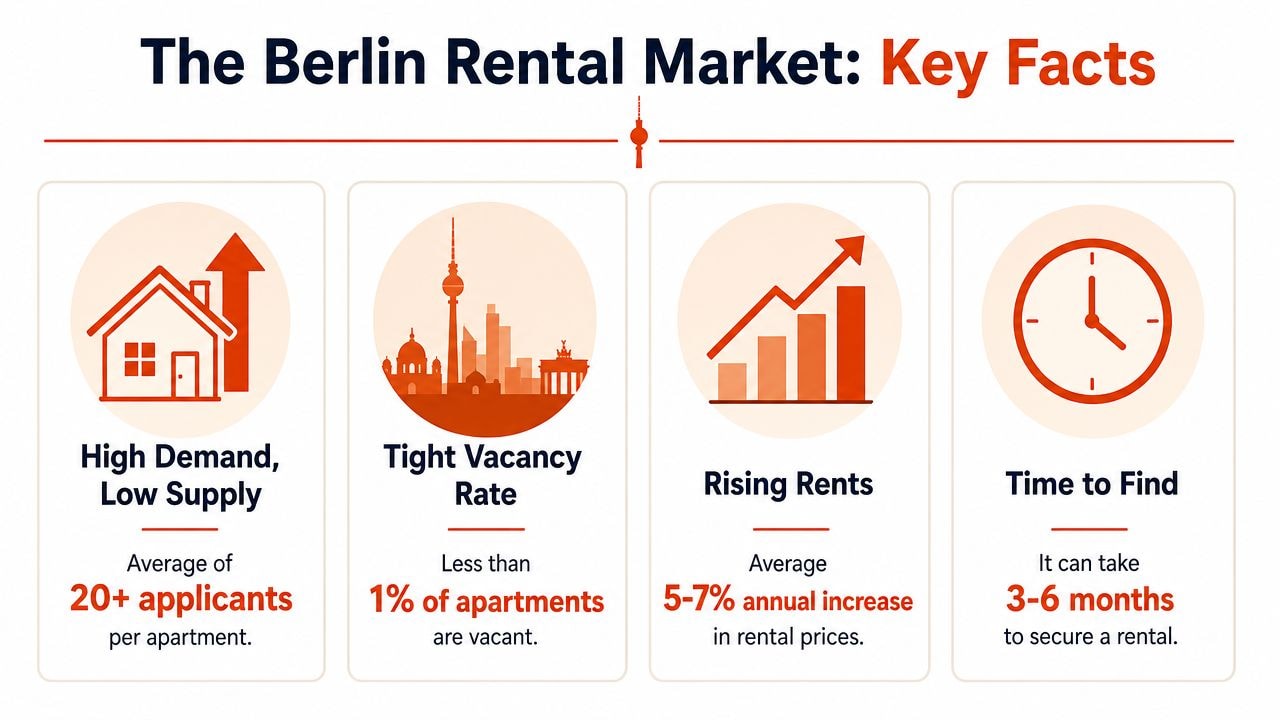
Berlin is predominantly a rental city, so newcomers are competing within the same housing system used by long-term residents. Demand is high, and clear documents, fast communication, and realistic location expectations matter.
Why the search feels personal when it isn't
When people get no replies, they often assume they wrote the wrong message or somehow failed the process. Usually, the bigger issue is structural. Berlin has a long history of stable renting, strong tenant protection, and long occupation periods. That makes landlords cautious, because choosing a tenant can shape the next many years.
The result is simple. Berlin landlords usually prefer tenants who look easy to assess on paper. Clean documents, reliable communication, stable income, and quick follow-up matter more than personality.
Practical rule: In Berlin, preparation often beats charm.
What the current market means for newcomers
The Kiel Institute summary on Berlin rental dynamics reports that its Q1 2026 GREIX update found an average asking cold rent of €15.84 per square metre in Berlin. It also found that regular rental listings across the full GREIX dataset had fallen by around 22% since 2015, while furnished long-term listings in major German cities had grown strongly. These figures describe asking rents and listing trends, not the rent of every individual Berlin apartment.
For newcomers, that creates a very specific trade-off:
| Option | What usually works | Main downside |
|---|---|---|
| Unfurnished long-term flat | Better for stability and normal city life | Harder competition and heavier document checks |
| Furnished medium-term flat | Faster move-in and easier landing | Confirm contract terms, total cost, and whether the housing provider will issue a Wohnungsgeberbestätigung |
| Short temporary stay | Useful while you search on the ground | Expensive and not a real settling solution |
Berlin is still workable if you approach it like a process, not a lottery. That means applying early, keeping your paperwork ready, and treating every viewing and phone call like part of one connected application.
Your Essential Application Dossier Bewerbungsmappe
You get a viewing invitation at 10:14. By 10:27, the agent has already written back to two other applicants because they sent a full dossier immediately. That is a normal Berlin moment, and it is why the Bewerbungsmappe needs to be ready before the first promising listing appears.
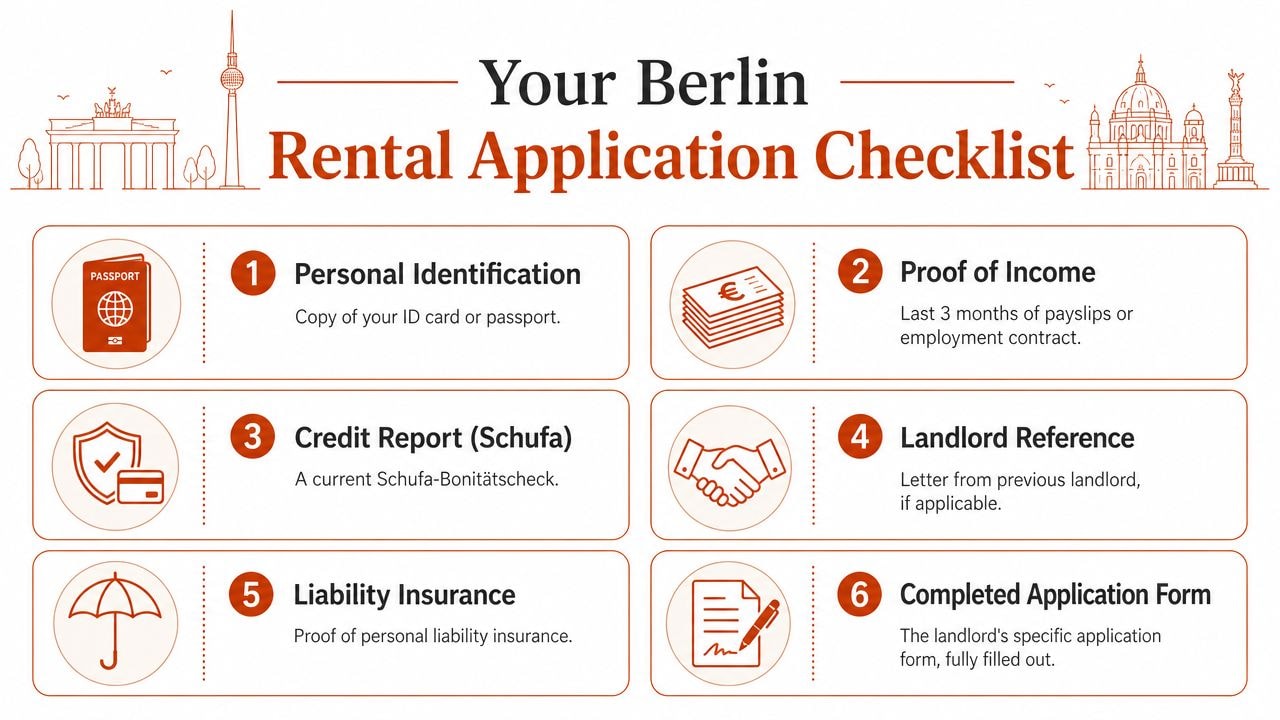
A good application folder does two things. It shows that you are financially reliable, and it saves the landlord or Hausverwaltung time. In a crowded search, that second point matters more than many newcomers expect. Strong applicants can still lose flats when their papers arrive in five separate emails, with file names no one can quickly understand.
The documents landlords usually expect
For most long term apartment rental in Berlin cases, landlords ask for the same core set of papers:
-
SCHUFA credit report. This is the credit record many landlords use to check payment history and reliability.
-
Mieterselbstauskunft. This self-disclosure form usually covers your job, income, household size, pets, and previous rental situation.
-
Proof of income. Usually the last three payslips, or a signed work contract if the job is new.
-
Mietschuldenfreiheitsbescheinigung. If you have one, it confirms you did not leave rent debt with a previous landlord.
-
ID copy. A clear passport or national ID scan is often requested, even if the listing does not mention it.
Some landlords also ask for a guarantor, especially if you are new in Germany, still in probation, freelancing, or studying. That does not mean the application is weak. It means they want another layer of security.
The trade-off is simple. Sending more documents can improve your chances, but only if the file stays clear and relevant. Do not bury the important pages under random attachments.
Protect your personal data. Do not send unredacted identity, banking, salary, or credit documents to unverified contacts. Share sensitive documents only when the listing and recipient appear legitimate, and redact information that is not needed for the application.
A practical system works best. Keep one neatly named PDF folder on your phone and laptop, and carry printed copies for viewings where an agent still accepts paper. If someone says, "Bitte schicken Sie Ihre Unterlagen heute noch," the package should be ready in minutes, not by the end of the day.
For a sharper setup, use this Berlin appointment documents checklist for renters and newcomers to make sure the file names, scans, and supporting papers are in order before viewings start.
What newcomers often get wrong
The biggest problem is rarely missing income. It is poor presentation.
Dossiers often arrive with screenshots instead of PDFs, untranslated file names, cropped passport photos, or contracts missing the signature page. From the applicant's side, that can feel minor. From the landlord's side, it creates work, and extra work is often enough to push an application aside.
Timing causes the second common failure. If you start ordering SCHUFA, asking a former landlord for confirmation, and hunting for payslips after the invitation arrives, the best window has already passed. Berlin rewards the applicant who can send a clean package while everyone else is still assembling one.
A complete dossier will not guarantee the apartment. A messy one can end your chances before the landlord reads your message.
Use this check before you apply:
-
Rename every file clearly. Use labels such as "Passport," "SCHUFA," "Work_Contract," and "Payslips_Last_3_Months."
-
Prepare one short introduction in German and one in English, so you are not rewriting from scratch under pressure.
-
Check consistency across documents. Name spelling, salary figures, employer name, and move-in date should not conflict.
-
Create a viewing version and a full version. The viewing version is quick to send. The full version is ready if the landlord asks for more.
-
Ask a local person to review the folder once. A German-speaking friend or a relocation helper can often spot small issues that make a dossier look unfamiliar or incomplete.
That last step helps more than people think. A local helper can check whether your introduction sounds natural, whether your file names make sense to a Hausverwaltung, and whether something important is missing before a stressful landlord call or same-day viewing.
If you need legal advice, tax advice, or a certified translation, use a qualified lawyer, tax advisor, or certified translation provider. The Bewerbungsmappe is practical preparation for a rental search, not legal advice.
Smart Search Strategies for Finding Listings
A common starting point is the big portals. That's sensible, but it's not enough on its own. Berlin rewards people who search in layers.
Use more than one channel
A strong search usually combines several routes:
-
Large property portals. These are still worth checking because many professional agents post there first.
-
District-based Facebook groups. Smaller neighborhood groups can surface sublets, lease takeovers, or direct landlord posts.
-
Personal networks. Friends, classmates, coworkers, and colleagues often hear about flats before they're publicly listed.
-
Employer and university channels. Some companies and institutions circulate housing leads internally.
-
On-the-ground observation. In some buildings, notices still appear in foyers or local shop windows.
The important part isn't using every platform equally. It's building a routine you can maintain. Check listings at set times, reply quickly, and keep a reusable message that sounds human rather than copied.
A good first message is short. Say who you are, why you're moving, your work or study status, when you can move in, and that your documents are ready. If you can send that in clear German, even better. If you can't, at least avoid a generic one-line request.
Furnished or unfurnished is not just a comfort question
For long term apartment rental in Berlin, the furnished versus unfurnished decision isn't mainly about furniture. It's about what kind of life the contract allows you to build.
Before booking any temporary or furnished accommodation, ask whether it can be used as your actual residence and whether the housing provider will issue a Wohnungsgeberbestätigung after move-in. Do not rely only on marketing phrases such as "ideal for relocation."
Here's a quick decision guide:
| Type of rental | Often useful for | Watch closely for |
|---|---|---|
| Unfurnished long-term lease | People planning to stay and settle | Full document burden and stronger competition |
| Furnished medium-term rental | Fast arrival and temporary landing | Confirm the total cost, contract terms, and whether the housing provider will issue a Wohnungsgeberbestätigung |
| Vacation-style listing | Very short stopgap only | Registration problems, unclear rights, and weak stability |
If a listing says “perfect for relocation” but says nothing precise about registration documents, ask directly whether the landlord will provide the Wohnungsgeberbestätigung. If the answer is vague, assume nothing.
Making an Impression at the Apartment Viewing
Getting a viewing invitation means your written application was good enough to pass the first filter. From there, the tone shifts. Now the landlord or agent is judging whether you seem organized, reliable, and easy to deal with.
What mass viewings are really like
A Berlin mass viewing can feel brisk and impersonal. People wait in the hallway, open cupboards quickly, and try to hand over documents before the next group enters. In that setting, long life stories don't help. Calm efficiency does.
Bring printed documents, arrive on time, and keep your questions focused. If the agent is moving quickly, ask the things that affect your decision or application immediately, such as move-in timing, what is included, and how the application should be submitted.
A one-to-one viewing is different. There's more room to observe the building, noise level, stairwell condition, cellar access, and whether the landlord answers clearly. Don't waste that chance by only saying “looks great.”
How to act like a serious tenant
The best impression is usually straightforward and polite. Dress normally, but tidy. Speak clearly. Don't oversell yourself.
Useful questions include:
-
About the flat. Is there a basement storage area, fitted kitchen, or any planned renovation?
-
About the contract process. Who makes the final decision, and how should documents be sent?
-
About move-in logistics. When are keys handed over, and what happens after selection?
Avoid turning the first viewing into a legal debate. If something in the lease later needs legal interpretation, that's the point to consult a tenants' association or lawyer.
If language is your weak point, practical support can change the whole interaction. A German-speaking person can help you ask precise follow-up questions. A helper can support routine communication, prepare questions, take notes, and help clarify practical next steps. This is not certified interpreting, contract interpretation, or tenancy-law advice. For on-site help with communication during viewings, see apartment viewing support in Berlin.
The viewing is not only about whether you like the flat. It's also when the other side decides whether they can picture dealing with you smoothly.
Securing Your Lease and Understanding the Contract
A lot of apartment searches in Berlin are lost after the viewing, not during it. The landlord is interested, asks for the file, and then the process turns messy. One missing attachment, one delayed reply, or one misunderstood question in German can push your application to the side.
Speed matters here, but accuracy matters just as much.
What to do once the landlord shows interest
Send a short follow-up the same day if you want the flat. Confirm that you're still interested, attach the documents in the requested format, and keep the message easy to scan. Property managers often handle many applications at once, so clear communication helps.
This stage often goes wrong for very practical reasons. A tenant sends screenshots instead of PDFs. Someone replies in three separate emails. A landlord asks for an updated salary slip, and the answer comes two days later with the wrong file attached. None of that looks dramatic, but it creates doubt.
A simple routine helps:
-
Reply promptly with the full dossier in the format requested.
-
Answer only what was asked. If they want one missing page, send that page clearly labeled.
-
Store everything. Keep emails, chat messages, and any written note about move-in date, kitchen, furniture, or repairs.
If German is the weak point, this is often the moment a local helper earns their keep. Short landlord messages can contain small but important distinctions about start dates, deposit timing, or which documents are still missing. Getting that wrong can cost you the apartment even after a strong viewing.
What to check before you sign
The Mietvertrag deserves a slow reading. Practical language support can help you follow routine wording and prepare questions, but it is not certified translation, contract interpretation, or legal advice. If a clause looks unusual or hard to interpret, ask a lawyer or a tenants' association to review it.
Focus on the points that affect your money, flexibility, and move-out risk:
| Contract point | Why it matters |
|---|---|
| Deposit terms | Check how much is due, when it must be paid, and which account receives it |
| Notice period | This determines how easily you can leave if your plans change |
| Repairs and condition clauses | These often matter later, especially during move-out disputes |
| Included costs | Confirm what is part of the rent and what you pay separately, such as electricity or internet |
The deposit is a common stress point. In Germany, the rental deposit is generally limited to three months of cold rent under §551 BGB. Even when that amount is legally familiar, it still hits hard in practice because you may be paying the first month's rent, buying furniture, and planning your Berlin Anmeldung process step by step at the same time.
Read the lease with the handover in mind. Check the exact move-in date, whether a fitted kitchen is included, whether subletting is restricted, and whether any special agreements were added at the end. Those small clauses are often what people forget, and they are usually the first points discussed later if something goes wrong.
Good support at this stage is less about theory and more about execution. Someone local can help you answer landlord questions quickly, spot practical issues before signing, and keep the process calm when the pressure rises. That kind of help does not replace a lawyer. It often makes the difference between losing momentum and getting the keys.
Navigating Move-In and City Registration Anmeldung
Signing the lease is a big milestone, but Berlin still expects a few more bureaucratic steps before your new address becomes fully useful in daily life.
Protect yourself at handover
When you collect the keys, don't treat the handover as a casual moment. This is when you should check the apartment's condition carefully and make sure defects are recorded in an Übergabeprotokoll.
Look at walls, floors, windows, appliances, meter readings, and existing damage. Take clear photos the same day and store them somewhere easy to access later. If something is scratched, broken, stained, or missing, it should be documented while both sides still agree on what existed at move-in.
A rushed handover can become an expensive argument at move-out.
How Anmeldung fits into the move
Once you move into a long-term rental in Berlin, Berlin.de states that residents generally need to register within 14 days after moving in. Identification and a Wohnungsgeberbestätigung are required, and a rental contract does not replace the Wohnungsgeberbestätigung. This registration is required for things like your tax ID, certain bank account setups, and residence permit processes.
For that appointment, you'll usually need the right address documents from the landlord, especially the Wohnungsgeberbestätigung. Don't assume it will arrive automatically. Ask for it early and check that the details are correct.
This sequence works well:
-
Get the keys first. Registration follows actual move-in.
-
Request the landlord confirmation immediately. You need it for the Bürgeramt.
-
Book the appointment and prepare documents. Keep your passport, registration form, and housing paperwork together.
-
Check every field before the appointment. Small address errors cause unnecessary stress.
If you want a practical walkthrough of the process, the Anmeldung in Berlin step-by-step guide is a useful place to prepare your paperwork and timing.
If your flat is sorted but your registration paperwork isn't, you're only halfway settled.
Common Questions About Renting in Berlin
Quick answers that save time
What's the difference between Kaltmiete and Warmmiete?
Kaltmiete is the base rent without many running housing costs. Warmmiete usually means the base rent plus additional costs charged with the apartment. Always check what is included, because internet, electricity, or other items may still be separate.
Can you negotiate the rent?
Sometimes, but Berlin is not a market where aggressive negotiation usually helps a newcomer. In many cases, clear documents and reliable communication matter more than trying to bargain immediately.
How do I avoid rental scams?
Be cautious with listings that pressure you to pay before a proper contract, identity check, or viewing arrangement. If the story feels inconsistent, the ownership details are unclear, or the communication becomes strangely urgent, step back and verify everything before sending money or documents.
What is a Staffelmiete or Indexmiete?
These are rent adjustment clauses. A Staffelmiete usually sets future rent increases according to a schedule written into the contract. An Indexmiete ties future changes to an index. Neither is automatically bad, but both affect what the apartment may cost later. If the clause isn't clear to you, ask for explanation in plain language and get legal advice if needed.
Can I rent long-term without German credit history?
It's harder, but not always impossible. Some landlords are more flexible than others. What helps is replacing uncertainty with strong paperwork, stable income proof, and clear communication from the start.
If you are dealing with listings, landlord messages, viewing preparation, or document organization, book a SettlyGo helper. SettlyGo can help with practical communication, appointment preparation, document organization, note-taking, and routine landlord coordination. SettlyGo does not provide legal advice, tenancy-law advice, contract interpretation, immigration advice, tax advice, insurance brokerage, medical guidance, certified translation, sworn interpretation, application filing, or official representation.
Need help with Anmeldung or the Bürgeramt?
Book a verified SettlyGo helper to guide you through city registration, document preparation, and office appointments in Berlin.