Renting in Berlin: Your Complete 2026 Newcomer's Guide
June 24, 2026 · 16 min read

You open ImmoScout24 on your phone before breakfast. By lunch, half the listings are gone. By evening, you've copied your passport, translated part of your work contract, asked three friends what SCHUFA means, and still have no idea whether your application is “ready enough” to send.
That feeling is normal. Renting in Berlin is stressful not only because flats are hard to find, but because the hardest part often starts after you finally get a viewing. People expect the search to be difficult. What catches newcomers off guard is the document scramble, the awkward landlord messages in German, and the strange moment where you need a rental contract to move forward with registration, while everyday admin tasks seem to depend on having that registration done.
If you're new to Germany, it can feel like every step depends on another step. You need a flat to do your Anmeldung. You need your paperwork organized to convince a landlord. You need fast replies in German to stay in the running. And you usually need all of that at once.
This guide is built for that exact reality. Not a fantasy version where you send one application and get accepted the next day. A real Berlin version, where speed, clarity, and document order matter almost as much as income.
Renting in Berlin Can Feel Impossible Here Is Your Plan
A lot of newcomers make the same assumption at first. They think the biggest challenge is finding listings. Then they attend a viewing, get asked to send documents “today if possible,” and realize they're not just competing on interest alone. They're competing on readiness.
A flat search in Berlin usually works better when you treat it as three separate jobs. First, finding suitable listings. Second, presenting yourself clearly. Third, handling the admin gap between “we like this apartment” and “we have all the paperwork.”
Practical rule: Don't wait for a promising viewing to start organizing your documents. By then, you're already late.
A calmer approach looks like this:
-
Pick a realistic search area based on budget, commute, and urgency.
-
Prepare a complete document folder before your next batch of viewings.
-
Use a short, polite intro message that can be adapted quickly for each listing.
-
Reply fast after viewings with one clean PDF set or a clearly labeled folder.
-
Track every application so you know who asked for what and when.
If you do only one thing after reading this guide, do this: build your folder first. That one step removes a huge amount of stress because it fixes the most common failure point in renting in Berlin. Not interest. Not motivation. Organization.
Why Finding a Flat in Berlin Is So Hard
Berlin's rental market is difficult for a simple reason. There are very few available long term flats, and when a decent one appears, many people go after it immediately.
Recent Berlin housing reports continue to show a very tight rental market, with low vacancy, high competition, and a large gap between existing rents and online offer rents. For newcomers, the practical result is simple: good listings move fast, landlords can be selective, and one missing document can push an application aside.
If you do use exact rent figures while planning, treat them as benchmarks rather than fixed citywide truths. Listing prices vary quickly by district, apartment type, furnishing, and whether the offer is a new listing or an older existing tenancy. As one example, Berlin rental market figures from Investropa describe a market where standard 1-bedroom offers can sit around 1,050 euros per month, while central districts such as Mitte and Prenzlauer Berg may reach roughly 18 to 22 euros per square meter.
What the numbers mean in real life
A 1.5% vacancy rate means most homes are already occupied. In practice, that creates three problems for newcomers.
-
Listings move fast: If you save a listing for later, it may already be closed.
-
Landlords can be selective: They don't need to chase tenants. Tenants chase them.
-
Mistakes become expensive: One missing file or one unclear message can push your application aside.
Berlin is also a city where renting is the norm, not a short stop before buying. EU housing data published by Destatis shows that 52.8% of Germany's population lived in rented accommodation in 2025. For newcomers, that means you're entering a system where rental paperwork is taken seriously and administrative steps like Anmeldung are part of everyday housing life.
When people say Berlin is hard, they usually mean two things at once. The flat is hard to find, and the admin is hard to navigate.
Set your budget by area not by hope
It helps to stop thinking in one citywide number and start thinking by district and apartment type.
If your dream is a renovated one bedroom in a central neighborhood, your budget needs to reflect central pricing. If your priority is securing a stable first home, outer districts can offer more breathing room. The same Investropa data notes that areas like Marzahn or Spandau start around 750 euros for a 1-bedroom, which can make a huge difference if you're new, on probation at work, or still setting up the rest of your life in Germany.
That doesn't make the market friendly. It just makes it clearer. Clear is better than hopeful when you're under pressure.
Your Step by Step Search and Application Process
The search works best when you stop treating every listing as a fresh start. Build a repeatable system instead.
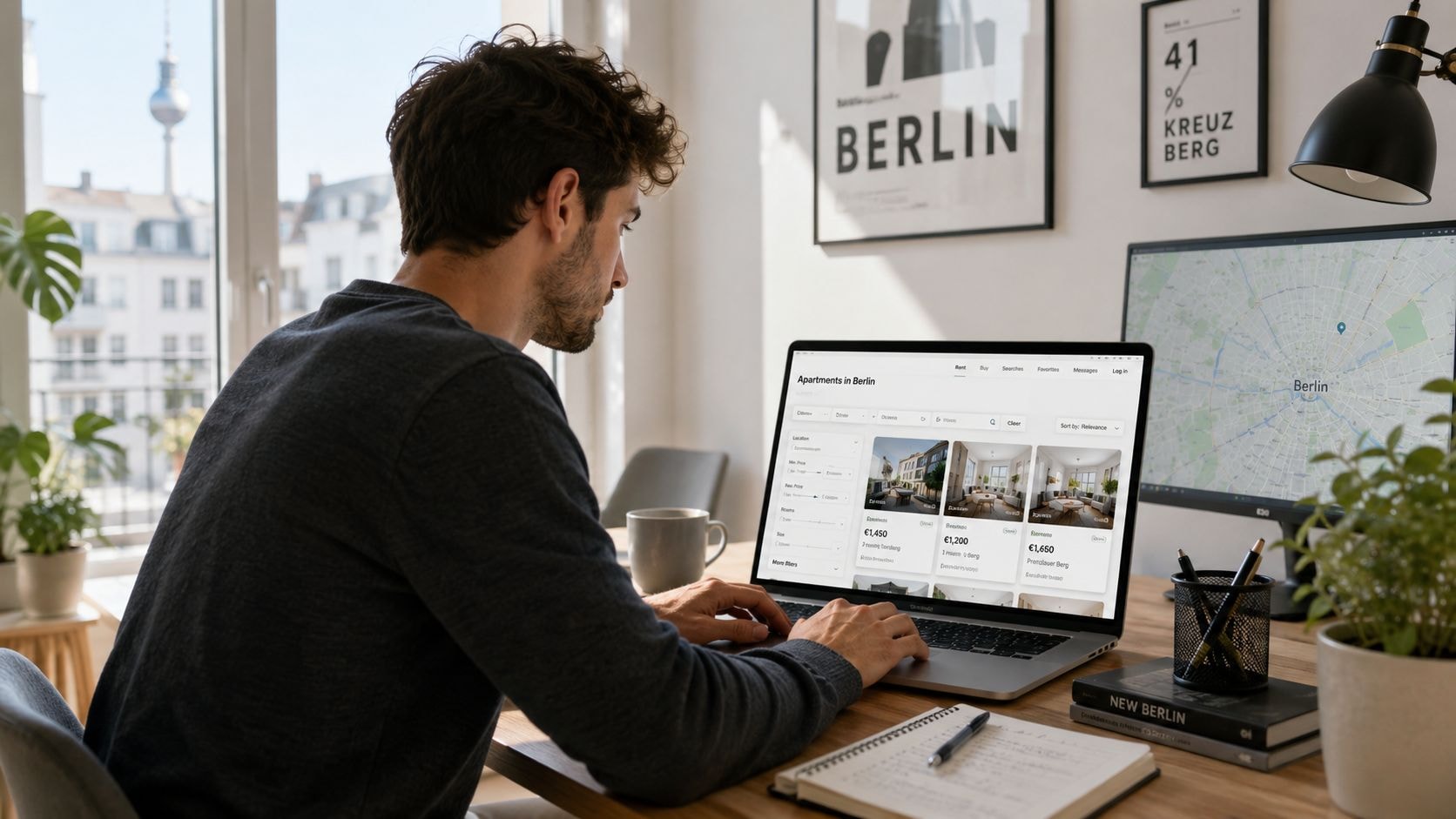
Use more than one search channel
Renters often begin with ImmoScout24. That makes sense. It's large, active, and often the first place agents post new listings. But don't stop there.
Try a mix of channels:
-
ImmoScout24: Good for standard apartments and agency listings.
-
Immonet: Useful as a second mainstream portal.
-
WG-Gesucht: Better for rooms, shared flats, and some temporary options.
-
Facebook groups: Mixed quality, but occasionally useful for direct offers or sublets.
-
Personal networks: Friends, classmates, coworkers, and Telegram or WhatsApp groups often help more than expected.
The point isn't to be everywhere all day. It's to avoid dependence on one platform.
Write one strong intro message and send it fast
Your first message should be short, polite, and easy to scan. Landlords and agents don't need your whole life story. They need reassurance that you're serious, employed or financially stable, and ready with documents.
A simple structure works well:
-
Who you are
-
Why you're moving
-
Your work or study situation
-
Who will live in the flat
-
When you can move in
-
That your documents are ready
Example:
Guten Tag,
my name is Ana Silva. I've recently moved to Berlin for work and I'm employed full-time with a permanent contract. I'm looking for a quiet long-term apartment for myself, and I can move in from the date listed. My application documents are prepared and I'd be happy to send them immediately.
Many thanks.
Keep an English version too, but if you can send a clean German message, that often helps with first impressions. If writing to landlords in German feels stressful, practical support with landlord communication help in Berlin can make the early stage much less messy.
What to do right after a landlord replies
Don't improvise once someone answers. Use a routine.
-
Confirm the viewing quickly.
-
Check whether they want documents before or after the appointment.
-
Save the appointment details in one place.
-
Rename your files before sending anything.
-
Prepare follow-up text in advance so you can send it the same day.
This walkthrough gives a useful visual overview of the search rhythm and what good preparation looks like: watch it on YouTube.
A lot of stress in renting in Berlin comes from switching between tabs, folders, apps, and half-finished messages. A simple system beats a perfect one.
Preparing Your German Proof Document Folder
This is the part many guides rush through. They list documents and move on. But the main problem isn't knowing the names. It's getting everything into a format that a landlord can understand quickly.
According to Waitly's Berlin apartment search guide, finding an apartment can take 1 to 6 months, and many newcomers lose 3 to 5 viewings per month because documents are incomplete or disorganized during the 24 to 48 hour window after a viewing.
That matches what many newcomers experience. They attend a viewing, feel optimistic, then spend the evening hunting for missing PDFs, asking an employer for a salary document, or sending six attachments with names like “Scan003-final-final2.pdf”.
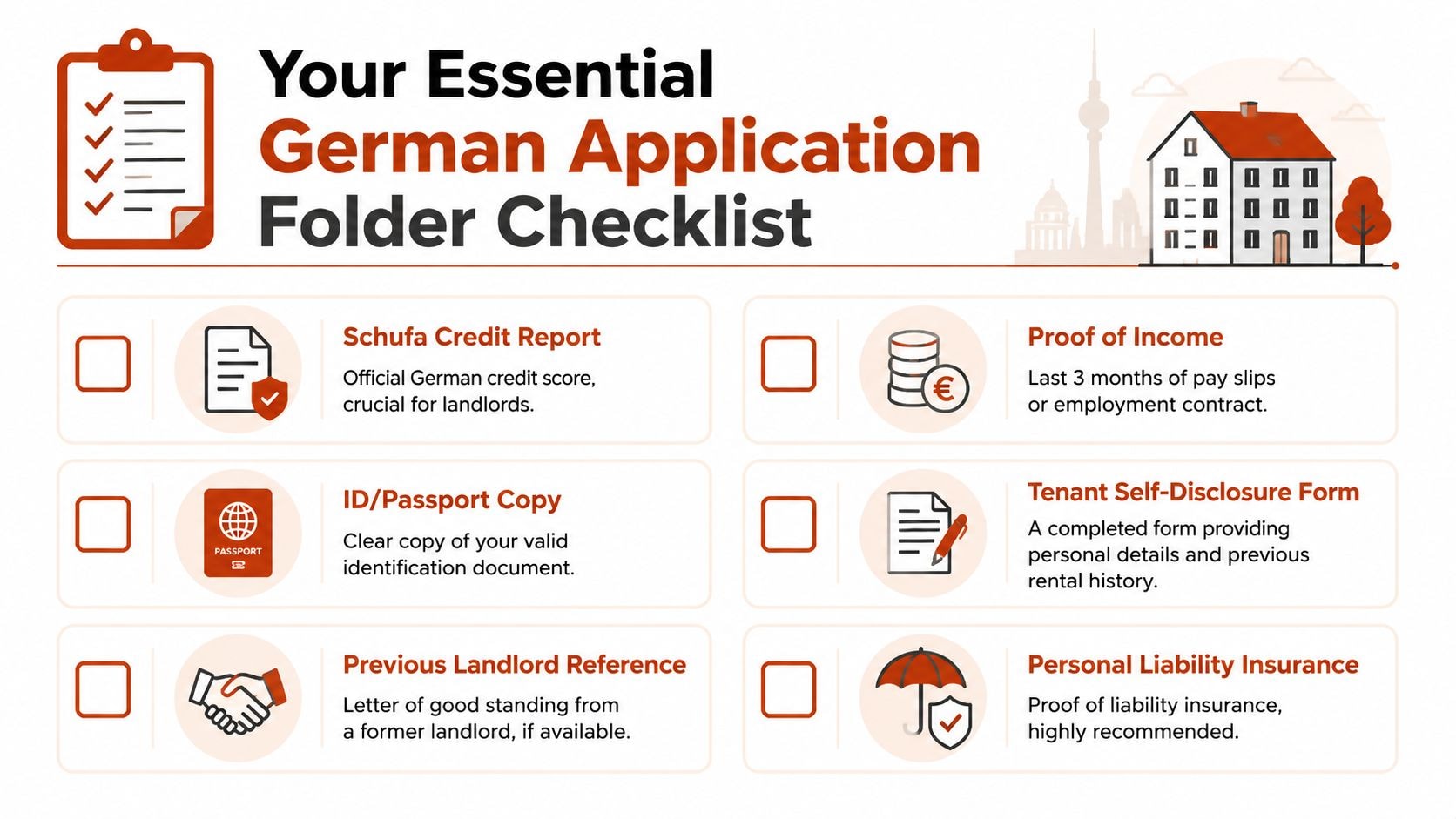
Build one folder before you book more viewings
Create one master folder on your computer and one copy in cloud storage. Inside it, use simple labels in either German or bilingual format.
A clean structure might look like this:
-
01_ID_Passport
-
02_Employment_or_Enrollment
-
03_Income
-
04_SCHUFA
-
05_Landlord_Reference
-
06_Cover_Letter
-
07_Extra_Documents
If a landlord asks for a full package, you should be able to send it within minutes, not hours.
What to include in your application pack
Requirements vary, but these are the documents newcomers are most often asked for in Berlin:
-
Passport or ID copy: Make sure it's clear, complete, and readable.
-
Proof of income: Often recent payslips, or your work contract if you've just started.
-
Employment contract or university enrollment proof: Useful if you're new in Germany and don't yet have a long local income history.
-
SCHUFA: If you have one. If you're new and don't, include other proof of reliability instead.
-
Mietschuldenfreiheitsbescheinigung: A certificate showing no rent debt from a previous landlord, if available.
-
Tenant self-disclosure form: Some agents provide this. Fill it in carefully and consistently.
-
Short cover note: A brief summary of who you are, written clearly.
If you want a practical prep list for related appointments and local paperwork, SettlyGo's documents checklist for Berlin appointments is a useful companion page.
Send documents that answer questions. Don't send random extras that create new ones.
How to send it without looking chaotic
There's a big difference between “all documents attached” and “easy to review.” The second one wins more often.
Use these habits:
-
Rename every file clearly: For example,
Ana_Silva_Passport.pdforAna_Silva_Employment_Contract.pdf. -
Match names everywhere: If your contract shows one version of your name and your email signature uses another, fix that.
-
Use one short email body: Mention the flat address, viewing date, and that your full application is attached.
-
Keep translations practical: If a document is in another language, a short explanatory note can help. For certified translations or legal review, use a qualified professional.
A newcomer-friendly application doesn't need to look fancy. It needs to look reliable.
Mastering the Apartment Viewing
A Berlin viewing isn't just a tour. It's usually your only chance to show that you're organized, responsive, and easy to deal with.
Some viewings are crowded and quick. Others are one-on-one and more conversational. In both cases, passive visitors tend to blur together. The people who stand out usually do small things well. They arrive on time, ask sensible questions, and send a clear follow-up afterward.
Treat the viewing like a short interview
You're not there to impress with charm. You're there to reduce uncertainty.
Bring or prepare:
-
A simple introduction: One sentence about work, study, or your move.
-
Your core facts: Move-in date, household size, smoking status if relevant, whether you have pets.
-
A follow-up plan: Know what you'll send afterward and when.
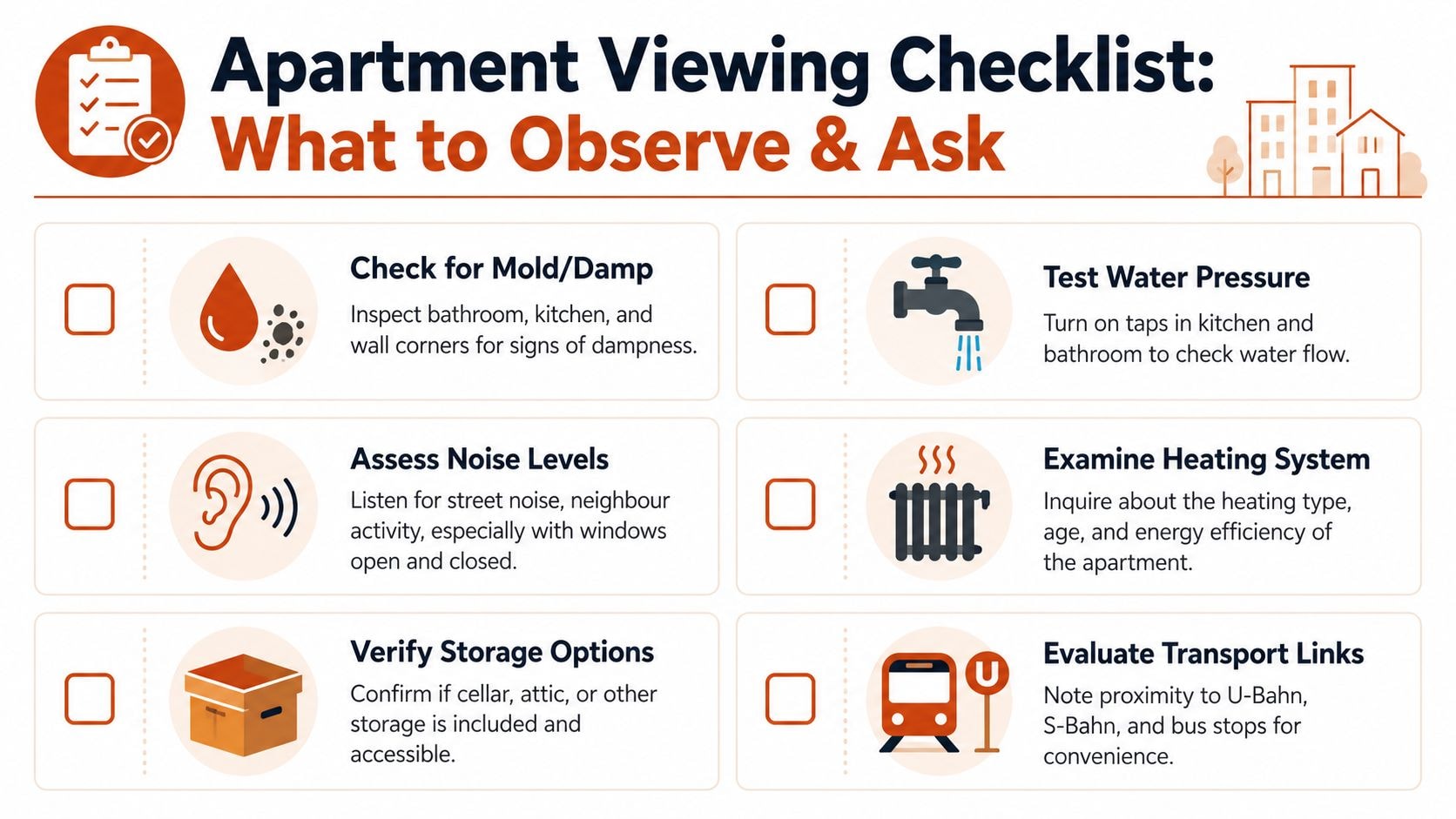
Watch the apartment carefully too. Newcomers sometimes focus so much on “please accept me” that they forget to assess the home itself.
Check practical points such as:
-
Bathroom and kitchen corners: Look for damp, mold, or strong cover-up smells.
-
Windows and street noise: Open and close them if possible.
-
Water flow: If the setting allows, test taps.
-
Heating setup: Ask what system is used and whether anything has been recently modernized.
-
Storage: Clarify whether cellar or attic space is included.
Questions worth asking on the spot
The best questions are calm and specific. They show that you understand the process.
Examples:
-
What is included in the rent?
-
Are utilities billed separately or included in the monthly total?
-
When is the preferred move-in date?
-
What documents do you want after the viewing?
-
Is the contract limited or unlimited?
-
Will I receive a Wohnungsgeberbestätigung for Anmeldung?
That last question matters more than many newcomers realize. If the landlord hesitates or answers vaguely, don't ignore it. You'll need that document for your address registration.
If you'd feel more confident with someone there to help interpret details in real time, SettlyGo offers apartment viewing support in Berlin, which can be especially useful when the conversation moves quickly in German.
A viewing is not just about whether you like the apartment. It's also about whether you understand the next step before you leave.
Typical rental costs in Berlin
Use this table as a planning tool, not a promise. Actual costs vary by district, building, and contract.
| Cost Item | Typical Amount |
|---|---|
| Standard unfurnished 1-bedroom apartment | €1,050 |
| Central district rent level | €18 to €22 per m² |
| Utility costs for a 50 m² property | About €200 per month |
| Median rent for a 60 m² apartment | €1,645 |
| Security deposit | Up to 3 months of cold rent |
The cost figures above are drawn from the verified market data already discussed earlier in this guide and from Berlin rental benchmarks covering rent, utilities, and deposit structure.
From Offer to Anmeldung Securing the Keys and Registering
Getting the “yes” email feels like the end. It isn't. It's the start of the part where details matter.
Read the contract slowly
A Mietvertrag should never be signed in a rush just because you're relieved. Check basic points first:
-
Names and address: Are all details correct?
-
Rent structure: What is the cold rent, and what is included on top?
-
Start date: Does it match what you agreed?
-
Deposit terms: Is the amount clearly stated?
-
Furnished or unfurnished status: Make sure it reflects reality.
-
Special clauses: Read these carefully.
If a clause seems unusual or you're not sure what legal wording means, get help from a qualified lawyer or a tenant association. Practical helpers can support with communication and organization, but they don't replace legal review.
Paying the deposit and doing the handover
The Mietkaution often causes confusion. Expatrio's guide to renting in Germany states that the security deposit is legally capped at no more than three times the monthly rent excluding utilities, and landlords must return it with accrued interest after move-out unless there is damage.
That gives you a clear benchmark. If someone asks for more than that, or asks for cash in a suspicious way, pause and check the situation carefully.
At handover, insist on an Übergabeprotokoll. This is the condition report for the apartment when you receive the keys. Take photos of walls, floors, kitchen surfaces, meter readings, and anything damaged or worn.
A good handover routine looks like this:
-
Read the protocol before signing.
-
Add missing damage notes.
-
Photograph every room.
-
Confirm how many keys you received.
-
Ask who to contact for repairs or urgent issues.
The Anmeldung step that follows
After move-in, the next practical task is Anmeldung at the Bürgeramt. You'll need the Wohnungsgeberbestätigung, which is the landlord's confirmation that you moved in.
Newcomers often encounter a strange administrative gap. You need the contract and landlord confirmation to register the address. At the same time, many other parts of life in Germany become easier once that registration is done. So don't leave this vague. Ask for the housing confirmation document early, and book your appointment as soon as you can.
For a practical walkthrough, SettlyGo's Anmeldung in Berlin step by step guide is a helpful place to check what to prepare before the appointment.
Know Your Rights and Avoid Common Scams
Berlin's rental market is competitive, but that doesn't mean landlords can do whatever they want.
Basic tenant protection you should know
According to Relokate HR's overview of Berlin rental restrictions, landlords can typically terminate a lease only for specific reasons, such as Eigenbedarf or serious tenant breaches, and the statutory notice period is usually three months or 90 days.
That matters for planning. It means a normal lease in Germany often gives more stability than newcomers expect.
A few basic principles to remember:
-
A lease is not casual paperwork: Read it carefully and keep a signed copy.
-
Notice periods matter: Don't assume moving out is instant just because your plans change.
-
Written records help: Save emails, protocols, rent confirmations, and landlord messages.
Scam signs that should stop you immediately
Most scams rely on pressure and distance. The story changes, the landlord is “abroad,” or the money must be sent before anything can be viewed.
Common warning signs include:
-
Payment before viewing: Be cautious if someone wants money first.
-
No proper contract review: A rushed deal is often a bad deal.
-
Strange identity gaps: The person showing the flat and the account receiving money don't match.
-
No willingness to provide housing confirmation: That can create problems later.
If you face a contract dispute, suspected fraud, or a serious rights issue, don't rely on general online advice. Join a Mieterverein or speak to a qualified Rechtsanwalt. That's the right path for legal problems.
Frequently Asked Questions About Renting in Berlin
Can my partner or friend move in later
Sometimes yes, but don't assume it's automatic. If another person will live in the apartment in a way that changes the original occupancy, tell the landlord and handle it properly. Undisclosed changes to the arrangement can create avoidable trouble later.
How long can a guest stay
Short visits are usually treated differently from subletting. But as Waitly's guide on house rules in Germany notes, if someone stays for a long period, contributes to rent, receives mail there, or effectively moves in, ask a tenant association or lawyer before assuming it is allowed.
That's why the distinction matters. A guest is not the same as a subtenant.
What is a Mieterverein
A Mieterverein is a tenant association. It can be very useful if you need help understanding disputes, rent issues, or formal landlord conflicts. For everyday admin and communication, practical support may be enough. For legal interpretation, a tenant association or lawyer is the safer choice.
What is the difference between Kaltmiete and Warmmiete
Kaltmiete is the rent without utilities. Warmmiete usually means the total monthly amount including the listed additional housing costs. Because deposits are tied to cold rent, it's important to know which number you're looking at before signing anything.
If you're still stuck between “I found a flat” and “I know exactly what to do next,” that's where practical help makes a real difference. SettlyGo can help with practical support: apartment viewings, landlord communication, German phone calls, document organization, and appointment preparation in Berlin. You can book support directly through SettlyGo. SettlyGo does not provide legal advice, tenant-law representation, immigration strategy, tax advice, insurance brokerage, medical advice, or certified translation. If you need help in any of those areas, use a qualified professional for that part.
Need help with Anmeldung or the Bürgeramt?
Book a verified SettlyGo helper to guide you through city registration, document preparation, and office appointments in Berlin.