Rooms in Berlin for Students: A 2026 Guide
July 21, 2026 · 15 min read

You've got your university place, your flight is booked, and then Berlin gives you a welcome message: housing listings in fast German, unanswered messages, WG castings that feel like job interviews, and a landlord asking for documents you've never heard of.
That's normal. Annoying, but normal.
Finding rooms in Berlin for students is rarely just about picking a district and clicking “apply.” The hard part is usually the human layer around the room: writing the first message in a way people answer, understanding what's happening at a viewing, and then dealing with the paperwork after you move in. If you know that from the start, the process gets less mysterious.
Berlin is still a city where students make it work. You just need a realistic plan, a bit of stamina, and some help with the parts that are easiest to mess up when you're new.
The Hunt for Student Rooms in Berlin
A lot of students arrive with the same assumption: if they're flexible on area, friendly in messages, and prepared to pay market rent, something will fall into place quickly. Sometimes it does. Often it doesn't.
Berlin's student housing market rewards people who move fast, write clearly, and understand local expectations. It also punishes hesitation. A good listing can disappear before you've finished translating the description.
That's why it helps to treat your search like a daily routine instead of a vague background task. Check platforms at set times. Save your documents in one folder. Keep a short intro message ready in English and, if possible, in German. When someone replies, answer quickly and politely. In Berlin, speed reads as seriousness.
Practical rule: Your first housing goal in Berlin doesn't need to be perfect. It needs to be workable, legitimate, and good enough to let you start your studies without chaos.
Many international students get stuck because they search for the ideal room from day one. They want the perfect Kiez, the perfect flatmates, the perfect rent, and a perfect contract in English. Berlin usually doesn't offer all of that at once.
A better approach is to separate your goals. First, secure a stable place you can realistically move into. Then, once you're registered, settled, and less stressed, you can decide whether to stay or search again with better local knowledge.
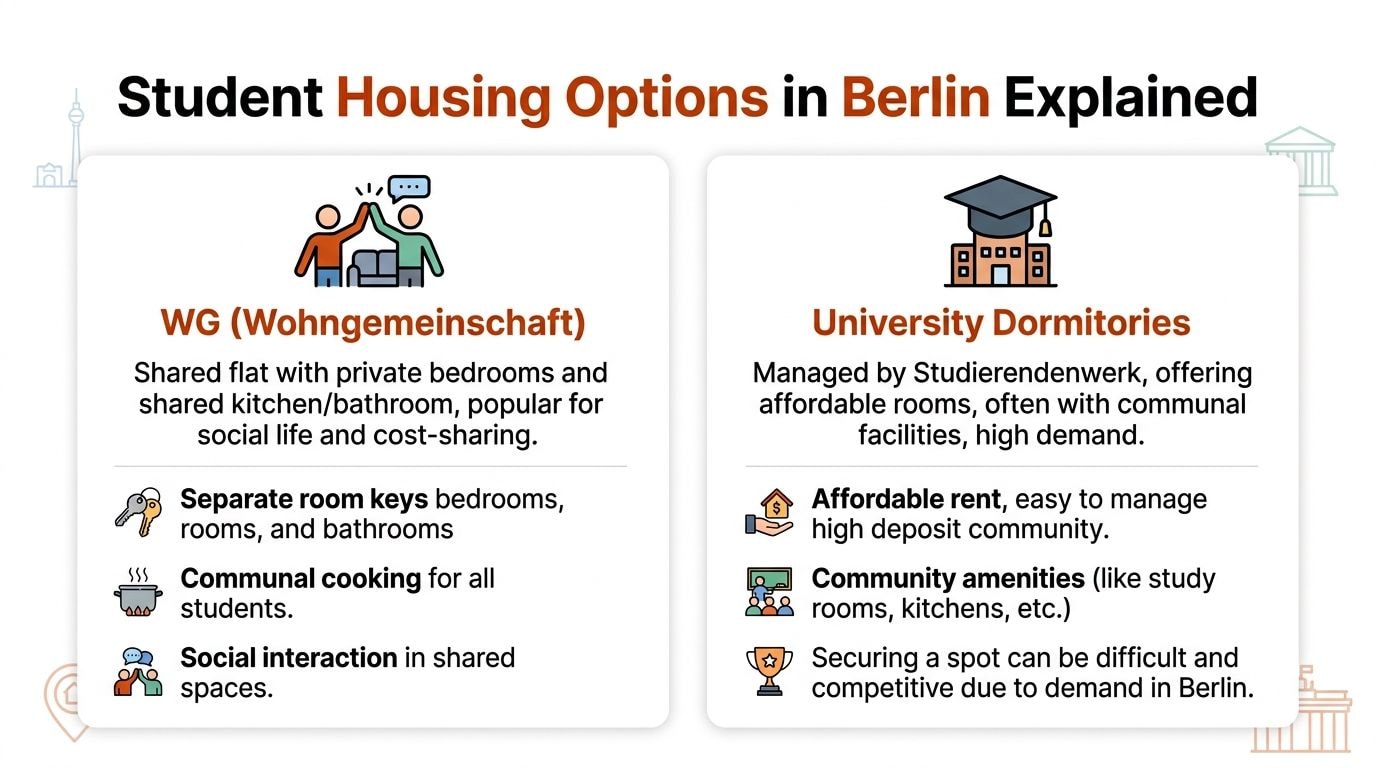
Student Housing Options in Berlin Explained
Before sending messages, it helps to know what you're choosing between. Most students end up in one of three paths: a WG, a student residence hall, or a private student apartment or micro-apartment.
For rooms in Berlin for students, the money side is blunt. According to HTW Berlin's guide to living in Berlin, the average cost for a room in a shared apartment (WG) is about €650 per month. HTW Berlin lists the average room in a shared apartment at approximately €650, while prices vary by location, size, condition, and furnishings. That same guide notes that Berlin's WG price sits above the national average and that the city's student housing vacancy rate is tight, which matches what students feel on the ground: good rooms attract a lot of interest very quickly.
What each option feels like in real life
A WG is the classic Berlin student setup. You get your own room and share the kitchen and bathroom. It can be social, flexible, and easier to find than a dorm place, but it also means flatmate dynamics, cleaning rules, and a selection process that can feel personal.
A student residence hall is usually the cheapest option. It's attractive for obvious reasons: lower rent, student-focused setup, and fewer surprises about basic structure. The downside is access. Cheap doesn't mean easy. It means competitive.
Then there's the private option, which can mean a studio, a micro-apartment, or a room through a private student housing provider. Private apartments and micro-apartments are usually much more expensive than WG rooms or student residences, especially in central areas. That's why many students who start by dreaming of their own apartment end up reconsidering quickly.
A private apartment gives you privacy. A WG often gives you affordability and a social landing. A dorm can be a lower-cost option if you can actually get in.
Berlin Student Housing at a Glance
| Housing Type | Average Monthly Cost | Pros | Cons |
|---|---|---|---|
| WG shared flat | €650 | Social, common student option, more listings than dorms | Competitive, shared living, language and personality fit matter |
| Student residence hall | Usually cheaper than private-market rooms, but availability is limited | Affordable, student-focused, predictable setup | Limited availability, apply early |
| Private apartment or micro-apartment | Usually higher than WG rooms and student residences | Privacy, simpler household rules, often more independence | Expensive, harder on a student budget |
If your budget is tight, apply for residence halls immediately and search for WGs in parallel. If you need privacy and can afford it, private providers can make the landing softer. If you want the broadest pool of listings, WGs are still the main hunt.
Your Search Strategy and Best Platforms
The usual starting points are WG-Gesucht for shared flats and ImmobilienScout24 for broader rental listings. University housing offices, student groups, and noticeboards can also help, especially if you're already in Berlin and can respond quickly.
The platform matters less than your setup. A weak profile gets ignored even on the right website. A strong profile gets more replies almost everywhere.
Where students actually search
On WG platforms, your intro text does a lot of work. Keep it short and human. Say who you are, what you study, when you're moving, how long you plan to stay, and one or two details that make you sound like a real future flatmate instead of a copied template.
A useful profile usually includes:
-
A clear photo: Not a party photo, not sunglasses, not a blurry airport selfie.
-
Basic facts upfront: University, course, move-in timing, smoking or non-smoking, and whether you've lived in shared housing before.
-
A realistic tone: Friendly beats overpolished. Berlin flatmates read hundreds of messages and can spot generic text quickly.
-
Fast follow-up: If someone invites you to a viewing or asks a question, answer the same day if you can.
Private student housing providers can be worth checking if you want a more structured process and more English-friendly communication. They're often less personal than WGs, but for many newcomers that's a relief.
How to handle the language barrier early
Many international students find themselves losing time without realizing why. A lot of guides say “just apply to WGs,” but they skip the fact that language can filter you out before anyone reads your personality.
Language still matters in practice. Some landlords and WG flatmates prefer German communication because it makes viewings, contracts, house rules, and daily coordination easier. That does not mean non-German speakers cannot find a room, but it does mean your first message should be clear, polite, and easy to understand.
Try this instead:
-
Prepare two first messages. One in English, one in German checked by a fluent speaker.
-
Don't apply only to “German required” listings. That sounds obvious, but many students waste energy there.
-
Use English-friendly providers strategically. They may cost more, but they can be a smart first landing place.
-
Get help with landlord communication if needed. The first phone call or message exchange is often where things either open up or die.
If a listing says the household language is German, take that seriously. It's not always a legal barrier. Often it's a practical one. People want smooth daily communication at home, and Berlin WGs can be very direct about that.
Preparing Your Documents and Acing Viewings
Once someone answers, the process gets more serious fast. In Berlin, a viewing is rarely just “come see the room.” It's usually also a first screening. The landlord, agent, or current flatmates are checking whether you seem reliable, easy to communicate with, and ready to move.
That's why students who keep their documents ready tend to feel calmer. You don't want to start hunting for files after the viewing invitation arrives.
What to put in your application folder
A simple application folder can be digital, printed, or both. The exact request depends on whether you're dealing with a WG, a landlord, or a private provider, but these are the items people commonly ask for:
-
Passport or ID copy: Keep a clear scan ready.
-
Proof of enrollment or admission: If you've already enrolled, use that. If not, your university acceptance can still help explain your situation.
-
Proof of finances: Bank statements, scholarship confirmation, sponsor letter, or parental support documents can all help show how you'll pay rent.
-
SCHUFA if you have one: Newcomers often don't. If you don't, say that clearly and offer other proof of reliability instead.
-
Short self-introduction: A few lines about your studies, routine, and move-in timing.
-
References if available: Previous landlord or employer references can support your case.
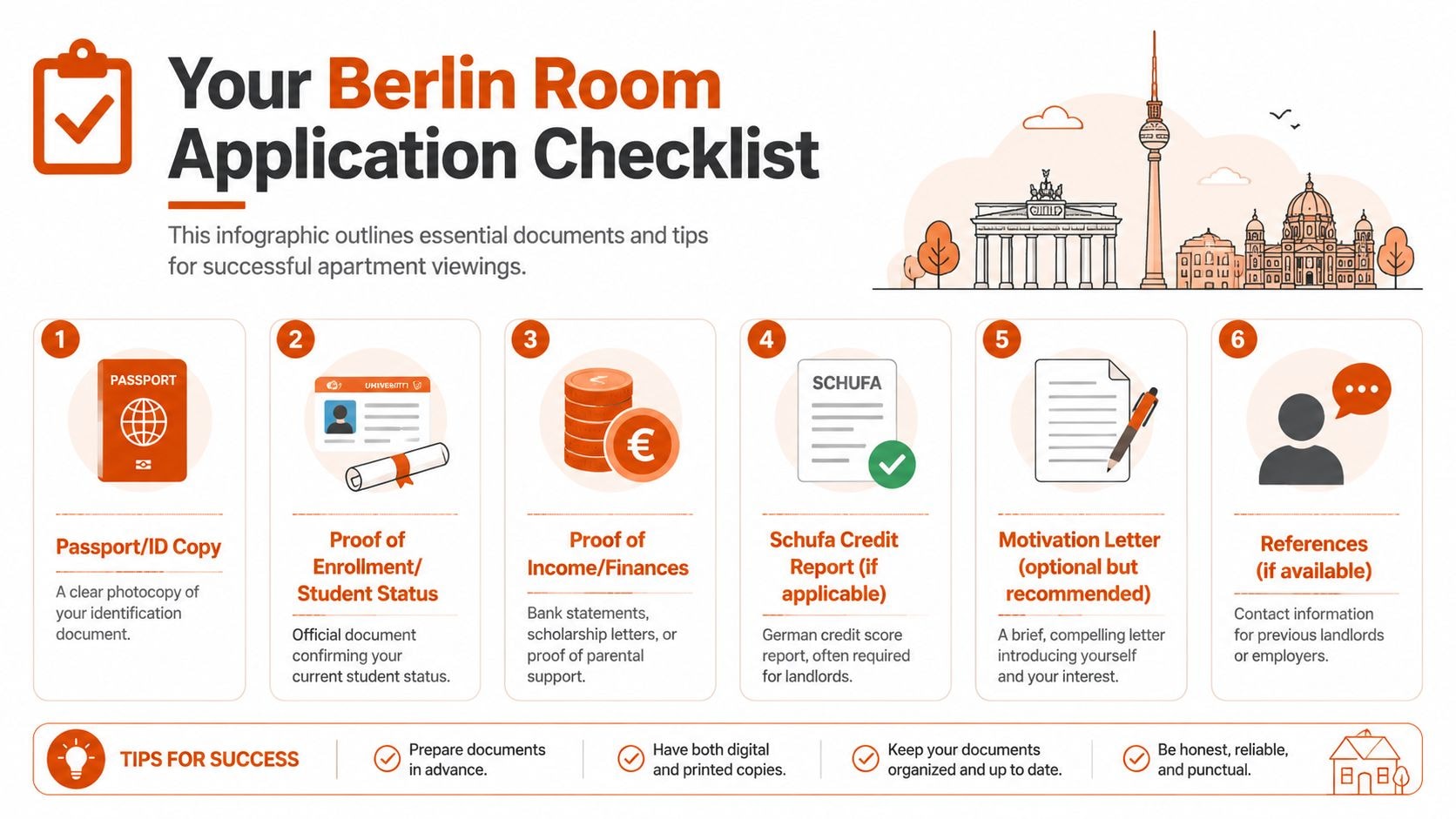
A SCHUFA is a German credit report. Many students arriving from abroad don't have one yet. That's common. Don't panic and don't pretend. Just replace it with strong alternative documents and explain your newcomer status clearly.
If you feel uneasy about in-person communication, practical apartment viewing support in Berlin can help with practical language support, landlord questions, note-taking, and the small details that are easy to miss when you're nervous.
How Berlin viewings usually work
A WG viewing can feel surprisingly social. You might sit in the kitchen with three current flatmates and answer casual questions that are screening questions. They want to know whether you clean up, whether you work late, whether you host guests often, and whether daily life with you will be easy.
For private rentals, the tone is often more formal. There may be less chatting and more document checking. In both cases, a few habits help:
-
Arrive on time: In Berlin housing, late means less serious.
-
Ask practical questions: What's included in the rent, how long is the contract, how are utilities handled, who is the main contact person?
-
Read the room: In a WG, social fit matters. In a landlord meeting, reliability matters more.
-
Send a follow-up message: Thank them, confirm your interest, and attach any missing documents quickly.
If a viewing feels like an interview, that's because it usually is.
One more thing. If the room looks very different from the photos, ask directly. If current tenants avoid clear answers about move-in dates, registration, or paperwork, take that seriously before you get emotionally attached to the place.
Spotting Scams and Understanding Your Rental Contract
The Berlin housing market creates pressure, and pressure makes people easier to trick. Scammers know that students are often searching from abroad, working across time zones, and willing to act quickly for fear of losing the room.
That's why “move fast” only works if it's paired with “check basics first.”
Scam patterns that keep showing up
Some warning signs are boring because they're so common. Still, they catch people every semester.
Watch out for these patterns:
-
The landlord is “abroad” and can't meet: They often claim they'll mail keys after payment.
-
Pressure to transfer money before a viewing: Especially by wire transfer or unusual payment method.
-
A room that looks underpriced for the story being told: Cheap does exist, but scam listings often use urgency and emotion to bypass your caution.
-
No clear registration possibility: If nobody can explain whether you can register there, stop and ask more.
-
A contract that appears only after payment is discussed: You should understand the setup before money moves.
Plain communication helps here. Ask direct questions. Who owns the apartment? Who is on the main lease? Can you see the contract before payment? Will you receive a signed document? Can you do Anmeldung at this address?
Never let desperation make the decision for you. A difficult room search is still easier than recovering money sent to a fake landlord.
For practical back-and-forth with a landlord or main tenant, landlord communication help in Berlin can make it easier to clarify logistics and avoid misunderstandings. That kind of support is practical, not legal.
Rental terms you should understand before signing
German rental language can look heavier than it really is, but you do need the basics.
Here are the terms students most often need to decode:
| Term | What it usually means |
|---|---|
| Kaltmiete | The base rent, usually without certain utilities |
| Warmmiete | Rent including additional running costs |
| Kaution | Security deposit |
| Kündigungsfrist | Notice period for ending the contract |
| Untermiete | Sublet arrangement |
| Wohnungsgeberbestätigung | Landlord confirmation needed for address registration |
If something in the Mietvertrag feels unclear, ask before signing. Ask what is included, who pays which bills, how long the minimum stay is, and whether registration is possible. Those are practical questions, not legal ones.
For legal disputes, contract interpretation, or tenant-rights issues, use a qualified lawyer or a tenants' association. SettlyGo does not provide tenancy-law advice, contract interpretation, or legal representation. Practical support can help you communicate and organize documents, but it can't replace legal advice.
You Have the Keys Now What About the Anmeldung
Getting the room isn't the finish line. In Germany, it's the moment the next clock starts.
One of your first tasks after moving in is the Anmeldung, which means registering your address at the Bürgeramt. Berlin.de states that you generally need to register your address within 14 days after moving in. Berlin.de also confirms that identification is required, the Wohnungsgeberbestätigung is required, a rental contract does not replace the Wohnungsgeberbestätigung, and the Anmeldung service is free. This registration is also important for early setup tasks such as getting a tax ID, opening a bank account, and enrolling in health insurance.
Why this appointment matters immediately
Students sometimes treat Anmeldung as admin they can do “later.” That usually creates knock-on problems. You might need your registration for banking, insurance, or other early setup tasks. So even if local reality sometimes feels messy, your planning should still assume this is urgent.
The appointment itself isn't usually difficult once your papers are correct. The stress comes from timing, forms, and the landlord document many new arrivals don't know about until the last minute.
A practical rhythm looks like this:
-
Get your move-in confirmed.
-
Ask for the Wohnungsgeberbestätigung immediately.
-
Book or monitor Bürgeramt appointments.
-
Bring complete documents, not “almost complete” documents.
What you need before you go
The exact document set can vary by situation, but students commonly need:
-
Passport or ID
-
Completed registration form
-
Wohnungsgeberbestätigung from the landlord or main tenant
-
Any supporting papers relevant to your specific case
The Wohnungsgeberbestätigung is the one that often delays people. Without it, the appointment can become pointless. Ask for it early and politely, and don't assume it will appear automatically.
If you want practical help preparing documents and handling the appointment, Anmeldung help in Berlin can be useful, especially if the forms and office process feel overwhelming.
Your Practical Support Kit for Berlin Bureaucracy
A room solves one major problem. Berlin then hands you several smaller ones.
There are phone calls you'd rather not make in German. There are official letters that look important but hard to decode. There are appointments where you're not sure which papers matter and which ones are just “nice to have.” That's normal for newcomers, especially students managing all of this while classes are starting.
A calm way to handle it is to build a small support system instead of trying to improvise every task alone. Keep your housing documents in one folder. Save copies of registration papers. Write down the names of offices and contact people. If a letter arrives and you don't understand it, get help early rather than guessing.
One practical starting point is this first 30 days in Berlin checklist, which helps you keep the early admin in a sensible order.
Berlin gets easier when you stop treating each bureaucratic task as a personal test and start treating it as a process.
If you need legal, tax, immigration, medical, or certified translation support, use the right qualified professional. But for the practical middle ground, things like preparing for appointments, handling German phone calls, organizing documents, or communicating with landlords, local hands-on help can save a lot of stress.
If you want practical support with the human side of settling in, from landlord communication and apartment viewings to Anmeldung preparation, document organization, and German phone calls, book a SettlyGo helper. SettlyGo can help with practical admin and communication support for real Berlin tasks. SettlyGo does not provide legal advice, tenancy-law advice, immigration advice, tax advice, insurance brokerage, medical guidance, certified translation, sworn interpretation, application filing, or official representation.
Need practical help in Berlin?
Book a verified SettlyGo helper for German phone calls, appointments, landlord communication, apartment viewings, and document preparation.