Social Security Number in Germany: A Newcomer's Guide
June 29, 2026 · 15 min read

You're filling out onboarding documents for a new job in Berlin. HR writes, “Please send your social security number.” You search online, open five tabs, and each one seems to use a different German word.
That stress is normal. A lot of newcomers get stuck here because Germany doesn't have one single number that works like a US-style SSN. In practice, people often use the phrase anyway, which creates the confusion. Many newcomers search for ‘social security number in Germany’ because employers, insurers, and online guides often use different English and German terms for separate identification numbers.
What you usually need is one of three things:
-
Tax ID for tax matters
-
Pension insurance number for payroll and social insurance
-
Health insurance number for your Krankenkasse
If you're not sure which one someone wants, you're not behind. You're dealing with one of the most common newcomer mix-ups in German bureaucracy.
Your Employer Wants a Social Security Number What Now
A common Berlin scenario goes like this. You sign your contract, your start date is close, and HR asks for your “social security number.” You check your passport, your visa papers, maybe your tax letter, and nothing seems to match.
In most cases, your employer doesn't mean one magical all-purpose number. They usually mean your pension insurance number, which in German may appear as Sozialversicherungsnummer, Versicherungsnummer, or sometimes Rentenversicherungsnummer. But they may also ask for your Tax ID separately, and sometimes people mix those terms up casually.
Practical rule: If a German employer asks for a “social security number,” ask them which German term they need. “Do you mean my Steuer-ID or my Versicherungsnummer?” is a completely normal question.
Each number serves a distinct function within the system. Your Tax ID is for taxes. Your pension insurance number is tied to social insurance and payroll. Your health insurance number belongs to your insurance provider.
That's why the phrase social security number in Germany causes so much unnecessary panic. The words sound familiar, but the system works differently.
A simple example helps:
-
For payroll setup: your employer often needs the pension insurance number and Tax ID
-
For a doctor or insurer app: you'll use your health insurance number
-
For tax paperwork: the Tax ID matters, not the health insurance number
If you remember one thing, remember this: don't hunt for one number. Identify which office or employer task you're dealing with, then match the correct German number to that task.
Germany's Three Key Numbers A Simple Breakdown
A lot of stress starts with one wrong assumption. People expect Germany to have one neat SSN, then panic when HR, the tax office, and the Krankenkasse all seem to ask for different numbers.
The clearer way to read the system is task first, number second. Ask yourself what you are trying to do, then match the number to that job.
A newcomer in Berlin might get one letter after registering their address, another message from their health insurer, and a separate request from HR. That feels random at first. It is not random. Germany keeps tax, pension, and health insurance in separate lanes.
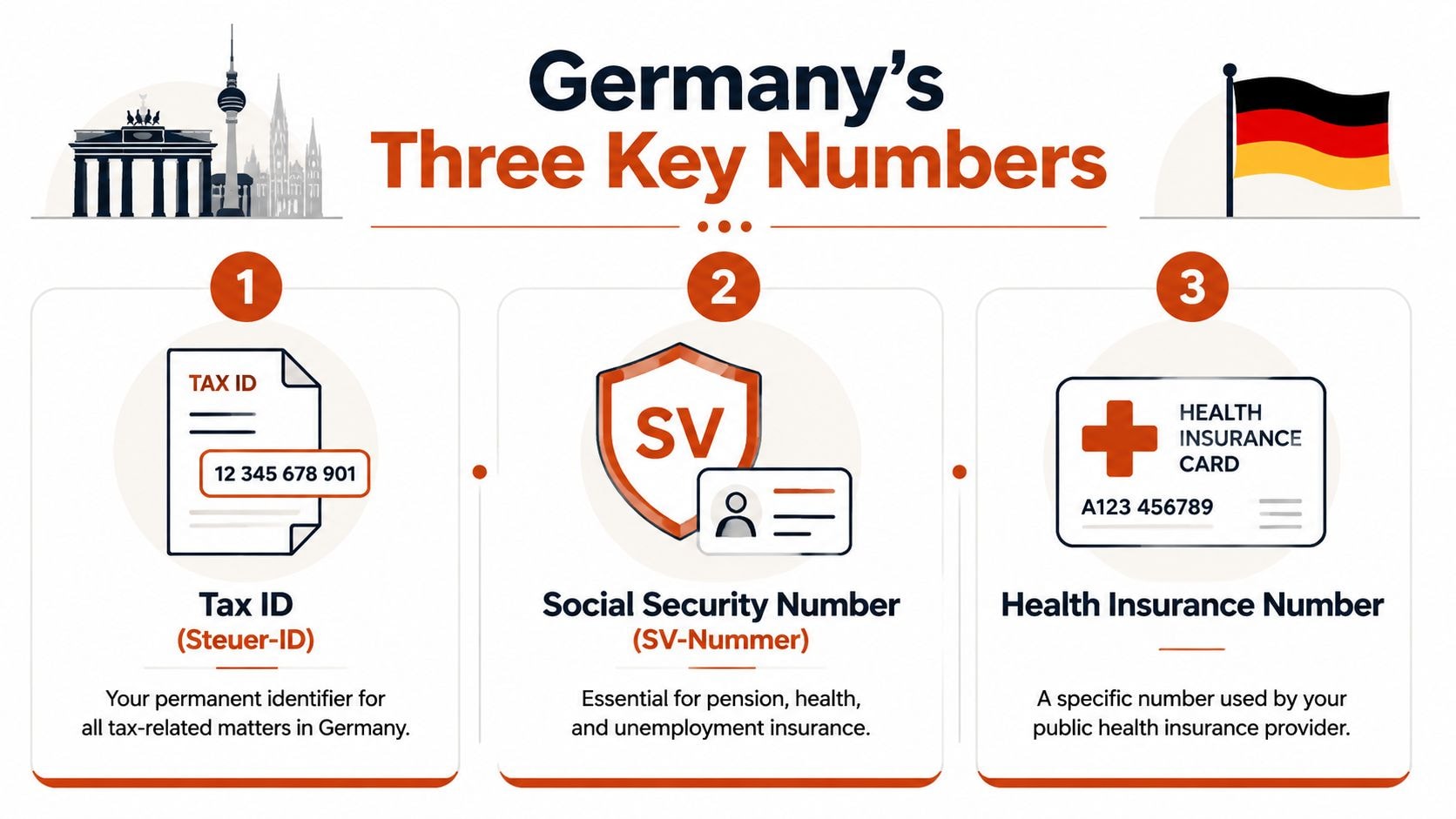
The quick answer
There is no single social security number in Germany. The three numbers newcomers deal with most often are the Tax ID, the pension insurance number, and the health insurance number.
If you are still waiting for paperwork because your address registration is not done yet, our step by step Anmeldung guide for Berlin shows where the process usually starts.
Germany's Key ID Numbers Explained
| Identifier | German Name | What It's For | Who Issues It |
|---|---|---|---|
| Tax ID | Steuer-ID | Tax matters and salary tax processing | Tax authorities |
| Pension insurance number | Sozialversicherungsnummer / Versicherungsnummer | Pension insurance and social insurance registration through employment | Deutsche Rentenversicherung |
| Health insurance number | Krankenversichertennummer | Your public health insurance records and insurer communication | Your public health insurance provider |
Here is the practical version.
Tax ID
Your Steuer-ID belongs to the tax system. Your employer needs it for wage tax, and you will also see it on tax-related letters and forms. The official source for this identifier is the Bundeszentralamt für Steuern (BZSt).
For many newcomers, this is one of the first important letters that arrives after address registration. If you have just moved and are checking your mailbox every day, this is one to look out for.
Pension insurance number
This is the number people often mean when they casually say social security number in Germany. In German, you may see Sozialversicherungsnummer, Versicherungsnummer, or Rentenversicherungsnummer.
Its job is to connect your employment record to pension contributions and related social insurance administration. HR often asks for it during onboarding. You may also spot it on payslips under shortened labels such as SVNR or similar payroll abbreviations. The official source is Deutsche Rentenversicherung, which also explains the Versicherungsnummernachweis.
If you only remember one thing, remember this. The pension insurance number is usually the closest German equivalent to what international employees mean by "social security number," but it is still only one part of the system.
Health insurance number
Your health insurance number belongs to your insurer, not the tax office and not the pension system. You use it for your insurance card, insurer portal, and communication with your Krankenkasse. Official statutory insurers such as TK explain the health insurance system here.
Many people get these numbers mixed up. The one that helps you book a doctor appointment is not the same one your employer needs for payroll.
A simple comparison helps:
-
Tax office task: Tax ID
-
Payroll and pension task: pension insurance number
-
Insurance or doctor task: health insurance number
Once you sort the numbers by purpose, German paperwork feels much less mysterious.
And this is usually the point where practical help matters more than theory. Guides can explain the labels. The hard part is often chasing missing letters, calling a Krankenkasse, or figuring out what HR requires. If that is where you are stuck, a service like SettlyGo can help with the practical admin work, especially when the problem is an appointment, a call, or a document request rather than a legal question.
The First Domino to Fall Your Anmeldung
For many newcomers, the actual starting point isn't the job contract. It's Anmeldung, your address registration.
In Germany, if you plan to live in the country for more than 3 months, you're generally required to register your residence, and you must do it within 14 days of moving to a new address. In Berlin, the official starting point is the Berlin service page for Anmeldung. This step enables a lot of later bureaucracy.
Why Anmeldung matters so much
Without Anmeldung, official letters can't reliably reach you. That creates problems fast. Employers ask for tax details. Health insurance paperwork gets delayed. Other offices may ask for proof of address registration before they process anything else.
In Berlin, people often hit their first wall. Appointments can be limited, so book as soon as you have a confirmed address and the required landlord confirmation.
If you already have a signed move-in and a landlord confirmation coming, don't wait until your first day at work to think about Anmeldung.
What to bring in Berlin
The one document people underestimate is the Wohnungsgeberbestätigung. In Berlin, it's the key paper that proves you moved into the address. For Berlin Anmeldung, the Wohnungsgeberbestätigung is one of the key required documents. Check the official Berlin.de service page for Anmeldung before going to the Bürgeramt.
Your practical checklist:
-
Passport or ID: Bring the same identity document you used for your housing and visa process.
-
Wohnungsgeberbestätigung: This is mandatory. If your landlord or main tenant hasn't given it to you, ask for it before the appointment.
-
Anmeldung form: Fill it out in advance if possible.
-
Supporting household documents: If you're registering with family, bring the documents that fit your case.
If you're preparing for this step in Berlin, this Anmeldung in Berlin step by step guide can help you organize the paperwork before your appointment.
A practical explainer like Versicherungsbüro Weiss on Anmeldung in Berlin can help with context, but the Berlin service page remains the best place to confirm the current required documents.
How to Get Your Pension and Health Insurance Numbers
You usually notice this step when HR sends a form and asks for a “social security number.” In Germany, that request often means one of two different things. Your pension insurance number for payroll reporting, or your health insurance number from your Krankenkasse.
Your pension insurance number is the work-related number tied to the public pension system. It is issued through Deutsche Rentenversicherung. Your health insurance number comes from your health insurer directly. They are separate numbers, issued by separate institutions, for separate jobs.
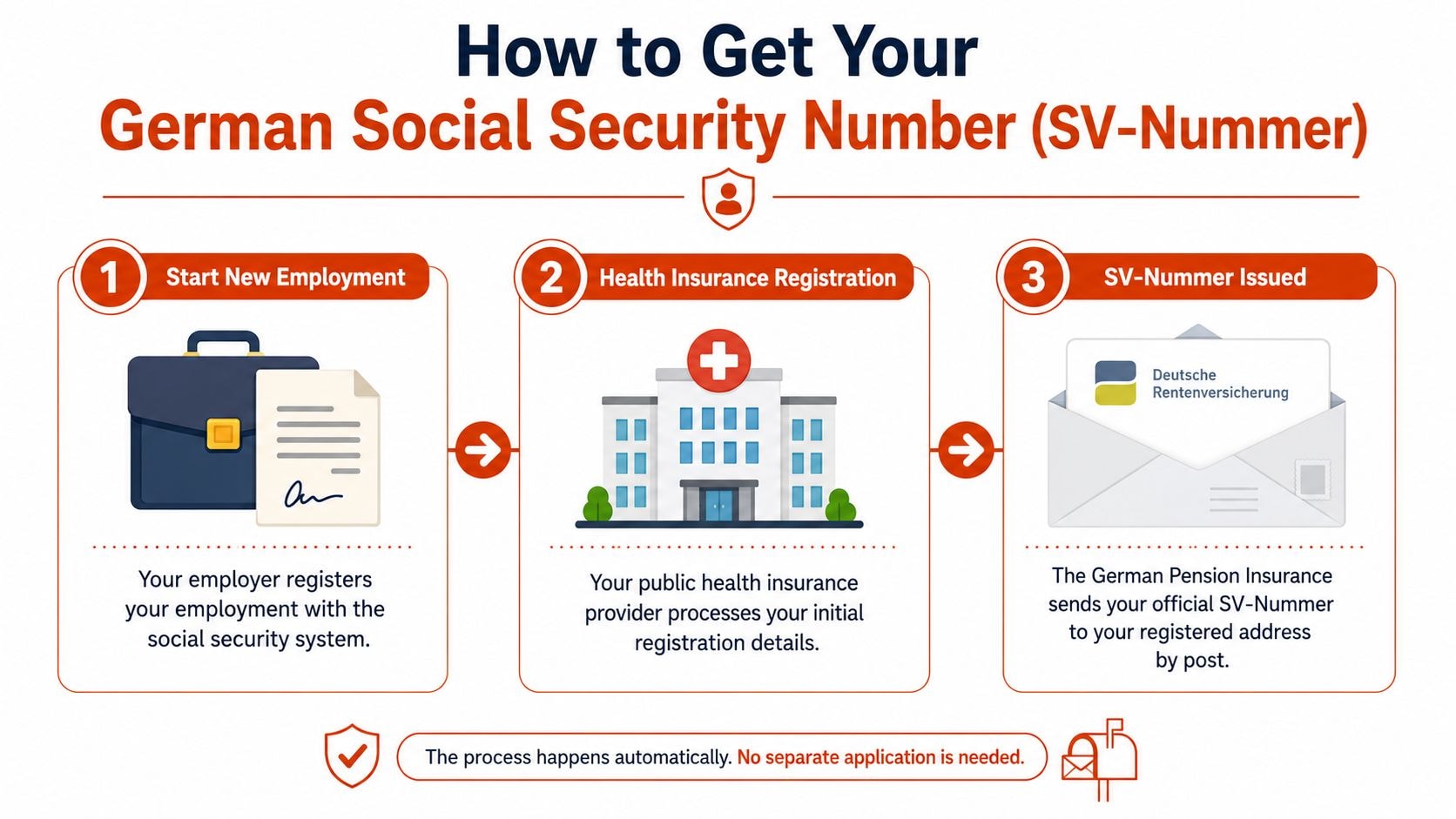
If you have public health insurance
For many employees, this process runs quietly in the background.
Once your address is registered, you join a public Krankenkasse, and your employer submits your payroll details, the pension insurance number is often created or matched automatically. Then it shows up later in official letters, payslips, or social security paperwork. Your health insurance number usually arrives faster because your Krankenkasse issues it as part of your membership.
A simple way to picture the order is this:
-
You complete your Anmeldung
-
You choose or confirm a public Krankenkasse
-
Your employer registers you for payroll and social insurance
-
Letters and confirmations arrive by post or through your insurer
If those first three steps are done, you often do not need to chase the pension number right away.
If you have private health insurance or you're a student
People often get stuck here, especially if they read a guide that assumes everyone is in the public system.
If you have private health insurance and have never been registered in Germany's public social insurance system before, the pension insurance number may not appear automatically. The same problem comes up for some international students, especially non-EU students. In those cases, you may need to request the number yourself from Deutsche Rentenversicherung and provide documents such as your passport and registration certificate.
A student-focused explanation from Provisit on getting a social security number as a non-EU student in Germany notes that privately insured newcomers and non-EU students often need to apply for the SVNR themselves rather than waiting for it to be issued in the background.
So the practical rule is simple. If you are publicly insured and starting a normal job, wait briefly and check your post. If you are privately insured, freelancing, or coming into the system through a less standard route, confirm early who is triggering the process.
If your employer says “please send your social security number,” ask one follow-up question: “Do you mean my pension insurance number or my health insurance number?” That one sentence saves a lot of back-and-forth.
If your employer asks before the number arrives, tell them clearly that it is still being issued or that you are requesting it now. German HR teams see this often with first-time employees and international hires.
And if the problem is not the form, but the phone call in German, appointment booking, or figuring out which office to contact, practical support can save you a lot of stress. SettlyGo offers health insurance call help in Berlin for exactly that kind of situation.
Lost a Number Here Is How to Find It
Sometimes the problem isn't getting the number. It's that you had it once and now can't find the letter.
That usually happens after a move, a rushed onboarding week, or a pile of unopened post from different offices. The good news is that the answer is often already in papers you have.
Where to look first
For your pension insurance number, start with documents tied to work.
Check these first:
-
Payslips: Look for labels such as SVNR, RV, or RNVR.
-
Annual social security statement: The official name can appear as Meldebescheinigung zur Sozialversicherung.
-
Yearly pension letters: If Deutsche Rentenversicherung has written to you before, the number may be there.
-
Health insurance membership documents: Public insurers sometimes include related information in your records.
For your health insurance number, look at your insurance card, membership confirmation, or insurer app or portal.
For your Tax ID, old tax letters or salary-related tax paperwork are often the easiest place to check.
If you still can't find it
If you're a privately insured newcomer or a non-EU student, keep one thing in mind: you may never have received the pension insurance number automatically in the first place. As noted earlier, that group often has to request the SVNR directly, and the process can take some time, so it is better to start early and keep HR informed.
A simple recovery plan helps:
-
First step: Search old payslips and official letters before making calls.
-
Second step: Contact your health insurer if you're publicly insured and ask what number they have on file.
-
Third step: Contact Deutsche Rentenversicherung if you still can't confirm whether a number exists.
-
Fourth step: Tell your employer what you've already done, so payroll knows the status.
A missing number and a not-yet-issued number are different problems. If you know which one you're dealing with, the next step becomes much clearer.
If your documents are all in German and you're not sure what you're looking at, it helps to sort them into three piles: tax, employment, and health insurance. That sounds basic, but it's often enough to spot the right letter quickly.
When to Use SettlyGo vs When to Hire a Professional
Most newcomer bureaucracy problems aren't legal problems. They're communication problems, document problems, or appointment problems.
That distinction matters. If you need someone to call a Krankenkasse, help you prepare for a Bürgeramt visit, organize your documents, or explain what a German letter is asking for in plain English, practical support is often enough. If you need legal interpretation, tax strategy, or formal representation, you need a licensed professional.
A simple decision guide
| Situation | Who is usually the right fit |
|---|---|
| You need help calling an office, landlord, or insurer in German | SettlyGo helper |
| You need support preparing standard documents for an appointment | SettlyGo helper |
| You need someone to help you understand a routine official letter | SettlyGo helper |
| You need legal advice about residency, a contract, or a dispute | Lawyer |
| You need tax advice, deductions, or freelancer tax setup | Tax advisor |
| You need a certified translation for official submission | Certified translator |
Where practical support helps most
SettlyGo is useful for friction points that make newcomers freeze:
-
German phone calls: Calling a Krankenkasse, Bürgeramt-related contact point, or landlord is often harder than the paperwork itself.
-
Appointment preparation: Many failed appointments happen because one form, one confirmation, or one copy is missing.
-
Document sorting: If your letters mention Steuer-ID, Versicherungsnummer, membership confirmation, and registration papers all at once, it helps to have a calm second pair of eyes.
-
Landlord communication and viewing support: This matters especially in Berlin, where housing paperwork often affects later registration steps.
For a clear scope of what practical support includes and where its limits are, read what SettlyGo can and cannot do.
SettlyGo does not provide legal advice, tax advice, immigration advice, medical advice, insurance brokerage, or certified translation. If your question is about tax treatment, visa law, employment disputes, or anything that needs formal legal or certified advice, use the right professional.
That honesty matters. It saves time and usually gets you better help faster.
Frequently Asked Questions
Do I need a social security number for a Minijob
Usually, your employer will still need the correct employment-related identifiers for registration. If someone says “social security number,” ask which German number they need. For many payroll situations, that means the pension insurance number, and employers may also need your Tax ID.
I'm a freelancer. What do I need
Freelancers usually focus more on tax registration than employee payroll registration. That means your tax-related identifiers matter most, and your setup can be different from an employee's. If you're freelancing in Germany and you're unsure what applies to your taxes, invoicing, or social insurance obligations, speak to a qualified Steuerberater rather than relying on general internet advice.
I have private health insurance. Will the number come automatically
Not always. If you've never had public health insurance in Germany, you may need to request the pension insurance number yourself from Deutsche Rentenversicherung. That's one of the most common reasons newcomers get stuck during onboarding.
I already started work and still don't have the number. Is that a disaster
Usually, no. Tell HR what you've already submitted and whether the number is still being issued or requested. The important thing is to clarify the status early instead of going silent.
What if I can't understand the official letters I'm receiving
Sort them by sender first. Tax office, health insurer, employer, pension office, and Bürgeramt letters each belong to different processes. Once you know which office sent the letter, the next action is usually much easier to identify.
If you're stuck between German letters, HR requests, health insurance forms, and Bürgeramt paperwork, book a SettlyGo helper. SettlyGo helps newcomers in Berlin with practical support like German phone calls, appointment preparation, document organization, landlord communication, and understanding routine letters. If your case needs legal, tax, immigration, medical, insurance brokerage, or certified translation advice, use a qualified professional for that part.
Need practical help in Berlin?
Book a verified SettlyGo helper for German phone calls, appointments, landlord communication, apartment viewings, and document preparation.