A Newcomer's Guide to the Tax Return in Germany
July 5, 2026 · 19 min read

You open a letter, see Finanzamt, and your stress level jumps immediately. That reaction is normal, especially if you're still getting used to Berlin paperwork, German terms, and the way official communication works here. A tax return in Germany can sound like one more difficult bureaucratic task, but for many newcomers it's also one of the few pieces of bureaucracy that can put money back into your account.
The hard part usually isn't only the tax rules. It's the process around them. Which number is your tax ID. Which papers matter. What that letter is asking for. Whether you need to call someone in German. Whether you should file at all. If that sounds familiar, this guide is for you.
Your First German Tax Return A Stress-Free Introduction
A common Berlin story goes like this. You started your job, your salary arrives, taxes are already taken out, and then someone at work casually says, “You should do your Steuererklärung.” If you're new in Germany, that advice can feel vague and slightly threatening.
In practice, a tax return in Germany is often just a yearly check between what was already withheld from your salary and what you owed. For employees, that's why filing can be worth it. Some published tax summaries report average refunds around the €1,000 range, including PwC's Germany tax administration overview, but that does not mean every newcomer will get a refund. Your result depends on your income, withholding, deductible expenses, family situation, and whether your filing is simple or complex.
That is why many people still choose to file, especially if they had commuting costs, home office expenses, or other deductible work-related costs during the year.
Why newcomers find this harder
The tax part is only one layer. Newcomers often hit trouble earlier:
-
Official letters feel unclear because the vocabulary is unfamiliar.
-
Missing documents create delays because employers, insurers, and offices all send paperwork separately.
-
German phone calls are stressful because even a simple clarification can feel high pressure.
-
Berlin timing matters because many admin steps connect to each other.
For example, your tax ID usually arrives after registration. In Berlin, Berlin.de confirms that registration is generally required within 14 days after moving in. It also confirms that identification is required, a Wohnungsgeberbestätigung is required, and a rental contract does not replace the Wohnungsgeberbestätigung. If that registration is delayed, later paperwork can feel messy too.
Practical rule: Tax filing gets much easier when your paperwork is sorted before you start. Don't begin with forms. Begin with your documents.
What deserves extra caution
Some situations are simple enough for software. Others are not. If you're self-employed, have multiple countries involved, have investment income you don't understand, or receive letters you can't interpret confidently, it's worth speaking to a qualified tax advisor. Practical support can help with communication and organization, but it can't replace professional tax advice.
German Tax Basics Explained Simply
The first confusing thing for many newcomers is that Germany uses several tax terms that sound almost identical. Once you separate them, the whole process feels less mysterious.
The two numbers people mix up
Steuer-ID means your personal tax identification number. It stays with you permanently. You usually receive it after registration, and you'll use it again and again for tax-related matters.
Steuernummer is different. That's a tax number connected to a specific tax file at the local tax office. Some people only encounter it later, especially once they begin filing.
A simple way to understand it:
| Item | What it is | How it feels in real life |
|---|---|---|
| Steuer-ID | Your long-term personal tax identifier | Like your permanent tax identity |
| Steuernummer | A file number used by the tax office | Like a local case number for tax processing |
The Finanzamt is your local tax office
Your tax return goes to the Finanzamt, which is your local tax office. In Germany, the responsible office is determined by your postal code. The tax year follows the calendar year, from January 1 to December 31, and tax residency begins when you establish a dwelling or stay more than six months in Germany.
Germany uses a progressive income tax system. The actual calculation depends on taxable income, personal circumstances, and current rules. For current calculations, use official tools such as the BMF income tax calculator or reliable tax software, and remember that taxable income is not the same as gross salary.
Germany does not use one flat income tax rate for everyone. The final result depends on your actual taxable income and circumstances.
Why Anmeldung and tax admin are connected
Many newcomers first meet the tax system indirectly through registration paperwork. After Anmeldung, other bureaucratic processes start moving more easily because your data becomes visible to the right offices.
If you're still trying to get that registration appointment in Berlin, it helps to check the official booking information and current requirements on Berlin.de.
That isn't tax advice. It's just one of those practical Berlin details that can prevent a chain of admin confusion later.
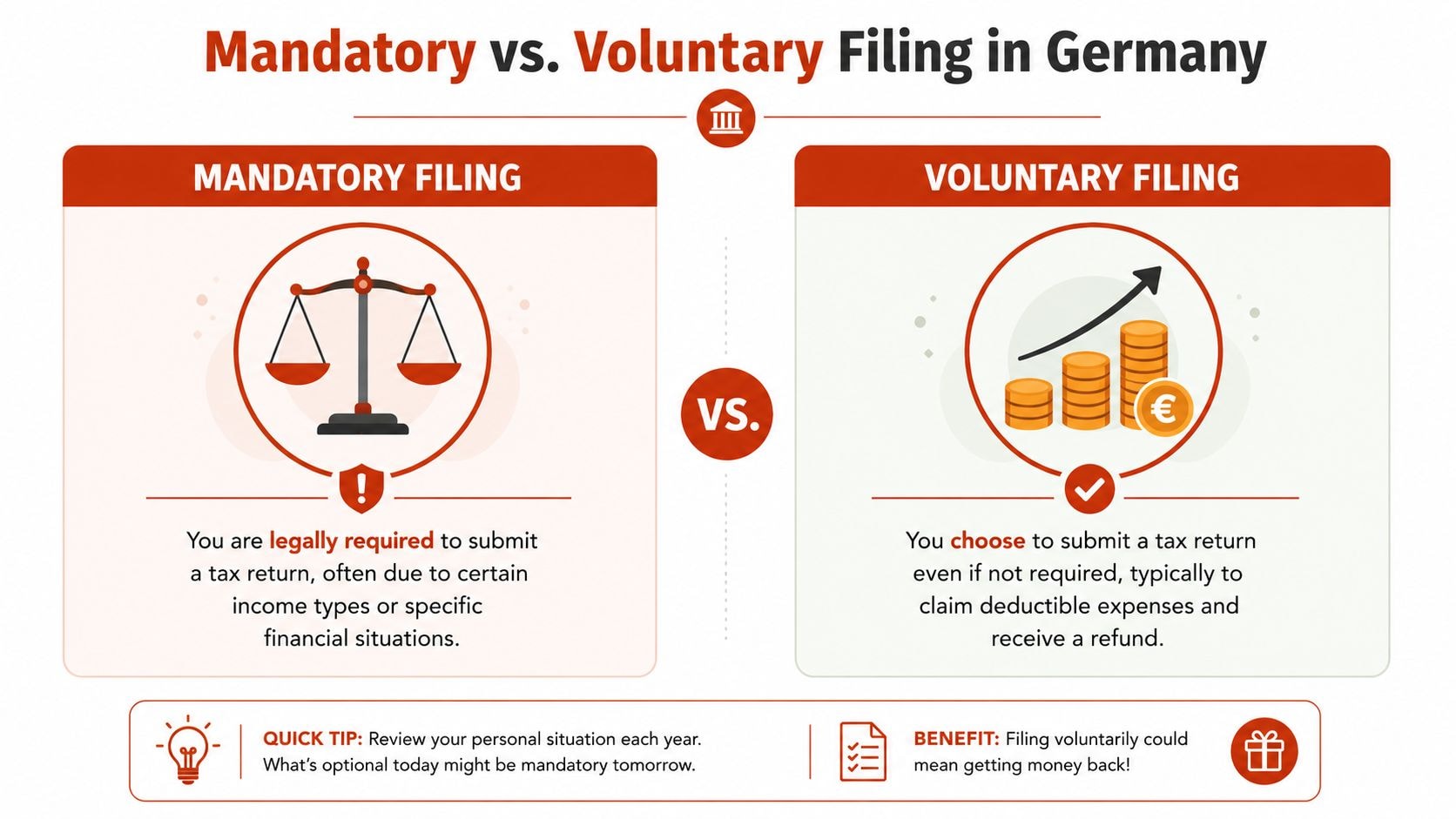
Do You Need to File a Tax Return Mandatory vs Voluntary
This is usually the first question people want answered. Not “How do I file?” but “Do I need to?”
The short answer is that some people must file, while others can choose to file because it may be financially worthwhile.
A quick decision guide
| Situation | Likely category | What it means |
|---|---|---|
| You are self-employed or freelance | Often mandatory | Payroll withholding usually has not settled everything |
| You have income not handled through German payroll | May be mandatory | The tax office may need the full annual picture |
| You had multiple employers, benefits, foreign income, or mixed situations | Case-specific | Check official guidance or ask a tax advisor |
| You are a typical employee with tax fully handled through payroll | Often voluntary | Filing may still be useful if you can claim expenses |
Whether you are required to file depends on your exact situation. Do not decide only from income level or online summaries. If you are unsure, check official guidance, ask the Finanzamt, use reliable tax software, or speak to a qualified tax advisor.
Mandatory filing
For newcomers, mandatory filing often applies in situations such as these:
-
Self-employment or freelance work, because payroll tax usually has not already settled everything for you.
-
Income outside normal German payroll withholding, which can make your yearly tax picture more complex.
-
Certain mixed situations involving Germany and another country, benefits, or multiple employers.
If any of these sound like you, do not rely on guesswork. This is the point where a Steuerberater or another qualified tax professional becomes important.
Voluntary filing
If you're a regular employee and your employer already withheld tax each month, you may not be legally required to file. But voluntary filing can still make sense because it's how you claim expenses and check whether too much tax was withheld during the year.
That matters for many newcomers because their first year in Germany is rarely “standard.” They move, work only part of the year, buy equipment, commute differently, or spend time working from home.
Good sign for voluntary filing: If your year involved change, transition, or extra work-related costs, filing is often worth checking.
A lot of stress comes from assuming that “not mandatory” means “not useful.” In Germany, those are two very different questions.
Key Deadlines and Processing Times
A common newcomer moment in Germany goes like this. You open a letter from the Finanzamt, recognize three words, and still cannot tell whether they want documents, payment, or just patience. With tax deadlines, that uncertainty is the primary problem. The date keeps running even if the German is hard to parse.
The main filing dates to know
German tax timing is easier once you separate two ideas. First, there is the tax year itself. Second, there is the deadline for sending in the return for that year.
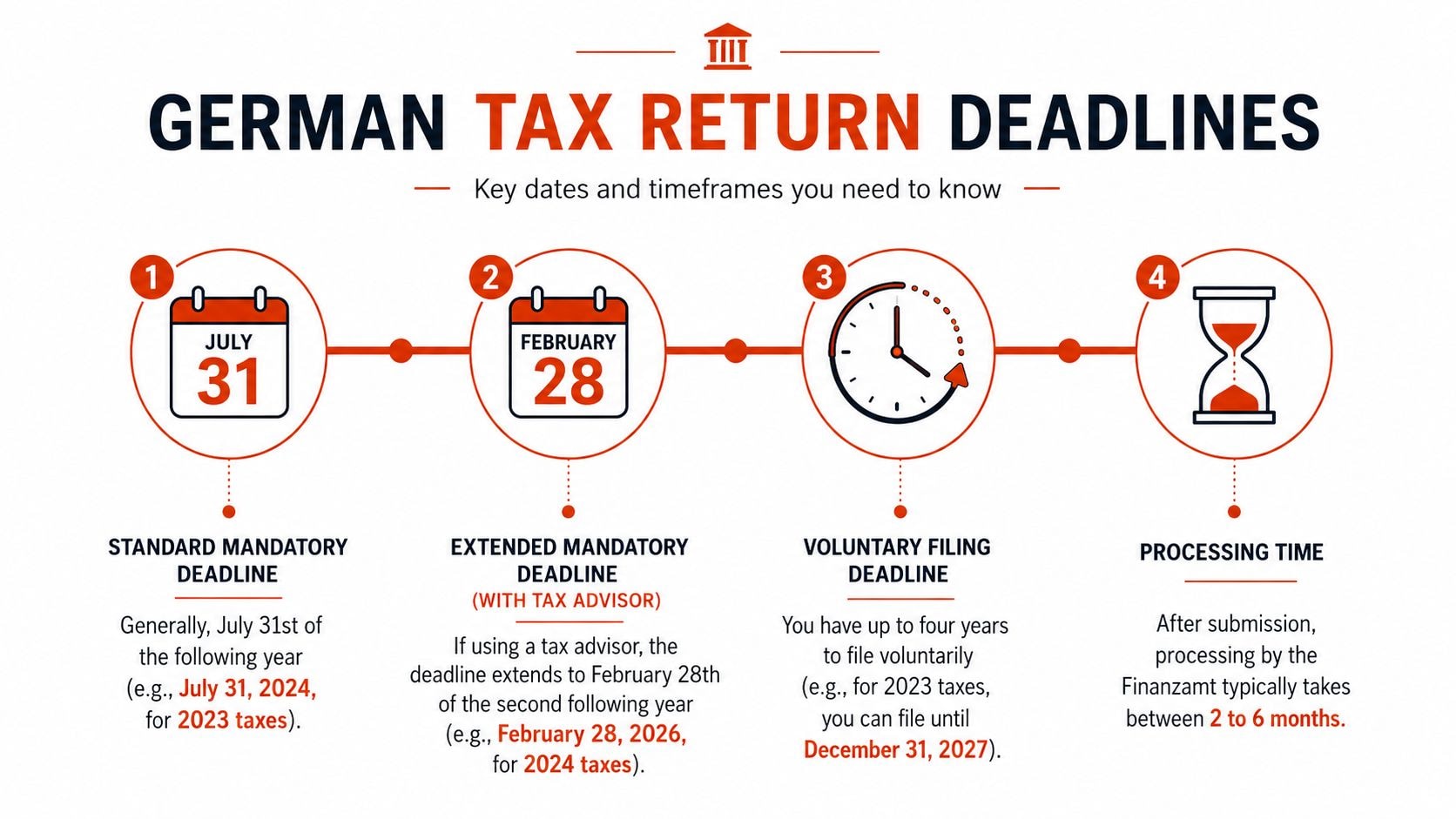
The tax year follows the calendar year, from January 1 to December 31. For people who are required to file, the standard deadline is usually 31 July of the following year. If a tax advisor or Lohnsteuerhilfeverein files for you, an extended deadline often applies. Voluntary filings usually follow a longer time window. Deadlines can change, and the Finanzamt can also request earlier action in individual cases, so always check the deadline for your exact tax year.
That extra time can help if your case involves foreign income, self-employment, or mixed residence questions. In those cases, professional tax help is the safer route.
Processing time after submission
After you file, the next step is waiting for the Steuerbescheid, the official tax assessment notice. It often takes weeks, sometimes longer, and the exact timing depends heavily on the local tax office.
Berlin may process some returns faster than other places, but there is no promise that your case will move quickly. A return with missing documents, unclear attachments, or questions from the Finanzamt can slow things down. A return filed perfectly in ELSTER can still sit in the queue.
A good practical rule is this. File early if you can, keep copies of everything, and check your post and inbox regularly after submission.
A simple calendar view
-
January to December. Your tax year runs with the calendar year.
-
By 31 July of the following year. This is usually the standard deadline for people who are required to file.
-
Later if a tax advisor or Lohnsteuerhilfeverein files for you. An extended deadline often applies.
-
After submission. The tax office reviews the return and sends the Steuerbescheid.
If you are waiting for a refund, silence does not automatically mean something is wrong. It often just means your file has not been processed yet.
The part many newcomers underestimate is the admin around the tax return, not the form itself. Letters arrive in formal German. Deadlines may be buried in a paragraph. A request for one missing document can pause the whole process. Keeping a clear folder from the start helps, and this document checklist for Berlin appointments is a useful model for organizing papers you may also need for tax matters.
If the tax office sends a letter you do not fully understand, act quickly. SettlyGo can help identify the sender, reference number, visible deadline and explicitly requested documents in the letter, and can help organize documents and prepare for calls. But if the letter asks for tax judgments, foreign income treatment, or corrections you are not sure about, speak to a qualified tax professional.
A Checklist of Required Documents and Information
The easiest way to reduce tax stress is to gather everything before you open any filing portal. Most problems come from missing papers, not from the form itself.
Your core folder
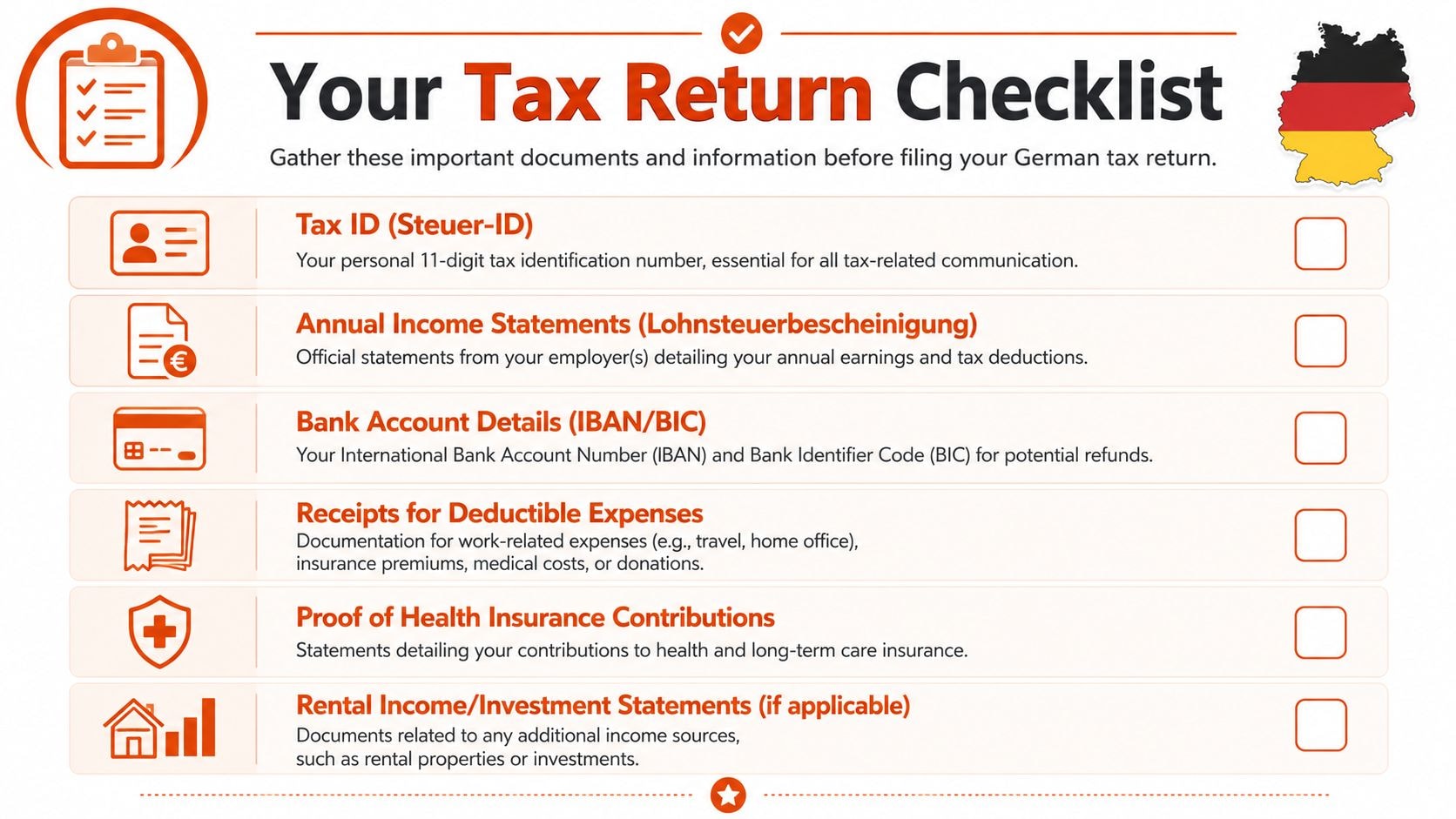
Start with the basics. These are the documents taxpayers need:
-
Steuer-ID. Your personal tax identification number.
-
Lohnsteuerbescheinigung. Your annual income statement from your employer.
-
Bank account details. You'll need your IBAN, and sometimes the BIC, so any refund can be paid correctly.
-
Health insurance contribution records. These are often issued automatically.
-
Any tax office letters you've already received.
If your paperwork is scattered across emails, paper envelopes, HR portals, and insurance accounts, it helps to build one folder first. A practical place to start is this documents checklist for Berlin appointments, which is useful even beyond appointments because the same habit of document organization makes tax admin much easier.
Proofs for common deductions
This is the folder people forget to build.
Keep supporting documents for things that might affect your return, such as:
-
Commuting-related records if your route to work changed during the year.
-
Home office records if you worked remotely and want to check whether that applies in your case.
-
Professional development such as courses or training related to your work.
-
Childcare or education expenses if those are relevant to your situation.
-
Donation receipts if you made eligible donations.
Some items are straightforward. Others depend on your exact status and the filing method you use. If you're unsure whether something counts, that's a tax advice question and belongs with a qualified advisor or trustworthy tax software guidance.
Extra papers for less standard cases
You may also need more if your year wasn't simple:
| Situation | Useful documents |
|---|---|
| You changed jobs | Income statements from each employer |
| You had foreign income | Statements and tax records from outside Germany |
| You had rental or investment income | Relevant annual summaries |
| You studied while working | Invoices or payment records related to education |
Keep this in mind: A missing receipt doesn't always end the discussion, but it does make your filing weaker. Save documents as you go, not months later.
For many newcomers, “doing taxes” is really “reconstructing a year of paperwork.” That's why preparation matters so much.
How to File Your Return Your Three Main Options
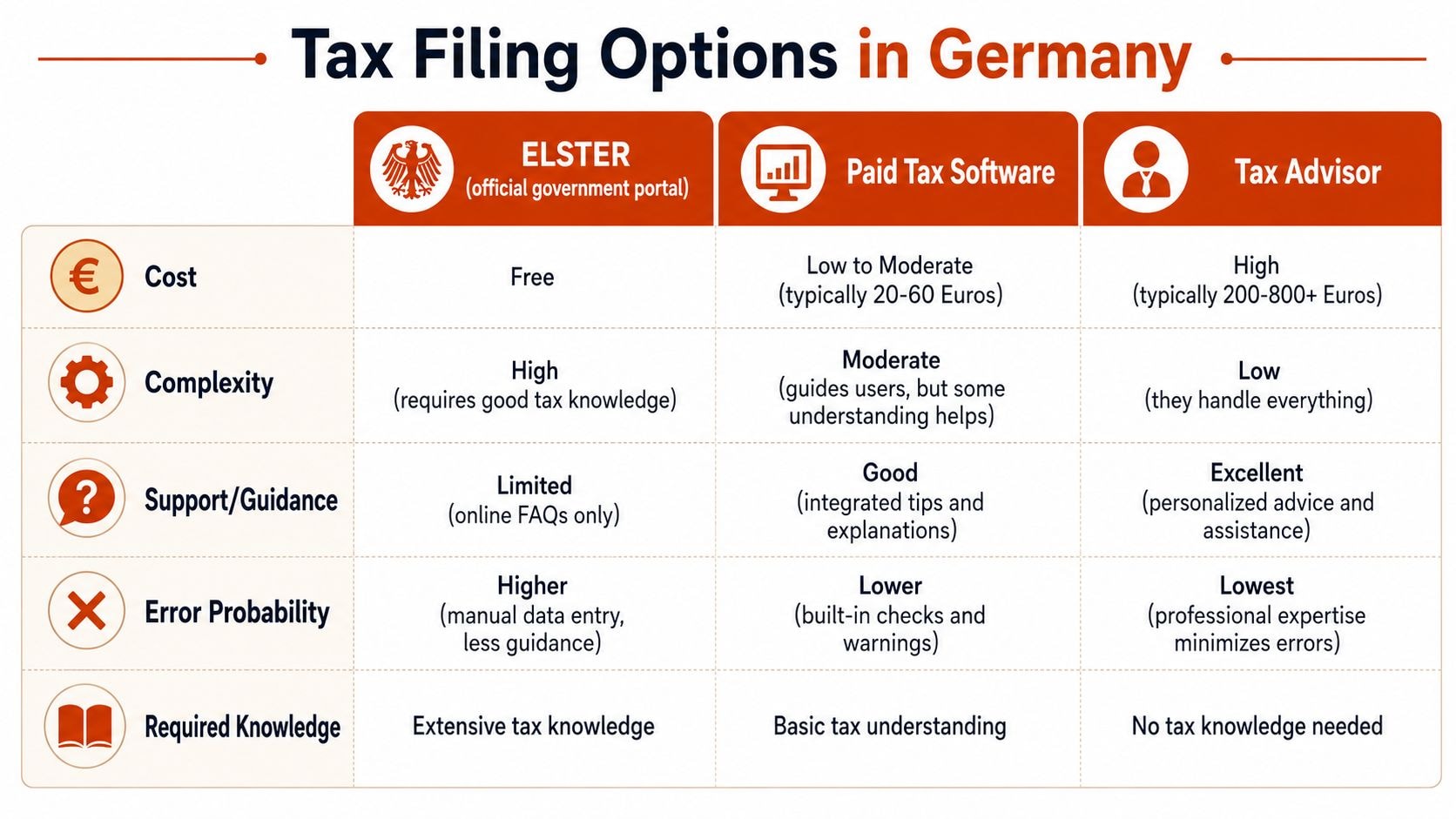
Most newcomers end up choosing between three routes: ELSTER, paid tax software, or a tax advisor. The best option depends less on confidence and more on how complicated your year was.
A quick comparison helps more than general advice.
Side by side comparison
| Criteria | ELSTER | Paid tax software | Tax advisor |
|---|---|---|---|
| Cost | Free | Low to moderate | Higher |
| Language comfort | Harder if your German is limited | Usually easier for newcomers | Communication depends on the advisor |
| Effort | High | Moderate | Lower for you |
| Best for | People comfortable with official systems | Employees with relatively standard cases | Complex or high-risk situations |
The infographic above includes typical price ranges, but the practical decision usually comes down to complexity and language comfort more than price alone.
Option one ELSTER
ELSTER is the official government portal. It's free, direct, and widely used.
It's also the least newcomer-friendly option if you don't read German well or if tax vocabulary still feels unfamiliar. ELSTER works best for people who are comfortable entering data manually and already understand the structure of German tax filing.
Option two paid tax software
Paid tax software sits in the middle. For many employees, this is the most realistic route because the software usually asks questions in a more guided way than official forms do.
That guidance doesn't replace tax advice. But it can reduce the risk of missing obvious entries and make the filing process feel less intimidating.
Later, if you need the practical side of settling into German admin more broadly, this Berlin bank account setup support page is relevant for one common newcomer bottleneck that often appears alongside tax paperwork.
To see how one filing route works in practice, this short video is useful:
Video walkthrough: watch it on YouTube.
Option three tax advisor
A Steuerberater is the right choice when your case includes questions that can materially affect the result or your compliance.
Use a qualified tax advisor if any of this applies:
-
Cross-border income from more than one country
-
Self-employment
-
Multiple income categories
-
Unclear obligations, especially after receiving official notices
-
Anything you might defend later if the tax office asks questions
Paying for professional tax advice can be cheaper than making a filing mistake you don't notice until later.
One boundary matters here. Practical admin support can help you organize documents, understand letters at a general level, and prepare for communication. It can't tell you what to claim, how to structure tax arguments, or what legal position to take.
Common Tax Scenarios for Newcomers
Tax guides often stay too abstract. Real life is messier. These are three situations that come up again and again for people filing a tax return in Germany for the first time.
The employee who worked from home and commuted sometimes
You moved to Berlin, started a job, and your year was a mix of office days and home office days. This is common, but many beginners only think about salary and forget the details around work.
Home office, commuting, work equipment, training, and other work-related costs may matter, but the rules and limits can change. Use reliable tax software or a qualified advisor before deciding what to claim.
The important part is not memorizing every deduction. It is realizing that your payroll withholding during the year may not reflect the full picture of your actual deductible costs.
The student or early-career newcomer
Students often assume tax returns are only for full-time employees. That's not always a safe assumption.
If you had part-time work, training-related costs, or an uneven work history during the year, filing may still be useful. International students and early-career workers also tend to have fragmented paperwork, especially when they moved accommodation, changed jobs, or switched health insurance arrangements.
In practice, the challenge is often documentation, not willingness. People know they “should probably file,” but they don't know where their records are or which papers are missing.
The person who worked only part of the year in Germany
This is one of the most overlooked newcomer situations.
If you worked only part of the year in Germany, filing may be worth checking because payroll withholding may not reflect your full-year situation. If another country is involved, get professional advice before deciding what to declare and how.
This scenario also deserves caution because cross-border income isn't something to improvise your way through. A qualified tax advisor is the right person to confirm how foreign income should be handled and what must be declared.
Common Mistakes and How to Get Practical Help
The stressful part of a German tax return is often not the tax return itself. It is the pileup around it. An unopened letter from the Finanzamt. A PDF buried in your downloads folder. A question you could probably solve with one phone call, if that call were not in formal German.
That is why small mistakes turn into big stress so quickly, especially for newcomers.
Mistakes that cause the most stress
The patterns are usually practical, not dramatic:
-
Mixing up voluntary and mandatory filing, then realizing the deadline mattered more than expected
-
Leaving tax office letters unanswered because the wording is hard to follow
-
Missing basic documents such as the annual income statement, insurance records, or relocation paperwork
-
Assuming payroll already handled everything even though the year included a move, job change, or part-year work in Germany
-
Treating a complex case like a simple one even when foreign income, freelancing, or self-employment is involved
A good way to think about this is paperwork momentum. Once one letter is ignored, the next step feels heavier. Then people stop because they are confused, not because the task is impossible.
Late filing is the mistake that creates the most pressure when filing is required. As noted earlier in the article, Germany can charge late filing penalties in mandatory cases. You do not need to memorize the formula. The practical lesson is simpler. If you may be required to file, do not leave the question unanswered for months.
Where practical support helps
Many newcomers do not need tax advice first. They need help getting the process into a manageable shape.
That often means:
-
Helping you identify the sender, reference number, visible deadline and explicitly requested documents in a Finanzamt letter, without giving tax advice or deciding what you should claim
-
Putting documents in order before using tax software or speaking to a tax advisor
-
Helping prepare or support a German phone call when you need to clarify practical information, while leaving tax judgments to qualified professionals
-
Creating one clear folder for letters, PDFs, payslips, insurance documents, and receipts
This kind of help matters because German bureaucracy often works like a relay race. One missing handoff slows everything down. If you cannot read the letter, you cannot answer it. If you cannot answer it, you cannot finish the return.
For language and admin friction in Berlin, practical human support for official letters, phone calls, and document organization can make the process much lighter.
Where practical support stops
Some situations need a qualified tax advisor, full stop.
Use a tax professional if your case involves foreign income, self-employment, business expenses with unclear treatment, legal interpretation, or any filing position you are not confident about. Practical support can help you prepare for that conversation by gathering papers and clarifying what the tax office asked for. It should not replace professional tax advice.
If you feel stuck, start with the next visible step, not the whole return.
-
Put every tax letter, PDF, payslip, and insurance document into one folder.
-
Find out whether your filing is voluntary or required.
-
Check what is missing before opening tax software.
-
Mark any issue involving foreign income or freelance work for a tax advisor.
-
Get help early if the main blocker is German, paperwork, or calling the office.
That approach saves a lot of wasted energy. You do not need perfect German or total confidence on day one. You need a clear next step, and enough support to take it.
If German tax letters, Finanzamt communication, or document organization are making the process stressful, book a SettlyGo helper. SettlyGo can help with practical admin support such as understanding routine German wording, organizing documents, preparing questions, and making German phone calls easier. SettlyGo does not provide tax advice, legal advice, immigration advice, insurance brokerage, medical guidance, certified translation, sworn interpretation, tax return preparation, tax filing, or official representation.
Need practical help in Berlin?
Book a verified SettlyGo helper for German phone calls, appointments, landlord communication, apartment viewings, and document preparation.