Translation Services for Families: Berlin Bureaucracy Guide
June 30, 2026 · 15 min read

Your first week in Berlin can feel like a stack of papers you didn't agree to. You're trying to settle your children, find the nearest supermarket, and figure out why an official letter has arrived before you've even learned where to buy printer paper. Then someone tells you that you need Anmeldung, another person says you need a certified translation, and a third says to just bring a German-speaking friend.
That mix of advice is where families usually get stuck.
In Germany, translation services for families aren't one single thing. You might need a sworn translator for one document, a live interpreter for a doctor's visit, and simple practical help for a Bürgeramt appointment or a landlord phone call. Choosing the wrong kind of support can waste money, delay paperwork, or leave you standing at a counter with the wrong documents.
Berlin makes this more intense because so much depends on getting the basics done quickly. Registration enables daily life. Official letters keep coming. Appointments are short. Staff often switch fast between questions, forms, and instructions.
This guide is for that exact moment. It's a practical map for families who need to know what kind of language help to use, when to pay for formal translation, and when a practical helper is enough.
You've Arrived in Berlin Now for the Paperwork
A familiar Berlin family scene looks like this. One parent is refreshing the Bürgeramt booking page. The other is checking whether the landlord already sent the Wohnungsgeberbestätigung. A child is asking when school starts. An envelope from a Krankenkasse is sitting on the table, unread, because every line seems important and none of it feels clear.
That stress is normal. German bureaucracy rewards precision, not improvisation. If you're new, it's hard to tell whether a task needs official translation, live interpreting, or just someone calm who can help you prepare documents and explain what the office is asking for.
Berlin is full of moments like that. You call a landlord and miss a viewing because the conversation moves too quickly. You attend an appointment and realize the issue wasn't your German vocabulary. It was that you didn't know which document mattered most, what the clerk would ask, or what had to be brought in original form.
Practical rule: Most family bureaucracy problems in Berlin are not pure language problems. They're a mix of language, timing, document order, and office expectations.
That's why generic advice often doesn't help. “Just translate everything” is expensive. “Just use DeepL” is risky. “Just ask a friend” can work for a casual message, but it's weak support for a residence-related appointment, health insurance call, or school meeting where details matter.
A calmer approach is to separate the task first. Is this about an official written document, a live conversation, or a practical appointment where someone needs to help you understand the process? Once you know that, the next step becomes much easier.
The Four Main Types of Language Support in Germany
Germany uses several kinds of language help, and families often mix them up. That confusion gets expensive fast, especially if you pay for a formal service when a simpler one would do, or arrive with informal help when the authority wants something official.
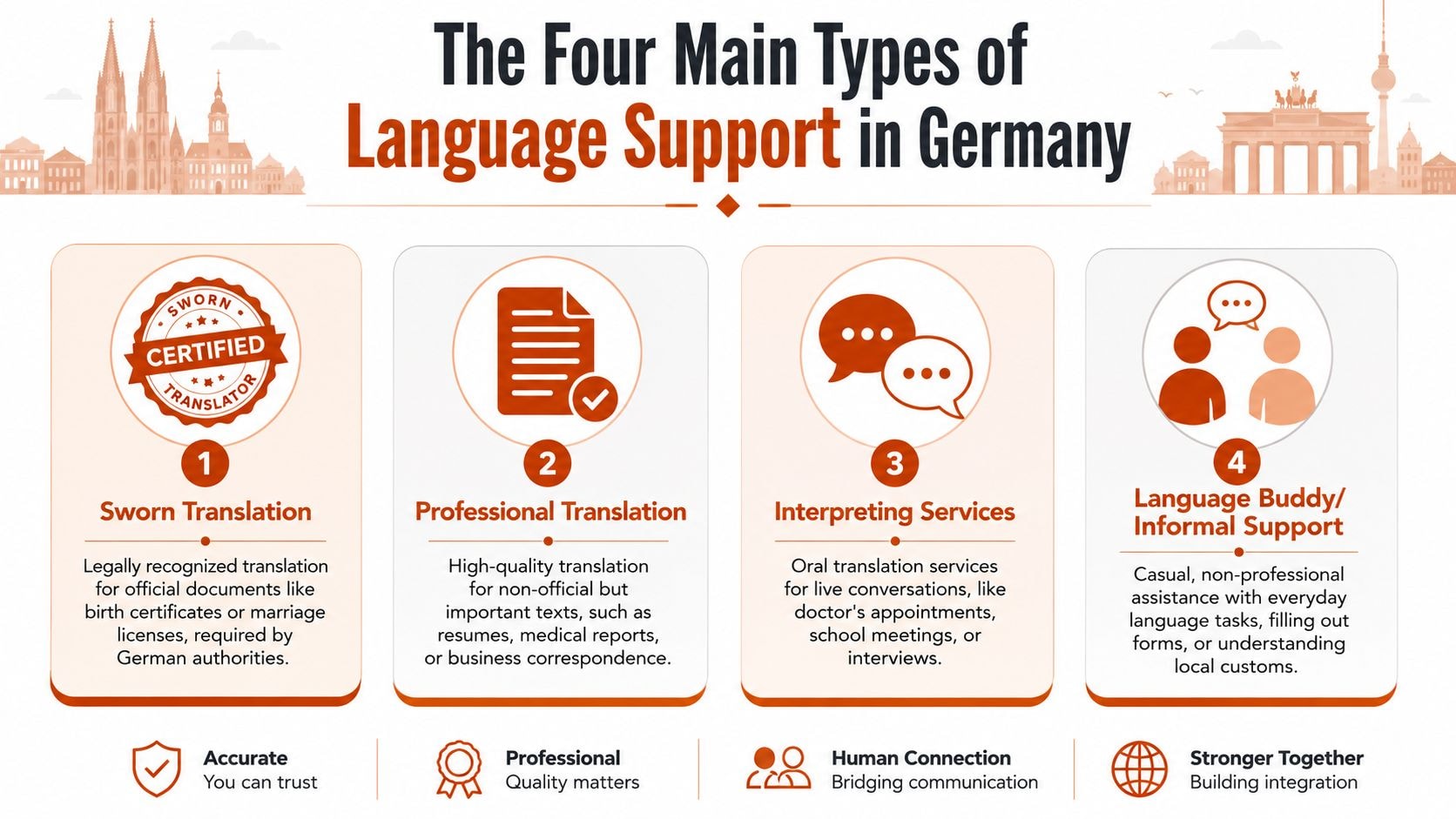
Sworn translators for official acceptance
A sworn translator translates documents that must be formally accepted by an authority or institution. Think of birth certificates, marriage certificates, academic records, or legal status documents when the receiving office explicitly asks for a certified or sworn translation.
This is not the place to save money by improvising. The point isn't just that the text becomes readable in German. The point is that the translated document carries the formality required for submission.
If an office, university, court, or immigration-related process says the translation must be certified, use a qualified sworn or certified provider. A practical helper cannot replace that.
Standard document translation for important but informal use
Sometimes you need a good written translation, but not a legally recognized one. That might include a school letter, a doctor's note you want to understand, a rental message, or supporting paperwork you're organizing for your own clarity before an appointment.
This category matters because professional document translation can still be costly. Professional translation costs vary by language pair, document type, urgency, and whether the translation must be certified. Always ask whether the quote is for a standard translation or a sworn/certified translation.
A non-certified translation can still be worthwhile when accuracy matters and machine translation feels too risky. But it's still the wrong tool if you need live support at a counter or on a phone call.
Live interpreters for conversations that happen in real time
Interpreting means spoken language support during a live interaction. Doctor's appointments, school meetings, landlord calls, and office appointments all fall into this category.
The value here is speed and clarity. A live interpreter helps both sides understand each other as the conversation unfolds. That matters because many family problems happen in real time. A receptionist asks a follow-up question. A clerk wants a missing paper. A doctor explains the next step. A school administrator asks about previous records.
Written translation won't solve that. You need someone who can listen, relay, and keep the conversation accurate.
Practical appointment helpers for everyday bureaucracy
There's also a fourth category that families in Berlin often need most. Practical support for routine bureaucracy. This isn't legal advice, and it isn't certified translation. It's help with tasks such as:
-
Preparing forms so you don't show up with half the paperwork missing
-
Understanding official letters well enough to know what action is needed
-
Making German phone calls to confirm what an office, insurer, or landlord wants
-
Attending routine appointments for language support and practical coordination
This type of support is especially useful for Anmeldung, bank appointments, landlord communication, and general document organization.
The practical takeaway is simple. Don't buy a legal tool for an everyday task. Don't use everyday help for a formal submission.
Deciding Between Certified Translators and Practical Helpers
Families often overpay or underprepare. They hear “translation” and assume every task belongs in the same bucket. It doesn't.
One useful way to decide is to ask a blunt question. Does the office need to accept a document, or do you need help managing communication? Those are different problems.
Use a certified or sworn translator when the document itself must be accepted
Choose this route when the translated paper is part of the formal file. Common examples include foreign civil-status documents, academic records, or any paperwork where the receiving office explicitly asks for a sworn or certified translation.
That kind of service is about document validity. The goal is acceptance. In Germany, you can search for publicly appointed or sworn translators and interpreters through the official German justice translator/interpreter database: justiz-dolmetscher.de. The English-language justice portal also explains the database and how it works.
Use this service when:
-
The authority says certified translation is required
-
You're submitting a birth or marriage certificate
-
You're filing academic or legal records that must become part of an official process
-
A school, court, or immigration-related office asks for a formally recognized translation
If you're unsure whether your case needs this level, check the office's written requirements before paying anyone.
Use an interpreter or practical helper when the problem is communication
A different approach makes sense when your real problem is the appointment itself. That's common with Anmeldung, landlord calls, school meetings, health insurance questions, and front-desk conversations where nobody is asking you to submit a sworn translation.
For practical scope and service boundaries, it helps to review what SettlyGo can and cannot do.
Bring a formal translator when the paper must pass inspection. Bring a practical helper when the conversation, preparation, or office navigation is the hard part.
A quick decision table
| Situation | Best fit | Why |
|---|---|---|
| Birth certificate for official submission | Sworn or certified translator | The document itself must be accepted |
| Marriage certificate for a formal authority process | Sworn or certified translator | Informal help isn't enough |
| Bürgeramt appointment for Anmeldung | Practical helper or interpreter | The main challenge is communication and preparation |
| Calling a landlord about missing documents | Practical helper | This is a live conversation, not a formal translated filing |
| Health insurance letter you need explained | Practical helper first, professional specialist if needed | Many letters need interpretation and next-step clarity rather than formal translation |
| Doctor's appointment | Professional interpreter where possible | Accuracy in live medical communication matters |
Families often try to solve all of these with one service. That's the mistake. Match the support to the task.
Your Family's Bureaucracy Checklist for Berlin Appointments
Berlin appointments become much easier when you prepare by task, not by panic. Every office has its own rhythm, but the same family pattern comes up again and again. Gather documents early, bring originals where needed, and decide in advance whether you need official translation or practical language support.
A good starting point is this visual checklist.
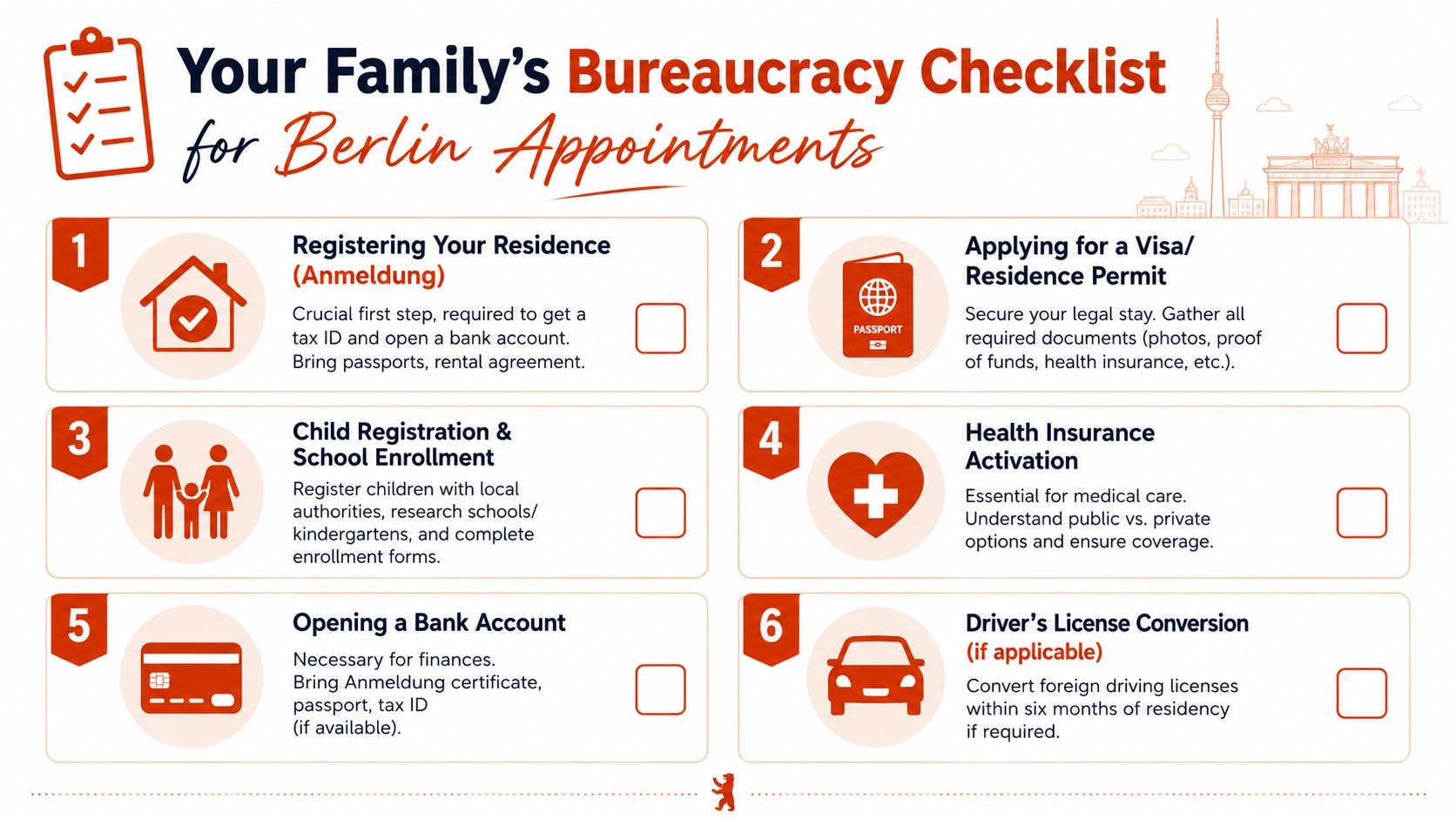
For a planning tool you can save and review before your visit, use this documents checklist for Berlin appointments.
Anmeldung at the Bürgeramt
Anmeldung is usually the first major hurdle. In Berlin, you generally need to register your address within 14 days of moving into a new home, according to the official Berlin service page for registering a residence.
The appointment itself is often brief. A Berliner Sparkasse guide explains that the Bürgeramt appointment usually takes around 10 to 15 minutes and that registration is required to get a Tax ID, open a bank account, activate a mobile contract, and enroll in health insurance. That's why families feel so much pressure around it. So many later steps depend on this one.
Your checklist:
-
Passports or ID documents for all family members attending
-
Anmeldung form completed as clearly as possible
-
Rental details ready and consistent with your housing paperwork
-
Wohnungsgeberbestätigung in the format requested by Berlin.de
The last item is the one that breaks many appointments. The Wohnungsgeberbestätigung is one of the key required documents for Anmeldung. A rental contract does not replace it. Check the current Berlin.de service page before the appointment and bring the form in the format requested there.
If you only double-check one paper before an Anmeldung appointment, make it the Wohnungsgeberbestätigung.
For language support, most families don't need certified translation here. They need help organizing the file, checking what's missing, and understanding questions during the appointment.
Residence permit at the Ausländerbehörde
Residence-related appointments are a different category. The stakes feel higher, and some documents may need more formal handling depending on your exact case.
Bring order to the paperwork before anything else:
-
Passport and current visa or entry documents
-
Appointment confirmation
-
Biometric photos if requested
-
Proof tied to your category, such as employment, studies, or family basis
-
Health insurance evidence
-
Housing-related documents
-
Any foreign civil-status records that the office specifically wants in formal translated form
Often, families mix up the support types. If the authority wants a formally accepted translation of a foreign record, use a qualified certified or sworn translator. If the appointment itself is the stressful part, practical support can still help you prepare the pack, sort the sequence, and understand what happened during the conversation.
A calm debrief after the appointment is often just as valuable as support during it. Many families leave the Ausländerbehörde with one new paper, one verbal instruction, and one deadline they didn't fully catch.
Opening a bank account
A bank appointment is usually less intimidating than an authority visit, but it can still go wrong if your registration is incomplete or if the branch asks for one extra item you didn't expect.
Typical preparation includes:
-
Passport or ID
-
Proof of address registration if available
-
Tax-related identification once issued, if the bank asks for it
-
Phone number and contact details
-
Questions you want answered, especially around cards, online banking, and account activation
This is a strong example of where a practical helper is usually enough. The issue is rarely legal translation. It's making the appointment, confirming requirements, and keeping the meeting clear if the staff member switches into rapid German.
School or Kita enrollment
Families often underestimate the language load here because the setting feels friendlier than a government office. But school and Kita paperwork can still be dense, especially when forms refer to previous records, vaccination information, emergency contacts, and local procedures.
Bring and organize:
-
Child identification documents
-
Address registration documents if required
-
Previous school or childcare records
-
Vaccination or medical forms if requested
-
Emergency contact details
-
Any school letters you need help understanding before the meeting
This is usually not a certified-translation-first problem unless the institution specifically asks for formal translated records. It's more often a practical communication problem. Parents need to understand what they're signing, what the next deadline is, and who to contact if something is missing.
For school and medical settings, avoid using your child as the family interpreter. It creates pressure, distorts communication, and puts responsibility in the wrong place.
How SettlyGo Offers Practical On-the-Ground Support
The most useful support for many families in Berlin isn't a full relocation agency and it isn't a sworn translator. It's focused human help for the exact task in front of you.
SettlyGo fits that middle space. It's built around practical newcomer support in Berlin, including German phone calls, appointment preparation, document organization, landlord communication, and routine bureaucracy help. If you want to see the service category directly, the most relevant page is paid human support in Berlin.
What this kind of help is good for
A few examples make the difference clearer.
You've received a health insurance letter and can't tell whether it's asking for missing documents or just confirming enrollment. A helper can go through the letter with you, explain the practical meaning, and help you prepare the next call or reply.
You have a Bürgeramt appointment tomorrow and want someone to check whether your file is complete, especially the Anmeldung form and housing papers. That's practical support.
You need to call a landlord, utility provider, bank branch, or insurance office and don't want to gamble on your German under pressure. That's also practical support.
Good practical help reduces avoidable mistakes. It doesn't pretend to replace specialists.
Where the boundary is
This matters just as much as the service itself. SettlyGo is not a law firm, immigration consultancy, tax advisory service, insurance broker, medical provider, or certified translation office. It doesn't provide legal advice, tax advice, or sworn translations.
That boundary is a strength, not a weakness. It keeps expectations clear. If your family needs a formally recognized translated document, use a qualified sworn or certified translator. If you need legal or immigration advice, use a qualified professional in that field.
But for the daily Berlin problems that wear newcomers down, confusing letters, office calls, document preparation, document organization, appointment support, landlord communication, and routine bureaucracy help, practical local help is often the most useful tool.
SettlyGo can help with practical support such as German phone calls, appointment preparation, document organization, landlord communication, and routine bureaucracy help.
SettlyGo does not provide legal advice, immigration advice, tax advice, insurance brokerage, medical advice, certified translation, or sworn interpreting.
Key Questions to Ask Any Language Service Provider
Families make better decisions when they ask sharper questions early. A good provider should answer clearly, without vague promises.
Questions for a sworn or certified translator
Ask these before sending documents:
-
Are you publicly appointed or sworn in Germany for this type of translation?
-
Will this translation be suitable for the specific authority or institution I'm dealing with?
-
What exactly is included in the fee?
-
How do you handle names, stamps, signatures, and formatting?
-
What turnaround can you realistically offer without rushing quality?
For written work, process matters. Strong providers use proper review and formatting checks so documents stay usable, especially when records include tables, headings, or structured forms.
Questions for an interpreter or appointment helper
The best questions here are practical:
-
Have you handled Bürgeramt, school, landlord, or health insurance situations like mine before?
-
Will you help before the appointment, during it, or both?
-
How do you handle something you don't know on the spot?
-
Can you help me prepare my documents in the right order?
-
Will you summarize the next steps afterward?
There's one more question families should ask themselves. Who is interpreting for us, and should they be? The answer should not be your child. For medical, school, or sensitive family conversations, avoid relying on children as interpreters. Use an adult professional, interpreter, or suitable neutral support person so the child is not put under pressure and important details are not missed.
You've Got This and You Are Not Alone
Berlin paperwork feels bigger when every task arrives at once. But the system becomes much easier once you stop treating every language problem as the same kind of problem.
Use a sworn or certified translator when the authority needs a formally accepted document. Use an interpreter when the risk is misunderstanding a live conversation. Use practical support when the challenge is preparing paperwork, understanding letters, handling phone calls, or getting through routine appointments without missing a step.
That distinction saves money, time, and stress.
Families usually don't need more information. They need the right kind of help for the exact task in front of them. One clear phone call, one checked document folder, or one calm appointment can change the whole week.
If you're stuck with a Berlin appointment, a confusing German letter, or paperwork you don't trust yourself to handle alone, get support before the stress snowballs.
If you need practical newcomer help with German phone calls, appointment preparation, landlord communication, or everyday bureaucracy in Berlin, you can book a helper through SettlyGo. For task-specific support, these pages are a good starting point: German phone call help, landlord communication help in Berlin, and health insurance call help in Berlin.
Need help with Anmeldung or the Bürgeramt?
Book a verified SettlyGo helper to guide you through city registration, document preparation, and office appointments in Berlin.