Apostille in Berlin: Document Legalisation Guide for Newcomers
September 4, 2026 · 11 min read
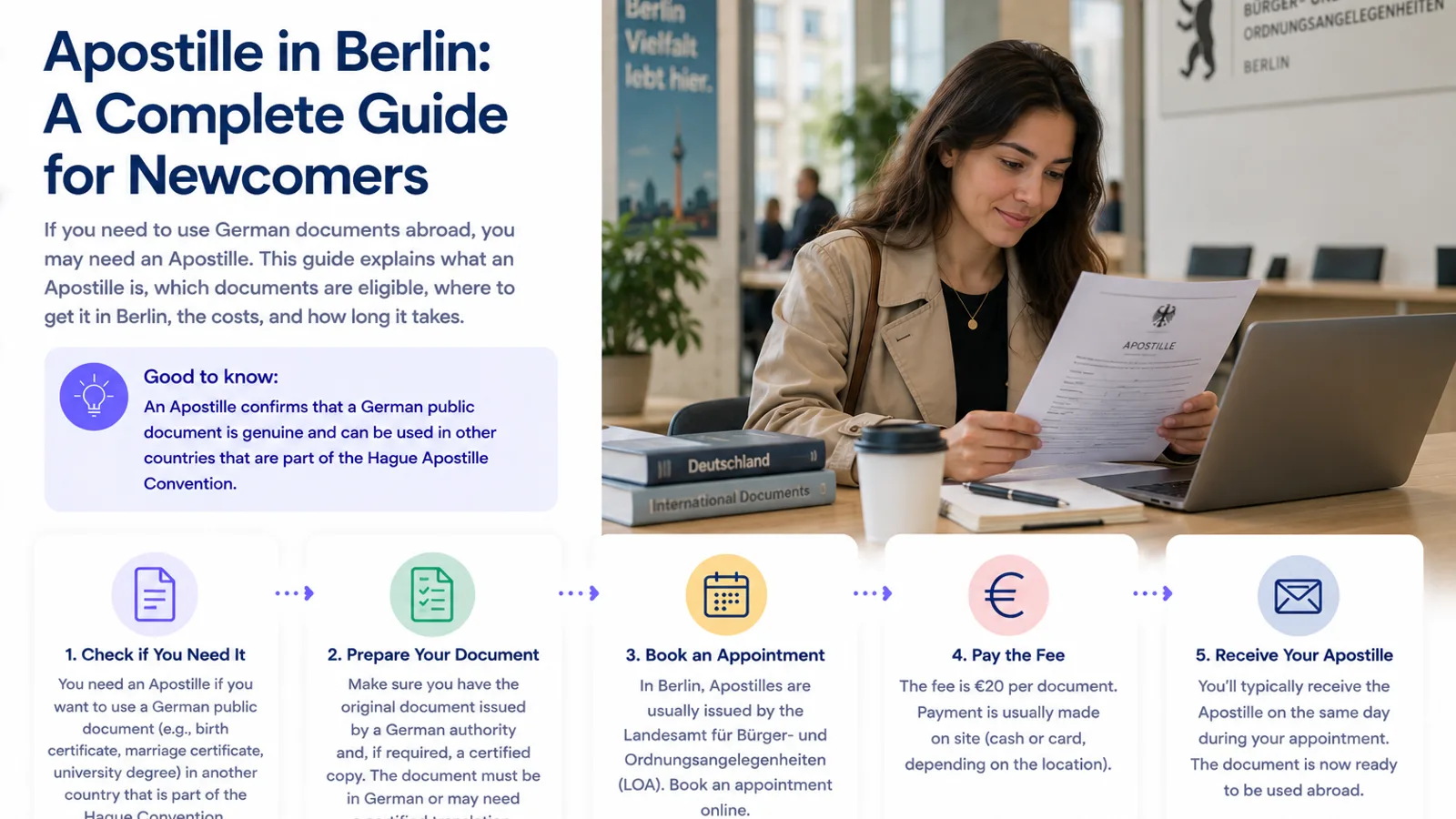
If you need to use a German document abroad, the receiving authority may ask for an apostille or legalisation before it will accept the document.
This comes up for newcomers and international families when dealing with matters such as marriage abroad, employment, study, family procedures or other cross-border administration.
The confusing part is that an apostille is not the same as a certified copy, a translation or a normal Bürgeramt certification. The correct route depends on the document, who issued it and the country where you want to use it.
SettlyGo scope: SettlyGo can help you find the relevant official Berlin process, organize visible requirements, prepare questions and support ordinary German communication. SettlyGo does not decide whether a foreign authority legally requires an apostille or legalisation, authenticate documents, certify translations, provide legal advice or guarantee that a receiving authority will accept a document.
What is an apostille?
An apostille is a standardized authentication used under the Hague Apostille Convention for public documents moving between participating countries.
Germany's Federal Foreign Office explains that an apostille confirms the authenticity of the signature and the authority of the person who issued the public document. Unlike legalisation, it is issued by a designated authority in the country where the document originated.
For Berlin administrative documents, the official Berlin apostille service says the Landesamt für Bürger- und Ordnungsangelegenheiten (LABO) can issue the apostille when the document falls within its responsibility.
Do not request an apostille simply because a document will leave Germany. First confirm that the receiving country and receiving institution actually use the apostille procedure for your document.
Apostille vs legalisation
These processes serve a similar purpose but use different routes.
Apostille
For countries where the Hague Apostille Convention applies in relation to Germany, the designated German authority can place the apostille on the public document.
There is normally no additional authentication by the receiving country's consulate as part of the apostille procedure itself.
Legalisation
For countries where the apostille procedure does not apply, the receiving country's embassy or consulate may require legalisation.
Berlin explains that LABO can issue a Vorbeglaubigung (a pre-authentication), and you then take the document through the further steps required by the relevant foreign representation.
The Federal Foreign Office notes that some countries may also require an additional German authentication step before the foreign mission performs legalisation.
Because country rules differ, ask the authority that will receive the document, or the relevant embassy or consulate, which procedure it requires before starting.
Which Berlin documents can LABO authenticate?
Berlin's LABO service applies to public documents issued by a Berlin authority and falling within LABO's area of responsibility.
You normally need to present the original document.
Examples can include Berlin administrative documents that a foreign authority wants authenticated for use abroad.
But not every document issued in Berlin goes through the same office.
The Federal Foreign Office explains that Germany divides apostille responsibility by document type. Administrative documents from Berlin generally go through LABO, while judicial and notarial documents can have different competent authorities.
What if the document comes from a Berlin court or notary?
Do not automatically send court or notarial documents to LABO.
Berlin has separate procedures for documents such as:
- court judgments and decisions;
- inheritance certificates and court settlements; and
- notarial documents, certificates and certain translations intended for use abroad.
For example, Berlin's separate court-document authentication service directs judicial documents to the responsible courts, while notarial-document authentication has its own judicial route.
Check the document's issuer first. Using the wrong authority can add an unnecessary extra step.
What about school certificates and university documents?
Some education documents need a pre-certification step before LABO can issue the apostille or pre-authentication for legalisation.
Berlin currently gives separate instructions depending on the institution.
For example:
- school documents can require prior handling by the responsible Berlin education administration;
- documents from a state university can require pre-certification by the university's responsible examination office; and
- documents from certain state-recognized private universities can require a different Berlin authority first.
The exact path depends on who issued the document.
Do not send an education certificate directly to LABO until you have checked whether a pre-certification is required.
What about medical certificates or tax documents?
Berlin also lists special pre-certification routes for some other document categories.
German-language medical certificates can require a prior step through the responsible health authority.
Certain tax-office certificates can require pre-certification through Berlin's finance administration.
Chamber documents (for example from professional chambers or the IHK) can also require the relevant chamber to act first.
These categories are a good example of why "I need an apostille in Berlin" is not enough information by itself. The document issuer matters.
Do you need the original document?
For the main Berlin LABO service, yes.
Berlin currently says documents issued in Berlin must be submitted in the original for authentication.
A normal photocopy or Bürgeramt-certified copy should not be assumed to replace the original for this procedure.
If the foreign authority asked for both an apostille and a translated or certified copy, confirm the required order of steps before altering, copying or translating the document.
Is a certified copy the same as an apostille?
No.
A beglaubigte Kopie confirms that a copy matches the original presented to the certifying authority.
An apostille authenticates a public document for cross-border use under the applicable international procedure.
A legalisation involves authentication through the diplomatic or consular route of the country where the document will be used.
If someone asked you for an apostille, getting only a certified copy is not an equivalent substitute.
If you only need a certified copy for a German administrative purpose, see the separate SettlyGo guide to beglaubigte Kopien in Berlin.
Is a translation included?
No.
An apostille does not translate the document.
The receiving authority may separately require a translation, and it may specify who is allowed to prepare that translation.
For court decisions used abroad, Berlin specifically advises applicants to handle a required translation after the authenticity certification when the destination requires one.
Do not assume the same order applies to every document or country. Ask the receiving authority which document, authentication and translation sequence it accepts.
How can you apply in Berlin?
Berlin currently allows the LABO process to be handled in person or by post.
The official service recommends the written/postal route for apostille and pre-authentication applications when practical.
If applying by post, use Berlin's current official form and mailing instructions rather than sending documents to a guessed office address.
If you need the documents returned outside Germany, Berlin warns that international return delivery can take longer and creates additional postage costs.
Do you need an appointment for an in-person application?
Berlin's current LABO location information says a prior appointment is not mandatory for this service; a waiting-number system is available.
Appointments can still be offered, and Berlin currently limits a booked appointment to a maximum of three documents requiring authentication.
If you have more than three documents, check the current instructions before booking or travelling to LABO.
Opening arrangements can change temporarily, so verify the location page on the day you plan to go.
Where is the Berlin LABO apostille office?
The current Berlin ServicePortal lists the responsible LABO unit at Friedrichstraße 219, 10969 Berlin.
Because offices can change opening arrangements or temporary access rules, use the location linked from the official service page immediately before travelling rather than relying on an old saved address or timetable.
How much does an apostille cost in Berlin?
As of 4 September 2026, Berlin lists:
- €19 per document for an apostille; and
- €19 per document for a pre-authentication for legalisation.
Additional postage applies when Berlin sends authenticated documents abroad.
Berlin separately lists €5 per page for a different service involving certification of German passports, identity cards and residence permits; do not confuse that with the €19 apostille fee.
Fees can change, so check the official service page before applying.
How long does it take?
Berlin currently gives very different estimates depending on how you apply.
For an eligible document handled in person, the ServicePortal lists the processing as immediate.
For documents sent to LABO by post and returned within Germany, Berlin currently gives an average processing time of about two weeks.
For international return delivery, Berlin does not provide a binding delivery time because postal transit is outside the authority's control.
If you have a foreign deadline, build in extra time for pre-certification, postal transit, embassy/legalisation steps and translation where applicable.
Can Berlin send the authenticated document abroad?
Berlin says international return shipping is possible, but it can take longer and involves additional postage.
The authority currently uses registered international delivery with return receipt for this route and provides a tracking number after dispatch.
Do not plan a visa, marriage, university or employment deadline around an assumed international delivery date. Berlin explicitly says it cannot give a binding arrival date for return shipments abroad.
How do you know whether the destination country uses apostilles?
Do not rely on an old country list from a blog or forum.
The Federal Foreign Office maintains current information about the Hague Apostille Convention and the countries for which it applies in relation to Germany.
There can also be bilateral or multilateral arrangements that remove or change authentication requirements for certain document types.
The safest workflow is to ask the foreign authority that will receive the document exactly what it requires, then confirm the German authentication route using current official guidance.
A practical workflow before applying
- Ask the receiving authority what it needs. Confirm whether it wants an apostille, legalisation, another authentication, or no authentication at all.
- Identify who issued the document. Berlin administrative authority, court, notary, school, university and professional-body documents can follow different routes.
- Check whether pre-certification is required. This is especially important for education, medical, tax and chamber documents.
- Keep the original intact. Do not assume a photocopy or certified copy can replace it.
- Choose in-person or postal processing. Check current access and form requirements.
- Plan translation separately. Confirm whether the destination wants translation before or after authentication.
- Allow enough time. Postal, embassy and international-delivery steps can extend the process considerably.
Common newcomer mistakes
Asking for an apostille before checking the destination requirement
Not every foreign authority requires one. Confirm the exact requirement first.
Sending the document to the wrong Berlin authority
LABO handles many Berlin administrative documents, but courts, notaries and special document categories can use different routes.
Confusing a certified copy with an apostille
They confirm different things. A Bürgeramt-certified copy does not automatically authenticate a document for foreign use.
Translating too early
The receiving authority may care about whether the translation covers the apostille or other authentication. Confirm the required sequence first.
Forgetting pre-certification
School, university, medical, tax and chamber documents can require another authority to act before LABO.
Assuming postal processing means guaranteed delivery by a deadline
Berlin gives an average processing time, not a guaranteed foreign delivery date.
Checklist before you submit documents
- I confirmed the receiving country and institution's current requirement.
- I know whether I need an apostille or legalisation.
- I identified the authority that issued my document.
- I checked whether LABO is actually the competent Berlin authority.
- I checked whether my document requires pre-certification first.
- I have the required original document.
- I checked the current Berlin fee.
- If applying by post, I am using the current official form and mailing instructions.
- If I need a translation, I confirmed the required sequence and translator requirements.
- I allowed extra time for postal or embassy steps.
How SettlyGo can support you
A SettlyGo helper can provide practical administrative and communication support such as:
- helping you identify the relevant Berlin ServicePortal route from the document issuer;
- organizing a checklist from the visible official requirements;
- helping prepare questions for LABO, a court, university or other issuing body;
- supporting an ordinary German phone call or email conversation;
- helping you distinguish an apostille from a certified copy or legalisation process; and
- accompanying you when in-person communication support is useful.
SettlyGo does not issue apostilles, certify documents or translations, determine which international authentication is legally sufficient, act as a notary or legal representative, or guarantee acceptance by a foreign authority.
Final takeaway
If you need to use a Berlin-issued public document abroad, start with the destination authority's requirement, not with the word "apostille."
For many Berlin administrative documents, LABO is the competent apostille or pre-authentication authority. But court, notarial, education, medical, tax and chamber documents can require a different authority or an extra pre-certification step first.
Berlin currently lists €19 per document for an apostille or pre-authentication, immediate processing for eligible in-person requests and around two weeks for postal processing returned within Germany.
Use the official Berlin apostille/legalisation service and the Federal Foreign Office's current international document guidance before submitting original documents.
For practical help organizing the process, preparing questions or handling German administrative communication, book SettlyGo support.
Need practical help in Berlin?
Book a verified SettlyGo helper for German phone calls, appointments, landlord communication, apartment viewings, and document preparation.