Elterngeld in Berlin: A Practical Guide for Newcomer Parents
August 8, 2026 · 13 min read
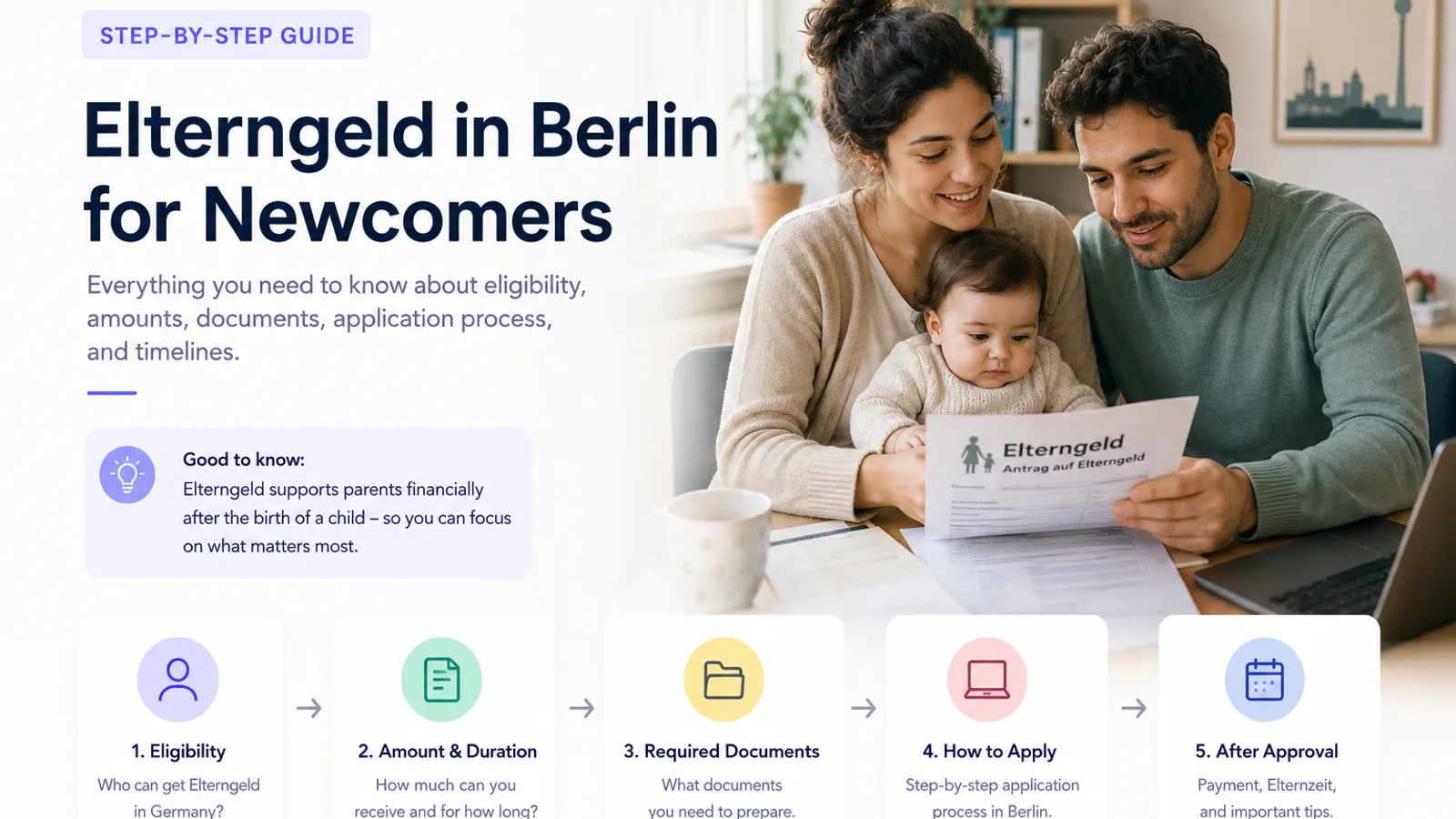
If you recently had a baby in Berlin, Elterngeld is one of the most important family benefits to understand. It can replace part of your income while you reduce or pause work to care for your child.
For newcomer parents, the difficult part is often not the basic idea but the details: whether your residence status qualifies, which months to choose, whether Basiselterngeld or ElterngeldPlus fits better, what income evidence Berlin wants, and how foreign income or documents affect the application.
This guide explains the process in practical terms and shows where newcomer families most often need extra preparation.
Important scope: This article provides general administrative information, not legal, tax or financial advice. SettlyGo can help you understand visible requirements, organize documents, prepare questions, make ordinary German phone calls and communicate with the responsible office. SettlyGo does not determine entitlement, calculate a legally binding benefit amount, provide tax advice, certify translations, submit an application as your official representative, access government accounts or credentials, or guarantee approval, payment amount or processing time.
The direct answer
Elterngeld is a German parental allowance for parents who care for their child themselves and reduce or stop work after the birth.
According to the Berlin ServicePortal, applicants generally must:
- Care for and raise the child themselves
- Live in the same household as the child
- Live in Germany, with Berlin handling applications for people registered in Berlin
- Work no more than 32 hours per week while receiving Elterngeld
- Stay below the applicable taxable-income threshold
For children born on or after 1 April 2025, Berlin states that the Elterngeld income limit is €175,000 in taxable annual income for couples and single parents.
Foreign parents can also qualify, but nationality and residence status matter. The federal Familienportal guidance for foreign parents explains that EU, EEA and Swiss parents can generally qualify when they live or work in Germany. For many non-EU parents, eligibility depends on the type of residence permit and whether it allows employment.
Apply after the birth, but do not wait too long
You can apply for Elterngeld only after your child is born.
The most important timing rule is the three-life-month retroactive limit. Berlin and the federal Familienportal both state that Elterngeld is normally paid retroactively for no more than three of the child's Lebensmonate before the application date.
A Lebensmonat is not necessarily a calendar month.
For example, if your child was born on 18 May:
- Life month 1 runs from 18 May to 17 June
- Life month 2 runs from 18 June to 17 July
- Life month 3 runs from 18 July to 17 August
This distinction matters when planning leave, part-time work and the months each parent wants to claim.
The federal Familienportal application guidance recommends applying soon after birth and within the first three life months if you want payment from the beginning.
Which Berlin office handles your application?
In Berlin, the responsible office is normally the Elterngeldstelle of the Jugendamt in your residential district.
The Berlin ServicePortal lists the district offices and states that responsibility follows your Wohnbezirk.
That means a family living in Neukölln normally uses the Neukölln Elterngeldstelle, while a family registered in Pankow uses the Pankow office.
Do not send documents to a random Jugendamt simply because it is closer to your workplace or hospital.
If you recently moved between Berlin districts, check which office is responsible for your current registered residence before submitting the application.
Can foreign parents receive Elterngeld?
Yes, in many cases.
EU, EEA and Swiss citizens
The federal Familienportal says parents from EU member states, Iceland, Liechtenstein, Norway and Switzerland can generally receive Elterngeld if they live or work in Germany, provided the other requirements are met.
Cross-border cases can become more complicated when one parent works in another country or another country also pays family benefits. Do not assume the German benefit is automatically calculated in isolation.
Non-EU citizens
For parents from outside those countries, the type of German residence status becomes important.
The Familienportal specifically identifies several statuses that can support eligibility, including:
- Niederlassungserlaubnis
- Erlaubnis zum Daueraufenthalt-EU
- EU Blue Card
- ICT or Mobile ICT card
- Certain residence permits that allow employment for the required period
Some other statuses do not qualify, or qualify only under additional conditions.
If your residence title is temporary, employment-restricted, linked to another family member, or recently changed, contact the responsible Elterngeldstelle for an individual assessment rather than relying on a general checklist.
SettlyGo can help you prepare a clear question and organize the documents you already have. It cannot interpret immigration law or decide whether your residence status creates entitlement.
Basiselterngeld, ElterngeldPlus and Partnerschaftsbonus
Berlin offers the same federal Elterngeld models used throughout Germany.
Basiselterngeld
Basiselterngeld is the standard model.
According to Berlin, it can generally be used during the child's first 14 life months. One parent normally claims at least two and no more than twelve Basiselterngeld months. Families may obtain two additional partner months when the relevant income conditions are met.
The federal Familienportal states that Basiselterngeld is normally between €300 and €1,800 per month, depending mainly on income before and after the birth and the family's circumstances.
ElterngeldPlus
ElterngeldPlus is designed to stretch the benefit over a longer period.
One month of Basiselterngeld can generally be converted into two months of ElterngeldPlus.
The federal Familienportal currently gives a normal range of €150 to €900 per month for ElterngeldPlus.
It can be especially relevant when a parent works part-time after the birth, because the interaction between reduced income and the benefit can make ElterngeldPlus more useful than simply dividing Basiselterngeld in half.
Partnerschaftsbonus
Parents who both work part-time during the same qualifying period may be able to claim additional ElterngeldPlus months through the Partnerschaftsbonus.
The federal Partnerschaftsbonus guidance currently requires both parents to work an average of at least 24 and no more than 32 hours per week during two, three or four consecutive life months.
Because one parent's working hours can affect both parents' bonus entitlement, keep accurate records and report relevant changes to the Elterngeldstelle.
How much Elterngeld will you receive?
There is no single amount that applies to all families.
The calculation can depend on:
- Income before the birth
- Income while receiving Elterngeld
- Whether you choose Basiselterngeld or ElterngeldPlus
- Self-employment or mixed income
- Maternity benefits
- Multiple births
- Older young children in the household
- Foreign income
- Other benefits
The federal Familienportal says Basiselterngeld is usually intended to replace a proportion of lost income, with lower-income parents potentially receiving a higher replacement percentage.
Use the official Elterngeld information and calculator for planning, but treat the result as an estimate rather than a guaranteed award. The Elterngeldstelle makes the official calculation from your application and evidence.
SettlyGo does not calculate or recommend a tax-optimal or financially optimal Elterngeld strategy.
Documents Berlin commonly requests
The Berlin ServicePortal document list is the best starting point because requirements can vary by family and employment situation.
Typical items include:
Application form
Use the current Berlin application version that matches your child's date of birth.
Berlin currently provides a specific form for children born on or after 1 April 2025.
Identity documents
Berlin lists identity documents for the parents, such as identity cards or passports. For some applicants, a recent Meldebescheinigung may also be relevant.
Child's birth certificate for Elterngeld
Berlin requests the birth certificate specifically issued zur Beantragung von Elterngeld.
The ServicePortal currently states that this birth certificate is required in the original for the paper process.
Do not send your only general-purpose birth certificate without checking which version the Elterngeldstelle requests.
Income evidence
For employed applicants, Berlin commonly asks for income records covering the relevant 12-month assessment period.
For self-employed parents or people with mixed income, the evidence can include the previous tax assessment or other business-income documentation.
Maternity-benefit evidence
Where relevant, Berlin asks for evidence of Mutterschaftsgeld from the health insurer and the employer's maternity-pay supplement.
Parental-leave and part-time evidence
If you are employed, you may need documentation showing your Elternzeit arrangement.
If you plan to work while receiving Elterngeld, Berlin may also request confirmation of expected working hours and expected income for the whole benefit period.
Residence documents for foreign applicants
Berlin explicitly lists Meldebescheinigung and Aufenthaltstitel for foreign applicants where applicable.
If your residence card has a supplementary sheet or employment restriction, keep those documents together rather than submitting only the front of the card.
Foreign income and international situations
Newcomer families often have income or employment history outside Germany.
Berlin explicitly warns that special rules apply to income earned abroad.
This can affect families where:
- One parent moved to Germany shortly before the birth
- A parent continued working for a foreign employer
- One parent lives or works in another EU country
- The family receives another country's parental or family benefit
- A self-employed parent has income from more than one country
Do not hide foreign income because you assume it is irrelevant. Provide the information requested by the form and ask the Elterngeldstelle what supporting evidence it needs.
SettlyGo can help you organize the visible document request or prepare questions for the office. It cannot determine cross-border tax treatment, social-security coordination or benefit priority rules.
Applying online in Berlin
Berlin supports online Elterngeld applications through the federal digital service.
The Berlin ServicePortal currently says you need a BundID account. The online process can use methods including username/password, an ELSTER certificate or an electronic ID function.
Berlin also states that application data, supporting documents and signatures can now be transmitted digitally through the online process, so printing and mailing the application is not generally required when the full online submission is used.
This is worth checking carefully because some district-specific pages or older instructions online may still describe earlier paper-based workflows.
Use the current citywide ServicePortal instructions rather than an old forum post or cached PDF as your primary source.
Applying by post
A paper application remains possible.
Berlin states that the written application can be sent by post and that, where both parents' signatures are required, both should sign the paper application.
Before mailing anything:
- Confirm the correct district Elterngeldstelle
- Check which documents must be originals and which can be copies
- Keep copies or scans of everything you submit
- Record the date you sent the application
- Avoid sending passports, residence cards or other original identity documents unless the office specifically requires them
Common mistakes newcomer parents can avoid
Waiting for every document before doing anything
Some evidence can take time, especially birth certificates, employer confirmations or foreign records. Start building the checklist immediately after the birth.
If one document is delayed, ask the responsible office how it wants you to proceed rather than silently missing the retroactive-payment window.
Confusing calendar months with life months
Elterngeld planning follows the child's Lebensmonate. A parent returning to work on the first day of a calendar month can still create a partial overlap with one of the child's life months.
Choosing months before checking maternity-benefit interaction
Mutterschaftsleistungen can affect how the mother's early Elterngeld months are counted. Do not plan the first months only from a generic online example.
Assuming a Blue Card automatically settles the whole application
A qualifying residence status addresses only one part of eligibility. Income, working hours, household and childcare requirements still matter.
Forgetting to report changes
If your working hours, income, bank account or planned benefit months change after submission, Berlin provides an Änderungsantrag for relevant updates.
Using outdated forms
Berlin currently separates forms by the child's birth date. Always download the current version from Berlin or ElterngeldDigital.
What if you return to work part-time?
You can work while receiving Elterngeld, but the general limit is 32 hours per week.
Your earnings during the benefit period can change the benefit amount.
Before starting or changing part-time work, keep documentation of:
- Weekly hours
- Start date
- Expected gross and net income
- Employer confirmation
- Any later change to the arrangement
If your working pattern changes significantly, inform the Elterngeldstelle. Do not wait until the end of the benefit period if the change could affect eligibility or payment.
What happens if another benefit is involved?
Elterngeld can interact with other public benefits.
Berlin notes that it may be counted when calculating benefits such as Bürgergeld, Grundsicherung or Kinderzuschlag. The exact treatment depends on the other benefit and your prior income.
The federal Familienportal also explains that different rules can apply depending on the type of social benefit and whether the parent worked before the birth.
Because this can directly affect household finances, ask the responsible benefit office or a qualified adviser about your individual case. SettlyGo can support the administrative communication but does not provide benefit or financial advice.
A practical application checklist
Before submitting, check:
- I know which Berlin district Elterngeldstelle is responsible.
- I am using the correct application version for my child's birth date.
- I understand which life months each parent wants to claim.
- I have checked Basiselterngeld versus ElterngeldPlus using official information.
- My planned working hours stay within the relevant limit.
- I have the child's Elterngeld birth certificate.
- I have the requested identity and residence documents.
- I have the relevant 12-month income evidence or self-employment evidence.
- I have maternity-benefit documents where applicable.
- I have employer confirmation for Elternzeit or part-time work where applicable.
- I have disclosed foreign income or cross-border circumstances when requested.
- I am applying early enough to protect the three-life-month retroactive period.
- I kept copies of everything submitted.
How SettlyGo can support you
Elterngeld applications can combine family documents, employment evidence, residence information and German administrative terminology. A SettlyGo helper can provide practical support such as:
- Organizing a document checklist from the current Berlin requirements
- Helping you identify the responsible district office
- Preparing questions for the Elterngeldstelle
- Supporting an ordinary German phone call to clarify missing documents or status
- Helping you understand what a German administrative request is asking for in plain language
- Accompanying you to an appointment when in-person communication support is useful
SettlyGo does not decide whether you qualify, calculate your official benefit, choose a financially optimal benefit model, provide tax or legal advice, certify translations, sign or submit the application as your representative, access BundID or government credentials, or guarantee approval or payment.
Final takeaway
For newcomer parents in Berlin, the most important Elterngeld steps are to start early, understand the child's life months, check residence-status eligibility, use the correct Berlin form and prepare complete income and family evidence.
Do not assume that a foreign passport or non-German employment history prevents you from applying. At the same time, do not rely on a generic eligibility statement when your residence permit, foreign income or cross-border employment creates a more complex case.
Use the current Berlin ServicePortal and federal Familienportal as your primary sources, and contact your district Elterngeldstelle when your situation does not fit the standard checklist.
For practical help organizing the paperwork, preparing questions or handling German administrative communication, book SettlyGo support.
Need practical help in Berlin?
Book a verified SettlyGo helper for German phone calls, appointments, landlord communication, apartment viewings, and document preparation.