EU Permanent Residence in Berlin: Daueraufenthaltsrecht Guide
September 2, 2026 · 11 min read
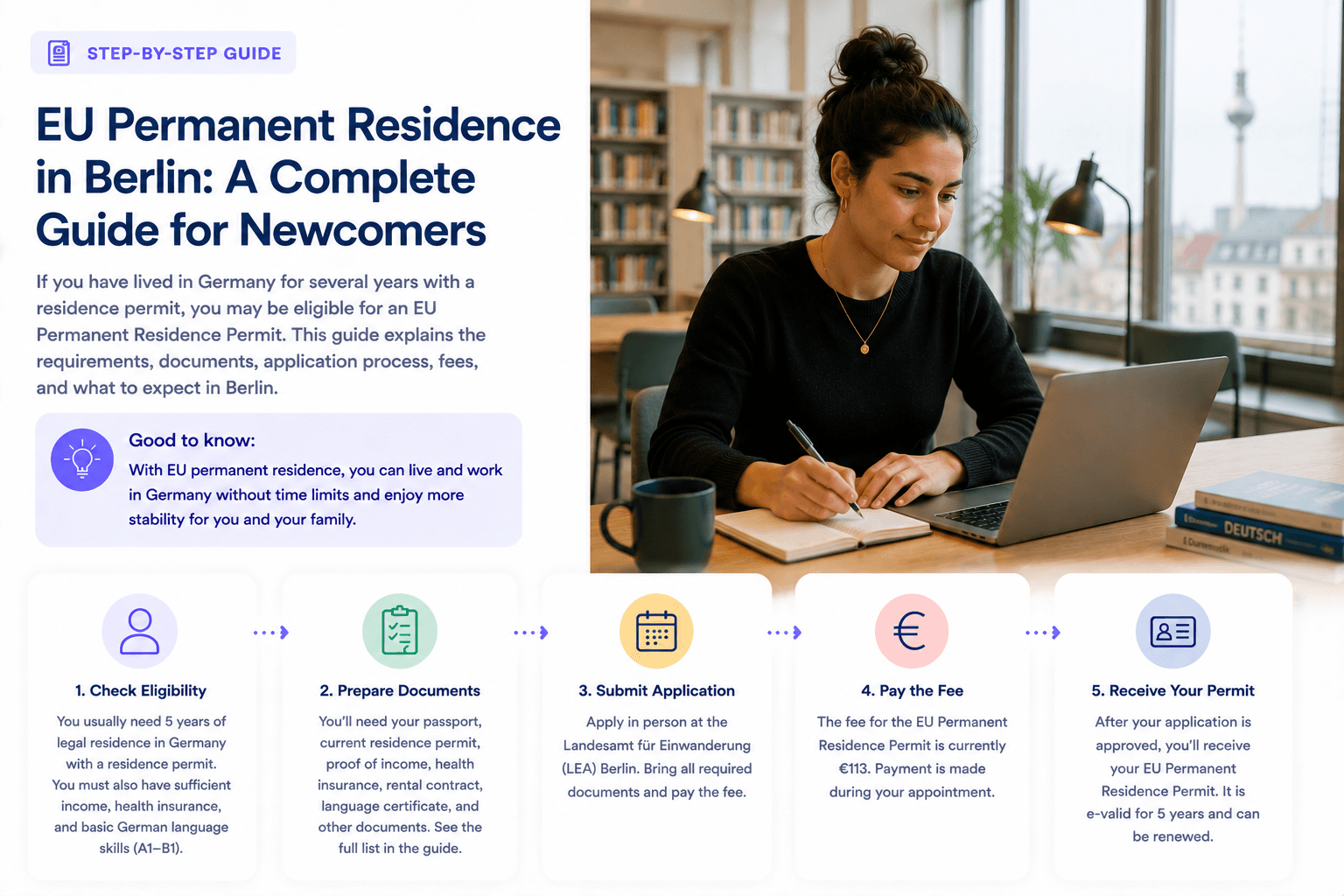
If you are an EU or EEA citizen who has lived in Germany for several years, you may come across the term Daueraufenthaltsrecht.
For many people, the confusing part is that this is not the same process as applying for a normal German permanent residence permit.
EU and EEA citizens can acquire a permanent right of residence under EU free-movement rules. Berlin can also issue a certificate confirming that right.
This guide explains the current Berlin process, what the certificate does, which documents can be relevant and how it differs from the residence card used by non-EU family members.
Important scope: This article gives general administrative information. SettlyGo does not provide legal advice or immigration advice. SettlyGo can help you organize visible requirements, identify the correct official page, prepare questions and support ordinary German communication. SettlyGo does not decide whether you have acquired a permanent right of residence, assess interruptions in residence, determine which periods count, represent you before the LEA or guarantee that a certificate will be issued.
Who is this guide for?
This article is specifically about the Berlin service for citizens of:
- EU member states; and
- the EEA states Iceland, Liechtenstein and Norway.
Berlin calls the document Bescheinigung über das Daueraufenthaltsrecht für Unionsbürger (EU/EWR).
If you are a non-EU family member of an EU or EEA citizen, the relevant document is normally a Daueraufenthaltskarte, which is a different Berlin service with different document and fee rules.
Do not use the two terms interchangeably.
When does an EU citizen normally acquire permanent residence rights?
Berlin's official Daueraufenthaltsrecht service says that EU and EEA citizens normally acquire a permanent right of residence after five years of continuous lawful residence in Germany while exercising a right of free movement.
The five-year point is therefore not just about having a Berlin address for five calendar years.
Berlin says the underlying free-movement conditions must have existed during the relevant period.
Examples listed by Berlin include residence as:
- an employee;
- a self-employed person; or
- a non-employed person with sufficient means of subsistence and health insurance.
Individual cases can be more complicated, especially when there were long absences, unemployment, periods abroad or changes in status.
SettlyGo cannot determine whether a particular residence history legally satisfies the five-year requirement.
Is the certificate what creates your permanent residence right?
No.
This is an important distinction.
Berlin explicitly describes the permanent-residence certificate as declaratory.
That means the certificate confirms a right that, if the legal conditions are satisfied, arises under the law itself.
Berlin also says the certificate is not required simply to have lawful residence or to complete ordinary administrative formalities.
So you should not assume that you become permanently resident only on the day the LEA prints the certificate.
Why would someone request the certificate then?
Even though the certificate is not what creates the right, some people want an official document showing that Berlin has confirmed their permanent-residence status.
That can be useful when you want clear documentary evidence of your residence history or status.
Before applying, check whether the institution asking you for evidence actually requires this certificate or whether another document is sufficient.
Avoid ordering documents simply because a private checklist uses a vague phrase such as “permanent residence proof.”
Which authority handles this in Berlin?
The service is handled by the Landesamt für Einwanderung (LEA).
Berlin's current service page points applicants to the LEA at Friedrich-Krause-Ufer and to the responsible LEA contact route for arranging an appointment.
Use the official ServicePortal page immediately before applying because appointment channels and organizational responsibilities can change.
What do you need to prove?
Berlin currently asks applicants to show both:
- continuous residence in Germany for the relevant period; and
- the basis on which they exercised EU free-movement rights during that period.
The exact evidence depends on your circumstances.
Evidence of residence
Berlin says a Melderegisterauskunft is the easiest way to demonstrate continuous residence.
The official page also notes that other records, such as tax assessments, can be used as evidence in appropriate cases.
If you moved between German cities, do not assume that five years of Berlin registration is required.
The legal question concerns residence in Germany, while the LEA still needs enough evidence to understand your history.
Evidence for employees
Berlin currently lists an employer certificate showing the type and duration of employment.
If you changed employers during the five-year period, prepare your records in a way that makes the timeline easy to follow.
Do not alter old documents or try to make gaps disappear.
Evidence for self-employed people
Berlin currently lists documents such as:
- Gewerbeanmeldung; and
- tax assessments.
Your exact evidence may depend on the kind of self-employment and the periods you need to document.
Evidence for non-employed people
Berlin currently lists:
- health-insurance evidence; and
- proof of sufficient means of subsistence.
The LEA can request additional documents in individual cases.
Do you need exactly five years of employment?
Not necessarily.
Berlin's service does not say that every applicant must have worked as an employee for all five years.
The relevant issue is whether you continuously had a qualifying basis for free movement during the period.
That may involve different categories at different times.
For example, someone could have been employed for part of the period and self-employed later.
Whether a particular combination qualifies is a legal-status question, so do not rely on a generic online calculator for a borderline case.
What if you lived in another German city before Berlin?
Living outside Berlin during part of the five-year period does not automatically mean the period is irrelevant.
Berlin's official guidance refers to continuous residence in Germany, not only residence in Berlin.
The practical challenge is proving that history clearly enough.
Collect registration evidence from the places where you lived and keep employment, self-employment, insurance or other relevant records organized by date.
If there are gaps you cannot explain, ask the LEA what evidence it wants rather than guessing.
What if you spent time outside Germany?
Absences can matter when assessing continuity.
The Berlin service page gives the normal five-year rule but does not provide a simple one-size-fits-all calculator for every absence pattern.
If you had extended periods outside Germany, military service, study abroad, family-care periods or other unusual interruptions, check your situation with the LEA or a qualified professional before relying on the five-year anniversary alone.
SettlyGo can help you prepare the timeline and questions, but it cannot decide whether a specific absence breaks legal continuity.
What documents should you prepare before contacting the LEA?
A practical preparation folder can include:
- valid passport or national identity document;
- registration-history evidence;
- employer confirmations for relevant employment periods;
- Gewerbeanmeldung and tax assessments for relevant self-employment periods;
- health-insurance evidence where relevant;
- evidence of sufficient means for relevant non-employed periods;
- documents explaining major changes in residence or activity; and
- the current LEA application form if the official page requires it.
Do not send a large archive of unrelated documents before the authority asks for them.
The goal is to make the five-year timeline understandable, not to upload every financial or personal document you possess.
How much does the certificate cost?
Berlin currently lists a fee of €10 for the Daueraufenthaltsbescheinigung for EU and EEA citizens.
Fees can change, so confirm the amount on the official ServicePortal page before the appointment.
This fee is different from the fee for a Daueraufenthaltskarte issued to a non-EU family member.
How long does it take?
Berlin currently states that the certificate is normally issued during the appointment.
That does not mean every case will always finish immediately.
If the LEA needs additional evidence or has to clarify your residence history, the process can take longer.
Do not make a time-sensitive legal, employment or travel decision based only on the average processing description.
Do EU citizens need an electronic residence card for this?
The Berlin service for EU and EEA citizens is a certificate of permanent residence rights.
It is not the same product as the electronic Daueraufenthaltskarte for a non-EU family member.
This distinction matters when searching online because the two Berlin pages have different requirements, fees and document formats.
If you are an EU citizen, start from the EU/EWR citizen certificate page rather than the family-member card page.
What if your spouse or family member is not an EU citizen?
A non-EU family member of an EU or EEA citizen can have a different route.
Berlin has a separate Daueraufenthaltskarte service for family members.
That service generally looks at whether the non-EU family member lived lawfully in Germany together with the EU/EEA citizen while the EU/EEA citizen exercised free-movement rights.
The family-member card currently has different fees and production steps from the EU citizen's certificate.
Do not submit one person's documents under the other person's service merely because both involve a five-year period.
What if your spouse is German rather than another EU citizen?
Berlin explicitly warns that non-EU family members of German citizens do not generally receive the Daueraufenthaltskarte under the EU free-movement route.
Different residence-law rules may apply.
There are exceptions connected with genuine prior exercise of EU free-movement rights in another member state, but these are not situations to self-classify from a short blog post.
Use the LEA's current guidance or qualified legal advice for that scenario.
A practical five-year evidence timeline
Before contacting the LEA, create a simple timeline for yourself.
For each period, note:
- where you lived in Germany;
- whether you were employed, self-employed or non-employed;
- which document proves that activity or status;
- what health-insurance evidence you have where relevant; and
- any substantial period outside Germany.
This makes it easier to identify missing evidence before an appointment.
Do not submit the timeline as a substitute for official evidence unless the LEA asks for it. Use it as an organizational tool.
Common mistakes to avoid
Treating the certificate like a normal residence-permit application
EU/EEA citizens acquire the permanent right under the free-movement rules when the legal conditions are met. The certificate confirms that right.
Counting only the date of your first Berlin Anmeldung
The relevant history may include qualifying residence elsewhere in Germany.
Assuming five years of registration automatically proves five years of free-movement rights
Berlin asks for evidence of the basis on which free movement was exercised during the period.
Mixing up EU citizens and non-EU family members
The Daueraufenthaltsbescheinigung and Daueraufenthaltskarte are different services.
Ignoring gaps in your timeline
Prepare a clear chronology and ask what evidence is needed for unusual periods.
Sending unnecessary sensitive records
Share the evidence the authority actually requires and avoid circulating unrelated financial or personal information.
Checklist before contacting the LEA
- I confirmed that I am using the EU/EWR citizen Daueraufenthaltsrecht service.
- I checked whether I have approximately five years of qualifying residence in Germany.
- I prepared evidence of my registration history.
- I organized evidence showing my employment, self-employment or other qualifying basis over the relevant periods.
- I identified any long absences or unexplained gaps.
- I checked the current LEA appointment instructions.
- I checked the current fee.
- I understand that the certificate is declaratory and is not what creates the right.
How SettlyGo can support you
A SettlyGo helper can provide practical administrative support such as:
- helping you locate the correct Berlin LEA service page;
- organizing a checklist from the visible official requirements;
- helping you put your existing documents into a chronological order;
- preparing questions about missing or unclear evidence;
- supporting an ordinary German phone call or email conversation; and
- accompanying you when in-person communication support is useful.
SettlyGo does not provide legal advice, determine whether your residence periods qualify, assess interruptions or free-movement status, represent you before the LEA or guarantee a permanent-residence certificate.
Final takeaway
For EU and EEA citizens, Berlin's permanent-residence certificate is not a normal permanent-residence permit and it is not what creates the underlying right.
The key question is whether you have completed the required period of continuous lawful residence in Germany while exercising EU free-movement rights, normally five years.
Prepare a clear residence and activity history, use the correct EU/EWR citizen service, and check the official Berlin page for the latest appointment instructions and fees before applying.
Use the official Berlin Daueraufenthaltsrecht service to confirm the current requirements.
For practical help organizing documents, preparing questions or handling German administrative communication, book SettlyGo support.
Need practical help in Berlin?
Book a verified SettlyGo helper for German phone calls, appointments, landlord communication, apartment viewings, and document preparation.