German Tax ID in 2026: How to Receive, Find and Use Your IdNr.
July 12, 2026 · 11 min read
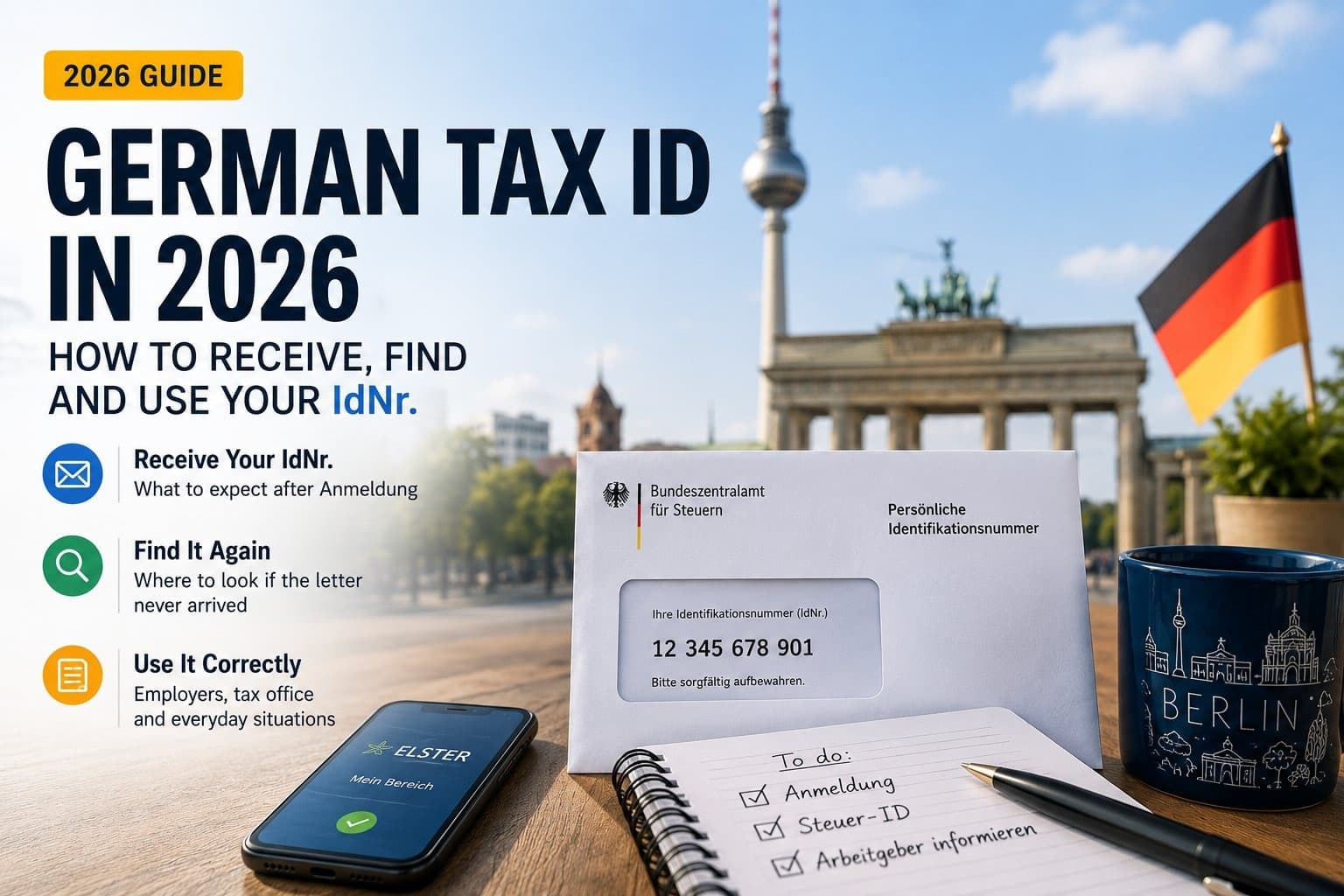
Your new employer has asked for your Steuer-ID, and you're staring at old emails, a pile of moving boxes, and a German letter you can't quite place. That moment is very normal in Berlin. The good news is that tax ID Germany is usually simple once you know whether you're waiting for it, looking for it again, or missing the address registration step that triggers it.
The Steueridentifikationsnummer, commonly called the Steuer-ID or IdNr., is your lifelong personal tax identification number. It's the number employers use to identify you for tax purposes, and official guidance describes it as an 11-digit identifier that is assigned once and stays the same. For people who become registered in Germany for the first time, the tax identification number is generally generated automatically after registration with the local registration authority. ELSTER states that it is normally communicated by post within four weeks. (ELSTER guidance)
If no letter has arrived three months after your first registration in Germany, you can use the Federal Central Tax Office’s online form to request that the number be communicated again. (BZSt online form)
If you're feeling behind already, you're not. Individuals typically need three things: what the number is, how it gets issued, and what to do if the letter never shows up. Berlin makes this more stressful than it needs to be because the process depends on paperwork, appointments, and post that reaches your mailbox.
Your First Piece of German Bureaucracy: The Tax ID
The first time many newcomers hear about the Steuer-ID, it's from an employer, payroll contact, or HR assistant asking for a number they've never seen before. That's a standard part of starting work in Germany. It doesn't mean you've done something wrong, it usually means your paperwork is moving faster than your memory can keep up.
The basic idea is simple. Your tax ID Germany number is a personal, lifelong identifier used for tax administration across the country, and it is not tied to one job or one city. Once it exists, it stays with you. That's why employers ask for it early, because they need the correct personal identifier to handle payroll and tax matters properly.
Practical rule: if someone asks for your Steuer-ID, they usually mean your personal number, not your business or freelance tax number.
A helpful way to think about it is this. The tax ID is for you as a person, while other German tax numbers can relate to a specific tax office or a business setup. That distinction matters later, especially if you freelance, invoice clients, or register a business.
If you're new in Berlin and still dealing with moving stress, keep this in mind. The number itself is not something you have to guess or invent. You either already have it in an old letter, or the registration process has set it in motion.
Tax ID vs. Steuernummer: Understanding the Difference
German bureaucracy likes to use words that sound almost the same, then expect you to know which one belongs in which folder. Steuer-ID and Steuernummer are a good example. They are easy to mix up, and that mix-up can create avoidable stress when an employer, accountant, or tax office asks for one number and you send the other.
The IdNr. is the lifelong personal identifier used for individual tax administration. A Steuernummer relates to a tax file administered by a Finanzamt and may change. Businesses may also receive a Umsatzsteuer-Identifikationsnummer, or USt-IdNr., and a Wirtschafts-Identifikationsnummer. Which identifier is required depends on the administrative, business and tax context.
This guide does not determine which number a business must place on an invoice or whether VAT, intra-EU supply or reverse-charge rules apply. Freelancers and businesses should confirm those matters with the Finanzamt, a Steuerberater or another appropriately qualified tax professional.
Quick comparison
| Feature | Tax ID (Steueridentifikationsnummer) | Tax Number (Steuernummer) |
|---|---|---|
| Main purpose | Personal tax identification | Tax office or tax case administration |
| Who it belongs to | You, as an individual | Your tax file at the local office |
| Stability | Lifelong and unchanged | Can change with office or tax situation |
| Typical use | Employers, payroll, personal tax matters | Tax returns, self-employment, office-specific filings |
| Invoice use | Not the standard business identifier required on an invoice | A Steuernummer may be used where the applicable invoice rules permit or require it |
If an employer requests your IdNr., provide the lifelong personal identifier shown on the official notification, an Einkommensteuerbescheid or a Lohnsteuerbescheinigung. Do not guess which identifier belongs in a business or tax context; check the exact request and seek qualified tax guidance where necessary.
The Standard Path: How Anmeldung Leads to Your Tax ID
Generally, the IdNr. does not require a separate application for a person registering in Germany for the first time. Registration with the local registration authority initiates the process. Berlin generally requires residents to register within 14 days after moving in, and the service has no fee. For an in-person registration, the official checklist includes the completed registration form, valid identification and the Wohnungsgeberbestätigung. Additional documents may be required depending on the household situation. A rental agreement does not replace the Wohnungsgeberbestätigung. (Official Berlin Anmeldung service)
What to bring to the appointment
-
Valid identification: Follow Berlin’s official instructions for every person being registered.
-
Registration form: Complete and sign the current official form.
-
Wohnungsgeberbestätigung: Obtain the confirmation relating to the actual move-in.
-
Additional household documents: Check whether civil-status documents, consent forms, a power of attorney or other documents apply.
-
Mailbox access: Make sure official post can reach the registered address.
Make sure official written correspondence can reach the address recorded by the authorities.
If the process feels messy, that's usually because it is. The logic is still straightforward, though. You register your address, the data moves through the system, and the IdNr. is communicated by post using the address data available to the authorities. If you want hands-on help with the appointment itself, a practical helper may assist with preparing questions, routine communication and organizing customer-provided documents. Anmeldung help in Berlin
Lost the Letter? How to Find Your Tax ID Again
The most common panic point is not that the number was never issued. It is the letter going missing during a move, or never reaching you in the first place. If that happened, do not treat it like the end of the process. The number may already have been assigned, and the next step is to check existing records or use the official BZSt request process.
Start by separating the issue into two parts, issue and access. According to the Federal Central Tax Office, you will usually find your IdNr. on an Einkommensteuerbescheid or a Lohnsteuerbescheinigung. If you do not have those documents available, you can request that the number be communicated again. For data-protection reasons, the BZSt does not communicate the IdNr. by telephone or email. The response is sent in writing. (BZSt guidance)
The most useful recovery paths
-
Check existing tax records: Look at an Einkommensteuerbescheid or Lohnsteuerbescheinigung.
-
Use the BZSt request form: If the number is already assigned but unavailable, request that it be communicated again.
-
Contact the Finanzamt when appropriate: The Finanzamt can answer individual tax-record or payroll questions and may provide information where legally permitted.
If you want help with German letters and paperwork, that kind of practical support may help with organizing correspondence, preparing questions and routine communication. Use only the personal information requested through the verified official process, and do not share tax identifiers or authentication information with a helper. If the address data held by the authorities may be outdated, contact the appropriate authority through its official channel to clarify how the address record should be corrected.
Practical rule: waiting longer helps only if the authorities have usable address data. If your address details are wrong, contact the relevant office and correct the problem first.
When people say “I never got my tax ID,” they often mean “I never received the letter.” That difference matters because the number may already be in the system. The next step is generally to check existing tax records or request that the IdNr. be communicated again.
When You Have Not Completed Anmeldung Yet
If you have moved to Germany from abroad and are subject to German registration requirements, completing Anmeldung is generally the route that initiates assignment of the IdNr. The special Finanzamt application for an IdNr. is intended for people who are not subject to registration under the Bundesmeldegesetz and who need an IdNr. for a specific tax reason. It is not a general substitute for delayed or unfinished Anmeldung. (ELSTER guidance on receiving an IdNr.)
An employee who has not yet received an IdNr. should speak with payroll. Where the employee is not responsible for the delay, official ELStAM guidance allows the employer to use expected wage-tax characteristics for up to three months. Depending on the situation, the Finanzamt may also issue a paper wage-tax certificate. The employer or Finanzamt must assess the individual case. (ELStAM employer guidance, ELSTER employee help)
Getting Practical Help with Your Tax ID
The basic IdNr. process is usually straightforward. The trouble usually starts around it. You may need to prepare the right documents, read an official letter, or make a phone call to the Finanzamt without getting stuck on fast German or bureaucratic wording. Practical support can save time here and lower the stress a lot.
There is a clear line to keep in mind. Help with calls, letters, appointments, or document preparation is practical newcomer support. Advice about tax class, deductions, or filing a tax return belongs with a Steuerberater. Questions about invoice identifiers, VAT or cross-border transactions belong with the Finanzamt, a Steuerberater or another appropriately qualified tax professional.
If the letter is lost, start with the address you used for Anmeldung. The IdNr. is communicated in writing using the address data available to the authorities. If you have already moved, check whether the letter may still be at your old mailbox or with the person who collected the mail. If that does not help, use the official BZSt process to request that the IdNr. be communicated again. Contact the Finanzamt when an individual payroll or tax-record question requires it.
A few practical checks usually clarify the next move.
-
You already have the letter: store the number safely and share it with your employer when asked.
-
The letter is missing: request it again or ask the local office.
-
You have not completed Anmeldung yet: speak with payroll and clarify whether ELStAM transitional handling or a paper certificate may apply.
-
You're stuck with forms or phone calls: speak with payroll and use official support channels; practical help may assist only with routine communication and organization.
That kind of help is about handling the process, not giving tax advice. A helper may help organize customer-provided documents, prepare questions, support routine communication and take notes. The customer remains responsible for providing personal tax data and completing official declarations.
SettlyGo does not provide tax advice, choose a tax class, determine tax liability, advise on VAT or reverse charge, decide which identifier belongs on an invoice, complete tax forms, access ELSTER or payroll accounts, communicate passwords or authentication codes, submit tax requests as an authorized tax representative, interpret a tax assessment or guarantee that an IdNr. will be issued or delivered by a particular date.
If a missing IdNr. has left you dealing with a routine phone call, unclear administrative instructions or document organization, book a SettlyGo helper. SettlyGo may help with practical communication, preparing questions, note-taking and organizing customer-provided documents. SettlyGo does not provide tax advice, determine tax status or tax class, complete tax forms, access ELSTER or payroll accounts, handle passwords or authentication codes, submit tax requests as an authorized tax representative, advise on VAT or invoicing, interpret tax decisions or guarantee issuance or delivery of an IdNr.
Need practical help in Berlin?
Book a verified SettlyGo helper for German phone calls, appointments, landlord communication, apartment viewings, and document preparation.