Identity Verification in Berlin: A Newcomer’s Practical Guide
July 16, 2026 · 16 min read
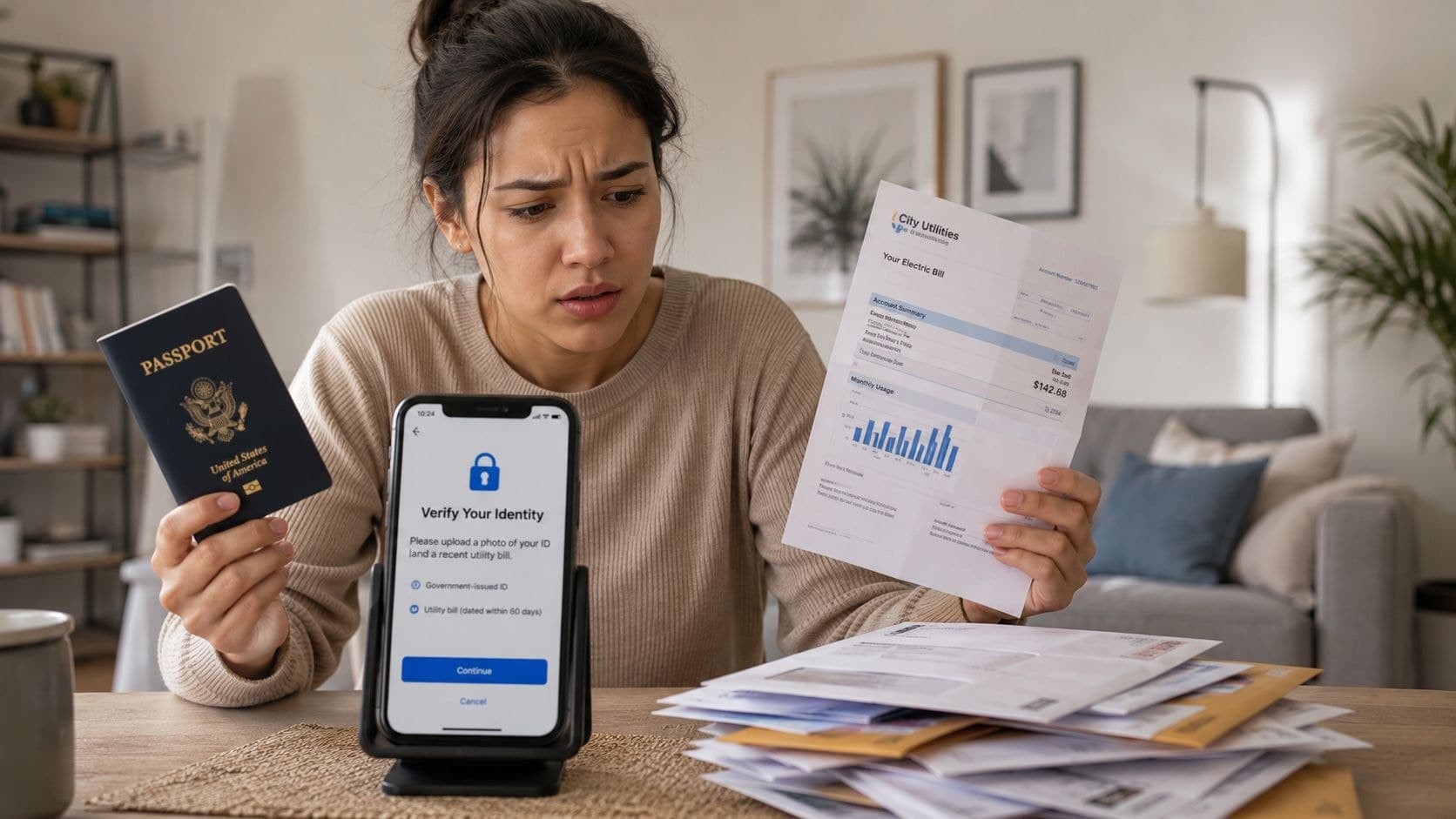
You've just arrived in Berlin. Your landlord asks for a passport copy. Your bank app wants a selfie video. A mobile provider asks you to verify your ID before activating your SIM. Then the Bürgeramt wants your documents in exactly the right order for your Anmeldung.
That repeating hurdle has a name: the identity verification process.
For newcomers, it rarely feels simple. You might have a valid passport, a visa, a rental contract, and every honest intention to do things correctly, yet a website still says “verification failed.” That's frustrating, especially when you're already dealing with housing stress, German paperwork, and appointments that are hard to book.
The good news is that most of this confusion becomes easier once you understand what each office or company is checking. In Berlin, identity checks aren't random. They're part of how landlords, banks, phone companies, and public offices confirm that you are who you say you are, and that your documents match the action you're trying to take.
A lot of people get stuck because they think one ID document should work everywhere in the same way. It doesn't. A bank app, a Bürgeramt clerk, and a mobile provider can all ask for identity proof differently.
If you're feeling overwhelmed, you're not doing anything wrong. You're dealing with a system that was mostly designed around people who already know how German bureaucracy works.
Why Is Everyone Asking for My Passport?
The same question in different forms
In your first weeks in Germany, “please verify your identity” can show up everywhere. A landlord may want your passport before sending a contract. A bank might ask you to complete VideoIdent. A phone company may block activation until your ID check is done. The Bürgeramt will expect documents that clearly connect your name, address, and move-in details.
It feels repetitive because each place is asking a slightly different question. One is checking whether the document is real. Another is checking whether you're physically the person in the passport. Another is checking whether your name and address match what you entered online.
Practical rule: If two places ask for “ID verification,” don't assume they want the same thing.
That's where people often get confused. You can pass one check and fail another on the same day, even with the same passport.
Do not send a full passport or identity-card copy to an unverified landlord, listing, intermediary or email address. Ask why the copy is necessary, whether showing the document is sufficient and whether unnecessary information may be redacted. When a copy is genuinely required, mark or watermark it for the specific recipient and purpose.
Why this feels harder in your first weeks
Berlin is full of small bureaucracy chains. You need one document to get the next thing done. Your rental paperwork affects your Anmeldung. Your Anmeldung affects other registrations. Your name spelling, move-in date, and document quality start to matter more than most newcomers expect.
The emotional part matters too. If you're reading German emails through a translation app, trying to book appointments, and hearing different advice from different people, every extra verification request can feel like a warning sign. Usually it isn't. Usually it's just process.
A calmer way to think about it is this: identity verification is the system's way of linking you, your documents, and your real-world situation. Once you understand that link, the requests stop feeling random and start feeling manageable.
Identity requests are not all legally or practically equivalent. A Bürgeramt checks identity for an administrative procedure, a bank may conduct legally required customer identification, a telecom provider may use an approved activation process, and a landlord or private platform may request information for a different purpose. Always check who is requesting the data, why it is needed and which verification method the provider officially accepts.
Throughout this guide, practical support means helping the customer identify the requested verification method, organize customer-controlled documents, prepare questions and communicate with routine customer service. A SettlyGo helper does not verify identity, authenticate documents, assess whether a document is genuine, complete biometric or selfie verification, perform VideoIdent or PostIdent for the customer, access bank or provider accounts, handle passwords, PINs, TANs or eID credentials, provide legal or financial advice, submit identity documents on the customer’s behalf or guarantee acceptance.
Understanding the German Approach to Identity
Why formal registration matters
Berlin generally requires residents to register their address within 14 days after moving in. Registration can take place only after the person has moved into the residence. The required documents and available process depend on the person’s situation.
Eligible users may be able to complete Anmeldung online using BundID and AusweisApp. Others generally use an in-person appointment or an authorized representative.
Anmeldung is an important administrative process, but it is not itself a universal identity-verification requirement for every bank, landlord, telecom provider or private platform.
Use the official Berlin service page for the current rules and process: https://service.berlin.de/dienstleistung/120686/
Identity is the key to other systems
Banks, insurers, landlords, mobile providers, and government offices don't all share one single process. But they often rely on the same principle. They want consistency.
That usually means checking whether these pieces line up:
-
Your person: You are the authentic individual presenting the document.
-
Your document: The passport, ID card, visa, or permit appears valid and untampered with.
-
Your details: Name, birth date, and address match the form, appointment, or contract.
-
Your situation: The request fits the task. For example, a move-in registration after the actual move-in date.
Germany's approach can feel rigid, but it often makes more sense once you see it as a chain of trust rather than a pile of random forms.
For Berlin newcomers, this explains why an office might reject a document that seems “good enough” in another country. The issue is often not whether the document exists. The issue is whether it fits the exact role that office needs it to play.
That's also why people run into trouble when they use inconsistent versions of their own details. A missing middle name, different transliteration, or old address can trigger questions even when nothing is fraudulent.
Common Identity-Verification Methods
Quick Guide to Berlin Identity Verification Methods
Here's the fastest way to sort out what kind of identity verification process you're dealing with.
| Method | How it generally works | Important limitation |
|---|---|---|
| In-person identity check | A staff member compares the person with a valid identity document | Required documents and purpose differ between authorities and companies |
| Video identification | A trained agent checks the person and identity document through a live video process | Not every provider or foreign document is supported |
| POSTIDENT in a branch | Deutsche Post checks the person and an accepted identity document using a provider-issued coupon or code | Available only when the contracting provider offers it |
| Automated app verification | The customer follows provider instructions to capture the identity document and their face or video | Acceptance depends on the provider, technology and supported document |
| Online ID function, or eID | Identity data are read from an activated ID card or electronic residence permit through AusweisApp | Requires an activated eID function, PIN and compatible NFC device or reader |
The company or authority decides which methods it accepts. A person cannot independently switch to POSTIDENT, eID or an in-person check unless that option is offered for the specific process.
For method details, see Deutsche Post POSTIDENT and AusweisApp, how to use the eID function.
What each method feels like in real life
In-person verification at the Bürgeramt is the most familiar format for many people. A clerk checks your identity documents alongside your registration paperwork.
For an in-person Bürgeramt appointment, follow the instructions in the official booking confirmation and check the exact location before travelling. Booking and check-in procedures can change, so use the current Service Berlin instructions rather than a third-party guide.
VideoIdent usually means a live video call with an agent. They may ask you to tilt your passport, show the photo page, move it closer to the camera, or repeat a code. The goal is simple. They're checking the document and checking that a live person is presenting it.
POSTIDENT may be offered through a Deutsche Post branch, video chat, automated app identification or the online ID function. The available option is chosen by the contracting company. Accepted foreign identity documents vary by method, and some documents may not meet the required security-feature or readability conditions. See Deutsche Post POSTIDENT and the POSTIDENT FAQ.
Automated digital verification is the one that often feels most mysterious. You upload document photos and then take a selfie or short video in an app. The exact checks depend on the provider. Follow the instructions shown in the verified app or website and read its privacy notice before submitting identity images or biometric data.
A practical way to choose your next step is this:
-
If an office gave you a fixed appointment, prepare for an in-person check.
-
If a bank app says verify now, expect VideoIdent or automated upload.
-
If video keeps failing, check whether the provider allows PostIdent or branch-based verification.
-
If the instructions are unclear in German, slow down and identify the method first. That usually tells you what the provider expects.
Most verification problems start before the check begins. They start when the person doesn't realize which verification method they've actually been asked to complete.
Your Document Preparation Checklist
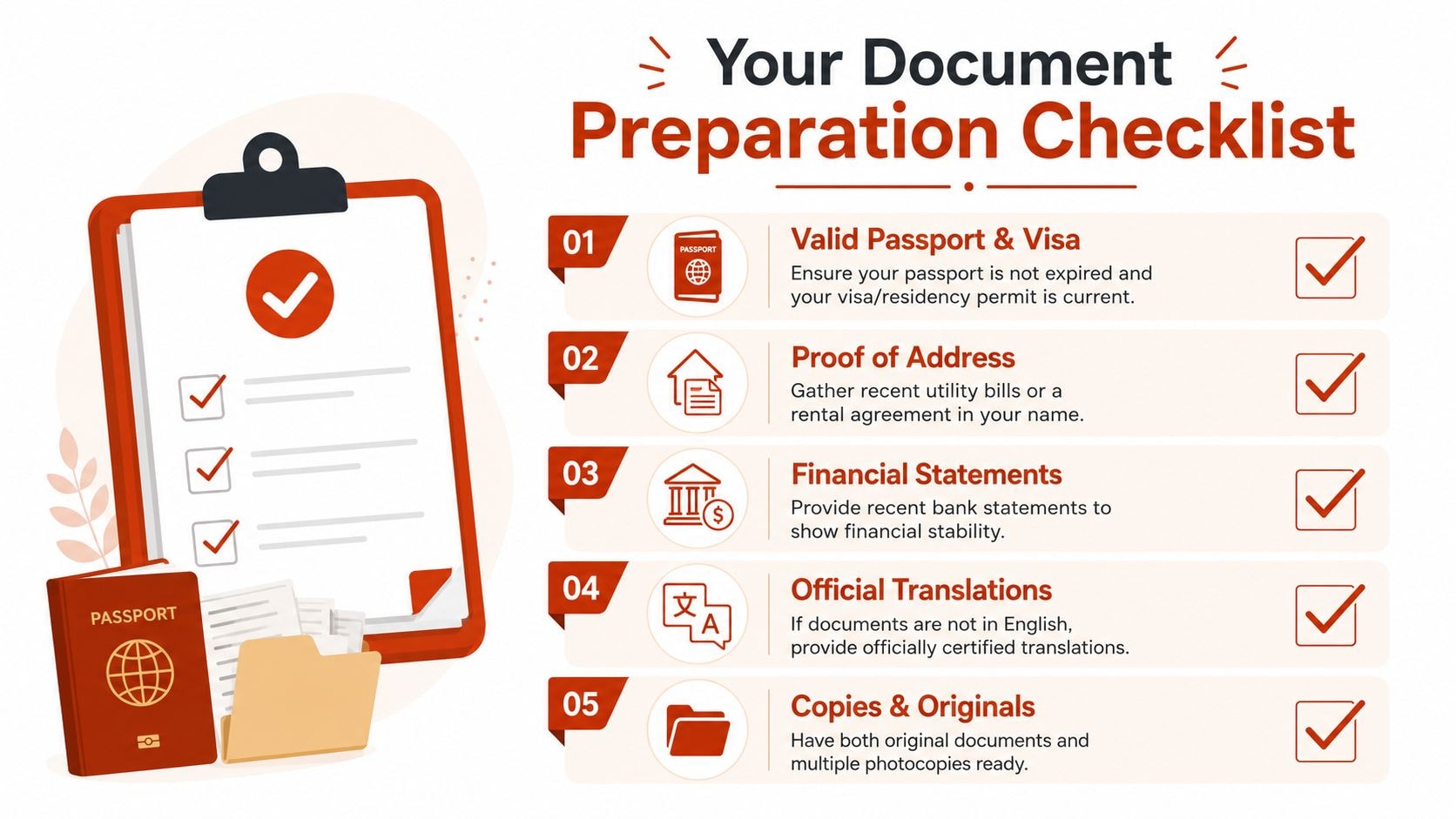
Good preparation solves more problems than people think. The identity verification process is often less about having unusual paperwork and more about having ordinary paperwork that is complete, readable, and consistent.
What to check before you upload or attend
Use this checklist before a Bürgeramt appointment, bank verification, or app-based ID check.
-
Passport validity: Make sure your passport is valid and in good condition. If the photo page is damaged, worn, or hard to read, expect extra friction.
-
Visa or residence document: If your task depends on your current status, bring the document that shows it.
-
Name consistency: Check spelling across passport, rental contract, booking confirmation, and any online form. Even small differences can trigger a pause.
-
Follow the exact checklist: Use only the documents and formats requested by the authority or provider.
-
Check document support: Confirm that the verification method accepts your passport, identity card or residence permit.
-
Match entered data: Enter your name, birth date and document number exactly as required.
-
Protect credentials: Keep passwords, PINs, TANs, eID PINs and account access private.
-
Control the device: Complete selfie, video and biometric steps yourself on your own device.
-
Use secure channels: Upload identity documents only through the verified authority or provider process.
If you want a practical prep list for Berlin appointments, this documents checklist for Berlin appointments is a useful starting point.
Small mistakes that cause big delays
Many rejections come from details that look harmless at first glance.
A common example is the name issue. Your airline booking, university record, and passport may not all use the same middle names or transliteration. That's especially common with long names or non-Latin scripts. If a form asks for your legal name, use it exactly as it appears on the main identity document for that task.
Another common problem is poor digital capture. If an app asks for your passport, place it on a plain background with even light. Don't hold it in your hand unless the app specifically tells you to. If the document has a glossy surface, change the angle until reflections disappear.
Use this quick pre-submission check:
-
Read the instruction twice: Some systems want passport only. Others want passport plus permit.
-
Match your entries: Date of birth, full name, and document number should match your document exactly.
-
Review your images: Zoom in before uploading. If you can't read it comfortably, the system may not either.
-
Keep a folder ready: Store PDFs, photos, confirmations, and screenshots in one place so you're not searching during a live verification step.
Why Automated Verification Can Fail for Newcomers
This is the part that upsets many legitimate newcomers most. You can do everything, upload a real passport, follow the app instructions, and still fail.
Why a valid passport can still fail
A valid foreign document can still be unsupported by a particular verification method. For example, Deutsche Post notes that its video process requires accepted documents with suitable visual security features and readable required information. When a method fails, contact the company requesting verification and ask which alternative methods it accepts. See Deutsche Post POSTIDENT and the POSTIDENT FAQ.
Failure reasons vary by provider. A document may be unsupported, required information may not be readable, image quality may be insufficient, the provider may not offer that method for the document type, or the automated process may require another attempt or manual review. Use the provider’s stated error and support channel rather than assuming the reason.
A failed automated check does not necessarily mean that the document is invalid. Contact the company requesting verification and ask which officially supported alternative is available.
Practical workarounds when the system says no
When automation fails, the answer is often a human path rather than a better selfie.
Try these workarounds:
-
Ask for an alternative verification route: Some providers offer PostIdent, branch appointments, or manual review.
-
Use customer support early: Don't keep repeating the same failed upload if the error message stays vague.
-
Prepare a short factual explanation: “The requested verification method did not accept my document. Which alternative method does your process officially support?”
-
Contact customer support when the automated process repeatedly fails and ask which officially supported alternative is available.
For Berlin administrative questions, Bürgertelefon 115 is available Monday to Friday from 08:00 to 18:00. Appointment booking may be available through the official Service Berlin portal or by telephone, depending on the service. Do not rely on unofficial claims about fixed appointment-release times.
The practical lesson is simple: when an automated method fails, use the provider’s official support channel and ask for an available manual or alternative verification route.
Is My Data Safe? Privacy During Identity Verification
A lot of people feel uneasy when an app asks for a passport scan and a selfie video. That concern is reasonable. These are sensitive documents.
What happens during a digital check
Digital verification methods vary. A provider may use a live agent, document images, an automated video sequence, a branch check or the official online ID function. Read the provider’s privacy notice before beginning and check what data are collected, why they are needed, who receives them and how long they are retained.
The official online ID function uses AusweisApp, an activated identity document and a PIN. Data are transferred only after the user approves the process. See AusweisApp, how to use the eID function and the BfDI guidance on the German identity card.
For German identity-card copies, the BfDI advises checking whether a copy is genuinely necessary or whether simply showing the document is enough. The copy must be clearly recognizable as a copy, used only for the stated identification purpose and limited to necessary information. Unneeded data can generally be redacted.
Use only the verified authority or provider channel. Before submitting identity data, check the stated purpose, required fields, recipient and retention information. Do not send passport copies, selfies or biometric material through an unverified email address or messaging account.
For a plain-language summary of how personal data is handled on one support platform, you can review the SettlyGo privacy page.
When practical help is enough and when you need a professional
Some identity issues are organizational. You need clearer communication, better document prep, or help understanding instructions in German. That's practical support.
Other issues need formal professionals. If an authority asks for a certified translation, use a qualified certified translation provider. If your case has legal or immigration consequences, speak to a qualified lawyer or immigration professional. Practical helpers can make bureaucracy easier, but they don't replace legal or certified services.
Feeling Stuck? Practical Support and Its Limits
Sometimes the hardest part of the identity verification process isn't the rule itself. It's figuring out what to do after something goes wrong.
When outside help makes sense
If you're stuck in a failed verification loop, practical support can help in very concrete ways:
-
Instruction clarification: Identify which verification method the provider requested.
-
Routine customer-service call: Ask whether another officially supported method is available.
-
Document organization: Organize customer-controlled documents against the provider’s written checklist.
-
Appointment preparation: Prepare practical questions and confirm the location or required administrative documents.
-
Note-taking: Record the provider’s stated next administrative step.
The customer must personally control their identity document, device, account and biometric verification. A helper must not take the selfie or video, impersonate the customer, enter an eID PIN, receive a TAN, access a bank or provider account, upload identity documents independently or confirm that an identity document is authentic.
For people who want broad practical support across these tasks, the paid human support service in Berlin shows the kind of help available for routine bureaucracy.
A calmer way through Berlin paperwork
You don't need to know every system detail before taking the next step. Usually, you need three things: the right verification method, the right documents, and a clear backup plan if automation fails.
That's especially true in Berlin, where official processes often work, but not always in a newcomer-friendly way. A failed bank verification, a confusing Bürgeramt instruction, or a German phone call you can't comfortably handle can turn a small task into a full week of stress.
The goal isn't to become an expert in bureaucracy. The goal is to get through it with fewer delays and fewer avoidable mistakes.
If you need practical help with calls, appointments, letters, or document organization, local support can make the process much lighter.
If an identity-verification process has left you dealing with unclear instructions, a routine customer-service phone call, document organization or appointment preparation, book a SettlyGo helper. SettlyGo can help with practical communication, preparing questions, note-taking, organizing customer-controlled documents and routine administrative coordination. SettlyGo does not verify identity, authenticate documents, perform KYC or biometric checks, complete selfie or video verification, access customer accounts or devices, handle passwords, PINs, TANs or eID credentials, submit identity documents, provide legal, immigration, financial or telecom advice, provide certified translation or sworn interpretation, file applications or act as an official representative.
Need practical help in Berlin?
Book a verified SettlyGo helper for German phone calls, appointments, landlord communication, apartment viewings, and document preparation.