Lost My Key in Berlin: Your 2026 Guide
July 18, 2026 · 14 min read
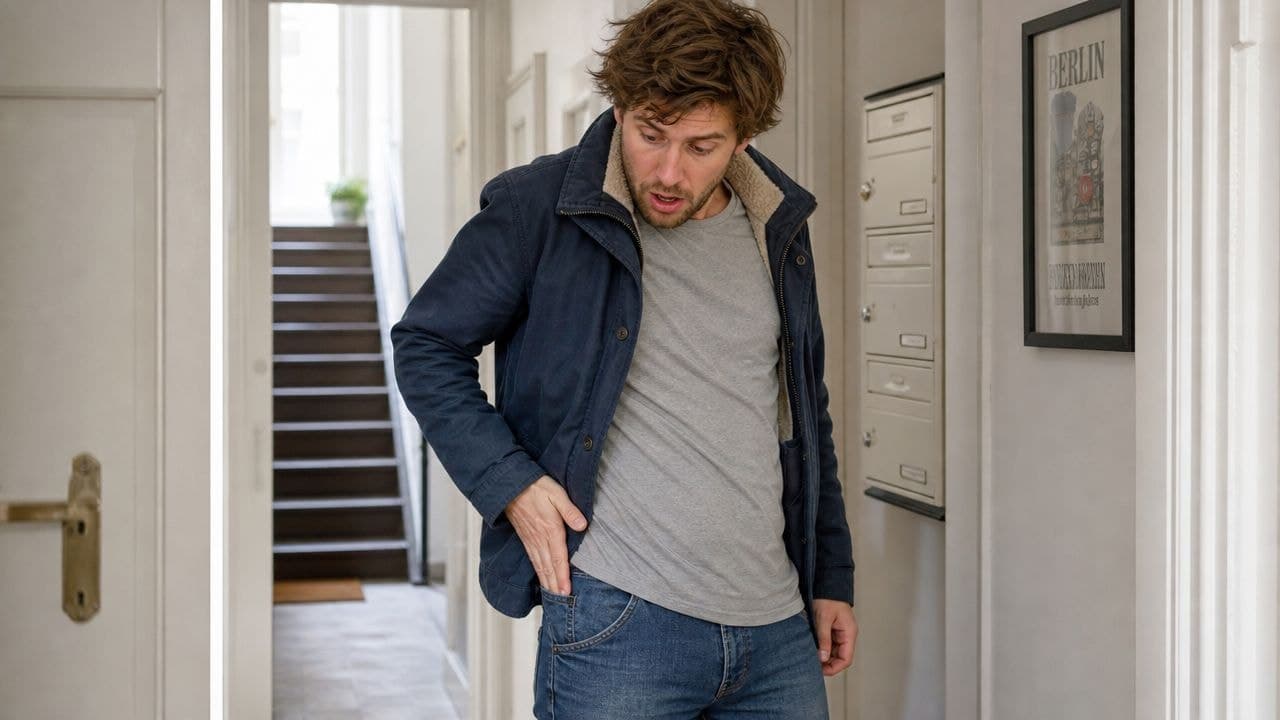
You check one pocket, then the other. You open your bag again, even though you already looked. You replay the last hour in your head and get that heavy, awful thought: I lost my key.
In Berlin, that feeling hits harder when you're new. It's not just about getting back inside. It can mean a message to your landlord in German, a possible locksmith call, worries about what your rental contract says, and a real fear that tomorrow's Bürgeramt or Anmeldung appointment might fall apart because your documents are inside the flat.
You're not overreacting. This is one of those small incidents that can turn into a full administrative mess if you handle it in the wrong order.
This guide is for the newcomer version of this problem. Not the generic “check your sofa” advice. The Berlin version. The one where your landlord might only reply in German, your building may use a shared locking system, and you may have your Wohnungsgeberbestätigung sitting inside the apartment while your registration deadline keeps moving closer.
That Sinking Feeling You've Lost Your Key in Berlin
A lot of people make the same mistake in the first few minutes. They switch from searching to spiraling. They start imagining the landlord's reaction, the locksmith bill, the building lock system, the missed appointment, the spare key they don't have.
That reaction is understandable, but it makes the next step worse.
For newcomers, key loss rarely stays “just practical.” If your phone battery is low, your landlord speaks only German, and your passport or registration papers are inside, panic shows up fast. In shared housing, it gets more awkward because you may also need to explain the situation to a main tenant. In larger buildings, it gets more serious because one missing key can raise security concerns beyond your own door.
Practical rule: Treat the first hour as a recovery window, not a disaster window.
Berlin generally requires residents to register within 14 days after moving in. The Wohnungsgeberbestätigung is an important required document, and a rental contract does not replace it. If documents needed for an upcoming appointment are locked inside, check whether you have digital copies and arrange access calmly (Berlin registration service).
That doesn't mean your life is derailed. It means the order matters. Search first. Secure access second. Inform the right people third. Preserve paperwork and appointment options after that.
The newcomer problem isn't only the key
If you grew up in Germany, you probably already know what a Hausverwaltung expects and how to talk to a Schlüsseldienst. If you're new, the hard part is usually the chain reaction:
-
Housing access
-
Landlord communication
-
Document access
-
Appointment risk
-
Unexpected costs
That's why a calm process works better than speed. Rushing often leads people to call the first locksmith ad they find, force a door, or delay telling the landlord because they hope the key will “turn up later.” Those are the mistakes that make a bad evening expensive.
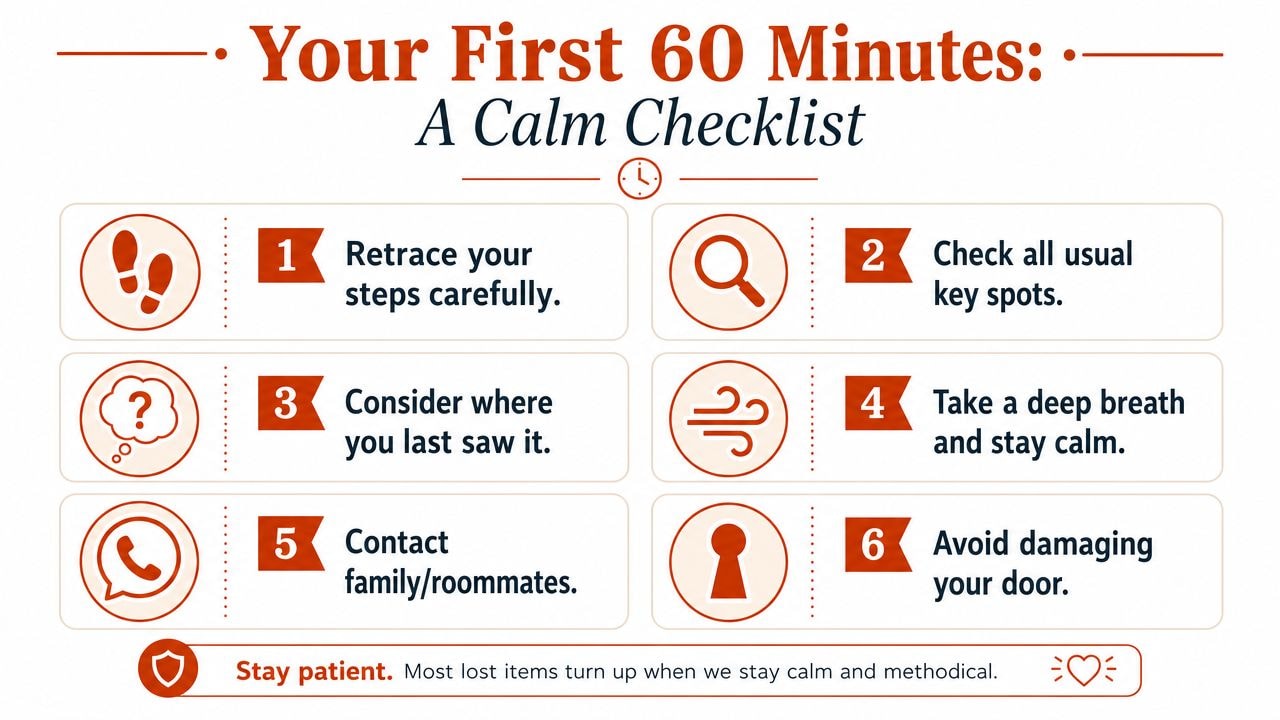
Your First 60 Minutes A Calm Checklist
Use the first hour to do three things in order. Retrace your steps carefully, flag any real security risk, and keep your housing paperwork in view if you have appointments coming up.
First, slow the situation down
Berlin makes this harder than it should be. If you are new here, you may already be thinking about your Anmeldung, your Wohnungsgeberbestätigung, or whether your landlord will expect a phone call in German. That stress is real, but panic is what gets people into overpriced lockouts and messy landlord conversations.
Sit down for two minutes and rebuild the timeline.
-
Name the last confirmed use. The last door you opened, the last time you held the key in your hand, or the last pocket you remember using.
-
Check the places keys hide. Coat lining, backpack corners, gym locker, tote bag seams, shopping basket, bike jacket, stroller pocket.
-
Contact the last location fast. Cafés, language school reception, office front desk, gym staff, a friend you visited.
-
Walk the route in reverse order. Start from the last confirmed point and retrace it exactly.
Specific descriptions help. “One apartment key, one mailbox key, black fabric tag, lost between Neukölln station and home” gives staff something real to look for.
If you moved recently, check old habits too. Newcomers often still use the pocket or bag they used in temporary housing, not the one they use now.
For other admin tasks that can be thrown off by a lockout, keep a separate list of what is time-sensitive. SettlyGo's first 30 days in Berlin checklist helps you see which documents and appointments need attention if you cannot get back into your flat quickly.
Then check the obvious recovery points
Public transport, rides, cafés, and gyms are the places where keys turn up surprisingly often. Report the loss with concrete details, not a vague message.
If BVG may be involved, use the official BVG lost property process and include the line, direction, time, and a clear description of the keyring. BVG keeps found items for up to six weeks, and its lost property process is explained on the official BVG Fundbüro page.
Do the same with places you visited:
-
Cafés and bars: ask staff whether they found a loose key or a full keyring
-
Gyms: check reception and the changing area separately
-
Coworking spaces: contact front desk or building security
-
Ride apps and taxis: use the trip record and contact the driver right away
-
Workplaces or schools: ask reception before assuming it is gone for good
If theft is suspected or confirmed
If the key disappeared together with a bag, wallet, ID, or address information, assess whether the items were simply lost or may have been stolen. If theft is known or reasonably suspected, block affected cards, notify your landlord when the key can be connected to your address, and report the incident to the police.
Start with the practical steps:
-
Block bank cards if your wallet is gone
-
Report the incident to police
-
Write down the case number
-
Tell your landlord or Hausverwaltung promptly if your address can be linked to the key
For reporting and service information, use the official Onlinewache portal and the Berlin Police service pages. Call 110 only for situations requiring immediate police assistance.
That report can matter later if there is an argument about whether a lock or key system had to be changed, or if your insurance asks what happened.
Keep your documents in mind
For newcomers, the immediate problem is often not only getting back inside. It is what sits inside the flat. Passport copies, rental papers, the Wohnungsgeberbestätigung, employer letters, and appointment printouts are often all in one folder near the door.
If you have an Anmeldung or visa-related appointment soon, make a quick note of what is locked inside and whether you have digital backups. That gives you a clearer picture before you speak to your landlord or decide how urgently you need access tonight.
The first hour is about control. A careful search, a proper report where needed, and a clear list of what is inside the flat will save you money and stress later.
Locked Out? Calling a Reputable Locksmith in Berlin
If the search failed and you can't get in, the next decision is more critical than it may seem. Berlin has good locksmiths. Berlin also has overpriced emergency operators who count on panic, urgency, and language gaps.
Locksmith prices vary according to the time, travel distance, door condition, and work required. Verbraucherzentrale recommends comparing local providers, asking where the technician is travelling from, and agreeing on a binding total price that includes travel and any night or weekend surcharge before dispatch (Verbraucherzentrale guidance on locksmith overcharging). Verbraucherzentrale says a straightforward weekday door opening should generally not exceed €150, but this is consumer guidance rather than a guaranteed fixed tariff.
What a proper locksmith will ask
A trustworthy locksmith usually doesn't sound vague. They'll want the address, the type of door, whether the key is inside or fully lost, and how access can be verified.
That proof point matters. A reputable locksmith should verify that you are entitled to enter the apartment. Ask in advance which proof they will accept if your identification or tenancy papers are locked inside.
Ask these questions before anyone drives over:
-
What is the full call-out price? Ask for the total price for your situation, not only the “starting from” price.
-
Does the price change at night or on weekends? It often does.
-
What documents do you need from me? Passport, Meldebescheinigung, or other address proof.
-
Will you drill immediately? Drilling should not be the default first step for a normal lockout.
What to say on the phone before anyone comes
Keep the call simple and specific. You don't need perfect German. You need clarity.
A useful structure is:
-
Your address
-
Whether you're locked out or the key is missing
-
Whether the key may have been stolen
-
What proof of address you have
-
A request for the full expected price before dispatch
If making that call in German feels risky, practical language help can save a lot of confusion. SettlyGo offers German phone call help, which is useful when you need someone to help communicate the situation, confirm the quoted price, prepare questions, and take notes. That's practical support, not legal advice.
Ask for the amount you're expected to pay if the door opens without drilling. Then ask what changes the price.
Red flags that usually mean trouble
A few patterns are worth avoiding:
| Warning sign | Why it's a problem |
|---|---|
| No clear price on the phone | You lose control before they arrive |
| Pressure to act immediately without details | Panic becomes part of the sales tactic |
| Refusal to discuss proof of address | Poor security practice |
| Drilling presented as the first option | Can create unnecessary replacement costs |
| Only cash, no proper receipt discussion | Harder to document later |
One more Berlin-specific point: don't damage the door yourself. Prying, forcing, or trying random internet tricks can turn a simple opening into a repair issue with your landlord.
Notifying Your Landlord or Hausverwaltung
Send the message early.
A lot of Berlin newcomers wait because they hope the key will turn up, or because they want to explain everything in neat German once they know the full story. That delay can create more trouble than the lost key itself. Your landlord or Hausverwaltung may need to tell you whether the key belongs to a shared locking system, whether they want a specific locksmith, or whether they require written documentation first.
This matters even more if you are new in Berlin and still mid-setup. If you have an Anmeldung, visa, bank, or residence-related appointment coming up, a missing apartment key can turn into a timing problem fast. You may be locked out, waiting on building management, and trying to explain the situation in German at the same time. A short factual message buys you time and shows you reported the issue promptly.
For rented flats in Germany, the practical question is not just “I lost a key.” It is often “what access did that key control?” If your contract mentions a Schließanlage, or if the same key opens the front door, cellar, bike room, or courtyard, the landlord will usually want to assess the security risk before anyone orders a replacement. Tenant guidance from Berliner Mieterverein on keys and locking systems explains why shared systems can trigger a different response than a single apartment cylinder.
Keep your note simple and useful. Include:
-
your full address
-
when you noticed the key was missing
-
whether it may have been stolen
-
whether any tag, document, or ID could connect the key to your address
-
whether you are locked out right now
-
a direct request for instructions
Do not promise to replace the lock yourself unless the landlord has told you to do that. In Berlin rentals, acting first and explaining later can create an argument about authorization, reimbursement, or whether the wrong lock was fitted.
A simple message you can send
English template
Subject: Lost apartment key at [your address]
Hello,
I am informing you that I have lost the apartment key for [full address]. I noticed it on [date] at around [time]. At this stage, I cannot confirm whether it is lost or stolen.
Please let me know how you would like me to proceed and whether there is a required process for replacement or lock security.
Kind regards,
[Name]
[Phone number]
German template
Betreff: Wohnungsschlüssel verloren, [Ihre Adresse]
Guten Tag,
ich informiere Sie darüber, dass ich den Wohnungsschlüssel für [vollständige Adresse] verloren habe. Ich habe den Verlust am [Datum] gegen [Uhrzeit] bemerkt. Im Moment kann ich noch nicht sicher sagen, ob der Schlüssel verloren oder gestohlen wurde.
Bitte teilen Sie mir mit, wie ich weiter vorgehen soll und ob es ein bestimmtes Verfahren für Ersatz oder Sicherungsmaßnahmen gibt.
Mit freundlichen Grüßen
[Name]
[Telefonnummer]
If the hard part is writing or speaking to the landlord in German, landlord communication help in Berlin can help you draft the message, place the call, and understand the reply. For newcomers, that is often the point where a manageable problem starts to spiral.
Understanding the Costs and Your Insurance
The money side of a lost key in Germany can be small, annoying, or brutal. It depends on one thing above all: what kind of access system your key belongs to.
What different key problems usually cost
Costs can remain limited for a straightforward door opening but become much higher if a lost key creates a genuine security risk for a shared locking system. Whether a tenant is responsible for replacing a Schließanlage depends on the circumstances, including fault, whether misuse is realistically possible, and whether the system is actually replaced. For a dispute or a large demand, speak to a tenants’ association or lawyer (BGH case summary via Berliner Mieterverein).
Don't assume the lost object is “just one key.” In many Berlin buildings, that one key may open several access points.
Where insurance may come in
This is the point where many tenants ask about Haftpflichtversicherung, which is personal liability insurance. Coverage depends on the policy. Private liability insurance may cover certain lost third-party keys, but coverage is not automatic and limits or exclusions may apply. Home-content or assistance policies can cover different costs. Contact the insurer and do not promise reimbursement to the landlord before checking the policy. Verbraucherzentrale guidance on lost third-party keys and insurance
This article can't tell you what your insurer will approve. That would be insurance advice, and for that you should speak directly with your insurer or a qualified insurance professional.
What usually helps in practice is being organized:
-
Keep the invoice and receipt from any locksmith
-
Save the message to your landlord or Hausverwaltung
-
Keep the police report number if theft is involved
-
Ask for any replacement or lock-change documentation
-
Store photos of the keyring if you have them
Next Steps and How a SettlyGo Helper Can Assist
Once you're back inside, there's usually still admin left to do. You may need permission for a replacement key, a follow-up with the Hausverwaltung, a visit to a specific key-cutting shop, or a call to sort out what your insurer wants in writing.
That part is often harder than the actual lockout for newcomers. The immediate crisis is over, but now you're dealing with German emails, building procedures, receipts, and possibly an upcoming Anmeldung appointment that still needs paperwork locked inside the apartment.
If your registration timing is under pressure, Berlin’s Bürgertelefon 115 is available Monday to Friday from 08:00 to 18:00. That doesn't solve the key problem, but it can stop the key problem from becoming an appointment problem too.
For practical help after the emergency, SettlyGo's paid human support in Berlin is useful when you need someone to help with phone calls, appointment preparation, landlord communication, or organizing the documents that were sitting inside your apartment. That support is practical and local. It's not legal advice, immigration advice, tax advice, or certified translation.
If you've lost your key in Berlin, the best move is usually the least dramatic one. Slow down. Search properly. Protect yourself if theft is possible. Get the right person involved early. Then clean up the paperwork before it turns into a second problem.
If losing your key has turned into landlord messages, a locksmith phone call, document stress, or routine follow-up with the Hausverwaltung, book a SettlyGo helper. SettlyGo can help with practical communication, preparing questions, note-taking, document organization, and routine administrative coordination. SettlyGo does not provide legal advice, tenancy-law advice, insurance advice or brokerage, emergency locksmith services, certified translation, sworn interpretation, application filing, or official representation.
Need practical help in Berlin?
Book a verified SettlyGo helper for German phone calls, appointments, landlord communication, apartment viewings, and document preparation.