Medical Insurance in Germany for Foreigners: 2026 Guide
July 19, 2026 · 22 min read

You arrive in Berlin with a suitcase, a rental contract, and a to-do list that already feels too long. Then someone tells you that you need Krankenversicherung, health insurance, before your residence permit, often before your job setup feels fully real, and sometimes before you even understand which office wants which document.
Health insurance is generally mandatory for people who reside in Germany, but the correct insurance route depends on employment, study, family circumstances, previous insurance and residence status. Anmeldung itself does not require health-insurance proof. Suitable coverage is, however, important for many residence-title, employment and university processes. See the Federal Ministry of Health overview of the statutory health insurance system and the Berlin service page for Anmeldung.
This guide is for that exact moment. It explains medical insurance in Germany for foreigners in plain language, with a focus on the friction points: what to do first, where people get stuck, and how to avoid wasting time with the wrong documents or the wrong kind of policy.
Your Complete Guide to German Health Insurance
If you're new to Germany, health insurance often feels less like healthcare and more like a gatekeeper. You may need suitable insurance proof for a visa or residence title, employment onboarding, university enrolment or another status-specific procedure. That sounds dramatic, but in practice it means one thing: deal with this early and life gets easier.
A typical Berlin story goes like this. You've found temporary housing in Neukölln or Charlottenburg, you're trying to book a Bürgeramt slot, and your employer asks for your health insurance details. At the same time, the insurer asks for documents you haven't fully organized yet. Nothing is impossible, but each step seems to depend on another.
That's why it helps to treat health insurance as a process, not a mystery. Once you know which system you belong in, which papers matter, and which kind of temporary coverage is accepted, the whole thing becomes more manageable.
For a broader arrival plan, the first 30 days in Berlin checklist is a useful companion because health insurance rarely happens in isolation. It usually sits next to Anmeldung, residence paperwork, bank setup, and employer onboarding.
Most newcomers don't struggle with the idea of insurance. They struggle with timing, paperwork, and the fact that every office asks for the same information in a slightly different way.
Why Health Insurance Is Your First Priority in Germany
On Monday, your employer asks for your insurance details. On Tuesday, the immigration office checklist says you need proof of health coverage. On Wednesday, the insurer asks for documents you are still trying to collect. That circular feeling is one of the first real friction points many foreigners hit in Germany.
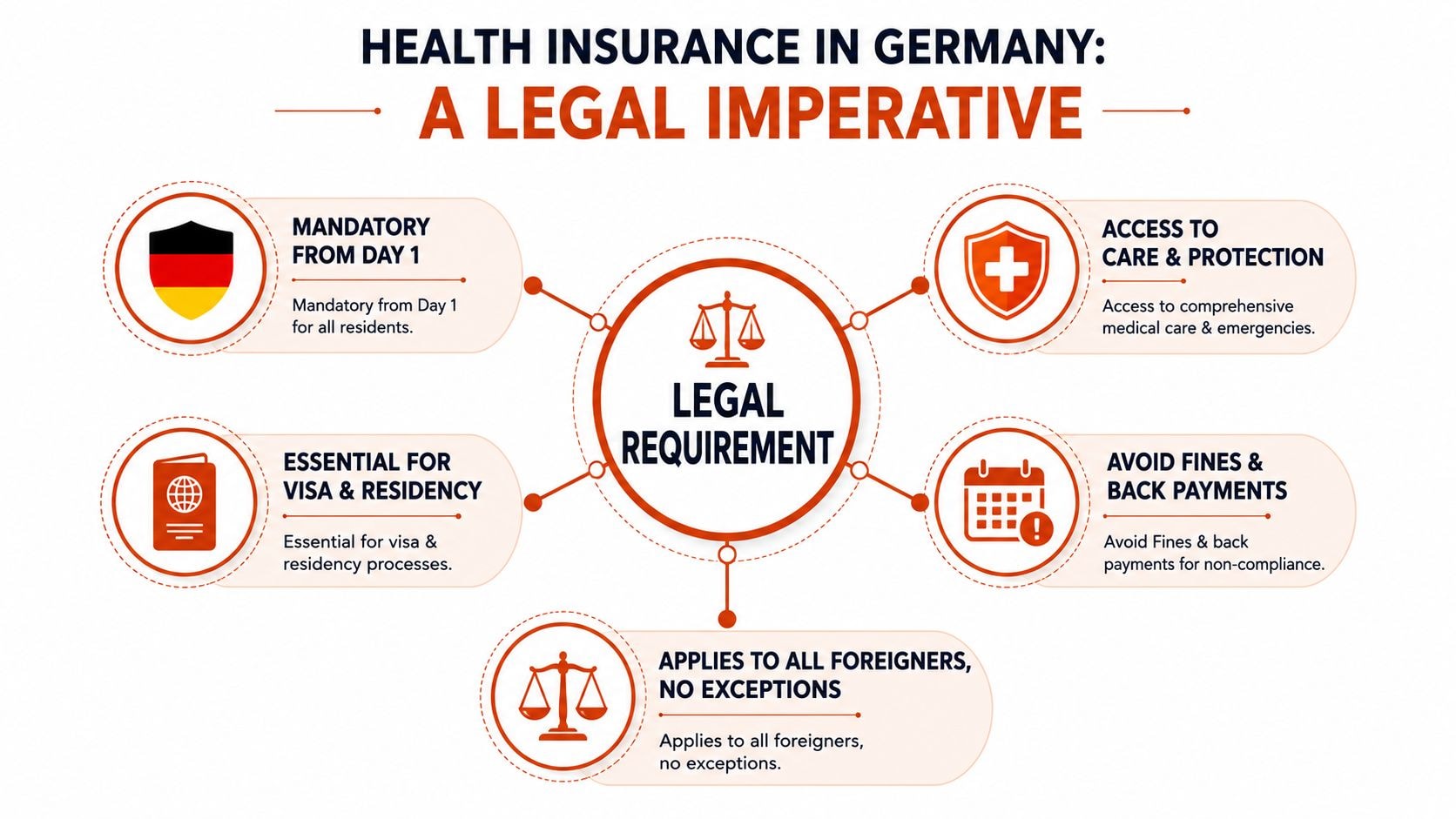
Health insurance sits near the start of that chain because German authorities treat it as part of your basic legal setup, not as something you can sort out once life is calmer. For non-EU foreigners, the link is especially direct. The residence permit process usually requires proof that your coverage is valid in Germany, as stated in the Berlin immigration office's information sheet on health insurance requirements.
That is why delays here spread outward.
Unclear insurance status can delay employer registration, university enrolment or a residence application when the required confirmation has not yet been provided. If you show up with travel insurance when the office expects German-compliant coverage, you may need to start over with new paperwork and another appointment.
The required proof depends on the recipient. A statutory insurer may provide a current membership confirmation, while some processes use electronic notifications. Berlin residence-title applications may accept a copy of the electronic health card or a current insurer confirmation for GKV coverage. Privately insured applicants may need a certificate from the insurer describing the scope and cost of coverage. See the Berlin service pages for residence permits and health insurance proof and other residence-title procedures.
A lot of confusion comes from the word "insurance" itself. Newcomers hear it and assume any policy counts. In Germany, that is often the wrong assumption. Travel insurance may be fine for a short stay, but many work and residence situations require either public insurance or a private plan that matches what the authorities expect.
Here is the practical test:
-
For residence paperwork: confirm that your policy is accepted for your permit type, not just valid for emergencies
-
For employment: ask whether your employer needs a statutory membership certificate or a private insurance confirmation for payroll
-
For forms and appointments: check the exact German term being requested, because "proof of insurance" can mean different documents in different offices
If you get stuck in the classic deadlock, insurer wants residence documents, residence office wants insurance proof, employer wants both, do not wait idly. Call the insurer and explain your status clearly. Ask what temporary proof they can issue based on your job contract, admission letter, or registration status. If the German phone call feels like the main obstacle, that is normal. A SettlyGo helper can assist with practical communication, preparing questions, organizing documents, taking notes and clarifying which confirmation an office has requested. SettlyGo does not compare, recommend, sell or broker insurance products.
Practical rule: If a document list mentions health insurance, verify the exact type of proof required before your appointment. That one check can save weeks of back-and-forth.
Public vs Private Insurance: The GKV and PKV Decision
You have a job offer in Berlin, your employer asks for your insurance details, and three tabs are open on your laptop. One says GKV, one says PKV, and one is a forum thread full of conflicting advice. That confusion is normal. This choice affects your monthly cost, your paperwork, and how much admin you will handle later.
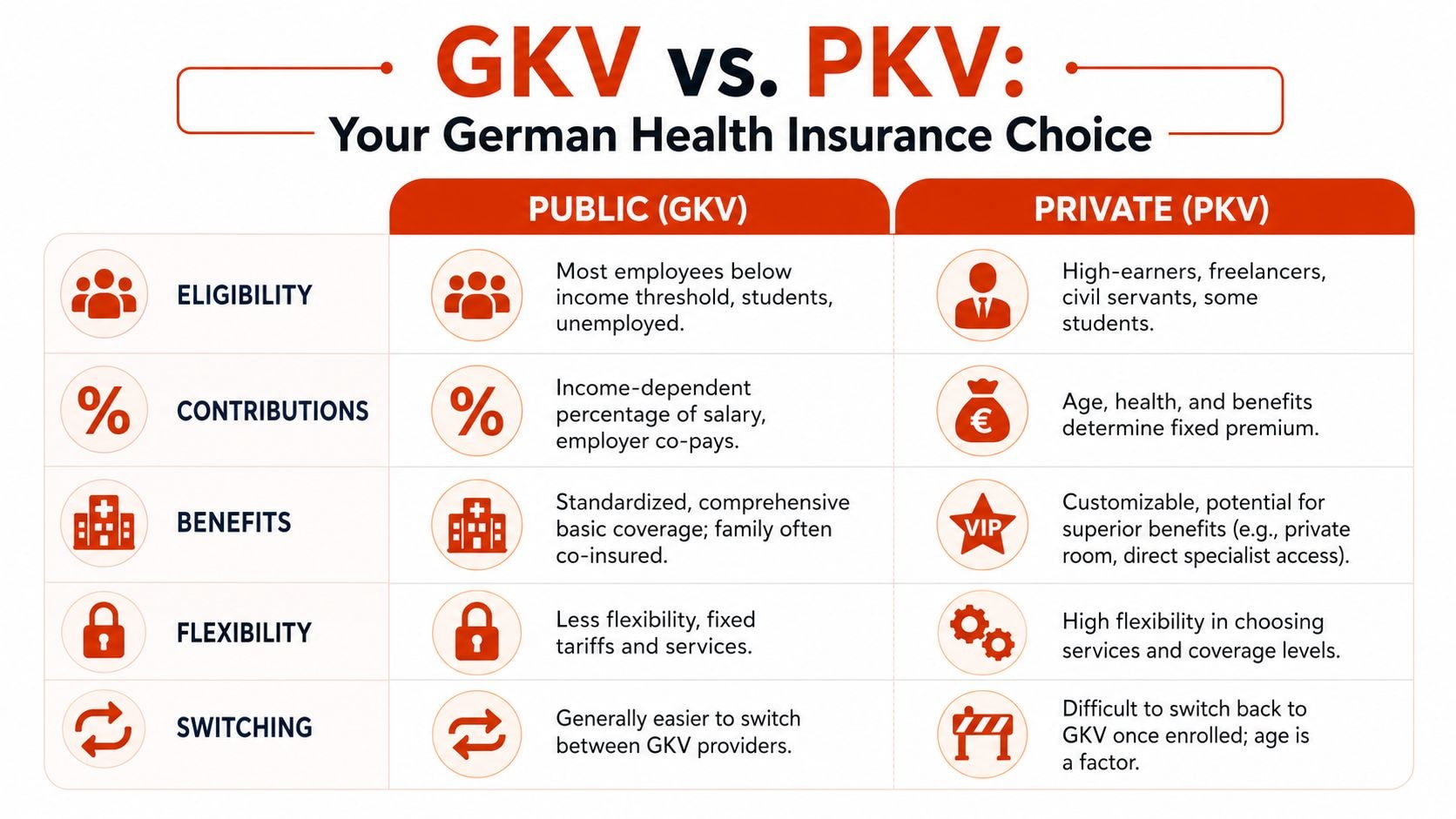
Germany uses two main routes for regular health insurance. GKV is the public system, short for Gesetzliche Krankenversicherung. PKV is the private system, short for Private Krankenversicherung.
The rule that settles many cases
For employees, one income threshold usually decides whether you have a choice at all. For 2026, the general annual compulsory-insurance threshold for employees is €77,400. Employees whose regular salary is above €603 per month and does not exceed €77,400 annually are generally subject to compulsory GKV membership. Above that annual threshold, an employee may be eligible to remain voluntarily insured in the GKV or choose PKV, as outlined by the Federal Ministry of Health and the Federal Ministry of Labour and Social Affairs 2026 social insurance figures announcement.
That is why some newcomers spend hours comparing private plans they are not even allowed to join yet.
Public insurance contributions follow a legal formula tied to income, and employers usually share the cost. Private insurance works differently. The price depends more on your contract, age, health profile, and the benefits you choose. The practical result is simple. GKV is rule-based and predictable at the start. PKV is individualized, which can be attractive, but it also creates more decisions and more fine print.
What the systems feel like in real life
The cleanest way to compare GKV and PKV is to ask a boring but useful question: what will this feel like six months after you move?
| Topic | Public insurance GKV | Private insurance PKV |
|---|---|---|
| Who usually enters this system | Many employees, especially those below the income threshold | Higher-earning employees, many freelancers, civil servants, and some students |
| How contributions work | Based mainly on income | Based mainly on the policy and personal risk factors |
| Coverage structure | Standard legal framework | Contract-based, with more variation between plans |
| Family setup | A spouse, registered partner or children may qualify for contribution-free family insurance if the statutory conditions are met | Each family member generally needs individual private coverage |
| Administration | More standardized forms and processes | More comparison work and closer attention to contract details |
| Long-term risk | Usually easier to predict early on | Requires more planning before signing |
Contribution-free GKV family insurance is conditional. Residence in Germany, income limits and the family member’s own insurance status all matter, as explained by the Federal Ministry of Health.
GKV works a bit like a shared public transport pass. The rules are broad, many people use the same system, and the structure is easier to explain to an employer, university, or immigration office. PKV works more like choosing a mobile phone contract with many plan variations. You may get a setup that fits you well, but only if you read the terms carefully and understand what you are signing.
Where newcomers usually get stuck
The actual friction is rarely the theory. It is the admin that follows.
With GKV, the process is often easier for newcomers because employers, payroll teams, and government offices see these documents all the time. If someone asks for a membership certificate, there is a standard path. With PKV, the policy may still be valid and suitable, but you may need to explain it more often, especially if the person on the other side of the phone is checking whether your documents fit a permit or enrollment requirement.
That matters when your German is limited and the office is speaking in abbreviations.
A private policy is not the wrong choice. It is a choice that asks more from you upfront. You need to be comfortable comparing terms, asking sharper questions, and checking whether the policy fits your status, not just your budget.
A practical way to decide
These examples usually make the decision clearer:
-
You have a standard employment contract and a salary below the threshold: you will usually go into GKV, so your task is choosing a public insurer, not debating the whole system.
-
You earn above the threshold: you may have a real choice, but the better question is whether you want a simpler setup or a more customized contract.
-
You are moving with a spouse or children: family insurance rules can make public insurance easier to reason through.
-
You expect lots of paperwork with immigration or university offices: the more standardized route often creates fewer back-and-forth requests.
One more point that saves headaches. Cheap is not the same as workable. A low-price private plan can create problems later if you need specific proof for a residence permit, payroll setup, or family coverage question.
If you are stuck between two valid options and the deadlock is practical rather than legal, for example you cannot tell what document the office wants or you do not want to make the insurer call in German alone, a SettlyGo helper can assist with practical communication, preparing questions, organizing documents, taking notes and clarifying which confirmation an office has requested. SettlyGo does not compare, recommend, sell or broker insurance products.
Useful rule: Choose the system you can explain and document easily for your current status, not the one that only looks better in a price comparison.
If you need formal advice about long-term cost planning, medical underwriting, or contract suitability, speak with a qualified insurance broker or advisor.
Who Is Eligible for Which Insurance Type
A lot of newcomers get stuck here for a simple reason. Two offices ask for different proof at the same time. The employer or university wants confirmation of insurance. The insurer wants documents that depend on your German status. The residence office may want both. Once you understand which category Germany places you in, that deadlock gets much easier to break.
The useful starting point is your complete situation. Employment, study, family circumstances, previous insurance, country of prior coverage and residence status can all affect how you are classified. Confirm the classification with the responsible insurer rather than relying on one factor alone.
Employees
If you have a normal German employment contract, your category is usually the easiest to sort. Payroll tells the insurer how to classify you, and the insurer gives the paperwork your employer needs.
Your friction point is often timing, not eligibility. Many people sign a contract from abroad, then get asked for a membership certificate before they have finished Anmeldung or opened a bank account. In practice, public insurers are often used to this sequence and can usually tell you what they need first and what can follow later.
What helps: contact the insurer as soon as you have the signed contract, and ask one direct question. “Can you issue provisional confirmation for my employer based on this contract?” If the call in German feels risky, prepare your documents in advance with a Berlin appointment documents checklist for newcomers, or use a SettlyGo helper for practical communication, preparing questions, organizing documents, taking notes and clarifying which confirmation an office has requested. SettlyGo does not compare, recommend, sell or broker insurance products.
Students
Students often assume their university will explain everything clearly. Sometimes it does. Sometimes you get a portal message, a German form, and a deadline.
The practical issue is recognition. A policy can look valid to you and still cause problems if the university system or immigration office does not accept it for your status. That is why student insurance is less about finding the lowest monthly price and more about getting the correct proof in the format the university expects.
If you are starting university in Germany, ask two questions early. First, does the university need an electronic notification from a statutory insurer? Second, if you want private insurance, will the school and immigration office accept that choice for your exact case? Those two questions save a surprising amount of back-and-forth.
Freelancers and self-employed people
Freelancers hit the most paperwork friction. The legal route may be possible. The hard part is proving your situation clearly enough for the insurer to classify you.
A new freelancer often arrives with foreign clients, uneven income, and no German tax notice yet. The insurer may ask for income estimates, contracts, bank statements, or a business description. None of that is strange. They are trying to place you into the right contribution logic.
Freelancers cannot assume that voluntary GKV entry is automatically available. Access can depend on previous insurance history, the timing of the application and other statutory conditions.
This is also where people get trapped in bureaucratic deadlock. The insurer asks for proof of activity. The residence process asks for proof of insurance. You are still setting up both.
The practical answer is to build a small evidence file before you apply: client contracts, invoices if you have them, a short description of your work, and any financial records that show how you support yourself. If the requests from the insurer are unclear or arrive only in German, a SettlyGo helper can assist with practical communication, preparing questions, organizing documents, taking notes and clarifying which confirmation an office has requested. SettlyGo does not compare, recommend, sell or broker insurance products.
Family members, job seekers, and EU arrivals
Family status can make things simpler or more complicated, depending on the main insured person's setup. If one spouse is in public insurance, family coverage is often easier to process and easier to explain to other offices. If the main insured person is privately insured, each family member usually needs separate attention and separate proof.
Job seekers need to be careful with assumptions. There is no single newcomer rule that covers everyone. Your previous insurance history, country of origin, and reason for stay all matter.
EU arrivals often assume the European Health Insurance Card solves everything. It may help for temporary stays or short-term situations, but it does not automatically answer the question an employer, university, or immigration office is asking. Those offices usually want proof that matches your current status in Germany, not just proof that you can receive urgent care somewhere in Europe.
If your case sits between categories, stop guessing and get the classification confirmed before you book a critical appointment. That one step can prevent the classic loop of “insurance says ask immigration” and “immigration says ask insurance.”
How to Enroll in Health Insurance Step by Step
You usually feel the pressure at the worst moment. Your employer wants proof of insurance. Your university portal asks for a certificate. Your residence appointment is coming up. Then an insurer sends a form in German asking for details you are not even sure apply to you yet.
That is normal.
Enrolling in German health insurance is rarely difficult because the form is long. It gets difficult because each office wants a slightly different version of the same story, and they all expect you to know which documents prove it. The safest approach is to do this in order and get written proof at each step.
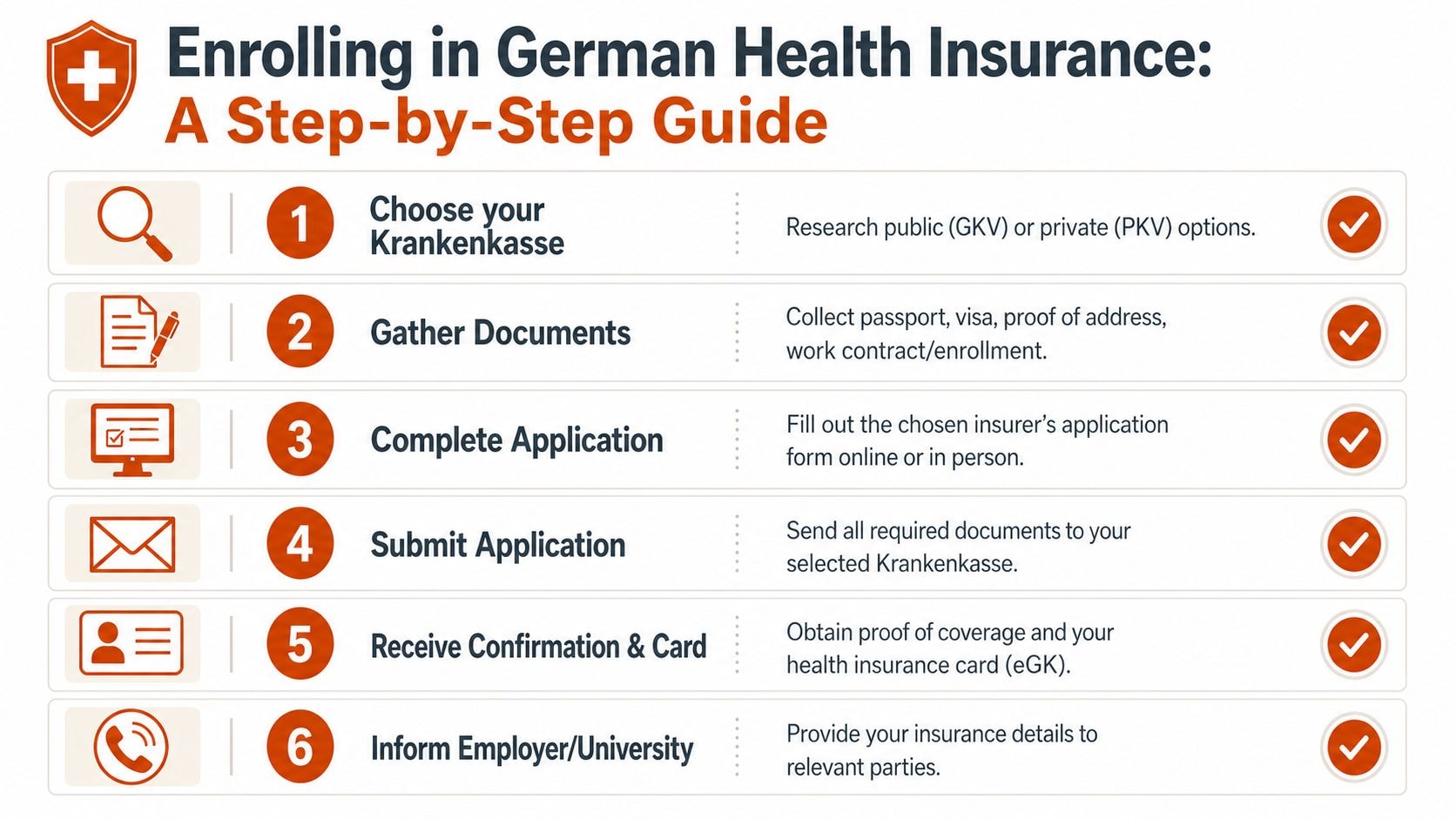
Your practical checklist
Before you apply, pause for ten minutes and sort your case into one clear category. Insurance enrollment in Germany works a bit like airport check-in. The counter staff can help you, but only after they know which line you belong in.
A practical order looks like this:
-
Confirm your status on paper
Use the status you can document now, not the one you expect later. Employee, student, freelancer, job seeker, or dependent family member each triggers a different process. -
Choose the insurance route that matches that status
If you belong in public insurance, pick a Krankenkasse and start there. If private insurance is an option, read the policy scope carefully before signing anything, especially if you will need the certificate for immigration or university use. -
Collect the documents the insurer will ask for first
In many cases that means your passport, proof of address registration if you already have it, proof of employment or study, and records that show how you support yourself. Students also often need their university enrollment certificate. -
Fill out the application slowly
The hard part is usually not the form itself. The hard part is choosing the answer that matches your legal and work status in Germany. If one field seems ambiguous, stop and clarify it before submitting. -
Ask for the exact confirmation document you need
Do not settle for a vague email saying your application is being reviewed if another office needs formal proof. Ask whether they can issue a membership certificate, provisional confirmation, or another accepted document for your employer, university, or permit appointment. -
Send that proof to the next office immediately
Delays often happen because applicants assume one office will automatically inform another. Sometimes that happens. Often it does not.
Health, identity, income and residence documents contain sensitive personal data. Send them only through verified insurer or authority channels, redact information that is not required, and avoid sharing medical records or financial documents with unverified intermediaries.
If your insurance proof is only one part of a bigger appointment packet, keep a Berlin appointment documents checklist so you do not solve the insurance issue and then get blocked by a missing registration paper or passport copy.
Where people usually get stuck
The main friction point is translation between systems. The insurer asks about residence status. Immigration asks about insurance status. HR asks for a membership certificate. Each office is logical from its own side, but newcomers get trapped in the middle.
A few examples come up again and again:
-
You have a visa, but your long-term residence status is still in process. The insurer may ask what basis you will stay on, and you may not have a final answer yet.
-
You earn freelance income from abroad. The insurer may want contracts, invoices, or bank records in a format you have not prepared.
-
Your Anmeldung is delayed. Another office still wants insurance proof even though your local registration appointment is weeks away.
-
You get a phone call in German. The issue itself may be simple, but one misunderstood question can delay your file for days.
A good rule is to keep one physical folder and one digital folder with the same documents in the same order. It sounds basic, but this is what shortens the back-and-forth. When an insurer asks for a scan again, you can send it in two minutes instead of searching through old emails.
If the blockage is administrative rather than medical or legal, a helper service can save time. A SettlyGo helper can assist with practical communication, preparing questions, organizing documents, taking notes and clarifying which confirmation an office has requested. SettlyGo does not compare, recommend, sell or broker insurance products.
Common Pitfalls and How to Avoid Them
Most guides explain the system. Fewer explain where newcomers lose time, buy the wrong policy, or end up in a loop between offices.
Insurance transitions after arrival
Insurance transitions after arrival depend on the person’s status. Do not assume that every newcomer faces a three-month coverage gap or must purchase a product marketed as ‘incoming insurance.’ Berlin generally accepts travel health insurance for entry and short stays of up to three months, while longer residence commonly requires statutory insurance or comparable private coverage. Some residence categories have different rules, so check the official requirements for the exact permit. See the Berlin immigration FAQ and the Berlin service page for residence permits.
The freelancer trap
Freelancers often get oversimplified advice: “You can choose private.” That's not enough.
The practical problem is that a cheap private or travel-style policy may not satisfy residence requirements, while public enrollment may require income evidence that a brand-new freelancer doesn't yet have. If your paperwork is thin, the issue isn't only price. It's compliance and proof.
What helps:
-
Check the official insurance requirements for your exact residence category: then ask the insurer whether it can issue the specific certificate or confirmation listed by the authority. The authority makes the final assessment.
-
Prepare income documents early: contracts, invoices, scholarship proof, or any financial statement that helps establish your situation.
-
Expect follow-up questions: freelance cases often involve more clarification than regular employment cases.
Two more misunderstandings
Two smaller misunderstandings create a lot of stress.
-
EHIC is not a full long-term solution: The EHIC provides access to medically necessary public healthcare during a temporary stay. It is not a universal substitute for long-term German insurance. If Germany becomes your habitual residence, ask the responsible insurer whether an S1 registration or German coverage is required, as explained by the European Commission's EHIC overview.
-
Travel insurance isn't the same as German-compatible health insurance: Whether travel insurance is accepted depends on the purpose and length of stay. Berlin generally accepts it for entry and short stays, while most longer-term residence procedures require statutory insurance or comparable private insurance. Some permit categories have specific exceptions.
The cheapest policy is expensive if the Ausländerbehörde refuses it and you have to start over.
Calling a Krankenkasse: A Practical Script
For many newcomers, the hardest part isn't choosing between GKV and PKV. It's making the call.
Phone menus are fast, staff may switch into English only partly, and one unclear answer can leave you wondering whether your application is complete. If you need to ask for a Mitgliedsbescheinigung, confirm your insurance number, or check whether a document arrived, a short script helps.
Simple bilingual phone script
Use this structure and keep your details written in front of you.
German: Guten Tag, mein Name ist [your name]. Ich bin neu in Deutschland und ich habe eine Frage zu meiner Krankenversicherung.
English: Hello, my name is [your name]. I'm new in Germany and I have a question about my health insurance.
German: Ich möchte wissen, ob meine Anmeldung bei Ihnen vollständig ist.
English: I'd like to know whether my registration with you is complete.
German: Ich brauche eine Mitgliedsbescheinigung für [meinen Arbeitgeber / die Universität / die Ausländerbehörde].
English: I need a membership certificate for [my employer / the university / the immigration office].
German: Können Sie mir bitte sagen, welche Unterlagen noch fehlen?
English: Could you please tell me which documents are still missing?
German: Können Sie mir die Bestätigung per E-Mail oder Post schicken?
English: Could you send me the confirmation by email or post?
Keep these ready before you call:
-
Your personal details: full name, date of birth, current address
-
Your application context: employee, student, freelancer, family member
-
Your document question: missing document, membership certificate, status confirmation
If the call feels too difficult, health insurance call help in Berlin can help with practical communication, preparing questions, organizing documents, taking notes and clarifying which confirmation an office has requested. SettlyGo does not compare, recommend, sell or broker insurance products. For legal interpretation, policy disputes, or formal insurance advice, use a qualified insurance professional instead.
Frequently Asked Questions About German Health Insurance
When does my German health insurance need to start
People residing in Germany generally need health-insurance coverage. The precise start date, classification and potential retroactive contributions depend on the person’s employment, study, family, previous-insurance and residence situation. Confirm the date directly with the responsible insurer rather than assuming that an uninsured gap is permitted.
Can I use cheap travel insurance for my residence permit
Do not assume that a travel policy will be accepted. The answer depends on the residence category and duration. For many longer-term permits, Berlin requires German statutory insurance or comparable private insurance, while travel insurance may be sufficient for entry, short stays or certain specific permit categories.
If I earn above the threshold should I automatically choose private insurance
Not automatically. Having a choice doesn't mean one answer fits everyone. Your family setup, long-term plans, comfort with contract details, and need for administrative simplicity all matter.
What documents should I prepare first
Start with your passport, address-related documents if available, your job contract or university enrollment proof, and anything showing your income or financial status. Then check what your chosen insurer asks for in your specific category.
When should I get outside professional help
Use a qualified professional if you need legal immigration advice, formal insurance product advice, tax advice, medical advice, or certified translations. Use practical support when the problem is organizing papers, preparing for calls, understanding letters, or getting ready for an appointment.
If health-insurance administration has left you dealing with document requests, a routine German phone call, appointment preparation or an unclear insurer letter, book a SettlyGo helper. SettlyGo can help with practical communication, preparing questions, note-taking, document organization and routine administrative coordination. SettlyGo does not provide medical advice, insurance advice or brokerage, legal or immigration advice, policy comparison or recommendation, certified translation, sworn interpretation, application filing or official representation.
Need practical help in Berlin?
Book a verified SettlyGo helper for German phone calls, appointments, landlord communication, apartment viewings, and document preparation.