Pet Travel to Germany: A Complete Checklist for 2026
June 25, 2026 · 18 min read

Moving to Germany with a pet often starts the same way. Your own paperwork is already spread across the table, your housing situation may still feel temporary, and now you're trying to work out whether your dog or cat can board the flight without a problem at check-in or at the border.
That stress is reasonable. Pet travel to Germany is one of those tasks that looks simple from far away, then suddenly turns into a chain of deadlines, signatures, chip scans, vaccine records, airport procedures, and post-arrival admin in Berlin. The good news is that it becomes much easier once you stop treating it like one huge problem and start treating it like a timeline.
The first split is simple. If your pet is already traveling from another EU country, the process is usually more straightforward. If your pet is coming from a non-EU country such as the US, UK, or Canada, the document path is different and timing matters much more.
If you're new to Berlin and already juggling Anmeldung, housing, letters from authorities, and appointments in German, it helps to know where practical support ends and where professional advice begins. SettlyGo explains that clearly on its what SettlyGo can and cannot do page. For formal legal, immigration, medical, or certified translation issues, you'll still want the right qualified professional.
Your Pet’s Big Move to Germany: A Stress-Free Start
The hardest moment is usually the beginning, when every rule seems equally urgent. A family in this situation might be comparing apartments in Berlin, checking airline policies at midnight, and trying to decode whether an old rabies certificate is still usable. Most of the panic comes from not knowing which step matters first.
For pet travel to Germany, the process works better when you think in phases. First, confirm the permanent identification and vaccination foundation. Then confirm which document path applies to your route. After that, work backward from your flight date and protect the final paperwork window.
The move feels personal because it is
People often worry about the wrong things first. They spend hours comparing carriers or pet accessories, while the main risk sits in the records from a previous vet visit. Germany's entry process is document-heavy, but it isn't trying to trick you. It's built around traceable identification, rabies control, and proof that the paperwork lines up with the animal in front of the border vet.
That's also why calm preparation matters more than speed. A rushed booking can still work if the records are perfect. A relaxed booking can still fail if one date is wrong or the wrong form is used.
Many pet moves go smoothly because the owner treated the trip like a project plan, not a last-minute travel add-on.
Two routes, one mindset
The first practical question is not “Which airline should I book?” It's “Is my pet entering from within the EU or from outside it?” That answer shapes the documents you'll need and how tightly you have to manage the calendar.
A second helpful mindset shift is this. Border problems usually come from process errors, not from the animal itself. Missing scans, invalid sequence, expired certificate windows, or the wrong entry form create more trouble than the flight itself.
If you stay organized, pet travel to Germany becomes manageable. Keep one folder for originals, one digital folder for scans, and one simple checklist with dates you can verify at a glance.
The Unbreakable Rules Microchip and Rabies Vaccination
The easiest way to avoid a border problem is to treat the microchip and rabies record as the foundation of the whole move. Carriers, flight bookings, and arrival plans can be adjusted later. A bad chip-vaccine sequence usually cannot.
Start with the chip, not the vaccine
This is the mistake that costs people the most time and money. A pet can have a perfectly good rabies shot on file, but if that shot was given before the microchip used for travel identification, Germany can treat that vaccination as invalid for entry.
The safe rule is simple. Implant the microchip first. Scan it. Then give the rabies vaccination and record that same chip number on the paperwork.
The chip should be an ISO 11784/11785 compliant 15-digit microchip. That number needs to match across the rabies certificate and later travel documents. If your pet already has a chip, do not assume the clinic will copy it correctly from old records. Ask them to scan it in the room and read the number back to you.
For many pets entering from non-EU countries, there is also a waiting period after the rabies vaccination before travel. That is one of the deadlines owners often misread, especially when they are trying to line up flights and final certificates at the same time. Check the official guidance for your departure country and airline before booking, because certificate forms and timing can change. The European Commission's rules for travelling with dogs, cats and ferrets within the EU and movement of pet animals from non-EU countries are good starting points.
What to ask the vet to do
At the appointment, be specific. Say you need a microchip check and rabies documentation for pet travel to Germany. That usually gets better results than asking for "travel vaccines."
Ask the clinic to confirm these points before you leave:
-
Chip standard: The chip is a 15-digit ISO-compatible microchip.
-
Readable scan: The chip was scanned successfully at the visit.
-
Matching number: The chip number on the rabies record matches the scanner reading exactly.
-
Correct order: The rabies vaccination was given after the chip used for identification.
-
Clean paperwork: You received a legible rabies certificate with the chip number, vaccination date, product details, and vet signature.
Check every line before you walk out. One transposed digit can create a paperwork problem later, and it is much easier to fix at the clinic than during the final pre-travel rush.
If your pet is coming from a country that requires a rabies antibody blood test (often called a FAVN or titer test), build that into your timeline early. Owners often focus on the flight and miss this step, or discover it too late to satisfy the waiting period. This is one of the reasons a timeline-based plan works better than a generic checklist. The documents are linked, and one early mistake can push the whole move back by weeks. If your case is unusual, ask an official veterinarian or qualified pet relocation professional.
The Two Paths EU Pet Passport vs Non-EU Health Certificate
This is the fork in the road that shapes the rest of your paperwork.
For pets already living in the EU, travel is usually built around an EU Pet Passport issued by an authorized EU vet. For pets entering from outside the EU, the usual route is an EU Animal Health Certificate plus any required government endorsement in the country of departure. If the country of origin is subject to extra rabies controls, a rabies antibody test may also be part of the file.
The mistake people often make is using advice meant for the wrong route. An EU passport and a non-EU health certificate are not interchangeable, and treating them as if they are can cost you a missed flight or a rushed second vet visit.
Pet Entry Requirements EU vs Non-EU Origin
| Requirement | Traveling from an EU Country | Traveling from a Non-EU Country |
|---|---|---|
| Core travel document | Usually an EU Pet Passport | Usually an EU Animal Health Certificate endorsed by the official authority in the country of origin |
| Microchip requirement | The passport should match the pet's current identification records | The certificate must show the correct ISO 11784/11785 compliant 15-digit chip |
| Rabies rule | Rabies vaccination still needs to be current and properly recorded | Rabies vaccination must match the chip record and meet the required timing |
| Extra blood test | Usually not part of standard intra-EU travel | Pets from certain countries must also complete a FAVN or rabies titer test on time |
| Timing pressure | Often lower if the passport is already valid and up to date | Higher, because the health certificate is issued within a limited pre-travel window |
| Common risk | Assuming an old passport entry is still valid without checking dates and chip details | Using the wrong form, missing endorsement, or booking travel outside the certificate window |
For travelers coming from the United States, the USDA APHIS Germany pet travel page says pets must be vaccinated against rabies at least 21 days before travel. USDA also notes that new non-commercial health certificate rules tied to EU 2026/131 Article 5 are expected to take effect on October 1, 2026, so it is worth checking official guidance again if you are traveling near that date.
The practical difference between these two paths is timing control. With an EU passport, the document often exists well before the trip. With a non-EU health certificate, part of the process happens close to departure, often inside a tight 10-day window. That is where people run into trouble. They book the flight first, then learn the certificate was issued too early, endorsed too late, or prepared on the wrong form.
Use a checklist that matches your country of origin. Generic pet travel lists often mix EU and non-EU rules together, which is how small paperwork errors turn into expensive same-week fixes. Rules can change, especially around certificate forms and timing.
Your Pet Travel Timeline A Step-by-Step Countdown
A lot of pet moves go wrong in the last two weeks, even when the owner has done nearly everything right. The usual pattern is simple. The rabies shot is valid, the microchip is in place, the flight is booked, and then the final paperwork misses the allowed window by a day or two.
That is why I always suggest building this as a countdown from your arrival date in Germany, not from your departure date. If you are moving to Berlin and juggling housing, registration, and your own visa paperwork at the same time, this timeline keeps the pet side from slipping.
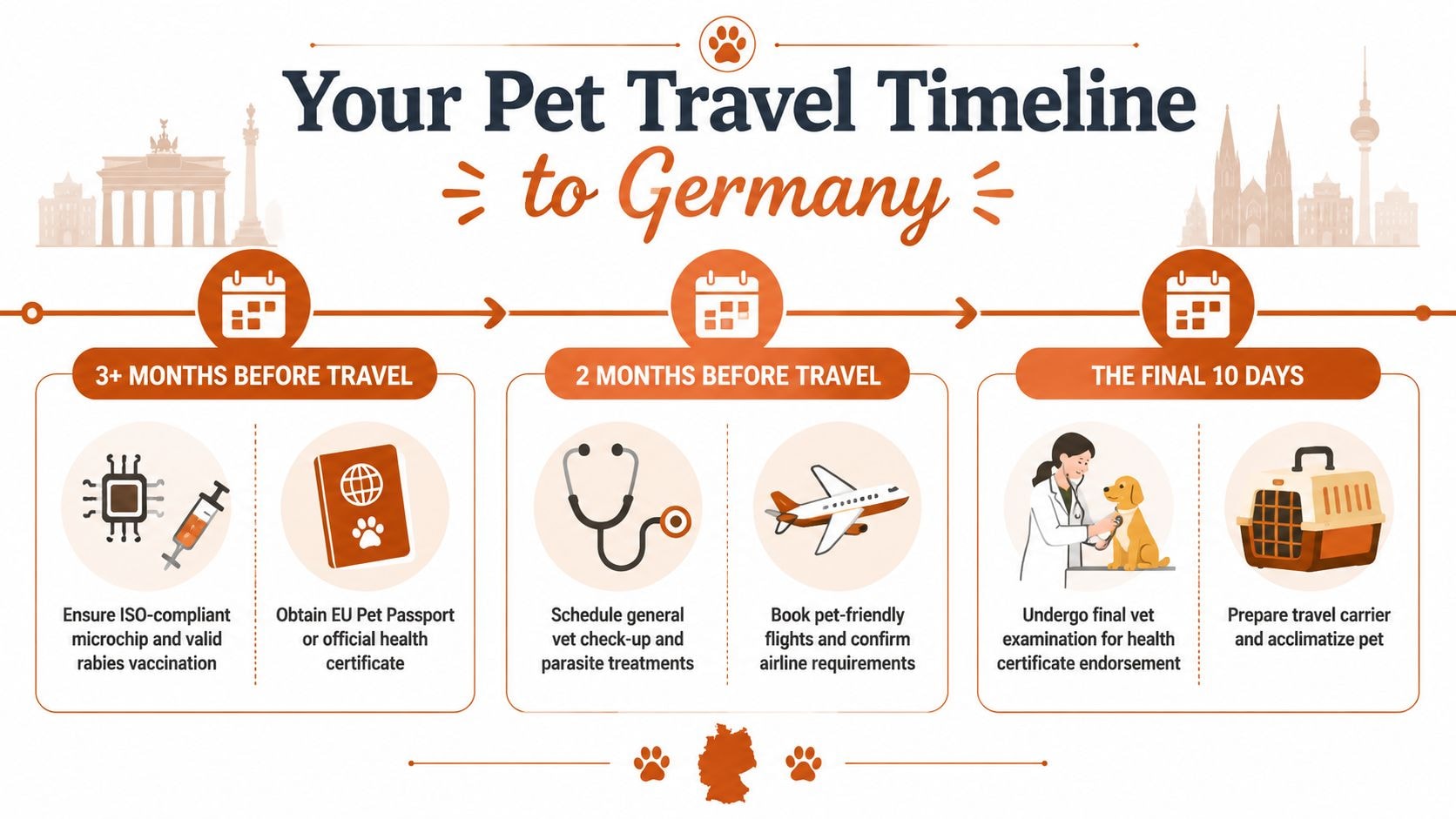
Three months or more before travel
Start with the items that take the longest to fix. Check the microchip number against every record. Check the rabies vaccination date. Then confirm which document path applies to you, based on where you are traveling from.
If your pet is coming from a high-rabies country, this is the point where the rabies titer test can set the pace for the whole move. As noted earlier, the blood sample must be taken after the required post-vaccination wait, and entry is only allowed after the additional waiting period has passed. If that timeline is off, no amount of last-minute effort will repair it.
This is also the best time to compare airlines in detail. Some are easier for in-cabin pets. Others are better set up for checked pets or cargo. Look at crate measurements, breed restrictions, summer heat embargoes, transit rules, and where the pet is released on arrival. A cheaper ticket is not always the better choice if it creates a difficult transfer or sends your pet through a cargo process you were not expecting.
Leave room for one error, one delay, or one rescheduled vet appointment.
About two months before travel
By this stage, the medical groundwork should already be done. Now the job is coordination.
Use this window to lock down the travel setup:
-
Book the pet space, not just your own seat: Airlines often limit the number of pets per flight. A reservation request is not the same as a confirmed pet booking.
-
Buy the correct carrier or crate early: Your airline may apply stricter size rules than the generic IATA standard.
-
Start crate practice at home: A pet that has already slept, eaten treats, and settled in the carrier usually handles travel better.
-
Match every name and number: Owner name, pet name, species, breed, and microchip number should read the same way across all documents.
-
Check whether your trip still qualifies as non-commercial: If the pet travels more than five days before or after the owner, the paperwork category can change.
That last point causes expensive problems. People often assume the pet can fly separately on the same documents, then learn too late that the certificate type no longer fits the trip.
If you want a simple reference point while planning the rest of your move, keep your broader relocation admin in one place with this Germany relocation FAQ checklist.
A short explainer can help if you want to hear the process described visually: watch it on YouTube.
The final 10 days
For non-EU departures, this is the part that needs the most care.
The EU Animal Health Certificate is tied to a strict 10-day pre-entry window. In practice, the risk is not just the vet appointment. The document also has to move through official endorsement in time, and that step can take several days depending on the country, the office, and whether anything needs to be corrected.
For US departures, the USDA APHIS Germany pet travel page is the best place to confirm certificate timing and endorsement steps. For EU-side rules, check the European Commission's movement of pet animals from non-EU countries. Count backward from the day your pet lands in Germany. Not from the day you leave home. Not from the day the airline first had space available.
My working checklist for this phase is short:
-
Confirm the final arrival date and airport.
-
Book the accredited vet appointment inside the allowed certificate window.
-
Check how long government endorsement usually takes in your country.
-
Review the form before submission, especially the microchip number and date format.
-
Print the endorsed originals and keep copies in a second folder.
Check the official guidance for your departure country and airline before booking, and if your case is unusual, ask an official veterinarian or qualified pet relocation professional.
Travel day
Keep every pet document in your hand luggage. Do not put originals in checked baggage, even if your pet is flying as excess baggage or cargo.
On the day itself, focus on a few practical checks:
-
Original paperwork: Health certificate or EU pet passport, rabies record, and any supporting lab results if they apply.
-
Carrier setup: Absorbent bedding, water setup allowed by the airline, and contact details attached to the crate.
-
Airport handoff plan: Know whether the pet goes to check-in, oversized baggage, or a separate cargo desk.
-
Arrival plan in Germany: Know whether you are collecting the pet at baggage reclaim, a live animal desk, or a cargo facility.
-
No handwritten fixes: If something looks wrong, ask the issuing vet or authority what to do. Crossed-out fields create avoidable questions.
A calm travel day usually comes from boring preparation. That is the goal here. Get the dates right early, keep the last 10 days clear for paperwork, and you reduce the chances of a very expensive delay.
Navigating the Airport Arrival and Customs in Germany
Landing in Germany is usually less dramatic than people fear, but it helps to know the sequence. At an airport such as BER in Berlin, your experience depends partly on whether the pet traveled in-cabin, as excess baggage, or via cargo.
What arrival usually looks like
For many non-EU arrivals, the pet's documents are checked as part of the border veterinary inspection process. The most important thing is to stay organized and keep your originals ready before anyone asks.
According to the US Army Rheinland-Pfalz pet travel information for Germany, pets arriving from non-EU countries must present a valid endorsed EU Animal Health Certificate, and their documents may be inspected by a veterinarian at the border. The same guidance notes a standard examination fee of approximately 55 EUR per pet.
If an officer directs you toward customs declaration or a veterinary desk, that doesn't automatically mean there's a problem. It often just means your pet's entry is being processed in the correct channel.
Border inspection feels much easier when your paperwork is clipped in the same order the officer expects to read it.
What to keep in your hand luggage
A small document pouch saves time here. Put the originals in one place and keep copies behind them in the same order.
Useful items to have immediately available:
-
Endorsed health certificate: The original, not just a phone photo.
-
Rabies vaccination record: Matching the chip number.
-
Microchip information: Easy to spot on the page without searching.
-
Flight and owner details: Helpful if anyone checks whether the movement is non-commercial.
-
Contact details for your vet or shipper: Useful if a clarification is needed.
If you're unsure how border-side procedures or practical arrival questions work in Germany, the SettlyGo FAQ is a useful place to understand the kind of everyday support newcomers often need after landing, especially when the next challenge is handling calls, letters, or appointments in German.
Welcome to Berlin Your Pet's First Days and Formalities
Once you're through the airport, the move shifts from import rules to normal Berlin life. This part matters more than many people expect because the first few days after arrival are when small administrative tasks start piling up.

Your first local admin tasks
For most newcomers in Berlin, the first two pet-related jobs are practical rather than dramatic.
The first is finding a local Tierarzt. Even if your pet arrived healthy, it helps to establish care early, especially if you'll need future vaccinations, routine treatment, or someone to review previous records from abroad. Calling clinics in German to ask whether they're accepting new patients, what documents to bring, and whether they can work with imported records can be surprisingly tiring when you've just moved.
The second is the city-level bureaucracy around dog ownership. If you've brought a dog, you should check the local registration and tax obligations that apply where you live in Berlin. Those letters and forms can feel familiar in one sense and completely unfamiliar in another, because even a simple request can use formal language that's hard to decode when you're new.
What's worth doing in the first week
A short post-arrival checklist keeps things calmer:
-
Find a nearby vet: Choose one with reachable opening hours and good transport access from your Berlin neighborhood.
-
Create a local file: Keep your pet's import papers, chip details, and vaccination records together with your housing documents.
-
Check landlord rules: Review your rental agreement for any pet notification or permission terms that apply.
-
Watch for official mail: If Berlin authorities send a letter related to dog registration or tax, don't ignore it because the German looks intimidating.
-
Build a routine: Locate your nearest green spaces, walking routes, and emergency vet option.
One practical habit helps a lot in Berlin. Keep both digital scans and printed copies of your pet documents. Newcomers often assume everything can be shown on a phone, but paper still makes many appointments and clarifications easier.
Berlin gets easier when you separate “official task” from “language barrier.” Very often, the process itself is manageable. The hard part is making the call, understanding the letter, or preparing the right folder.
When practical help is useful and when you need a professional
Practical support can save time. If you need help calling a veterinary practice, understanding a German letter, preparing a folder for an appointment, or communicating with a landlord about your pet, local admin support is often enough. If you need legal advice about pet liability, immigration implications, formal tax advice, or certified translations for an authority, use a qualified professional.
A broader Berlin setup checklist also helps put pet admin in context with everything else you're handling at the same time. The first 30 days in Berlin checklist is useful if your pet move is happening alongside Anmeldung, banking, health insurance, and housing follow-up.
Berlin is a good city for settling in with a pet once the paperwork is behind you. The hard part is rarely the whole year ahead. It's the first few steps, done in the right order.
If you need calm, practical help after arrival, book a SettlyGo helper. SettlyGo can help with practical newcomer tasks in Berlin, such as German phone calls, appointment preparation, landlord communication, understanding official letters, and organizing documents. SettlyGo does not provide legal advice, immigration advice, tax advice, insurance brokerage, medical/veterinary advice, or certified translation. For those cases, use a qualified professional.
Need practical help in Berlin?
Book a verified SettlyGo helper for German phone calls, appointments, landlord communication, apartment viewings, and document preparation.