Relocating to Berlin: Your Practical Newcomer's Playbook
July 20, 2026 · 15 min read
You've probably already felt the Berlin contradiction. The city is exciting, international, and full of possibility. At the same time, you're staring at housing ads, official forms, insurance questions, and appointment systems that seem built to test your patience.
That combination is normal. Relocating to Berlin rarely feels like a neat checklist in real life. It feels more like several moving parts that depend on each other at the wrong time. You need an address to register. You need registration for other basics. You need documents for appointments that are hard to book in the first place.
Most generic guides stop being useful at this point. They tell you what exists, but not what gets people stuck.
Berlin is highly international. At the end of 2025, Berlin’s resident register recorded around 3.91 million people with a main residence in the city, and foreign nationals represented approximately 24.9% of registered residents (Statistics Berlin-Brandenburg, Einwohnerregisterstatistik 2025).
Welcome to Berlin: Your Relocation Adventure Begins
Relocating to Berlin usually starts with two versions of the city at once. One is the version you imagined. Cafés, neighborhoods, new work, new friends, a fresh start. The other is the version sitting in your inbox. Lease terms in German, appointment confirmations, health insurance questions, and letters you can't fully decode.
That gap is where stress builds. Not because Berlin is impossible, but because the order of tasks is rarely intuitive. The official process looks linear on paper. Life in Berlin doesn't.
What works better than a checklist
A newcomer doesn't just need a list of tasks. You need a playbook for the deadlocks. That means knowing which document enables the next step, which delay is common, and which problem needs a professional rather than a helpful bilingual friend.
Practical rule: Treat your move as a sequence of bottlenecks, not a sequence of forms.
If you do that, the city gets much easier to handle. You stop asking, “What should I do eventually?” and start asking, “What must I secure first so the next three steps don't collapse?”
Typically, that means three early priorities:
-
Get usable accommodation paperwork. Not every place that rents to you can support the next admin step.
-
Organize your documents before appointments start. The missing paper is often the main delay.
-
Prepare for communication, not just forms. Many problems come from not being able to ask one clarifying question at the right time.
Berlin is international, but the bureaucracy is still German
Berlin has a huge international population, so you won't be the only person figuring this out. That helps emotionally. It doesn't remove the need to show up with the right document, on the right day, in the right format.
A calm approach works best. Expect some waiting. Expect one or two loops. Expect that one office will ask for something another office barely mentioned.
That doesn't mean you're failing. It means you're relocating to Berlin in practice.
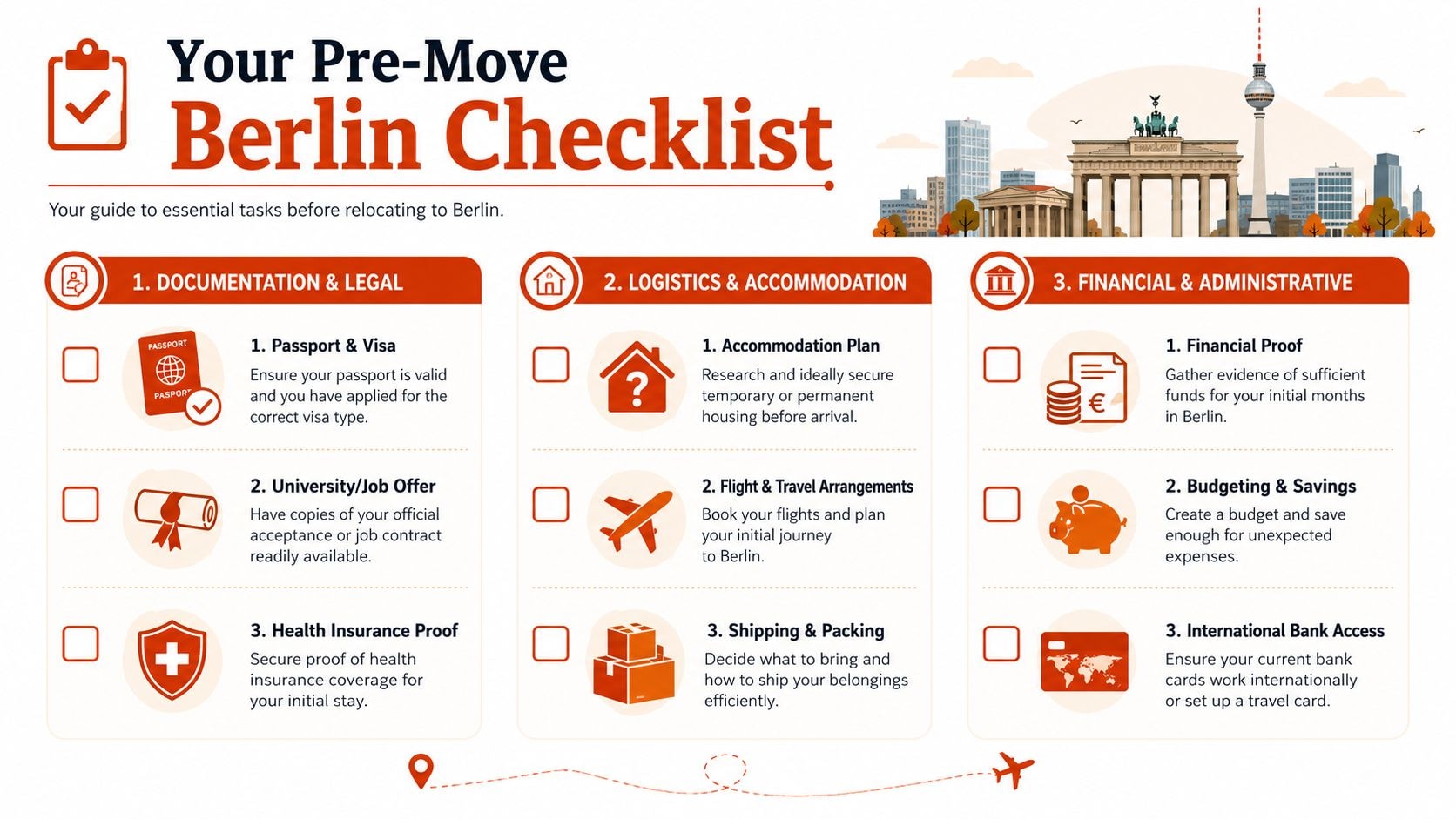
Your Pre-Move Document and Planning Checklist
The best pre-move preparation is boring. That's exactly why it works. If your documents are organized before you land, you'll make fewer rushed decisions, fewer bad bookings, and fewer panicked print-shop visits.
Build one document folder before you fly
Create one digital folder and one physical folder. Keep the digital version available offline on your phone and laptop. Keep the physical version in your carry-on, not in checked luggage.
What belongs inside depends on your situation, but most newcomers should gather:
-
Identity documents. Passport, visa paperwork if relevant, and any national ID that may still be useful.
-
Civil status documents. Birth certificate, marriage certificate, or family documents if you're moving with a partner or children.
-
Work or study proof. Job contract, university admission, internship confirmation, or scholarship paperwork.
-
Health insurance proof. Keep the version that clearly shows active coverage.
-
Housing documents. Temporary accommodation booking, lease, landlord contact details, and any written confirmation about move-in.
-
Financial records. Recent bank statements and anything that helps you show financial stability if asked.
-
Qualifications. University degrees or certificates if your work, visa, or professional recognition may depend on them.
A simple habit helps here. Rename files clearly. “Passport.pdf” is better than “scan_0042.pdf”. On a stressful morning, naming matters.
For a more practical packing list for appointments, use this documents checklist for Berlin appointments.
Know when a translation is not enough
This trips people up all the time. There's a difference between understanding a document and submitting a document.
If you need to understand a lease clause, a health insurance letter, or an appointment email, practical language support can help you follow routine wording and prepare questions. This is not certified translation, sworn interpretation, document certification, or legal interpretation. If an authority requires a certified or sworn translation, everyday help won't replace that. You'll need a qualified professional who can provide the formally accepted version.
If an office says a document must be certified, believe the exact word they used. A helpful translation is useful for you. A certified translation is for the authority.
That distinction matters before you move, because some people arrive with scans and informal translations, then lose time replacing everything.
Book accommodation with paperwork in mind
A temporary place can solve one problem and create another. Before booking, ask a simple question in writing: Can this accommodation be used as my actual residence, and will the housing provider issue a Wohnungsgeberbestätigung after I move in?
Confirm the arrangement in writing before booking. Short stays and genuine residential arrangements can have different registration consequences.
Budget for a deposit, initial rent, temporary accommodation if needed, transport, household setup, and unexpected administrative expenses. Housing costs vary considerably by district, property type, contract length, furnishing, and the individual listing.
Tackling the Bureaucracy Your First Week in Berlin
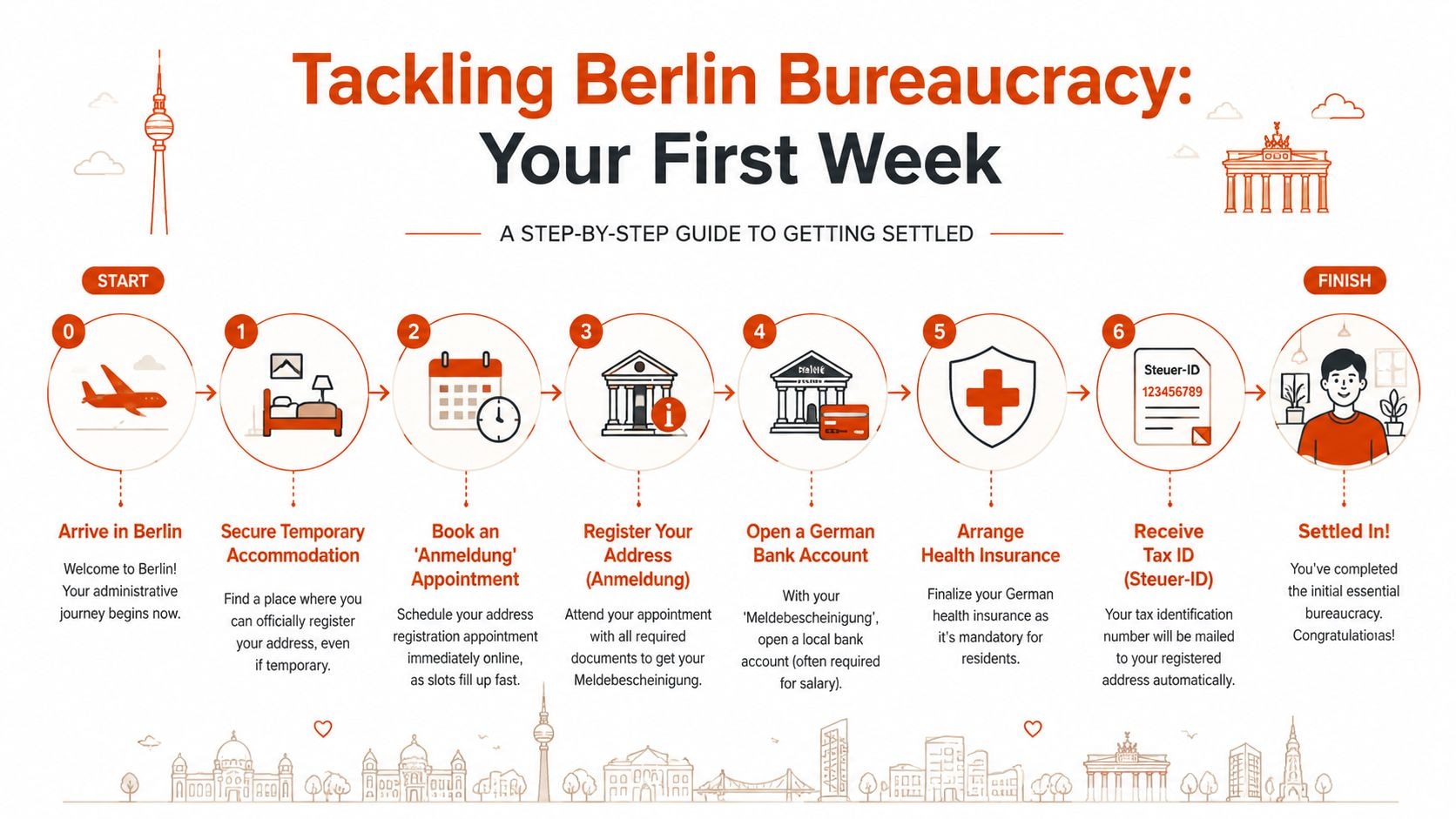
The first week matters less because you'll finish everything, and more because you'll start the right things in the right order.
The deadlock most people hit first
Berlin newcomers often run into a circular problem. You need an Anmeldung to access basic admin life. But to get the Anmeldung, you usually need a rental situation that produces the right landlord confirmation. At the same time, landlords often want documents that newcomers don't yet have in the German system.
This is why relocating to Berlin feels harder than a normal move. It's not one task. It's a chain where each link depends on the previous one.
Anmeldung is the registration of your residential address. Berlin generally requires it within 14 days after moving in. You need valid identification, the required registration information, and a Wohnungsgeberbestätigung. A rental contract does not replace the Wohnungsgeberbestätigung (Service Berlin, Anmeldung einer Wohnung).
Eligible adults who are German or EU citizens and have moved within Germany may be able to complete Anmeldung online using BundID and an activated eID. Other newcomers generally need an in-person appointment or an authorized representative.
What your first days should actually look like
On day one, don't try to solve everything. Check that your housing situation is usable for registration. If it isn't, you need to know that immediately, not after unpacking.
On day two, start hunting for the Bürgeramt appointment. For an in-person Anmeldung, search across all Berlin Bürgerämter rather than limiting the search to your district. Berlin lists the service as available city-wide. Bürgertelefon 115 is available Monday to Friday from 08:00 to 18:00 (Service Berlin, Anmeldung einer Wohnung; Service Berlin, Bürgertelefon 115).
Book the first workable appointment you can get. You can always refine later. Waiting for the "perfect" office is how people lose weeks.
The other smart move is to separate “nice to have” from “blocks progress.” A SIM card can wait a day. Registration planning can't.
What to prepare for Anmeldung
For an in-person registration, prepare the completed registration form, valid identification for the people being registered, and the Wohnungsgeberbestätigung. Depending on your household situation, additional civil-status or parental-consent documents may be needed. A rental contract does not replace the Wohnungsgeberbestätigung (Service Berlin, Anmeldung einer Wohnung).
A few practical details reduce stress on the day:
-
Check the appointment confirmation and office location before travelling.
-
Bring the valid identification and required documents listed for your household situation.
-
If another person represents you, prepare the required signed form and written authorization.
-
Eligible applicants using the online service can upload the Wohnungsgeberbestätigung digitally.
For an in-person registration, the Meldebestätigung is normally provided after the documents are checked. Eligible users of the online service receive a digital Meldebestätigung for download.
If this is your first registration in Germany, the registration authority sends your details to the Federal Central Tax Office. Your tax identification number is then assigned automatically and mailed to your registered address. If no letter has arrived within three months, you can contact the BZSt (Service Berlin on tax identification number after registration).
If you want a plain-English overview of which offices typically matter first, this Berlin offices guide for newcomers is a useful starting point.
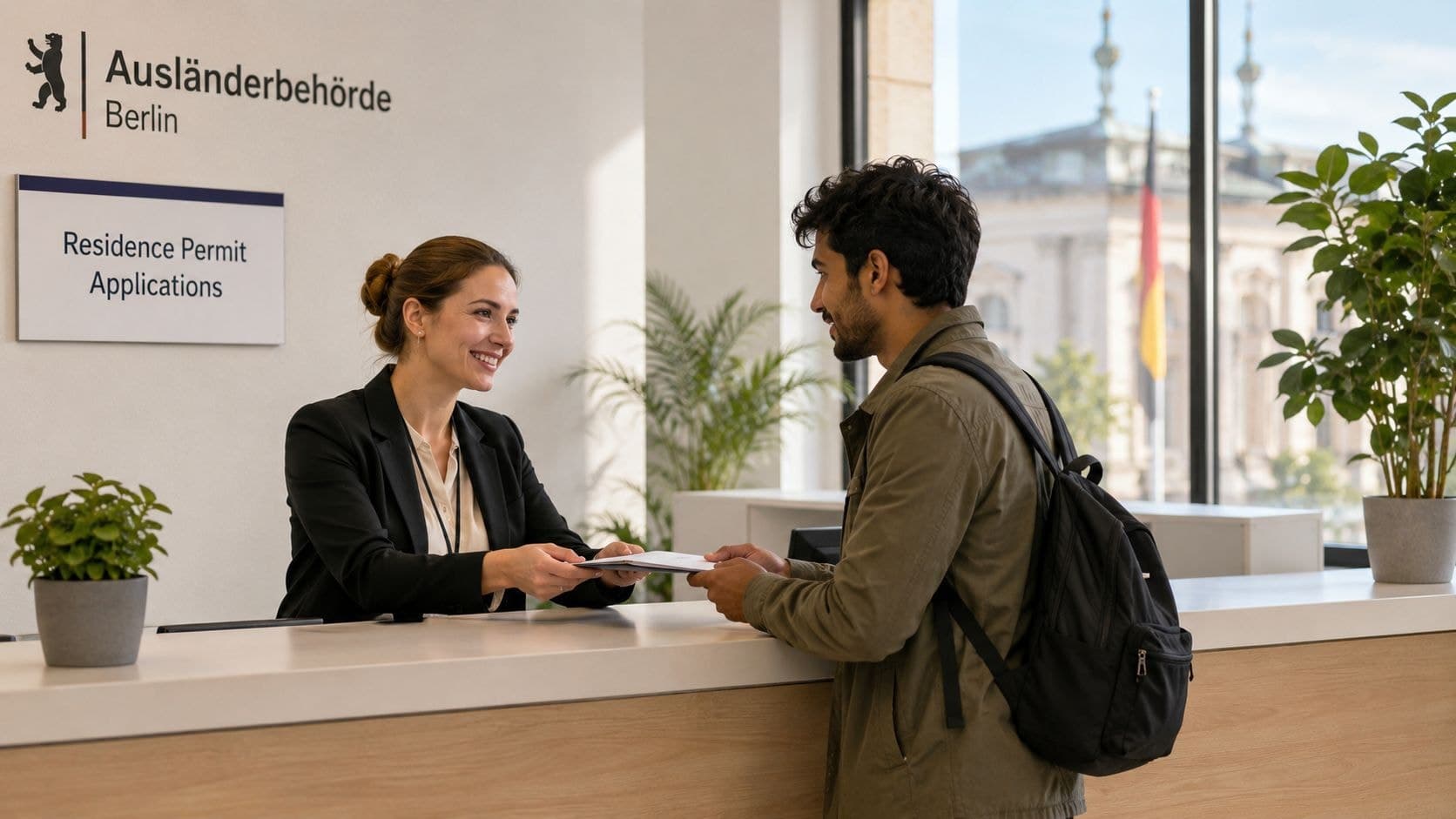
The Residence Permit: Navigating the Ausländerbehörde
Once registration is moving, non-EU citizens usually face the next major pressure point. The residence permit process is where missing documents, unclear communication, and appointment-day confusion become expensive in time and energy.
What slows this process down
Residence-title procedures depend on the applicant’s purpose of stay and individual circumstances. Berlin now provides online applications for many employment, study, family, humanitarian, self-employment, and permanent-residence categories. After submission, the LEA reviews the application and may request additional documents or provide an appointment (Berlin Immigration Office, online applications and procedures).
That doesn't mean every appointment must happen in perfect German. It means you need to be able to follow what is being asked, answer consistently, and avoid misunderstandings about your documents or situation.
There's also a difference between visa categories. Some paths move faster than others when documents are complete, while others involve more review. The practical lesson is the same in every case. Show up prepared and don't improvise explanations under pressure.
A weak appointment doesn't always end in a formal rejection. Sometimes it just creates silence, follow-up requests, and a longer wait.
A simple appointment-day plan
Keep your residence permit file separate from your general relocation folder. That file should be clean, current, and arranged in the order you expect to discuss it. If you hand over a pile of mixed papers, the stress level rises for everyone.
A workable routine looks like this:
| Focus | What helps | What causes trouble |
|---|---|---|
| Documents | Printed, ordered, and easy to hand over | Mixed originals and random screenshots |
| Communication | Clear answers about income, work, study, or housing | Guessing what the official meant |
| Timing | Arriving early and knowing the office details | Rushing in after printing on the way |
| Follow-up | Keeping copies of what was submitted | Forgetting what was asked for |
Save the confirmation PDF produced by the online application and keep copies of everything submitted. The legal effect of an application confirmation depends on the applicant’s existing visa or residence status.
For practical language support during the appointment, residence permit appointment help in Berlin can be useful when the issue is communication and preparation rather than legal strategy.
A SettlyGo helper can assist with practical preparation, routine communication, organizing documents, preparing questions, and taking notes. SettlyGo does not provide immigration advice, legal strategy, application completion or filing, certified translation, sworn interpretation, or official representation. For legal uncertainty, refusals, appeals, status changes, or complex family cases, use a qualified immigration lawyer or authorized advice service.
Finding a Home and Setting Up Your Life
Housing is where Berlin feels most personal and most administrative at the same time. You're not just looking for a place you like. You're also trying to present yourself clearly, respond fast, and avoid misunderstandings before someone else gets the apartment.
What landlords usually want from you
Many apartment applications rely on a familiar stack of documents. The difficulty for newcomers is that one or two pieces may not exist yet in Germany, especially early on.
That's where a flexible approach matters. If you don't have the typical local paperwork, some landlords will still consider alternatives if the rest of your file is strong and clearly organized. A concise message, readable documents, and a prompt response often matter more than people expect.
The communication side is where people lose momentum. A viewing invitation arrives in German. A landlord asks for one extra document. An agency sends a short message that sounds vague, but contains a deadline.
Useful habits here are simple:
-
Reply fast and clearly. Short, polite, complete answers work better than long explanations.
-
Keep one rental application folder ready. Don't rebuild it from scratch every time.
-
Ask direct questions before a viewing. Confirm what documents they want and what the next step is.
-
Read the tone, not just the words. Some German messages sound abrupt when they're routine.
Protect sensitive data. Do not send unredacted passports, bank statements, salary records, or credit documents to unverified listings or recipients. Share only information that is reasonably necessary after checking that the contact and property appear legitimate.
For support with those conversations, landlord communication help in Berlin can be useful when the problem is practical communication rather than a legal dispute.
The rest of life setup is mostly communication
Once housing is in motion, the next layer is less dramatic but still tiring. Internet setup, electricity questions, health insurance calls, bank branch questions, school or Kita emails for families, and official letters that arrive before you've learned the vocabulary.
Many newcomers underestimate the emotional load. The task itself may be small. The friction comes from doing ten small tasks in a language you don't fully trust yourself in.
A few rules keep this manageable:
-
Save every confirmation. Screenshot appointment bookings and archive emails by topic.
-
Write down reference numbers immediately. You'll need them later.
-
Handle one provider problem at a time. Bundling everything into one afternoon usually backfires.
Relocating to Berlin gets easier when you stop trying to “finish bureaucracy” and start creating a reliable system for handling it.
When You Need Help: A Guide to Your Support Options
People usually ask for help too late, and often from the wrong person.
The pattern in Berlin is familiar. An Anmeldung delay blocks the bank setup. The missing bank document slows the apartment application. A letter from an office sits unanswered because the wording is unclear. Three small admin problems turn into one stuck system.
That is why it helps to choose support by bottleneck. Start with the task that is stopping everything else.
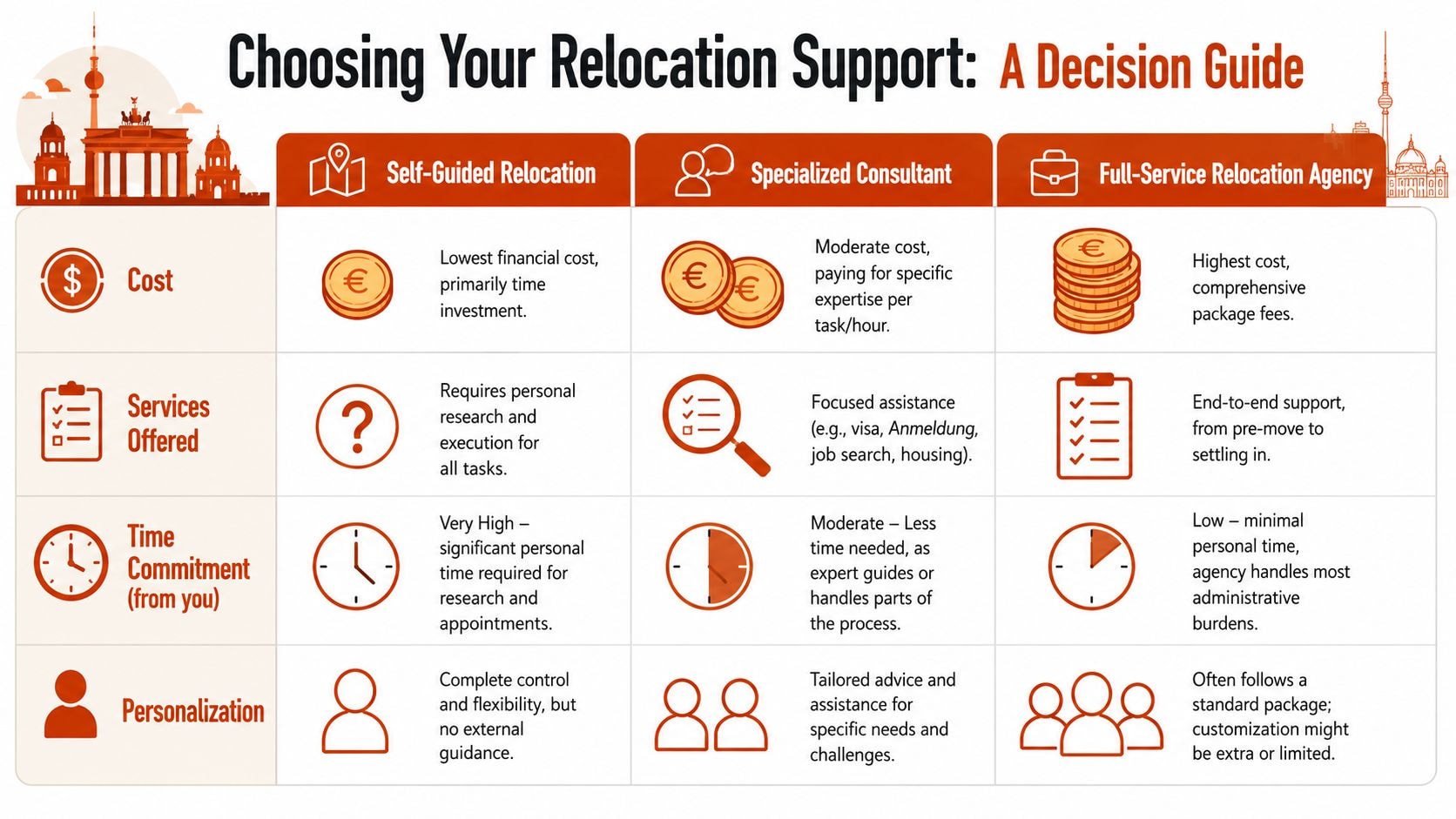
A quick decision table
| Situation | Best fit |
|---|---|
| You can handle forms, calls, and bookings yourself, but need time | Self-guided |
| You need help with one specific problem such as a legal immigration issue, tax matter, or certified translation | Specialized professional |
| You want broad relocation handling and can pay for a larger package | Full-service relocation agency |
| You mostly need practical day-to-day help with appointments, German calls, letters, landlord messages, or document prep | Local appointment and bureaucracy support |
The trade-off is straightforward. Full-service agencies are useful if you want someone to coordinate a lot of moving parts. They can be expensive if the problem is narrower, such as one Bürgeramt appointment, one landlord exchange, or one document request you are not sure how to answer.
Specialists matter too, but only for the right kind of problem. A lawyer helps with legal judgment. A tax advisor handles tax filings and planning. A certified translator prepares documents that must meet formal office requirements. None of them are a good substitute for routine admin help.
That middle layer is where many relocations stall. The task itself is often ordinary. The problem is execution. The call has to happen in German. The appointment fails because one paper is missing. The landlord asks for something that sounds simple but changes the application if you answer it badly.
SettlyGo handles that practical layer of relocation work. It helps with appointment preparation, German phone calls, landlord communication, official letters, apartment viewing support, and routine in-person language help. It does not replace a lawyer, tax advisor, immigration consultant, insurance broker, or certified translator.
That distinction saves time and money.
If your move feels stuck, do not ask, “Who handles relocation?” Ask, “What is the blocker?” Once you name the blocker clearly, the next step usually becomes obvious. That is how people get through Berlin bureaucracy in real life. One deadlock at a time.
If relocating to Berlin has left you dealing with appointment preparation, German phone calls, landlord messages, official letters, apartment viewings, or document organization, book a SettlyGo helper. SettlyGo can help with practical communication, preparing questions, note-taking, document organization, appointment preparation, and routine administrative coordination. SettlyGo does not provide legal advice, immigration advice, tax advice, insurance advice or brokerage, certified translation, sworn interpretation, application filing, social-work services, government services, or official representation.
Need practical help in Berlin?
Book a verified SettlyGo helper for German phone calls, appointments, landlord communication, apartment viewings, and document preparation.