Ummeldung in Berlin: Moving to a New Address Within Germany
August 30, 2026 · 10 min read
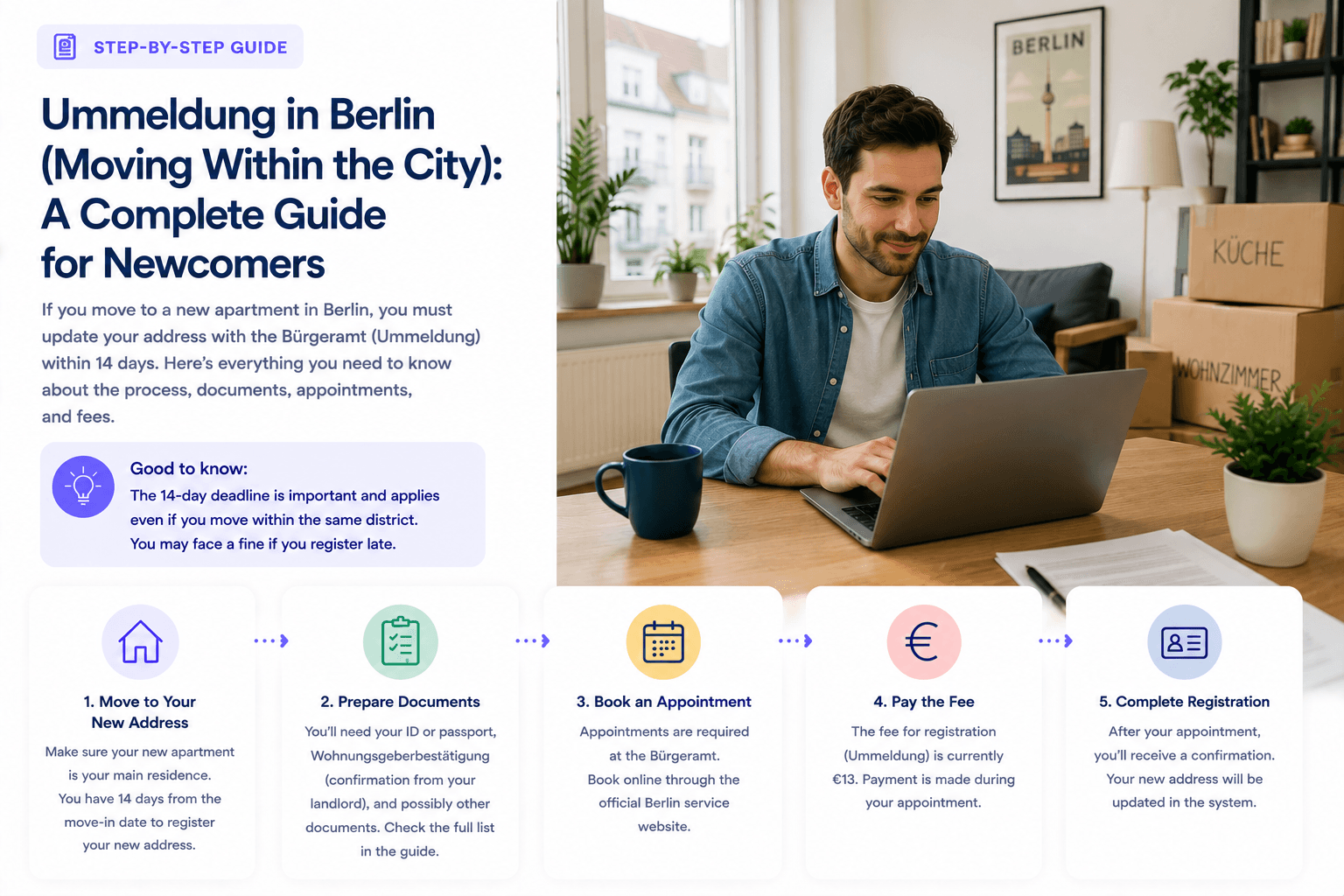
If you already live in Germany and move to a new address in Berlin, you may search for Ummeldung Berlin.
Berlin does not use a completely separate registration system for this situation. In practice, you register the new main or sole residence with the registration authority. The old German address is then dealt with through that move; you do not normally submit a separate Abmeldung just because you moved from one German address to another.
This guide focuses on that specific situation: changing your registered home after moving within Berlin or from another German city to Berlin.
Important scope: This article provides general administrative information. SettlyGo can help you organize visible requirements, prepare questions, understand routine German instructions and provide language support. SettlyGo does not determine your legal residence status, decide which address must legally be your Hauptwohnung, make declarations for you as a legal representative or guarantee that a Bürgeramt will accept particular documents.
Is "Ummeldung" different from Anmeldung?
People commonly say Ummeldung when they mean changing their registered address after a move.
Berlin's official service is called Wohnsitz - Alleinige Wohnung oder Hauptwohnung anmelden.
That service covers registering a new sole or main residence in Berlin, including moves within Germany.
So if you move from Neukölln to Friedrichshain, or from Hamburg to Berlin, you normally use the new-address registration process rather than looking for a separate "Ummeldung" service.
Do you need to unregister the old address first?
Usually not when you move from one German address to another.
Berlin's official Abmeldung service says that if you are moving within Germany, you generally only need to register with the registration authority responsible for the new home.
A separate Abmeldung is mainly relevant in situations such as:
- moving abroad;
- giving up a registered secondary or additional residence without moving into another German residence; or
- certain other cases where a registered Berlin dwelling is being given up without a replacement residence in Germany.
Do not submit an Abmeldung simply because your Berlin street address changed.
How quickly do you need to register the new address?
Berlin currently says you must register the new sole or main residence within 14 days after moving in.
The relevant date is the actual Einzugsdatum, the date you moved into the new home.
This is separate from the date you signed the lease or received the keys if those dates are different.
If you cannot complete the process immediately, keep the documents showing your real move-in date and use the earliest suitable official route available to you.
What is a Wohnungsgeberbestätigung?
A Wohnungsgeberbestätigung is the confirmation of your move-in from the person or organization providing the accommodation.
Berlin currently requires it for registration.
The official guidance says the confirmation should include information such as:
- name and address of the Wohnungsgeber;
- owner's name if the Wohnungsgeber is not the owner;
- move-in date;
- address of the dwelling; and
- names of the people required to register there.
A rental contract by itself does not replace the Wohnungsgeberbestätigung.
If you are still waiting for the document, contact the landlord, property manager or other responsible Wohnungsgeber rather than inventing or altering one yourself.
Can you do the address change online?
Some people can complete Berlin's residence registration online.
As of 30 August 2026, Berlin says the online route is available when the stated eligibility requirements are met. These currently include:
- you are at least 18 years old;
- you are a German citizen or EU citizen;
- you moved within Germany;
- you have a BundID account;
- you have a German Personalausweis or an eID-Karte with the online ID function activated;
- you know the PIN; and
- you can use AusweisApp with a compatible device.
The online route is therefore not available to every newcomer.
In particular, a non-EU national relying on a passport and electronic residence permit should check the current Berlin eligibility wording rather than assuming the online process will work.
What happens in the online process?
Berlin's official process first checks whether you meet the eligibility conditions.
You then provide the required residence information and use electronic identification.
The exact interface can change, so follow the live Berlin instructions rather than screenshots from an old blog or forum post.
If the online route rejects your situation, use the in-person Bürgeramt process instead of entering inaccurate information to force the application through.
What do you need for an in-person Bürgeramt appointment?
Berlin currently lists the following core documents for in-person registration:
- the completed registration form;
- valid identity documents for the people moving;
- the Wohnungsgeberbestätigung; and
- additional documents where your family or housing situation requires them.
For foreign nationals, Berlin lists passports, passport-replacement documents and, where relevant, the electronic residence permit among the accepted identity evidence.
Bring the originals requested by Berlin.
Do you need civil-status documents again?
Berlin notes that civil-status documents such as marriage or birth certificates can be relevant, particularly for a first registration in Berlin.
If you were already correctly registered in Berlin and are only changing address, the requirements can be simpler.
However, family situations differ. If multiple family members are moving, names or family status changed, or the Bürgeramt specifically requests supporting records, bring the documents it asks for.
Can someone else register the address for you?
For an in-person application, Berlin allows representation in certain situations.
The representative needs the required written authorization and the correctly completed registration form. The form itself must be signed as required by the official instructions.
Do not assume that giving someone your passport alone is enough authority to complete the process.
Check the current Bürgeramt requirements before sending another person on your behalf.
What if children are moving too?
Additional consent rules can apply when minors move.
Berlin currently distinguishes between situations where parents live together and situations where parents with joint custody live separately.
If a child's sole or main residence changes between parents, additional consent and identity evidence can be required.
This can become legally sensitive. SettlyGo can help you read the visible checklist and prepare questions, but it cannot decide custody or residence-law questions for a child.
What if you keep the old apartment too?
Then the situation may no longer be a simple address change.
If you keep more than one dwelling in Germany, one may be the Hauptwohnung and another a Nebenwohnung.
Berlin has a separate process for registering a secondary residence, and additional rules can apply to deciding which dwelling is the main residence.
If you are keeping the old home rather than giving it up, check whether you need the Nebenwohnung process instead of treating the move as a simple replacement of one main address with another.
What happens to your Meldebestätigung?
After successful registration, Berlin issues a Meldebestätigung showing your registered address information.
Keep it with your administrative records.
Some banks, employers, insurers or other organizations may ask for proof of address later, although each organization decides what evidence it accepts.
A Meldebestätigung is not the same thing as every possible type of Meldebescheinigung. If an institution asks for a specific certificate, check exactly which document it means.
Does the address on your German ID get updated?
Berlin's in-person service states that address data on documents such as a German Personalausweis, eID-Karte or electronic residence permit can be updated as part of the registration process where applicable.
The exact handling depends on your identity document and the route you use.
Do not assume that updating one private account automatically changes every government or commercial record connected to you.
What other places should you update after moving?
Residence registration does not automatically update every organization in your life.
Depending on your situation, you may still need to update your address with organizations such as:
- employer;
- health insurer;
- bank;
- mobile or internet provider;
- electricity provider;
- insurance companies;
- university or school;
- vehicle registration authority where applicable; and
- Beitragsservice for the Rundfunkbeitrag if you are the registered contributor.
Only update organizations that actually hold your address and use their official channels.
What about the Rundfunkbeitrag after moving?
The Rundfunkbeitrag is a separate process from Bürgeramt registration.
If you already pay the contribution, the Beitragsservice says your personal Beitragsnummer moves with you and you should update the address.
If another person pays for your new shared dwelling, different steps apply.
Use the official Beitragsservice guidance rather than assuming Bürgeramt registration automatically completes the broadcasting-contribution update.
Common mistakes after moving within Berlin
Looking for a separate "Ummeldung appointment"
For a new sole or main residence, Berlin uses the normal residence-registration service.
Deregistering the old German address first
If you are simply moving to another residence within Germany, Berlin says you normally only register the new home.
Bringing only the rental contract
The rental agreement does not replace the required Wohnungsgeberbestätigung.
Using the online service when you are not eligible
Check the nationality, age, eID and move-origin requirements before starting.
Using the lease-start date instead of the real move-in date
Berlin's 14-day registration period is based on when you actually move into the new residence.
Forgetting that keeping the old home changes the situation
If you retain another German dwelling, Hauptwohnung/Nebenwohnung rules may apply.
Practical checklist before your address change
- I know my actual move-in date.
- I have a correct Wohnungsgeberbestätigung.
- I know whether I am giving up the old residence or keeping it.
- If I want to use the online service, I checked the current eligibility requirements.
- My identity documents are valid.
- I have the required registration form if attending in person.
- I checked whether family or child-consent documents apply.
- I know whether another person will represent me and, if so, what authorization is required.
- I use the official Berlin ServicePortal rather than an unofficial appointment seller.
Practical checklist after registration
- I saved my Meldebestätigung.
- I checked the registered spelling of names and the new address.
- I updated organizations that still hold my old address where necessary.
- If I pay Rundfunkbeitrag, I checked the Beitragsservice address-change process.
- If I own a vehicle, I checked whether vehicle-registration action is required.
- I kept copies of important move-related documents.
How SettlyGo can support you
A SettlyGo helper can provide practical administrative and communication support such as:
- helping you identify whether the normal residence-registration or Nebenwohnung process matches the visible facts of your move;
- helping you turn Berlin's published requirements into a checklist;
- preparing questions about missing or unclear documents;
- supporting an ordinary German phone call or email;
- helping you understand Bürgeramt instructions; and
- accompanying you when in-person language or communication support is useful.
SettlyGo does not provide legal advice, determine Hauptwohnung status, decide custody or residence-law questions, create or alter official documents, sign declarations for you, represent you legally or guarantee registration.
Final takeaway
If you move from one German address to a new sole or main residence in Berlin, the practical "Ummeldung" is usually handled by registering the new address.
Berlin currently requires registration within 14 days of moving in and requires a Wohnungsgeberbestätigung; a rental contract alone is not enough. A separate Abmeldung is generally not required for a straightforward move within Germany. The online route exists, but it is limited to people who meet Berlin's current eligibility requirements.
Use the official Berlin residence-registration service to confirm the latest requirements and application channels before submitting anything.
For practical help organizing documents, preparing questions or handling German administrative communication, book SettlyGo support.
Need help with Anmeldung or the Bürgeramt?
Book a verified SettlyGo helper to guide you through city registration, document preparation, and office appointments in Berlin.