Birth Certificate in Berlin: Newborn Guide for Newcomer Parents
August 22, 2026 · 9 min read
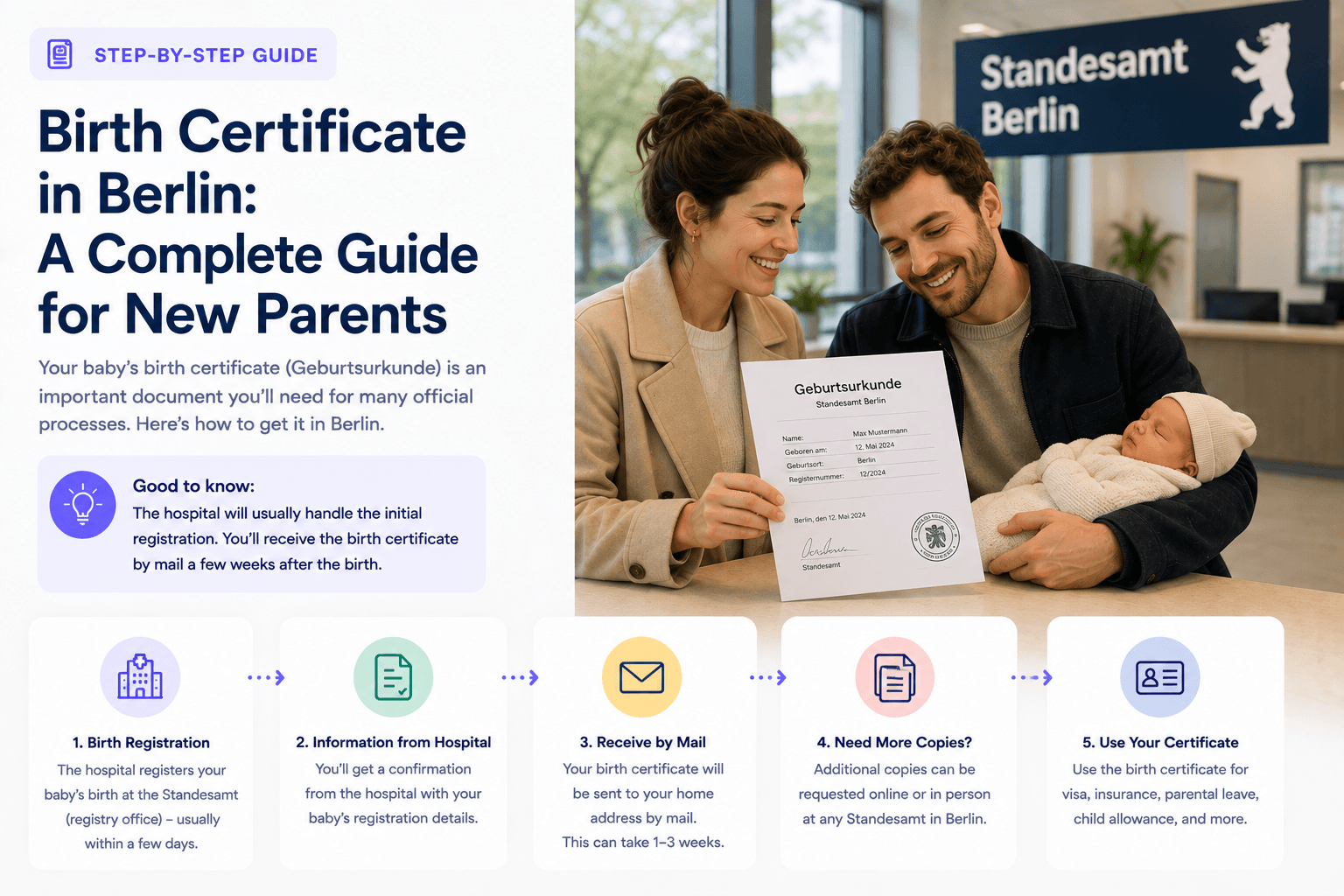
Having a baby in Berlin starts a chain of administrative steps. Before many later applications can move forward, the birth must be recorded by the correct Standesamt and the family needs the right birth certificates.
For newcomer parents, the process can become more complicated when one or both parents have foreign citizenship, foreign marriage or birth documents, different name spellings, or questions about the child's family name.
This guide explains the current Berlin process, which office is responsible, what documents may be needed and what to check before submitting anything.
Important scope: This article provides general administrative information. SettlyGo can help you organize visible requirements, identify the responsible Berlin office, prepare questions and support ordinary German communication. SettlyGo does not determine parentage, nationality, naming law or legal status, certify translations, authenticate foreign documents, make declarations on your behalf or guarantee that a Standesamt will accept a particular document.
Which Standesamt handles the birth?
Berlin's official birth-registration service says the birth is handled by the Standesamt of the Berlin district where the child was born.
The parents' home address does not determine the responsible office.
For example, if you live in Lichtenberg but the baby is born in a hospital in Mitte, the responsible Standesamt is based on the place of birth, not your home district.
What happens if the baby is born in a hospital or birth centre?
If the child is born in a Berlin hospital or licensed birth centre, the facility normally sends the birth notification to the responsible Standesamt.
That means parents usually do not need to report the birth themselves from scratch.
You may still need to provide documents and declarations before the Standesamt can complete the registration and issue certificates.
What happens after a home birth?
For a home birth, Berlin says the midwife, doctor or other authorized medical professional issues a birth confirmation.
The parents must then submit the birth to the responsible Standesamt.
Berlin currently states a one-week deadline for reporting a home birth.
Do not wait for all later family-benefit paperwork before completing this step.
Which documents can the Standesamt ask for?
The exact list depends on the parents' family situation and citizenship.
Berlin's official guidance makes clear that the document list is not exhaustive and that additional documents can be required.
Commonly relevant documents can include:
- parents' passports or identity documents;
- the parents' own birth certificates;
- marriage certificate, if the parents are married;
- documents relating to parentage or acknowledgment of paternity where applicable;
- documents relating to custody where applicable; and
- the declaration of the child's first name and family name.
If documents were issued outside Germany, the Standesamt may need to clarify whether a translation, apostille, legalization or another form of authentication is required.
Ask the responsible Standesamt what it needs for your specific documents rather than assuming a foreign certificate will be accepted in the same form as a German one.
Foreign parents should check early
Berlin explicitly recommends that families seek guidance from the responsible Standesamt when one or both parents have a nationality other than German.
This is especially useful when:
- the parents married outside Germany;
- a parent's own birth certificate is foreign;
- names are written differently across passports and civil-status records;
- one parent's nationality law may affect the child's family name; or
- a document needs authentication before Germany can use it.
The Standesamt decides which evidence is sufficient.
SettlyGo can help you prepare the questions and organize the documents you already have, but it cannot decide which country's law applies or certify a document.
What certificates do parents receive for a newborn?
Berlin currently states that families receive three free certificates for official purposes connected with:
- Elterngeld;
- Kindergeld; and
- health insurance.
These purpose-specific certificates are different from additional private copies you may order for your own records.
Keep the free certificates with the application they are intended for and avoid sending the same original to several places at once.
How much do extra birth certificates cost?
Berlin currently lists these fees for additional documents connected with the birth registration:
- €12 for a birth certificate for private use;
- €12 for a certified copy from the birth register;
- €12 for an international birth certificate; and
- €6 for each additional certificate of the same type ordered at the same time.
The birth notification itself is currently free.
Fees can change, so check the current ServicePortal page before ordering extra copies.
What is an international birth certificate?
Berlin can issue a multilingual, or international, birth certificate.
This can be useful when a foreign authority asks for a civil-status document in a standardized multilingual format.
It does not automatically remove every foreign-country authentication requirement. A foreign authority may still have its own rules.
If you need the certificate for an embassy, consulate or foreign administration, ask that authority which document format it accepts before ordering multiple copies.
Birth certificate versus certified copy from the birth register
A normal Geburtsurkunde confirms the core registered birth information.
A beglaubigte Abschrift aus dem Geburtenregister or certified extract from the birth register can contain more complete register information, including later amendments.
These documents are not always interchangeable.
Order the type specifically requested by the authority or institution you are dealing with.
Can you order a birth certificate later?
Yes.
Berlin has a separate official service for ordering a birth certificate.
Berlin's service normally supports applications online or in person. For an online request, identify the register-holding Standesamt and follow the current ServicePortal instructions; check the page before starting because online processing can be temporarily interrupted.
For in-person applications, Berlin lists identity documents and, depending on who is applying, proof of relationship, legal interest or a power of attorney.
What if you do not know the responsible Standesamt?
For a newborn, the responsible office follows the district of birth.
For an older birth record, Berlin says you can search for the responsible Standesamt if you know enough details.
If you cannot identify the office at all, Berlin also offers a paid search service. That is a separate process and can take considerably longer.
For a recent hospital birth, start with the hospital's birth location and the Standesamt responsible for that district.
What if the parents are not married?
The registration can require additional documents about parentage and custody.
Do not assume that being named on a hospital form automatically completes every civil-status step.
If a paternity acknowledgment or custody declaration is relevant to your case, ask the Standesamt which document it needs and whether that declaration must be completed before or after the birth registration.
SettlyGo does not provide legal advice on parentage or custody.
What if the parents use different surnames?
The child's family name can raise additional questions, especially in international families.
Berlin's official birth-registration service includes a declaration regarding the child's first and family names, and the Standesamt may need to check the applicable naming rules.
Do not alter spellings casually to make documents appear consistent.
Use the legal names shown on official documents and explain genuine differences clearly.
Common reasons the process can take longer
A straightforward hospital birth with German civil-status documents can be relatively simple.
International cases may take longer when the Standesamt must clarify:
- foreign birth or marriage records;
- translations;
- apostilles or legalization;
- name spellings;
- parentage documents;
- custody documents; or
- which naming law applies.
This is why newcomer parents benefit from checking document requirements before the expected birth date when possible.
A practical checklist before the birth
- I know which Berlin district the planned hospital or birth centre is in.
- I checked the responsible Standesamt's current instructions.
- Both parents' identity documents are valid.
- I collected our birth and marriage documents where relevant.
- I checked whether foreign documents may need translation or authentication.
- I compared name spellings across passports and civil-status documents.
- I prepared questions about the child's first name and family name if our case is international.
- I know which additional documents may be needed if the parents are not married.
A practical checklist after the birth
- I confirmed that the hospital or birth centre sent the birth notification.
- For a home birth, I submitted the required birth confirmation within the current deadline.
- I responded promptly to any Standesamt request for documents.
- I checked the spelling of names and dates on the issued certificate.
- I separated the free purpose-specific certificates for Elterngeld, Kindergeld and health insurance.
- I ordered extra private or international copies only if I actually need them.
- I kept copies of correspondence and submitted documents.
Common mistakes newcomer parents can avoid
Contacting the Standesamt for your home address
The responsible Standesamt is based on where the child was born, not where the parents live.
Assuming the hospital completes everything
The hospital sends the birth notification, but the Standesamt may still need documents or declarations from the parents.
Sending foreign documents without checking requirements
Ask first whether translation, apostille, legalization or another form of authentication is needed.
Using inconsistent name spellings
Use legal spellings and explain legitimate differences instead of changing records yourself.
Ordering the wrong type of certificate
A normal birth certificate, international certificate and certified register extract serve different purposes.
Waiting until a benefit deadline to resolve certificate issues
If your family situation is international or document-heavy, check with the Standesamt early.
How SettlyGo can support you
A SettlyGo helper can provide practical administrative support such as:
- helping identify the responsible Standesamt from the place of birth;
- organizing a checklist from the visible official requirements;
- preparing questions about foreign documents or missing paperwork;
- supporting an ordinary German phone call or email conversation;
- helping you understand visible requests for additional documents; and
- accompanying you when in-person communication support is useful.
SettlyGo does not determine parentage, custody, citizenship or naming law, certify translations, authenticate documents, sign declarations for you, provide legal representation or guarantee registration or certificate issuance.
Final takeaway
For a baby born in Berlin, the most important first rule is to deal with the Standesamt of the district where the birth happened.
Hospital and birth-centre births are normally reported by the facility. Home births must be reported by the parents within Berlin's current one-week deadline. International families should check foreign-document and naming requirements early because those questions can delay registration.
Use the official Berlin birth-registration service to confirm the latest requirements before submitting documents.
For practical help organizing documents, preparing questions or handling German administrative communication, book SettlyGo support.
Need practical help in Berlin?
Book a verified SettlyGo helper for German phone calls, appointments, landlord communication, apartment viewings, and document preparation.