Kindergeld in Berlin: A Newcomer Family Guide for 2026
September 10, 2026 · 12 min read
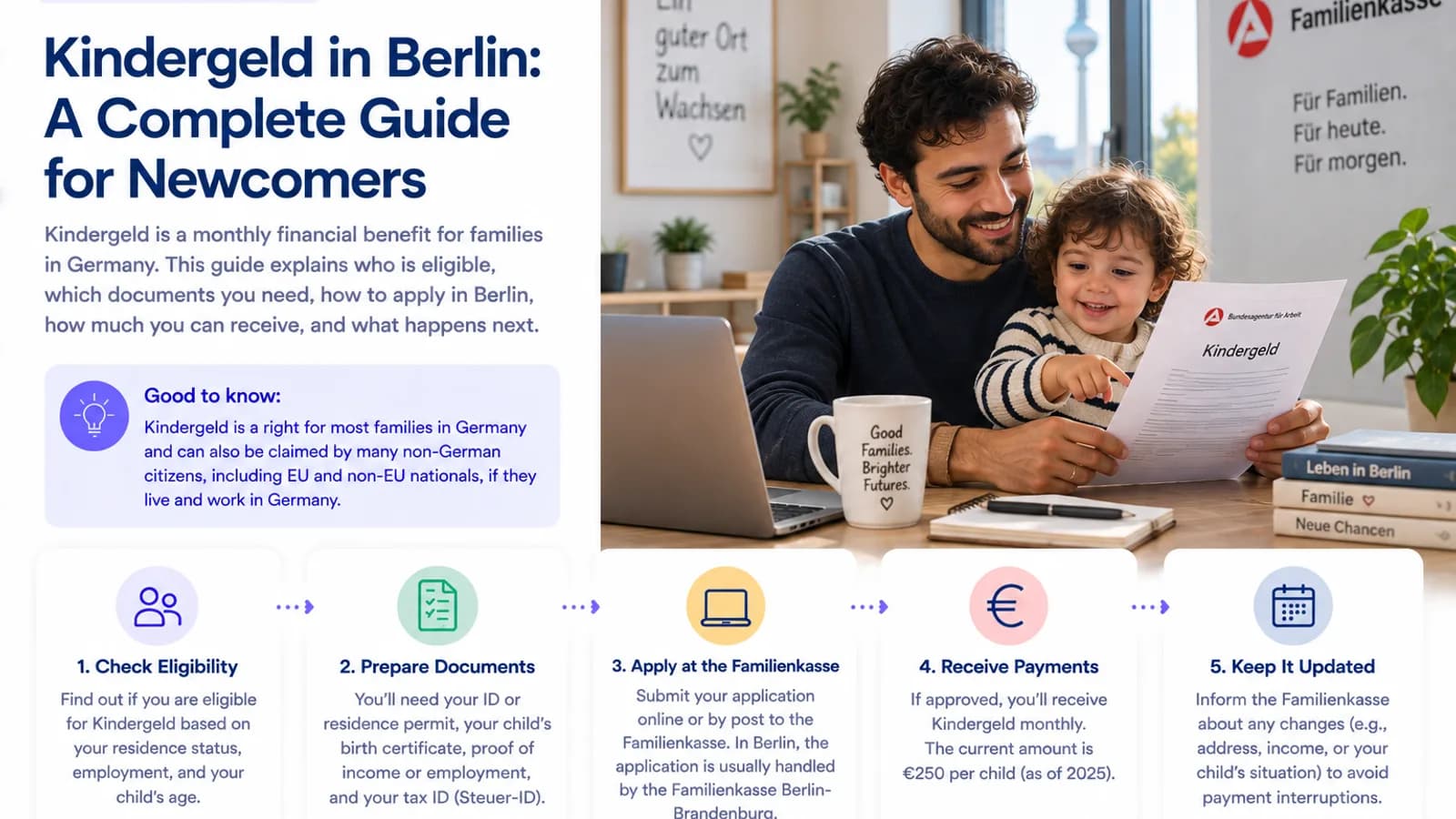
Moving to Berlin with children comes with a long list of administrative tasks. One of the most important family-benefit questions is whether you can receive Kindergeld, Germany's monthly child benefit.
As of 2026, Kindergeld is €259 per month for each eligible child. It is generally administered by the Familienkasse of the Federal Employment Agency.
For newcomers, the difficult part is often not the amount but understanding which application route applies, which documents are required, and whether your residence situation affects eligibility.
Important scope: This article provides general administrative information, not legal, immigration or tax advice. SettlyGo can help you understand visible official instructions, organize documents and prepare routine questions. SettlyGo does not determine whether you are legally entitled to Kindergeld, interpret your residence status, provide professional tax advice, represent you before the Familienkasse or guarantee approval. For questions about your individual entitlement, consult the Familienkasse or a qualified professional.
What is Kindergeld?
Kindergeld is a monthly payment intended to support families with the costs of raising children.
The Berlin Senate's Kindergeld information explains that Kindergeld is normally paid through the Familienkassen of the Federal Employment Agency.
Since 1 January 2026, the amount is €259 per month for each child. The Federal Employment Agency confirmed the 2026 increase and automatically adjusted payments for families that were already receiving or had already applied for Kindergeld.
You can check the current amount on the Federal Employment Agency's Kindergeld information.
How long can Kindergeld be paid?
For most families, Kindergeld is available for children until their 18th birthday.
It can continue beyond age 18 in certain situations. Official guidance currently includes, for example:
- children in school, university or vocational training, usually up to age 25;
- children in a recognized voluntary service, usually up to age 25;
- certain transition periods between education stages;
- children under 21 who are unemployed and registered as seeking work; and
- some children with disabilities under separate conditions.
The rules become more detailed after age 18, so families with an older child should use the current Familienkasse guidance rather than assuming the standard under-18 rules continue automatically.
The Federal Family Portal summarizes the age-related conditions.
Can newcomers and foreign nationals receive Kindergeld?
Potentially, yes, but nationality alone does not answer the question.
Berlin's Welcome Center Kindergeld guidance specifically addresses people who are new to Berlin and explains that access can depend on the parents' residence situation.
EU and EEA citizens, Swiss nationals, German citizens and many non-EU residents can qualify under the applicable rules. For non-EU nationals, the type and validity of the residence title can matter.
Do not rely on a friend's case simply because you have similar passports or jobs. Residence history, where the child lives, cross-border employment and the type of residence permission can change the result.
If your family has connections to more than one EU country, there can also be coordination rules determining which country pays first. Those cases are especially important to confirm directly with the Familienkasse.
Which Familienkasse handles applications in Berlin?
For people living in Berlin, the responsible authority is generally the Familienkasse Berlin-Brandenburg.
The Berlin Welcome Center lists this authority for newcomer Kindergeld questions and applications.
You can submit many applications and documents through the Federal Employment Agency's online services. Postal and in-person routes are also available when needed.
Use the official Familienkasse service to confirm the current application method and contact details before sending documents.
What documents do you usually need?
The exact checklist depends on your family situation, but newcomer families should expect to prepare some combination of the following:
- the Kindergeld application;
- an Anlage Kind for each child;
- your tax identification number (Steuer-ID);
- the child's tax identification number;
- identity documents;
- information about where the child lives;
- birth documentation, especially when a child was born outside Germany;
- residence-title information where relevant; and
- additional evidence if your family lives, works or receives benefits across borders.
Berlin's Welcome Center currently states that for children aged 0 to 18, applicants need the Steuer-ID of both the applicant and the child. It also advises including a copy of the birth certificate when the child was born abroad.
The Familienkasse can request additional documents after reviewing the application, so treat any general checklist as a starting point rather than a guarantee that nothing else will be needed.
What if your child does not have a German Steuer-ID yet?
This is a common newcomer problem.
After registration in Germany, a Steuer-ID is normally assigned automatically. Newborn children registered in Germany also receive a tax identification number.
If the number has not arrived, do not invent one or submit another person's number. Check the current procedure for requesting renewed notification of the Steuer-ID from the responsible authority.
SettlyGo has a separate guide explaining the practical process: Steuer-ID in Berlin for newcomers.
Because tax-identification questions can become case-specific, SettlyGo does not provide tax advice or decide which tax identifiers should be used in unusual family situations.
How can you apply for Kindergeld in 2026?
There are several official routes.
Online application
The Federal Employment Agency provides an online Kindergeld service. Depending on the application flow, electronic identification may be needed to complete the process fully online.
Berlin's Welcome Center currently explains that newcomers can use the online assistant and may need a BundID account for the digital route.
Start from the Federal Employment Agency's family e-services rather than relying on an old bookmarked form, because the digital workflow can change.
Printed application by post
Berlin's Welcome Center also describes a route where you complete the application, print it, sign it and send it with the required documents to Familienkasse Berlin-Brandenburg.
This can be useful when the fully digital route does not work for your situation.
Multilingual forms
The Federal Employment Agency provides Kindergeld information and forms in several languages. This can make the application easier to understand, although supporting documents may still need to meet the Familienkasse's requirements.
Always download forms from the current official site instead of using copies shared in social-media groups.
When should you apply?
Apply as soon as reasonably possible once you are eligible and have the necessary information.
The Berlin Welcome Center currently warns that Kindergeld can generally be paid retroactively for only up to six months before the month in which the application is received.
That means delaying an application for a long period can result in losing payments for older months even if you would otherwise have met the eligibility conditions.
For example, if a family becomes eligible but waits many months before applying, the Familienkasse does not necessarily back-pay the entire period.
If you are uncertain when your eligibility started, ask the Familienkasse rather than guessing a date.
Do you need to wait until after Anmeldung?
Newcomers often connect Kindergeld with Anmeldung because registration helps establish the family's address and triggers other administrative processes such as issuance of tax IDs.
However, Kindergeld entitlement itself is not simply created by completing Anmeldung.
Your eligibility depends on the Kindergeld rules and your individual circumstances. Registration is an important practical part of establishing your situation in Germany, but it should not be treated as a substitute for the eligibility assessment.
If your Anmeldung is still incomplete, check which documents the Familienkasse currently accepts and whether you should submit the application now with additional evidence later.
What happens after you apply?
The Familienkasse reviews the application and may ask for missing evidence.
If approved, you receive a written decision. Keep that decision and your Kindergeldnummer because the number is used for future communication and is linked to payment scheduling.
Processing times can vary depending on application complexity and whether documents are missing. Avoid relying on unofficial claims that every application takes a fixed number of weeks.
If the Familienkasse asks for a document, respond using the official channel shown in the request and keep a copy of what you submit.
When is Kindergeld paid each month?
Kindergeld does not arrive on the same calendar day for every family.
Payment dates are linked to the final digit of the Kindergeldnummer. The Federal Employment Agency publishes current payment dates online.
Use the official Kindergeld payment calendar rather than assuming another family's payment date will match yours.
Do you need to report changes later?
Yes.
Receiving Kindergeld creates an ongoing obligation to tell the Familienkasse about relevant changes.
Berlin's official guidance highlights changes such as:
- address;
- bank details;
- separation or divorce;
- employment in the public sector or abroad; and
- changes in the child's education or other circumstances.
Moving to a new apartment does not mean you should simply wait for German authorities to synchronize every system automatically.
Check whether the Familienkasse needs a separate change notification.
What if your family moves abroad or one parent works abroad?
Cross-border cases can be more complicated.
For example, one parent might work in Germany while the child lives in another EU country, or both parents might work in different countries. EU coordination rules can determine which country is primarily responsible and whether another country pays a difference.
Do not assume that living outside Germany automatically means there is no entitlement, or that employment in Germany automatically guarantees full German Kindergeld.
Use the Familienkasse's international guidance for your specific countries and circumstances. SettlyGo can help with practical communication and document organization, but it cannot interpret cross-border benefit law for you.
What if your residence permit expires soon?
This is a particularly important issue for non-EU newcomers.
The Berlin Welcome Center notes that residence-title validity can affect access to Kindergeld in some cases. If your residence document is expiring, being extended or replaced by another status, ask the Familienkasse how that affects your application or ongoing payment.
Do not alter dates or omit residence information because you are worried about the result.
SettlyGo does not provide immigration or legal advice. For interpretation of your residence rights, use an official migration-advice service or a qualified professional.
Is Kindergeld based on income?
Kindergeld itself is generally paid independently of the parents' income.
That is different from Kinderzuschlag, which is a separate benefit for certain families with lower incomes and has its own eligibility calculation.
Do not confuse the two applications. Receiving Kindergeld can be relevant to Kinderzuschlag eligibility, but approval for one does not automatically mean approval for the other.
The Berlin family-benefits guidance provides an overview of both benefits.
Common mistakes newcomer families can avoid
Waiting too long to apply
Because retroactive payment is generally limited to six months, a long delay can cost money.
Assuming Anmeldung automatically applies for Kindergeld
It does not. Kindergeld requires its own application process.
Forgetting the child's Steuer-ID
For a standard application involving a child under 18, the Familienkasse generally needs tax IDs for both the applicant and the child.
Sending incomplete foreign birth documentation
If the child was born abroad, check the current document requirements before applying and keep legible copies of what you submit.
Using an old PDF from a forum
Forms and online services change. Start from the Federal Employment Agency's current website.
Assuming another foreign resident's eligibility proves yours
Residence-status and cross-border rules can differ significantly even between families who appear similar.
Ignoring Familienkasse letters
A request for missing evidence can delay the application if you do not respond.
Forgetting to report changes
Address, bank, employment and family changes may need to be reported separately.
Practical checklist
- I have checked the current Kindergeld eligibility information for my family situation.
- I know which person in our household will apply.
- I have my Steuer-ID and my child's Steuer-ID.
- I have the required birth and identity documents.
- I have checked whether my residence status requires extra evidence.
- I have checked whether any parent or child lives or works outside Germany.
- I am using the current official application rather than an old downloaded copy.
- I am applying promptly because retroactive payment is limited.
- I have kept copies of the application and supporting documents.
- I will keep the Kindergeldnummer and decision after approval.
- I know that later changes may need to be reported to the Familienkasse.
How SettlyGo can support you
A SettlyGo helper can provide practical administrative support such as:
- helping you find the current Familienkasse application page;
- organizing your document checklist;
- helping you understand visible instructions on official forms;
- preparing a list of questions before you contact the Familienkasse;
- supporting a routine German phone call or written enquiry; and
- helping you keep track of documents requested in follow-up correspondence.
SettlyGo helpers cannot determine whether you qualify for Kindergeld, choose or interpret a residence status, provide legal or tax advice, complete facts they cannot verify, impersonate you, sign declarations for you or guarantee a Familienkasse decision.
Final takeaway
For newcomer families in Berlin, Kindergeld is worth checking early rather than leaving it until the rest of the move is complete.
As of September 2026, the standard amount is €259 per month for each eligible child. Most applications are handled by the Familienkasse, and Berlin provides newcomer-specific guidance through its Welcome Center.
The practical priorities are simple: verify your family's eligibility, gather the correct tax IDs and supporting documents, use the current official application route, and apply without unnecessary delay because retroactive payment is generally limited to six months.
Before applying, re-check the Berlin Welcome Center's current Kindergeld guidance and the Federal Employment Agency's Kindergeld information.
For practical help organizing the process or handling routine German administrative communication, book a SettlyGo helper.
Need practical help in Berlin?
Book a verified SettlyGo helper for German phone calls, appointments, landlord communication, apartment viewings, and document preparation.