Healthcare Language Support in Berlin: Interpreter, Translator or Practical Helper?
July 14, 2026 · 14 min read
You open a letter from a clinic in Berlin, recognize the word Termin, and then the rest turns into a blur. There's a date, maybe a department name, maybe instructions about bringing documents, maybe a note about fasting before a test. You're already tired, and now you also have to decide whether you need an interpreter, a translator, or just someone who can help you get through the practical parts without making a mistake.
That confusion is common. In Germany, healthcare language support isn't one single thing. A hospital interpreter, a certified medical translator, and an everyday appointment helper do very different jobs. If you mix them up, you can waste time, bring the wrong person, or rely on support that isn't appropriate for the situation.
This guide focuses on the non-clinical administration surrounding healthcare: appointment booking, reception communication, insurance calls, organizing documents requested by the clinic and preparing questions. Spoken medical communication and written medical translation require appropriately qualified professionals.
Throughout this guide, a practical helper means non-clinical administrative support around healthcare: booking or confirming an appointment, communicating with reception, organizing customer-provided documents, preparing questions and recording administrative next steps. A practical helper does not interpret symptoms, diagnoses, test results, consent discussions, treatment options, risks, medication instructions, dosage or discharge advice. SettlyGo does not provide medical interpretation, medical translation, medical advice or emergency assistance.
Navigating German Healthcare Without German
A newcomer usually doesn't struggle only inside the doctor's room. The stress starts earlier. You need to understand the letter, book or confirm the appointment, figure out which insurance card to bring, explain your symptoms clearly, and then leave knowing what happens next.
That's where many people get stuck. The medical part may be manageable, but the admin part often isn't. A clinic might help with spoken communication in a treatment setting, while routine bureaucracy around the visit can still land on you.
In practice, that means things like:
-
Reading a clinic letter: Is this a confirmation, a cancellation, or a request for more documents?
-
Calling in German: Are you booking a first consultation, moving a slot, or asking whether the doctor accepts your insurance?
-
Organizing documents: Which records or documents did the clinic explicitly ask you to bring?
-
Administrative follow-up: Did the clinic ask you to book another appointment, contact reception, organize a referral or provide another document?
Practical rule: Treat healthcare language support as two separate needs. One is safe medical communication. The other is practical appointment navigation.
Interpreter availability, permitted attendees and the scope of language support vary between clinics. Before the appointment, ask whether professional interpreting is available, whether you must arrange it yourself and whether any cost applies.
Interpreter vs Translator vs Helper: What You Need
Three roles that sound similar but aren't
People often search for translation services for healthcare when they need one of three very different things.
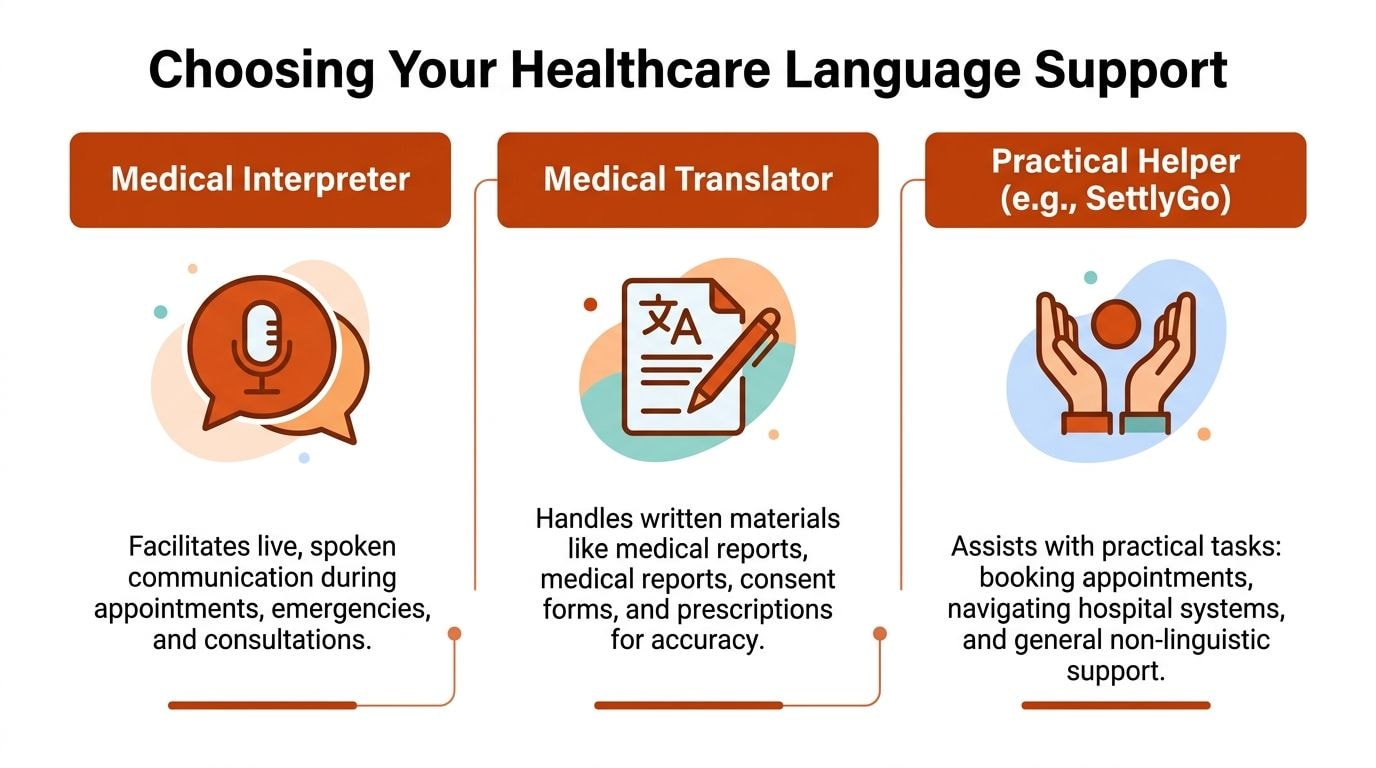
A professional healthcare interpreter supports live spoken communication between the patient and healthcare professionals. This is the appropriate option when symptoms, diagnosis, consent, treatment, risks, medication or clinical instructions are being discussed.
A qualified medical translator works with written medical material. If a clinic, insurer, court or authority requires a certified or formally recognized translation, confirm the exact requirement and use an appropriately authorized translator.
A practical helper supports non-clinical administration around the visit, such as booking, reception communication, organizing documents requested by the clinic, preparing questions and recording administrative next steps.
A practical comparison
| Type of support | Appropriate for | Not appropriate for |
|---|---|---|
| Professional healthcare interpreter | Live communication about symptoms, diagnosis, consent, treatment, risks, medication and clinical instructions | Certified written translations unless separately qualified |
| Qualified medical translator | Written medical reports, records and other medical documents | Live clinical conversations unless also qualified as an interpreter |
| Practical helper | Booking, reception communication, document organization, preparing questions and administrative follow-up | Symptoms, diagnosis, consent, treatment, medication, dosage, test results or other clinical communication |
The trade-off is straightforward. If the issue is strictly non-clinical administration, a practical helper may be appropriate. If any clinical information or medical decision must be communicated accurately, use a professional healthcare interpreter. If the issue is a document that must be formally translated, you need a qualified translator, and sometimes a sworn one.
A good rule in Berlin is this: if the risk sits in the spoken medical decision, use a medical interpreter. If the risk sits in the document itself, use a medical translator.
For newcomers, the daily question is simpler. Ask yourself: Am I trying to understand a diagnosis, or am I trying to manage the process around the appointment? That usually tells you what kind of help to book.
How a SettlyGo Helper Supports Your Doctor Visit
You finally get a GP appointment in Berlin after calling three practices. Then the real stress starts. The receptionist asks for your insurance details at speed, mentions a referral, and switches to admin German that is harder than anything you learned in class. A lot of the pressure around healthcare is not the medicine itself. It is the paperwork, the phone calls, and the small misunderstandings that pile up before you even see the doctor.
A SettlyGo helper can support the administrative side of a healthcare appointment. This may include booking or confirming the appointment, communicating with reception, organizing documents the clinic has explicitly requested, preparing a list of questions and recording non-clinical next steps. The helper does not interpret the clinical conversation. For that kind of routine support, practical doctor-appointment administration and reception support is the relevant service.
Before the appointment
The best help often happens before you walk into the practice.
A helper can help identify visible administrative details in the appointment letter, such as the date, address, department and documents explicitly requested by the clinic. Clinical preparation instructions, including fasting or medication directions, must be confirmed directly with the clinic. That usually includes dates, addresses, referral questions, insurance details, and the documents practices routinely request.
Typical support looks like this:
-
Booking support: Calling to book, confirm, cancel or reschedule an appointment.
-
Reception questions: Asking about the address, department, arrival time, accepted insurance and whether a referral is required.
-
Document organization: Organizing documents the clinic has explicitly requested.
-
Question preparation: Helping the customer write down questions they want to ask the doctor.
A helper should not decide which medical records are relevant, explain clinical preparation instructions or interpret fasting, medication or treatment directions. Verify those matters directly with the clinic.
That sounds simple. Under stress, it rarely feels simple.
During and after the visit
During the visit, a practical helper may support reception check-in and other non-clinical administrative communication, provided the patient agrees and the clinic permits the person to be present.
Once the conversation involves symptoms, medical history, diagnosis, examination findings, treatment choices, risks, consent, prescriptions, dosage, test results or follow-up medical instructions, a professional healthcare interpreter should be used. A practical helper should not relay, summarize or explain that clinical content.
After the appointment, a helper may help record visible administrative tasks such as booking another appointment, contacting reception or organizing a referral document. Questions about medication, treatment or medical instructions must be clarified with the doctor, clinic, pharmacist or another qualified healthcare professional.
Finding Certified Medical Translators in Berlin
There are moments when practical support stops being enough. That's not a failure. It's a boundary that protects you.
When practical help isn't enough
Use a qualified professional when the document or conversation has formal consequences. That includes written medical records for legal or immigration use, consent documents tied to serious treatment, expert reports, and anything explicitly requiring certified or sworn translation.
Family members or untrained staff should not be relied on for high-stakes clinical communication involving diagnosis, consent, treatment, medication or risk. Spoken interpretation and written translation are different professional activities. A person qualified for one is not automatically qualified for the other. Ask the receiving clinic, insurer, court or authority whether it requires ordinary translation, certified translation, sworn interpretation or another specific qualification.
That same practical logic applies in Berlin. If a clinic, court, insurer, or authority needs a formally translated document, casual language support won't solve the problem.
How to find the right professional
When you need a certified medical translator or sworn interpreter in Germany, Germany’s official Justice Administration database lists translators and interpreters who are officially authorized, appointed or sworn under the applicable federal or state rules. Search by language, location and professional category, and confirm that the professional has experience with medical material: Justice Administration database.
Ask these questions before booking:
-
Is the professional formally qualified for the exact document or interpreting task you need?
-
Do they work with medical terminology rather than only general translation?
-
Will the receiving office accept the format they provide?
-
Do you need interpretation, written translation, certification, or another specific qualification?
For practical support before you reach that stage, it's still helpful to know how a platform checks the people providing routine appointment help. How helpers are vetted gives you that context. It doesn't replace certified credentials, but it does matter when you're choosing someone for everyday bureaucracy support.
Your Healthcare Appointment Preparation Checklist
The most effective way to reduce stress is to prepare like the appointment will move quickly. In Berlin, many do. Reception desks are busy, doctors are often short on time, and follow-up instructions may come fast.
Before your appointment
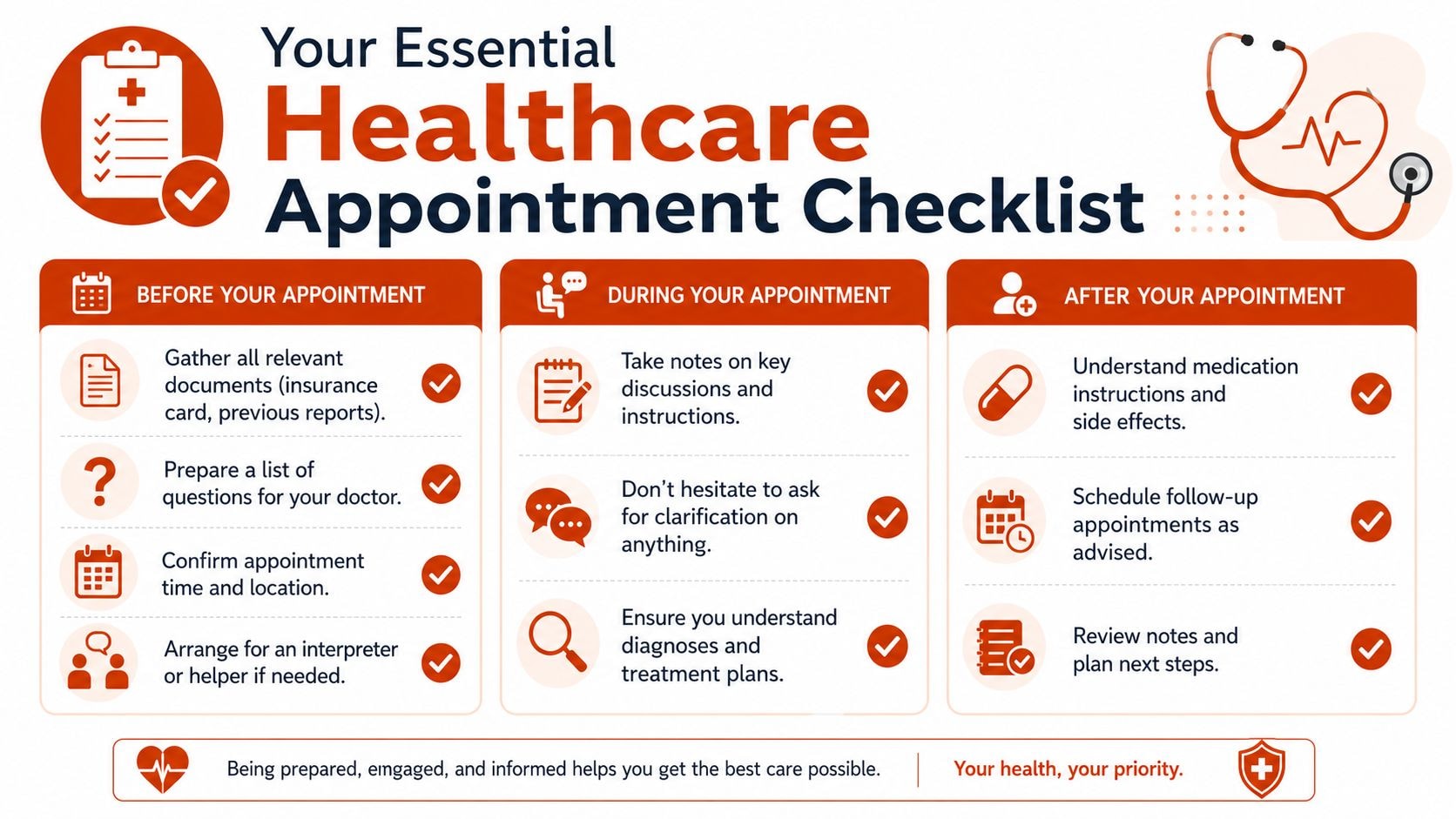
Start with a document check. For medical visits, the useful basics are usually your insurance card, ID, referral if one was requested, a medication list, and documents the clinic asked you to bring and records your treating professional advised you to provide. Don't bring a random pile of papers if you can avoid it. Bring the documents that answer the likely questions.
Then write a short note for yourself in simple English. Keep it compact.
-
Main reason for visit: One sentence. "Headaches for two weeks" is better than a long story.
-
Timeline: When it started, whether it got worse, and what makes it better or worse.
-
Medication list: Current medicines, vitamins, and anything you started recently.
-
Questions: Three to five questions you don't want to forget.
Medical, identity and insurance documents contain highly sensitive personal information. Share them only through verified channels, provide only what is necessary for the task and do not give a helper portal passwords, PINs, full account access or unrelated medical records.
If paperwork stresses you out generally, a structured prep list helps beyond healthcare too. This documents checklist for Berlin appointments is useful for building that habit.
A few practical checks matter the day before:
-
Confirm the location: Large clinics sometimes have multiple buildings or departments.
-
Check arrival timing: Early arrival often helps with reception forms.
-
Know your insurance status: Public and private processes can differ in practice handling.
-
Arrange language support early: Don't wait until the morning of the appointment if you already know you'll struggle.
Bring your questions in writing. Stress makes people forget simple things they were sure they'd remember.
During your appointment
Once you're in the room, don't try to sound complex. Simple language is better. Short sentences are easier to interpret, easier to repeat, and easier for a doctor to respond to clearly.
A good pattern is:
-
State the problem first.
-
Give the time frame.
-
Mention what changed.
-
Ask your question directly.
Example: "I have stomach pain. It started last week. It gets worse after eating. Do I need tests?"
Do not rely on a general translation app as the sole basis for understanding consent, diagnosis, medication dosage, treatment instructions, test results or discharge advice. Ask the doctor to explain important information in understandable language and use a professional interpreter when reliable mutual understanding is uncertain.
This approach aligns with the patient's right to understandable medical information and informed consent under German law: BGB section 630e and gesund.bund.de guidance on the right to information and explanation.
Use this mini-checklist inside the appointment:
-
Ask for repetition: If something matters, hearing it twice helps.
-
Request a written note: Especially for medication timing, dosage, or follow-up.
-
Clarify the next step: Is it a test, a referral, rest, or another appointment?
-
Check one instruction at a time: Don't leave with bundled half-understood information.
After your appointment
The dangerous moment is often after you leave. You're tired, you think you understood, and then a pharmacy label, referral note, or clinic summary raises new questions.
Do these three things before the day ends:
| Task | Safe next step |
|---|---|
| Medication or prescription question | Ask the prescribing doctor or pharmacist what the medicine is for, how to take it and for how long |
| Clinical follow-up question | Confirm the test, referral or return appointment directly with the clinic |
| Administrative follow-up | Keep referrals, receipts, appointment confirmations and insurer correspondence organized |
A practical helper can assist with the administrative row. Medical and medication questions belong with the responsible healthcare professional.
If medication, dosage, treatment, symptoms, test results or another clinical instruction remain unclear after the appointment, contact the doctor, clinic or pharmacist for clarification. A practical helper should not infer, summarize or explain the medical meaning.
One more practical point for Berlin newcomers. Healthcare stress rarely sits alone. It often comes alongside other admin pressure. If you're also dealing with registration, housing paperwork, or official phone calls, keep your systems simple. One folder for health, one folder for city admin, one place for appointment notes. That habit prevents the usual "I know I had that letter somewhere" spiral.
Emergencies, Privacy, and Your Rights in Germany
When the situation feels serious, stop thinking about perfect German. Get help first.
If it's urgent
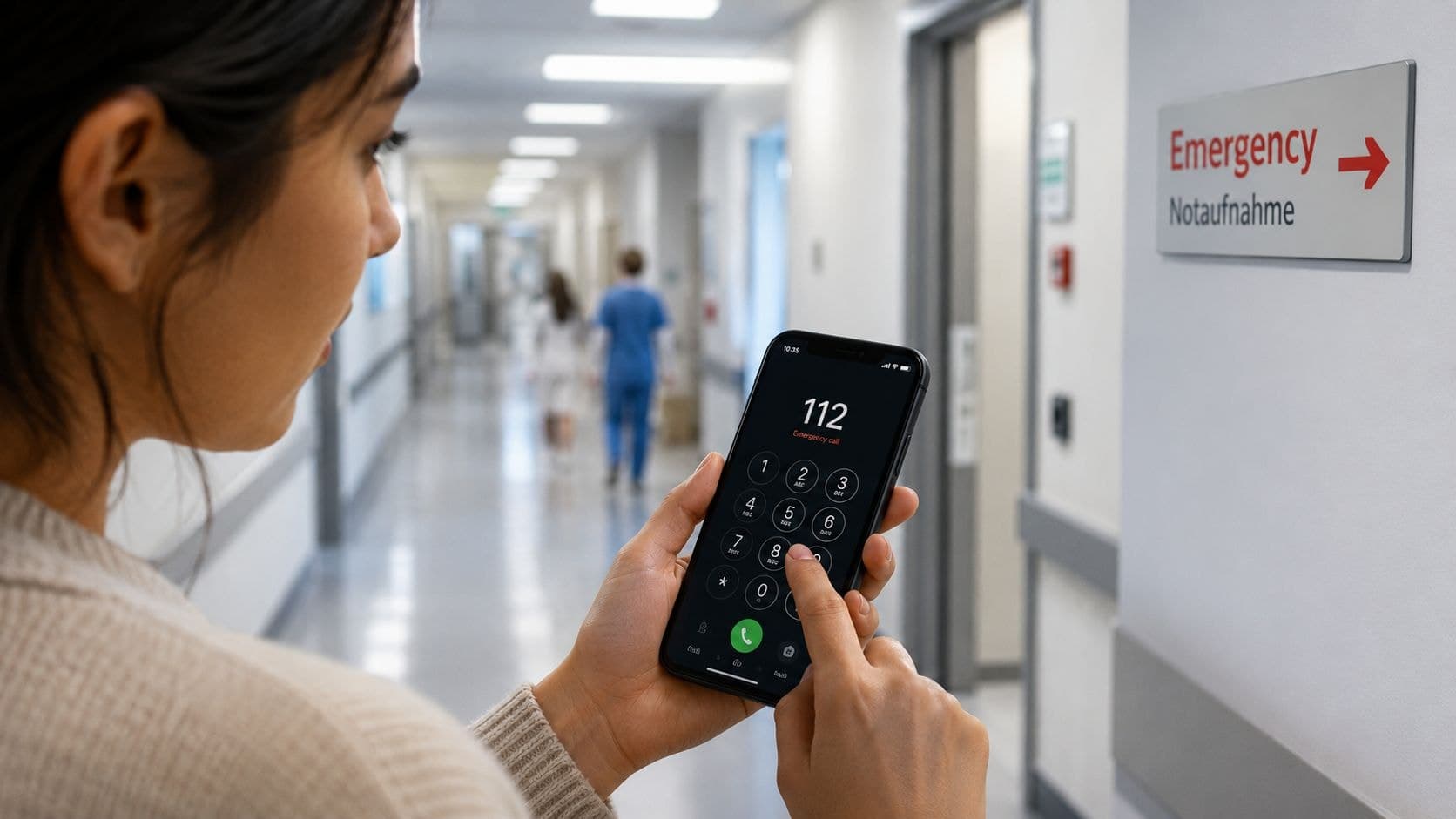
For a life-threatening emergency in Germany, call 112. Give the location and describe the immediate problem as clearly as possible. Do not delay emergency care while looking for a helper or interpreter.
For an urgent but non-life-threatening medical problem that cannot wait until the regular practice reopens, call the medical on-call service at 116117.
See gesund.bund.de guidance on emergencies and first aid and gesund.bund.de guidance on the medical on-call service.
In an emergency department or hospital, tell staff immediately that you need language support. Do not delay urgent care while trying to arrange a helper or achieve perfect German.
Privacy and consent
Medical information is confidential. Before bringing a helper, friend or interpreter into a consultation, tell the clinic and make sure you are comfortable with that person hearing sensitive information.
German patient-rights rules require information connected with medical consent to be understandable. If reliable understanding is uncertain, ask the clinician to use different words or arrange appropriate professional interpretation. A practical helper is not a substitute for professional interpretation in a clinical discussion.
See the Federal Ministry of Health overview of patient rights and BGB section 630e.
What you can reasonably ask for
You can ask people to slow down. You can ask them to repeat key instructions. You can ask for written notes. You can ask reception to clarify which desk or department you need. Those are normal requests, not special favors.
For routine healthcare bureaucracy in Germany, it also helps to remember what practical support can and can't do:
You can ask the doctor to slow down, repeat an explanation or explain it in different words. You can also request access to your medical record and copies of documents signed in connection with information or consent, subject to the applicable legal rules. See BGB section 630g.
-
Useful practical support: booking calls, appointment preparation, reception communication, organizing documents explicitly requested by the clinic and recording administrative next steps.
-
Professional-only territory: certified translations, formal legal or immigration use of medical documents, and high-stakes clinical interpretation.
-
Emergency priority: immediate care first, language perfection later.
If healthcare administration has left you dealing with appointment booking, reception communication, an insurance phone call or organizing documents requested by a clinic, book a SettlyGo helper. SettlyGo can help with non-clinical practical communication, preparing questions, note-taking, document organization and routine administrative coordination. SettlyGo does not provide medical advice, medical interpretation, medical translation, diagnosis or treatment guidance, medication or dosage explanations, emergency assistance, insurance advice or brokerage, legal or immigration advice, certified translation, sworn interpretation, application filing or official representation.
Need help with a German call in Berlin?
Book a verified SettlyGo helper for German phone calls, appointment preparation, landlord communication, and document organization.