Blue Card Permanent Residence in Berlin: 21 vs 27 Months Explained
August 25, 2026 · 11 min read
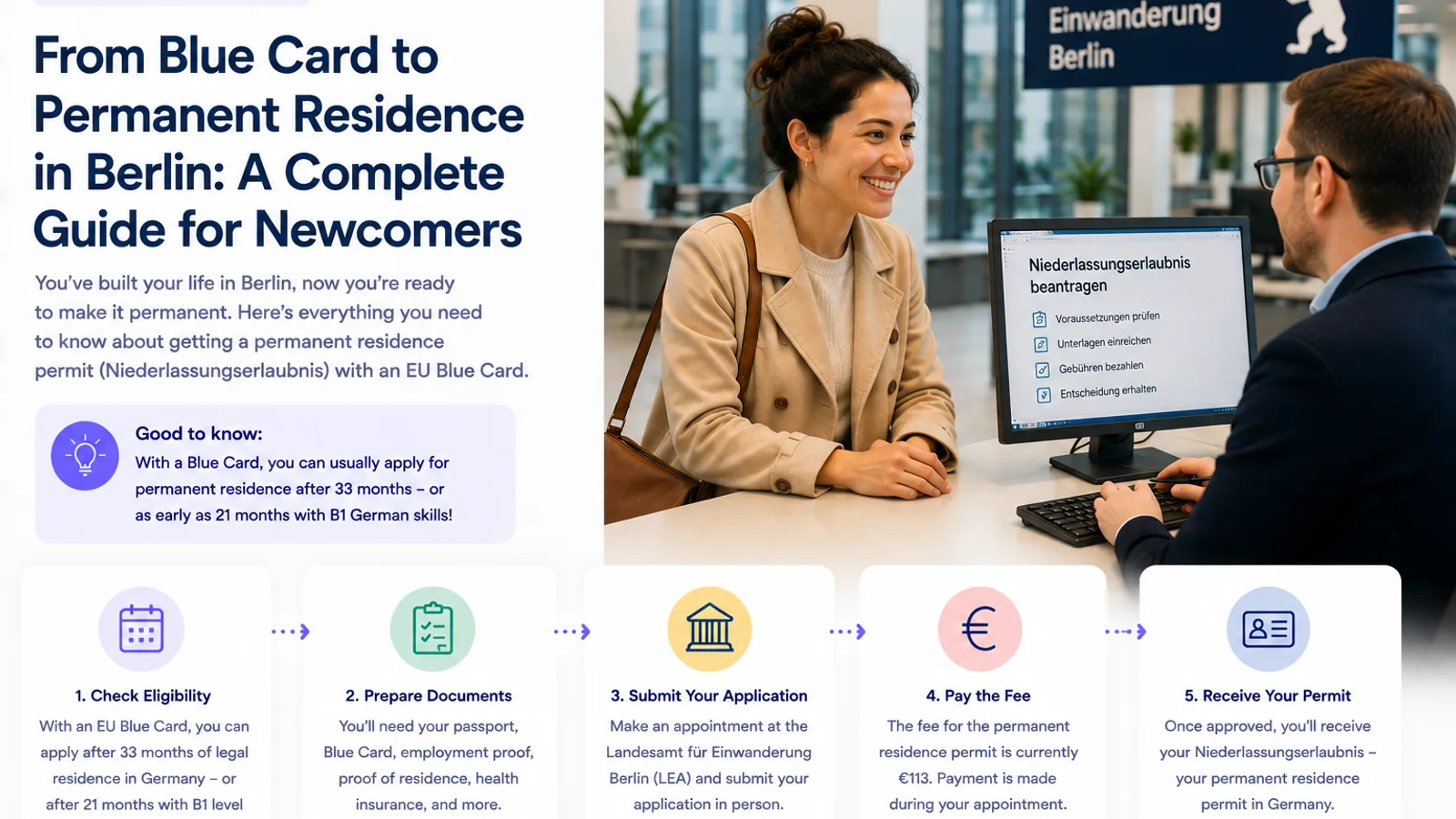
For many EU Blue Card holders in Berlin, the biggest long-term milestone is moving from a temporary residence permit to a Niederlassungserlaubnis, Germany's permanent settlement permit.
The Blue Card route is faster than the general five-year settlement-permit route, but the headline numbers (21 months and 27 months) can be misleading if you ignore the other conditions.
This guide explains what Berlin currently requires, how the two timelines differ, what evidence to prepare and what happens after you apply.
Important scope: This article provides general administrative information. SettlyGo can help you organize visible requirements, prepare questions and support ordinary German communication. SettlyGo does not provide legal or immigration advice, determine whether you qualify for permanent residence, represent you before the LEA or guarantee approval.
What is the Blue Card permanent-residence route?
Berlin has a dedicated settlement-permit procedure for people who have been working in employment that satisfies the EU Blue Card requirements.
The legal basis is the facilitated route for EU Blue Card holders under section 18c(2) of the German Residence Act.
This is different from the general settlement-permit route that normally starts from a five-year residence requirement.
Berlin's official Blue Card settlement-permit service is the best place to check the current local requirements before applying.
21 months or 27 months: what is the difference?
Berlin currently uses two main timelines.
27 months with A1 German
You can use the 27-month route if you have:
- at least 27 months of qualifying employment;
- German language skills at A1 level; and
- the other settlement-permit requirements explained below.
21 months with B1 German
The employment period can be reduced to 21 months if you can demonstrate German at B1 level.
The practical difference is therefore not simply six months of waiting. You need the higher language level for the shorter route.
The federal government's Make it in Germany Blue Card guidance confirms the same 27-month/A1 and 21-month/B1 structure.
Does every month in Germany count?
No.
Berlin's rule is tied to qualifying employment, not simply the number of months since you arrived in Germany or first registered your address.
Berlin currently says you must have spent the required 21 or 27 months in employment that meets the conditions for an EU Blue Card.
That can include periods in which you held an EU Blue Card or another residence title while performing employment that satisfied the relevant Blue Card employment conditions.
Do not assume that every month of legal residence automatically counts toward the Blue Card settlement-permit timeline.
If your employment history changed significantly, your salary fell below the relevant requirements, or you changed residence categories, get qualified advice if you are unsure how your time should be assessed.
Do pension contributions matter?
Yes.
For the required employment period, Berlin expects contributions to the statutory German pension insurance system or comparable qualifying private or occupational pension provision.
That means the 21- or 27-month employment history and the pension evidence should tell a consistent story.
Berlin lists a Renten-Information or Renten-Auskunft from Deutsche Rentenversicherung as typical evidence.
If you use comparable private pension provision instead, check the exact proof Berlin currently accepts before submitting.
Do you still need a qualifying job when you apply?
Yes.
Berlin currently requires you to still be working in employment that meets the conditions for an EU Blue Card.
So reaching month 21 or month 27 does not by itself lock in eligibility if your employment situation later changes.
Before applying, check your current contract and employment status rather than relying only on what was true when your Blue Card was issued.
What German-language proof can Berlin accept?
Berlin lists several possible ways to prove German language ability.
Examples currently include:
- an A1 certificate for the 27-month route;
- a B1 certificate for the 21-month route;
- a successfully completed integration course;
- certain German school, vocational or university qualifications; and
- other listed evidence that demonstrates the required level.
Do not assume any language-school attendance certificate is automatically enough.
Use the current Berlin document list to confirm that your exact evidence is accepted.
What other requirements apply?
The shorter Blue Card timeline does not remove the other settlement-permit requirements.
Berlin currently also requires, among other things:
- secure living expenses;
- adequate health insurance in Germany;
- sufficient housing for you and family members living with you;
- basic knowledge of Germany's legal and social system and living conditions;
- no disqualifying criminal issues or unresolved investigation that prevents processing;
- a Hauptwohnsitz in Berlin; and
- a current email address for communication with the LEA.
The exact assessment depends on your circumstances.
How can you prove knowledge of German society and law?
Berlin lists several possible forms of evidence for the required basic knowledge of Germany's legal and social system.
Examples include:
- a completed integration course;
- a completed orientation course;
- the Leben in Deutschland test;
- the German citizenship test;
- certain German school, vocational or university qualifications; or
- some other qualifications specifically listed by Berlin.
If you already studied or trained in Germany, check whether your qualification can satisfy this requirement before booking another test unnecessarily.
What documents should you prepare?
Berlin's current checklist includes documents such as:
- color copies of your passport data pages;
- a copy of your current residence permit;
- your employment contract;
- proof of your net salary for the last six months;
- a current employer certificate, currently required to be no more than 14 days old;
- proof of German health insurance;
- evidence of the size and current cost of your home;
- pension-insurance evidence;
- proof of German-language knowledge; and
- proof of your knowledge of Germany's legal and social system.
Depending on your situation, additional documents can be required.
For rented housing, Berlin currently asks for the rental contract and proof of current monthly housing costs. For owner-occupied property, different housing-cost evidence applies.
How does the Berlin application process work?
Berlin currently handles this settlement-permit application through an online application with Quick-Checks, followed by LEA review and an in-person appointment if the case is positively assessed.
The official service page says the application itself is exclusively online.
Before submitting:
- use the relevant Quick-Checks;
- verify that you meet the current requirements;
- prepare the listed documents; and
- confirm that the official online service is available and functioning.
After submitting, save the PDF confirmation carefully.
Berlin states that this confirmation can document continued lawful residence in Germany beyond the previous expiry date of your current national visa or residence permit, subject to the conditions described on the official page.
Do not rely on a blog article alone for status-extension questions. Read the wording on your own application confirmation and obtain qualified immigration advice if your right to remain or work is unclear.
How much does the application cost in Berlin?
Berlin currently lists two standard fees for most applicants:
- €56.50 processing fee during the online application; and
- €56.50 issuance fee at the in-person appointment.
That is €113 in total if both standard fees apply.
Berlin lists lower special fees for certain Turkish nationals based on age.
The official page also warns that the processing fee may not be refundable once substantive processing has begun, even if the application is later withdrawn.
Fees can change, so check the live ServicePortal immediately before paying.
What happens after the online application?
The LEA reviews the submitted information and documents.
If the application is positively assessed, Berlin sends an appointment for an in-person visit.
The service is handled by the Landesamt für Einwanderung at Friedrich-Krause-Ufer.
At the appointment, follow the current LEA instructions and bring the originals or other documents requested in your appointment communication.
Berlin says you receive written confirmation of lawful residence at the appointment while the electronic residence title is being produced.
How long does the card take after the appointment?
Berlin currently states that after the in-person appointment it takes at least four weeks for the Niederlassungserlaubnis to be produced as an electronic residence title and become available for collection.
That is the card-production stage after a positive application process. It is not a promise that the complete process from initial online submission to collection will take only four weeks.
Avoid making travel or employment decisions based on an assumed processing date.
What if your current permit expires while the application is pending?
This is a high-stakes point.
Berlin says the PDF confirmation generated after the online application can confirm continued validity of an existing national D visa or residence permit beyond its previous expiry date in qualifying cases.
The exact effect depends on your status and the confirmation you receive.
A short-stay Schengen C visa is explicitly treated differently by Berlin.
Keep the application confirmation and read it carefully. If your ability to remain in Germany, work or travel is uncertain, seek qualified immigration advice rather than relying on general guidance.
A practical timeline before you apply
Around month 18 to 20
If you are aiming for the 21-month route:
- check whether your B1 evidence is already sufficient;
- review your pension record;
- confirm your employment still meets the Blue Card conditions; and
- identify any missing social-system or housing evidence.
Around month 24 to 26
If you are using the 27-month route:
- confirm your A1 evidence;
- check the pension contribution record;
- collect your employment history; and
- make sure your current job still qualifies.
Shortly before applying
- obtain the current employer certificate at the right time so it is not too old;
- collect the last six months of salary evidence;
- download current pension information;
- verify your housing evidence;
- check your health-insurance proof; and
- use Berlin's current Quick-Checks.
Common mistakes to avoid
Counting residence months instead of qualifying employment months
The Blue Card shortcut is based on qualifying employment, not simply time spent living in Germany.
Assuming B1 is optional for the 21-month route
The shorter 21-month route specifically depends on sufficient German language skills at B1 level.
Ignoring pension evidence
The required employment period must also align with pension contributions or accepted comparable provision.
Letting the employer certificate get too old
Berlin currently says the employer certificate should not be older than 14 days.
Treating the online application as automatic approval
Submitting the application starts the review. It does not guarantee that the settlement permit will be issued.
Assuming the four-week card-production period is the full processing time
Berlin's four-week statement starts after the appointment and refers to producing the electronic residence title.
Checklist before applying
- I have at least 21 months of qualifying employment with B1 German, or at least 27 months with A1 German.
- My current job still meets the EU Blue Card employment conditions.
- I have pension-insurance or accepted comparable pension evidence for the relevant period.
- My living expenses are secured under the current Berlin rules.
- I have adequate German health insurance.
- I have current housing evidence.
- I have accepted proof of German language ability.
- I have accepted proof of basic knowledge of Germany's legal and social system.
- My Hauptwohnsitz is in Berlin.
- I have my passport and current residence-permit copies ready.
- I have six months of salary evidence.
- My employer certificate meets Berlin's current recency requirement.
- I checked the official ServicePortal and Quick-Checks immediately before applying.
How SettlyGo can support you
A SettlyGo helper can provide practical administrative support such as:
- helping you locate the correct official LEA pages;
- organizing a checklist from the visible requirements;
- preparing questions about missing or unclear paperwork;
- supporting an ordinary German phone call or email conversation;
- helping you understand appointment instructions; and
- accompanying you when practical communication support is useful.
SettlyGo does not provide legal or immigration advice, calculate whether your employment months legally qualify, assess the effect of gaps or permit changes, represent you before the LEA or guarantee a settlement-permit outcome.
Final takeaway
For EU Blue Card holders in Berlin, permanent residence can be possible after 27 months of qualifying employment with A1 German, or after 21 months with B1 German, provided the other requirements are also met.
The most common mistake is focusing only on the month count. Your current employment, pension contributions, language evidence, living expenses, health insurance, housing and other requirements still matter.
Use the official Berlin Blue Card settlement-permit service and the federal Make it in Germany Blue Card guidance to confirm the latest rules before applying.
For practical help organizing the process, preparing questions or handling German administrative communication, book SettlyGo support.
Need practical help in Berlin?
Book a verified SettlyGo helper for German phone calls, appointments, landlord communication, apartment viewings, and document preparation.