Foreign Driving Licence in Berlin: How to Exchange It
August 24, 2026 · 12 min read
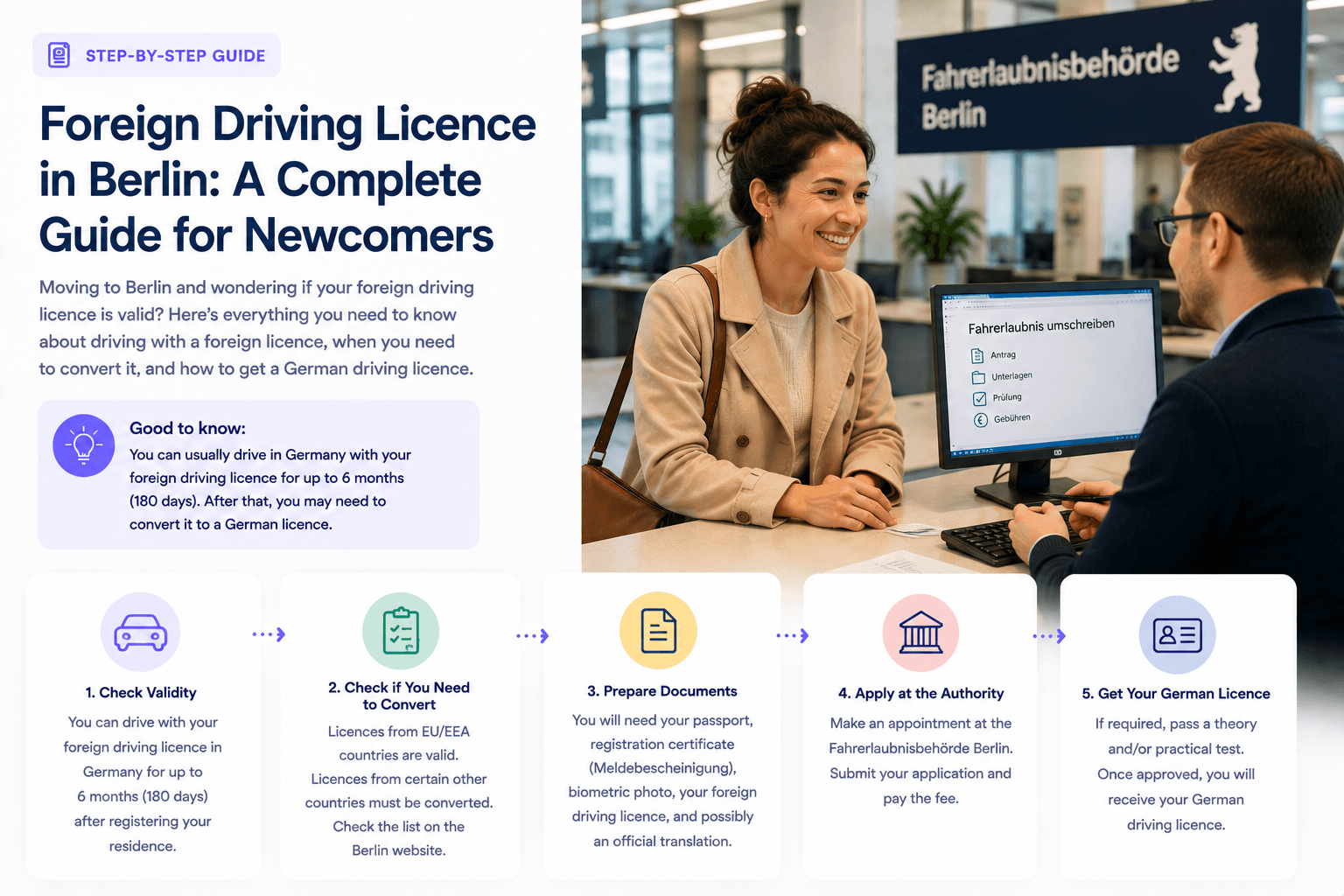
Moving to Berlin with a foreign driving licence raises one question very quickly: can you keep driving with it, or do you need to exchange it for a German licence?
The answer depends mainly on where your licence was issued.
Germany treats licences from the EU/EEA differently from licences issued in other countries. For non-EU/EEA licences, the issuing country can also determine whether Germany requires no test, one test, or both the theory and practical tests for the exchange.
Important scope: This article gives general administrative information. SettlyGo can help you organize visible requirements, prepare questions and support ordinary German communication. SettlyGo does not determine whether you are legally entitled to drive in an individual case, assess licence validity, interpret driving bans, provide legal advice, certify translations, complete driving tests for you or guarantee that Berlin will exchange a licence.
First question: where was your licence issued?
Berlin has separate official procedures for:
- licences issued in an EU or EEA country; and
- licences issued in a non-EU/EEA country.
The distinction matters because the recognition rules and exchange requirements are different.
Use Berlin's EU/EEA exchange service if your licence comes from an EU or EEA state.
Use Berlin's non-EU/EEA exchange service if it was issued elsewhere.
Do EU and EEA licence holders have to exchange immediately?
Not usually.
A valid EU or EEA driving licence is generally recognized in Germany under the rules in §28 of the Fahrerlaubnis-Verordnung.
There are exceptions, especially for certain heavy-vehicle classes, expired licences, restrictions, previous German measures or licences that were themselves converted from some third-country licences.
If you only hold ordinary car or motorcycle classes and your EU/EEA licence remains valid, do not assume that moving to Berlin automatically creates an immediate exchange deadline.
If your licence is expiring, contains unusual restrictions or has a complicated history, check the official rules before driving.
What about licences from outside the EU and EEA?
For a licence issued outside the EU/EEA, the German six-month rule is important.
Under current §29 of the Fahrerlaubnis-Verordnung, when you establish your ordinary residence in Germany, a qualifying non-EU/EEA licence generally continues to authorize driving for six months.
The law allows the Fahrerlaubnisbehörde to extend that period by up to another six months if you can credibly show that your ordinary residence in Germany will not last longer than twelve months.
Do not treat the six-month period as a deadline that automatically makes every foreign licence exchangeable. The original licence still needs to meet the applicable validity and recognition rules.
What happens after the six-month period?
If your non-EU/EEA licence no longer authorizes you to drive in Germany after the applicable recognition period, you must not keep driving simply because your exchange application is still pending.
The exchange process can continue after that point, but your right to drive and your administrative application are separate questions.
Plan early if you rely on a car for work or family responsibilities.
What is Anlage 11?
Germany's Anlage 11 to the Fahrerlaubnis-Verordnung lists countries and licence classes that receive simplified exchange treatment.
Depending on the country and class, the table can waive:
- the theory test;
- the practical test; or
- both tests.
The rules are country- and class-specific, so a statement such as “people from country X never need a test” can be wrong if it ignores the licence class or a footnote in Anlage 11.
Check the current official Anlage 11 list for your issuing country and licence class.
What if your country is not in Anlage 11?
If your licence was issued in a non-EU/EEA country that does not receive the relevant Anlage 11 exemption, Berlin can require both the theory and practical driving tests for the corresponding German licence.
Berlin's service page also requires you to provide the driving school and testing organization details when a test is necessary.
Do not book training or tests based only on an old forum post. Confirm the current requirement for your exact country and licence class.
Where do you apply in Berlin?
Berlin currently requires your Hauptwohnsitz, or main residence, to be in Berlin for the normal exchange procedure.
If Berlin is only your secondary residence, an application is generally possible only in justified exceptional cases with approval from the authority responsible for your main residence.
Berlin also states that personal attendance is required.
The ServicePortal offers Berlin-wide appointment booking for the participating offices.
Which documents are normally required?
For both EU/EEA and non-EU/EEA exchanges, Berlin generally asks for core identity and licence documents.
Common items include:
- passport or identity document;
- a current biometric passport photo on paper;
- the original foreign driving licence; and
- additional documents depending on the issuing country and licence class.
For non-EU/EEA applicants who are not EU/EEA citizens, Berlin also lists the residence title where applicable.
The original foreign licence must normally still be valid when you apply for a non-EU/EEA exchange.
Can you exchange an international driving permit by itself?
No.
Berlin explicitly states that an international driving permit is not exchanged on its own.
The valid national driving licence is the underlying document required for the exchange.
An international permit can help with recognition or translation in some situations, but it does not replace the national licence for this application.
Do you need a translation?
For non-EU/EEA licences, Berlin currently says a translation is always required when the licence is not issued in German or English.
The Fahrerlaubnisbehörde can also decide in a particular case that a translation is required even where the need is unclear at the time of application.
Use a translation source accepted by the authority. Do not assume that an informal translation or machine translation will satisfy the requirement.
Do you need a first-aid course?
For the ordinary non-EU/EEA third-country route, Berlin lists proof of first-aid training as required.
The detailed requirement can differ for Anlage 11 cases, so follow the current checklist for your country and licence class rather than applying every third-country requirement automatically.
Do you need an eye test?
For standard car and motorcycle classes from ordinary third countries, Berlin currently requires a Sehtest.
For Anlage 11 countries, Berlin says an eye test is generally not required unless a footnote in the country list says otherwise.
Truck and bus licence classes have additional medical and eyesight requirements.
What does it cost?
Berlin currently lists these administrative fees for a non-EU/EEA exchange:
- €37.50 when the exchange does not require a test; and
- €45.10 when the exchange requires a test.
For an EU/EEA exchange, Berlin currently lists a fee of €37.50.
These are the administrative exchange fees. They do not include possible costs for translations, passport photos, first-aid training, eyesight tests, driving-school services or theory/practical examinations.
Check the current ServicePortal page before the appointment because fees can change.
Do you need a driving school?
Not every exchange requires a driving school.
If no test is required, the process can be much simpler.
If a theory or practical test is required, Berlin asks for the relevant driving school and testing organization details as part of the application process.
A driving school can also help you prepare for the practical and theory requirements, but the authority determines what is legally required for the exchange.
Can you apply with an expired foreign licence?
The rules differ between EU/EEA and non-EU/EEA licences.
Berlin's EU/EEA service says the EU licence can still be presented for exchange even if its period of validity has already expired.
For a non-EU/EEA exchange, Berlin currently says the foreign licence must still be valid at the time of application.
That difference is important. Do not assume the same rule applies to both categories.
What if your foreign licence was lost or stolen?
For an EU/EEA licence that was lost or stolen, Berlin asks applicants to provide as much detail as possible about the original licence, including classes, issuing place and issue date.
A copy of the old licence or confirmation from the issuing country can help if available.
For a non-EU/EEA exchange, the current Berlin service expects the valid original licence, so contact the Fahrerlaubnisbehörde before assuming a lost licence can be processed in the same way.
What happens to your original licence?
The German authority may need the original foreign licence before the German card licence is issued or handed over.
Berlin's Fahrerlaubnis FAQ says that, for EU/EEA exchanges, the original foreign licence must be with the Fahrerlaubnisbehörde before the new German card is sent or handed over.
For third-country exchanges, Berlin also requires the original foreign licence and, where applicable, the original examination certificate at the final stage.
Follow the instructions you receive for your individual application rather than mailing an original document without being asked.
A practical process for EU/EEA licence holders
- Check that your licence is an EU/EEA licence and review whether an exchange is actually needed now.
- Confirm Berlin is your Hauptwohnsitz.
- Book the appropriate Berlin appointment.
- Prepare your ID, biometric photo and original licence.
- Prepare additional medical documents if you are exchanging truck or bus classes.
- Attend in person.
- Follow the Fahrerlaubnisbehörde's instructions for surrendering the original licence and receiving the German card.
A practical process for non-EU/EEA licence holders
- Check when you established ordinary residence in Germany and whether the six-month recognition period affects you.
- Confirm whether your issuing country and licence class appear in Anlage 11.
- Check which theory or practical tests are required, if any.
- Confirm Berlin is your Hauptwohnsitz.
- Prepare your passport or ID, residence title where applicable, biometric photo and valid original national licence.
- Arrange an accepted translation if the licence is not in German or English or the authority requests one.
- Prepare first-aid and eyesight evidence where required.
- If tests are required, provide the driving-school and testing-organization details requested by Berlin.
- Attend the application appointment in person.
- Do not continue driving after your German recognition period ends unless you still have a valid legal basis to drive.
Common mistakes newcomers can avoid
Assuming every foreign licence is valid indefinitely
Non-EU/EEA licences generally have a limited recognition period after establishing ordinary residence in Germany.
Assuming every non-EU licence requires both tests
Anlage 11 can waive one or both tests depending on the country and licence class.
Treating an international permit as the licence being exchanged
Berlin requires the national licence. The international permit alone is not enough.
Waiting until month six to start researching the exchange
If you need tests, translations or additional evidence, the process can take longer than expected.
Using the EU rules for a third-country licence
The required documents and validity rules differ significantly.
Assuming a pending application lets you keep driving
Submitting an exchange application does not itself extend a non-EU/EEA driving entitlement.
Checklist before the appointment
- I confirmed whether my licence is EU/EEA or non-EU/EEA.
- Berlin is my Hauptwohnsitz.
- I checked whether my non-EU/EEA country and licence class appear in Anlage 11.
- I checked which tests, if any, are required.
- My passport or ID is ready.
- My residence title is ready if Berlin requires it for my case.
- I have a current biometric passport photo.
- I have the original national driving licence.
- I checked whether a translation is required.
- I prepared first-aid, eyesight or medical evidence where applicable.
- I provided driving-school and testing-organization details if a test is required.
- I checked the current Berlin fee and appointment instructions.
- I know whether I am still legally allowed to drive in Germany while the exchange is pending.
How SettlyGo can support you
A SettlyGo helper can provide practical administrative support such as:
- helping you identify the correct Berlin exchange procedure;
- organizing a checklist from the visible official requirements;
- helping you prepare questions about missing documents or appointment instructions;
- supporting an ordinary German phone call or email conversation;
- helping you understand visible correspondence from the Fahrerlaubnisbehörde; and
- accompanying you when in-person communication support is useful.
SettlyGo does not determine whether your licence is legally valid, decide whether you are entitled to drive, interpret sanctions or driving bans, certify translations, provide legal representation, take tests for you or guarantee issuance of a German driving licence.
Final takeaway
The most important step is to classify your licence correctly before doing anything else.
EU/EEA licences follow a different recognition and exchange route from non-EU/EEA licences. For a licence issued outside the EU/EEA, Germany's current law generally limits driving after establishing ordinary residence to six months, while Anlage 11 determines whether an exchange can be simplified.
Berlin currently requires Hauptwohnsitz in Berlin and personal attendance for both exchange routes. For non-EU/EEA licences, current administrative fees are €37.50 without a test or €45.10 with a test; the EU/EEA exchange fee is currently €37.50.
Before applying, check the official Berlin EU/EEA service or the official Berlin non-EU/EEA service for the latest requirements.
For practical help organizing the process, preparing questions or handling German administrative communication, book SettlyGo support.
Need help with Anmeldung or the Bürgeramt?
Book a verified SettlyGo helper to guide you through city registration, document preparation, and office appointments in Berlin.